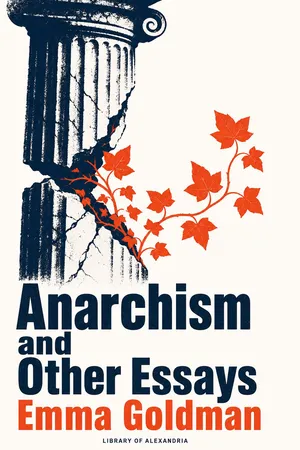
What does liberty mean when the state, society, and even our closest relationships demand obedience? Emma Goldman makes that question personal, urgent, and impossible to dismiss.
First published in 1910, Anarchism and Other Essays brings together Goldman's arguments about political authority, social inequality, and individual autonomy. Drawing on her experience as an agitator and lecturer, she presents anarchist thought not as a wish for disorder but as a challenge to coercion. Her subjects range from prisons and patriotism to women's suffrage, marriage, and the conditions that prevent people from directing their own lives.
Goldman's force lies in her refusal to separate public politics from private experience. She asks whether a vote guarantees independence, whether punishment remedies social harm, and whether national loyalty can become an excuse for submission. Her passionate prose gives these arguments the energy of a public address. More than a historical statement of radical belief, the collection remains an invitation to examine familiar institutions rather than accept their authority as inevitable.
What readers find inside:
- Anarchist principles - Goldman explains a political ideal grounded in voluntary cooperation and resistance to coercive authority.
- Women's autonomy - Her discussions of suffrage, marriage, and sexual exploitation question the limits of formal equality.
- Prisons and punishment - She challenges the prison system's social purpose and its claim to prevent crime.
- Patriotism and power - Her critique of nationalism probes the relationship between loyalty, militarism, and individual liberty.
- Social transformation - Across the collection, she connects institutional change with the struggle to live and think independently.
This collection will appeal to readers of political philosophy, students of feminist history, and anyone interested in the roots of radical social criticism. It offers a direct encounter with arguments that continue to provoke debate about authority, equality, and personal choice.
Begin with Goldman's questions and consider where your own understanding of liberty leads.