"Bravely takes on . . . not the legendary shapeshifting creature spoken about sporadically on the Swahili coast of Tanzania, but rather popobawa discourse." —
The Journal of Modern African Studies
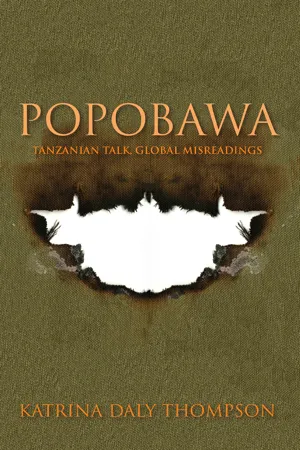
Since the 1960s, people on the islands off the coast of Tanzania have talked about being attacked by a mysterious creature called Popobawa, a shapeshifter often described as having an enormous penis. Popobawa's recurring attacks have become a popular subject for stories, conversation, gossip, and humor that has spread far beyond East Africa. Katrina Daly Thompson shows that talk about Popobawa becomes a tool that Swahili speakers use for various creative purposes such as subverting gender segregation, advertising homosexuality, or discussing female sexuality. By situating Popobawa discourse within the social and cultural world of the Swahili Coast as well as the wider world of global popular culture, Thompson demonstrates that uses of this legend are more diverse and complex than previously thought and provides insight into how women and men communicate in a place where taboo, prohibition, and restraint remain powerful cultural forces.
"While Popobawa surely belong to one of the most interesting African legends, Katrina Daly Thompson, instead of asking where the story originated, asks about how people talk about this trickster and what these conversations really mean." —Claudia Boehme, University of Trier
"A well-researched and well-documented addition to the body of knowledge on local legends and their global manifestations." —
Journal of Folklore Research
"Thompson's movement between local and global discourses demonstrates the importance of a phenomenon that could otherwise be viewed as exotic ethnographic trivia, while her theoretical orientation makes the text as relevant to linguistic anthropologists as to African studies scholars." —
African Studies Review
- 238 pages
- English
- ePUB (mobile friendly)
- Available on iOS & Android
eBook - ePub
About this book
Trusted by 375,005 students
Access to over 1.5 million titles for a fair monthly price.
Study more efficiently using our study tools.
Information
Print ISBN
9780253024497
Subtopic
Folklore & Mythology1 Contextualizing Popobawa
Society is not a text that communicates itself to the skilled reader. It is people who speak. And the ultimate meaning of what they say does not reside in society—society is the cultural condition in which speakers act and are acted upon.
—Talal Asad, “The Concept of Cultural Translation”
WE CAN LEARN something from the people who speak about Popobawa. While there are some intriguing claims and convincing elements in previous reports and analyses of Popobawa as a phenomenon, ultimately they fall short in their explanations of how Swahili-speakers actually make meaning from the legend and its legendry in their everyday lives. Popobawa exists in discourse, and it is only through studying the diverse ways that people talk and write about the legend that we can understand the role of such discourse in social life. In this chapter, I show how previous writing about Popobawa has failed to capture its dialogic, storied, and polyphonic nature, and what we can gain by not only exploring Popobawa discourse as multivocal but also doing so through ethnographic writing that incorporates the “voices and countervoices” of those who talk and write about Popobawa.1 Essentially, we’re studying Popobawa to understand how voices in coastal Tanzanian society speak and communicate meaning about what it’s like to live in that society.
Polyphony
What does it mean to say that a discourse is multivoiced? Translators of Mikhail Bakhtin use multivoiced and related terms to translate from Russian a number of interrelated concepts that are central to his work on the novel as a genre and on Dostoevsky’s novels in particular.2 Polyphony is Bakhtin’s term for “multivoicedness” or “multivocality,” defined as “a plurality of independent and unmerged voices and consciousnesses.” Bakhtin saw this plurality of voices not only as the norm in the social lives of human beings but also as an ideal to which society should aspire and which novelists should aim to capture.3 Kamani Njogu and Ken Waliaula, scholars of Swahili literature, have argued that “Bakhtin’s notion of dialogism should not be restricted to the novel” and shown that it is a useful way of understanding multivocality in various Swahili genres, including riddles and poetry.4 Applying these aims and aspirations to Popobawa discourse, I will show that polyphony is not only its inherent feature but also a value to be pursued in writing about it. Indeed, I agree with postmodern ethnographers that it is a value to be pursued in all ethnographic writing, and this book is thus an example of how I think ethnography should be done.5
A polyphonic utterance or text is one that highlights the dialogic (interactive, conversational) nature of the discourses it contains. Like many other Swahili genres, Popobawa discourse does this in its frequent use of metalanguage—references to rumor, gossip, overheard talk, and other versions of the legend. In referencing things that other people said, people who talk or write about Popobawa use metalanguage to varying ends, such as to mask their own opinions, to construct themselves as authorities, or to demonstrate that the subject is real and worth talking about because it has been discussed before. Let’s consider an example, “Popo Bawa Terrorises a Pregnant Woman in Mkoani,” the second narrative in a collection made for anthropologist Martin Walsh by his research assistant Jamila during the 1995 Popobawa panic. The excerpt is long, but it serves as a complete, solid example of a story from beginning to end and will help you to see an example of what this book is about.
We first heard reports of Popo Bawa one afternoon in the first week of Ramadhan, from one of our neighbours. He had been to Mkoani to take his wife home to give birth. He had stayed there for three days, and this was the day of his return. We greeted him and asked him what news he had from Mkoani (we were thinking about the condition of his wife, who he had left there). Instead he gave us the news about Popo Bawa. He began by saying: “The only news from Mkoani is the news about Popo Bawa: there is no other news.” We were all shocked just to hear this name: how could we reply? He went on to explain that Popo Bawa had entered Mkoani, that people are not sleeping, but are gripped with confusion, and do not know whether they are coming or going. Some people asked him whether it was the same Popo Bawa who had come in the past and sexually assaulted people. He replied: “Until leaving today I had not heard that he is doing anything like that, except that the Popo Bawa who is there terrifies you and does every kind of mischief to you, so that you are scared out of your wits. Why, he came to me last night, and today I’m here; whereas I’ve heard that when the old Popo Bawa came to you, you couldn’t leave the house for three days or more.”
All of us asked him in one voice: “Yesterday he came to you?”
He replied: “Yes, last night he came to me, though I wasn’t his intended victim; nonetheless I was terrified and passed out. And,” he began to explain, “it was like this:
We were sitting and talking with my parents-in-law for a long time, until around 10 pm, when we went to bed. At the side of the house in which my parents-in-law slept there is a small hut with two rooms, and that’s where it was arranged that my wife and I would sleep—where we usually sleep when we stay there. So, after that conversation, we went to bed without any worries, because up until then no one had said anything about Popo Bawa. After we had both been asleep for a long time, around 2 am I woke up with a start to hear my wife making a lot of noise, the outside door of the hut being hammered, and the sound of people shouting, ‘Open up! Open up!’ I tried to rise from the bed, but couldn’t. I tried a second time and this time felt that I had succeeded in getting up. Meanwhile my wife was still crying at the top of her voice, and the door was still being banged. I stood up to go towards the door, but when I got near it I sensed the shadow of a tall and broad person who was wearing something white across his face. I opened the door as quickly as I could, but as soon as it had opened I fell and lost consciousness.
When I came to I found that I was in my in-law’s house, surrounded by a lot of people. Some of them were possessed by their masheitani, and each one was talking with his or her own spirit. The first question I asked was: ‘Where is my wife?’ I was told: ‘She is here.’ ‘Then’, I replied, ‘Let her come so that I can see her. Or is she sick?’ She answered me herself: ‘I’m here and I’m well.’ She came and I was surprised to see that she was perfectly well. I said: ‘So, tell me what happened.’ Then I was told: ‘It was Popo Bawa who came: your wife’s description has indicated clearly that it was Popo Bawa who came tonight.’ I asked my wife to explain what she had felt from beginning to end, and she began to explain as follows:
‘I was in a deep sleep, when suddenly I felt as though something heavy had fallen near to the bed. I didn’t know whether it was a dream or not: I woke up with a start and turned to see what it was that had fallen. My heart jumped to see that it was a man, terrifying to see. After looking at him for just a second, he placed his hand on my face, and his hand alone on my face felt like a large and heavy stone. My body turned to jelly and I was shaking and couldn’t breathe. At this point he left my face and, placing his hand on my ribs, started to squeeze me. I began to breathe and scream, though it seemed to me as though no sound was coming out, however hard I tried. I did this hoping to wake my husband (we were sleeping together) with the noise that I was making: I couldn’t even lift a finger at the time. As it turned out, people outside of the house could hear me, though my husband couldn’t hear a sound. Eventually people came to bang on the door, and my husband woke up and got out of bed to open it. I thought that he’d left me and that I wouldn’t see him again, but he had fallen down and passed out.’
At this point the elders there again said: ‘This is the work of Popo Bawa: tonight he has come. We forgot to tell you that Popo Bawa has been here since the day before yesterday, squeezing pregnant women and babies.’”
So, our neighbour explained: “My friends, Popo Bawa is in Mkoani, our friends and relatives there are very unhappy, and most of all he wants small children and pregnant women. When I woke up safely in the morning and saw that both my wife and I were well, I thought that I’d better come home. One old person told me: ‘Don’t worry, he didn’t touch you; it’s only your fear.’ But there’s no way you can avoid being frightened; this isn’t a laughing matter.’”6
This is a remarkably polyphonic text. Through Walsh’s English translation, we access Jamila’s words; through the frame of Jamila’s written narrative, we access the voice of her neighbor; and through her neighbor’s narrative, we have the embedded narrative of his wife, a victim of Popobawa, alongside the voices of his wife’s parents (“the elders”) and another “old person” who spoke to the neighbor.
Likewise, Jamila uses a great deal of metalanguage, language that according to Bakhtin, “has a dialogic relationship to the language it describes and analyzes.”7 She describes Popobawa talk as reports and news, and her neighbor also refers to “news about Popo Bawa,” suggesting its truth value for those involved. Rather than simply launching into a narrative about her neighbor, Jamila contextualizes it by describing how she acquired the narrative, hearing it from her neighbor. Even that hearing is contextualized within ordinary, everyday speech acts: first, she and unspecified co-present others greet him and ask him for news. Similarly, the neighbor’s narrative is embedded in ordinary speech acts: “sitting and talking with my parents-in-law for a long time.” Not only is the main Popobawa narrative here one Jamila heard from her neighbor, but the neighbor also compares his own experience to what he heard about “the old Popo Bawa” who terrorized Pemba in the 1960s. Rumor is important. Talk is also relevant after Popobawa appears in the narrative: others present who “have” masheitani (demons or spirits), a fairly common experience on the East African coast, especially for women, became possessed and start talking with them, possibly in other languages.8 In another narrative, Jamila explains:
According to general belief here in the islands a sheitani is a being which can enter into your body and do, or order you to do, whatever it wants, in which case you have no choice but to obey. Although you cannot see it, everyone around you will believe that you have been entered by a devil, especially when you begin to shake your head, shiver violently, pant, and say whatever you have been made to say. When you do this it will be obvious that a devil has entered you and that everything which you say is being said by the devil.
This embedment of others’ voices in one’s own—evident not only in hearsay reports but also in the voices of spirits embodied in those they possess—is an apt symbol for the many voices that speak different versions of Popobawa.
“Voice,” “sound,” and “noise”—all of which can be translated by the same word, sauti, in Swahili—are a key trope here. Jamila and the others speak “in one voice,” suggesting not only simultaneous speech but also a sense of shared thinking. Jamila’s neighbor becomes aware of Popobawa’s presence because of noise, including verbal noise as people shout, “Open up!” His wife cries “at the top of her voice” while being attacked by Popobawa, trying to wake her husband “with the noise I was making” and yet she feels “as though no sound was coming out.”
Just as the pregnant woman feels silenced by Popobawa, Jamila remarks not just on what is said but also what is unsaid: “We were all shocked just to hear this name: how could we reply?” she asks rhetorically. And so does her neighbor, who reports going to bed worry-free “because up until then no one had said anything about Popo Bawa.” We also know from the reference to those who were possessed, talking with their own spirits, that there are other (supernatural) voices present besides those we (and even the narrator) can hear.
A great deal of the neighbor’s narrative is in the form of reported speech, or constructed dialogue, with quotations from himself, unnamed others, and his wife. Even some of what he is told is in the form of indirect speech. “I was told: ‘… your wife’s description has indicated clearly that it was Popo Bawa who came.’” By the time we read this claim, we are getting it fifth-hand (after others present, then the neighbor, then Jamila, then Walsh) or even sixth-hand, if you count that you, dear reader, are getting it from me.
This book is another instantiation of Popobawa (meta)discourse, and so it is by necessity and design as multivocal as the talk and texts on which I base it. In writing about Popobawa through a polyphonic ethnography, my aim is to ensure that no one gets the last word. I see this dialogic process as feminist because it denies hierarchical constructs that place the scholar above her “subjects.”9 Explaining why different features of Popobawa are more prominent in some versions than others, my Zanzibari friend Hassan told me, “Popobawa yuko, kila mmoja anamchukulia anavyotaka”—Popobawa is just there, everyone interprets him as they like. I understood Hassan to mean that each person’s take on Popobawa is different; each person uses the legend to his or her own end. Therefore, we should not mistake any given version of the tale as primary, least of all mine. Popobawa is as much a story as a tool, a means that speakers (and writers and filmmakers) use with a purpose. Indeed, I am just another writer who is using Popobawa as a tool, in this case to discuss discourse in coastal Tanzanian society.
To interpret Popobawa through a single voice, whether it be that of a generalized Swahili-speaker or that of a researcher, would be a fundamental mistake. My refusal to offer a unifying frame is not an evasion of my responsibility as a scholar but is rather both an attempt to document the “shared authority” that emerged through the field conversations I had with Swahili-speakers and in stories like those Jamila collected as well as an insistence that Popobawa defies monologic interpretation.10 In fact, it’s because Popobawa defies monologic interpretation that the legend is such an important part of Swahili discourse. The key point about Popobawa talk is that it’s tricky and multipurpose. It’s a way to cope with the silences in polite discourse and an ideal subject of study because it allows people to talk about so many subjects.
Dialogic Ethnography: From Fieldwork to Writing
Ethnography is essentially a dialogic process, meaning that it is produced in and through dialogue with others. “‘Fieldwork’ in its anthropological sense,” according to Charles Briggs, is “research that involves intense interaction between researcher and a given population over a substantial period of time” and encompasses various research modalities, including interviews.11 Such “intense interaction” does not always involve formal interviews, but it does always involve language, dialogue, and “i...
Table of contents
- Cover
- Title Page
- Copyright
- Contents
- Acknowledgments
- Introducing Popobawa
- 1 Contextualizing Popobawa
- 2 Voicing Expertise and Authority
- 3 Talk and Believe: How to Prevent a Popobawa Attack in Two Easy Steps
- 4 The Butt of a Joke
- 5 Queering Popobawa
- 6 Women as Sexual and Discursive Agents
- 7 Batman in Africa
- 8 Global Metanarratives
- (In)Conclusion
- Notes
- Bibliography
- Index
Frequently asked questions
Yes, you can cancel anytime from the Subscription tab in your account settings on the Perlego website. Your subscription will stay active until the end of your current billing period. Learn how to cancel your subscription
No, books cannot be downloaded as external files, such as PDFs, for use outside of Perlego. However, you can download books within the Perlego app for offline reading on mobile or tablet. Learn how to download books offline
Perlego offers two plans: Essential and Complete
- Essential is ideal for learners and professionals who enjoy exploring a wide range of subjects. Access the Essential Library with 800,000+ trusted titles and best-sellers across business, personal growth, and the humanities. Includes unlimited reading time and Standard Read Aloud voice.
- Complete: Perfect for advanced learners and researchers needing full, unrestricted access. Unlock 1.5M+ books across hundreds of subjects, including academic and specialized titles. The Complete Plan also includes advanced features like Premium Read Aloud and Research Assistant.
We are an online textbook subscription service, where you can get access to an entire online library for less than the price of a single book per month. With over 1.5 million books across 990+ topics, we’ve got you covered! Learn about our mission
Look out for the read-aloud symbol on your next book to see if you can listen to it. The read-aloud tool reads text aloud for you, highlighting the text as it is being read. You can pause it, speed it up and slow it down. Learn more about Read Aloud
Yes! You can use the Perlego app on both iOS and Android devices to read anytime, anywhere — even offline. Perfect for commutes or when you’re on the go.
Please note we cannot support devices running on iOS 13 and Android 7 or earlier. Learn more about using the app
Please note we cannot support devices running on iOS 13 and Android 7 or earlier. Learn more about using the app
Yes, you can access Popobawa by Katrina Daly Thompson in PDF and/or ePUB format. We have over 1.5 million books available in our catalogue for you to explore.