"Plunges the reader into a tour de force across radically divergent artistic responses to Mediterranean migration." —
Bulletin of Francophone Postcolonial Studies
Ex-Centric Migrations examines cinematic, literary, and musical representations of migrants and migratory trends in the western Mediterranean. Focusing primarily on clandestine sea-crossings, Hakim Abderrezak shows that despite labor and linguistic ties with the colonizer, migrants from the Maghreb (Morocco, Algeria, and Tunisia) no longer systematically target France as a destination, but instead aspire toward other European countries, notably Spain and Italy. In addition, the author investigates other migratory patterns that entail the repatriation of émigrés. His analysis reveals that the films, novels, and songs of Mediterranean artists run contrary to mass media coverage and conservative political discourse, bringing a nuanced vision and expert analysis to the sensationalism and biased reportage of such events as the Mediterranean maritime tragedies.
"
Ex-Centric Migrations is crucial reading for scholars and students of contemporary Maghrebi, French, and Spanish literatures and cultures. It breaks new ground by encompassing the literature, film, and music of 'return migration' and examining the trajectories of Maghrebi migration outside France." —
H-France
"Hakim Abderrezak convincingly illustrates how politically committed artistic practices serve to humanize the challenges of human migration, and in the process dramatically improves our understanding of the complex cultural, economic, political, and social realities that shape 21st-century existence." —Dominic Thomas, author of
Africa and France: Postcolonial Cultures, Migration, and Racism
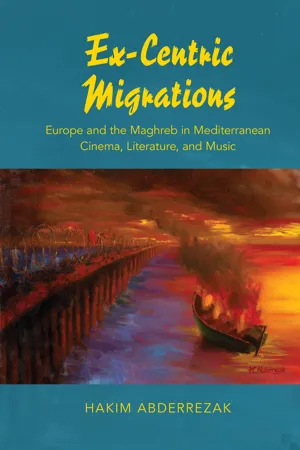
eBook - ePub
Ex-Centric Migrations
Europe and the Maghreb in Mediterranean Cinema, Literature, and Music
- 284 pages
- English
- ePUB (mobile friendly)
- Available on iOS & Android
eBook - ePub
Ex-Centric Migrations
Europe and the Maghreb in Mediterranean Cinema, Literature, and Music
About this book
Information
Print ISBN
9780253020758
Subtopic
African Literary Criticism1Disimmigration as a Remedy for the Illness of Immigration in Ismaël Ferroukhi’s Le Grand voyage
The Monolingualism of the Host(age)
On November 2, 2009, a grand débat (great debate) was initiated by Eric Besson, Nicolas Sarkozy’s minister of the lengthy and ambitious Ministère de l’immigration, de l’intégration, de l’identité nationale et du développement solidaire (Ministry of immigration, integration, national identity, and solidarity development). The debate on national identity soon turned into a reflection on how to assert one’s Frenchness, and the consequent stigmatization of the supposedly “non-integrate-able” Other, embodied by the North African, the Arab, and in the post-9/11 era, the “out of place” Muslim in “secular” France. The goal was to win the votes of the most conservative fringe, but confusion and controversy caused the debate to be dropped within a few months. Racist comments were made by average French citizens and governmental officials alike, as was evidenced by many unfortunate statements that circulated on television and the internet. The debate was an avenue for what some may deem slippages of speech, and for others, a willful decision to say aloud what many were thinking softly. Such a discourse evolves in a Foucauldian sense as a discursive practice and is thus subject to power structures. It is a production that becomes a grid, reading the Other and confining him behind it. The national debate showed its limits and its sinister nature. Aware of its stigmatizing effect, many politicians warned the government against the second debate that Sarkozy asked his government to initiate, le débat sur l’Islam (the debate on Islam), right before the cantonnales (local elections, which took place in spring 2011), and a few months before the French presidential elections of May 2012.
The underlying questions that the film Le Grand voyage poses are relevant in the context of the major nationwide debate on French identity and the ongoing questioning of the compatibility of Islamic values with secularism. It is also pertinent within a revival of nationalism and Islamophobia in Europe, which have not spared France. Finally, it is a response to a pervasive racist environment that continues to affect the social fabric of various nations. One of the questions the film asks is: do we need to revisit the idea of immigration to, and integration in, France? Le Grand voyage was released by Moroccan-French filmmaker Ismaël Ferroukhi in 2004.1 Michel Cadé observed, “If Le grand voyage won the Luigi de Laurentis prize at the 2004 Venice Film Festival, and had a certain success in North America and Britain, it found only a small audience in France (76,501 entries since 2004).”2 In this production, Réda (Nicolas Cazalé), a young Frenchman who grew up in southeastern France, learns that his father (Mohamed Majd) wishes to go on a pilgrimage to Mecca and has decided to travel by car. For practical reasons, Muslims usually fly from Europe to Saudi Arabia. The son is therefore taken aback by such an eccentric proposition. He is even more surprised to hear that his father has chosen him to drive to the Arabian Peninsula. The three thousand–kilometer trip will lead them through Italy, Slovenia, Serbia, Bulgaria, Turkey, Syria, and Jordan before they reach Saudi Arabia. Flabbergasted, Réda claims in vain that the timing is not right, for he is about to take his baccalaureate exam again, which he failed the previous year. “Sullen and angry at being torn from his student lifestyle to this elongated journey,” the young man obliges in spite of the fact that he is also not happy at the prospect of being separated from his girlfriend.3
Contrary to the potentially misleading title of the film, Le Grand voyage (The Grand Journey) is not a leisurely enterprise. It refers to the long-awaited trip that a man is eager to undertake in order to fulfill one of his religious duties as a Muslim.4 One may argue that Le Grand voyage is only that. After all, the religious aspect of the journey is made clear from the very beginning of the film and it remains present until the very last scene. Yet the “voyage” is not “grand” exclusively for its spiritual component. It also owes its grandeur to its ability to intertwine many themes. The journey, I contend, is also a migratory endeavor. But how could a film that is incontestably about the theme of hajj (“pilgrimage” in Arabic) be a representation of emigration? How can one claim that Le Grand voyage welcomes such a reading when the two men did not go through any administrative procedure to seek asylum or migrant status outside of France?5
Here are a few elements of response, which I will supplement in the course of the chapter. As in many cases of emigration, such as those of Maghrebis to France in the second half of the past century, many sojourns intended to be temporary ended up being permanent. This historical reality is illustrated in Le Grand voyage where a Maghrebi community has settled in a banlieue (inner city) near Marseilles and will most likely continue to be embedded in it unless it decides to leave, and thus follow the steps of the spiritual archetypal character of the film, the hājj-to-be.6 And besides being a model for showing his relatives and neighbors how to carry on the tradition and fulfill the religious obligation of visiting the holy sites of Islam, Réda’s father, who remains nameless throughout the film, is also a migratory leader. Indeed, the patriarch dies in his place of destination. He will not be able to return home alive or even dead.7 Saudi Arabia welcomes and keeps the old man ad eternam. It thus becomes his new host country. As a matter of fact, it is customary for pilgrims who pass away during their pilgrimage to be buried in the holy cities in order to facilitate their access to Paradise. As for Réda, though we logically expect him to be off to the airport to catch a flight to France after his father’s death, the film closes on an open-ended shot of the young man in a Saudi cab on his way to an unrevealed destination. The last sequence purposefully stops the trip short thousands of miles away from Réda’s homeland. This ending instills in the viewer a feeling of uncertainty as to Réda’s future plans. However, regardless of whether the young man intends to go back to France or not, emigration after all is derived from the Latin word migratio, which simply means to move from one place to another.
I propose to read Le Grand voyage as a film that uses religion to tell us about the protagonists’ positions vis-à-vis issues of migration. The film reaches its climax in a beautiful shot of the Ka’aba surrounded by millions of pilgrims, yet in the form of an oblique sociological commentary it delivers an additional message—not religious—that the father had been carrying throughout the film ever since he and his son left their family back in France. This message concerns the old man’s feeling that migration has had a heavy toll on the relations between the Maghrebi community in France and its French-born offspring. The father is adamant about getting this message across through a trip in which the son is trapped. The scene at the Ka’aba is a focal point of the film. It is also the point of departure for my argument, for it raises various questions. One of them is “what happens next?” Indeed, the father dies and leaves his Beur son stranded miles away from his land, language, and culture, just as in an act of treason or abandonment, or perhaps instead as a way of cutting the son’s moorings to France and giving him independence from his past.
But before I discuss in depth my claim that Le Grand voyage reflects on the theme of Beur and Maghrebi ex-centric migration, I would like to touch briefly on the most common interpretation of this film, namely that it is about two protagonists who learn about one another. There is no doubt that the film lends itself to this analysis as well. In fact, from the very first shots, the spectator witnesses stark differences in the portrayal of the two characters. In the beginning, a polarization between the son’s Frenchness and the father’s Arabness is established. The son seems to ignore the Arab aspects of himself, from his family history to the motive of the trip he has been made obligated to take. The sharp dichotomy between the father and the son’s personalities and ways of life is conveyed throughout in various ways, especially in the minimalistic conversations between the two men. Furthermore, the verbal exchanges take place in different languages, since the father addresses his son in Arabic and Réda responds in French. The limited verbal interactions and the sparse use of paradialogic additions symbolize the difficult cohabitation of two generations divided by linguistic differences. The following quotation I borrow from Derrida is easily applicable to monolingual Réda, who:
speaks a language of which he is deprived. The French language is not his. Because he is therefore deprived of all language, and no longer has any other recourse—neither Arabic, nor Berber, nor Hebrew, nor any languages his ancestors would have spoken—because this monolingual is in a way aphasic (perhaps he writes because he is an aphasic), he is thrown into absolute translation, a translation without a pole of reference, without an originary language, and without a source language [langue de départ]. For him, there are only target languages [langues d’arrivée], if you will, the remarkable experience being, however, that these languages just cannot manage to reach themselves because they no longer know where they are coming from, what they are speaking from and what the sense of their journey is. Languages without an itinerary and, above all, without any superhighway of goodness knows what information.8
The French language is not eligible as one of Le Grand voyage’s “target languages,” since French is reduced to a preposterous mode of communication in Eastern Europe and the Middle East where the two men are headed. Were they traveling through France’s Maghrebi ex-colonies, Réda might be able to make himself understood in French. This option is not available to him in Saudi Arabia where the monolingualism of the other (autre)—to quote a Derridean expression—or the monolingualism of the host (l’hôte) is in effect. Instead, Réda is invited to engage in a process of arrival to languages, such as his father’s Arabic and the various foreign languages of strangers met along the way. In this context, Réda’s French is “without an itinerary” on the map of European languages. Neither does his survival English help Réda get anywhere. On the other hand, colloquial versions of Arabic cohabit successfully, as is demonstrated in the scene where the father communicates in Moroccan Arabic with a fellow pilgrim from Egypt, without Réda’s being able to take part in the conversation. Indeed, the Egyptian man asks him what his name is, but Réda’s monolingualism, which reinforces his status of stranger in the community of Arab speakers, needs his father’s intervention. The latter answers the Egyptian’s questions about his son. The helpless young man, a dependent of his father on many levels, is unable to be a resource and resorts to silence, irremediably turned into an object of discourse.
In the eyes of the father, the son’s not being conversant in Arabic is unacceptable. Despite Réda’s apparent absence of an identity crisis, he is disconnected from what linguists would call his “speech community.” In the words of the director: “[Réda] lives in France, he has grown up in France, his friends are high-school students who speak French. So he has lost touch with everything that binds him to his language and culture. He is disconnected. . . . So we are watching a real discovery of a part of himself that he has lost touch with. The voyage is, in part, just that: Réda’s rediscovery of himself.”9 The father’s desperation prompts his surprising decision to initiate a return to the “originary” or source language, to show Réda “where [his language is] coming from, what [it is] speaking from and what the sense of [his] journey is” or as one could also put it, “where it speaks from, where it departs from.” While driving along highways with his son, the father traces a trajectory, creating an “itinerary” for his son’s monolingualism to arrive at the realization that his “mother tongue” (French) is not his mother’s tongue (Arabic).
Though Islam and Arabness are not interchangeable, they are conflated here, for the trip to Saudi Arabia is presented as a voyage justified for religious, cultural, and linguistic reasons. Thus, the trip is a multipurpose endeavor designated to acquaint Réda with many things that he deems quaint, for example, his father’s value system in addition to everything that the patriarch represents. I will therefore use Arabness to mean the Arabic language, the Muslim religious tradition, and the Maghrebi cultural background. The young man’s lacunae are of various types. They are surely linguistic, but as many critics have noted, they are also religious. The father is a devoutly religious man; he reads the Qur’an and focuses all of his energy on completing the trip to Mecca. As for the son, he dresses like any young French man of his age, has a girlfriend, and does not show signs of religious belonging. More importantly, the film showcases his initial resistance to what his father incarnates, namely, all that is Arabic and Muslim. As a matter of fact, Réda asks his father questions on Islamic tenets, refers to his religion as “your religion,” and partakes in haram (sinful) practices, such as an extramarital relationship and the consumption of alcohol. “[Réda] does not understand his father or his faith, and he certainly doesn’t understand why they can’t just take a plane.”10 Therefore, in the manner of a disciple asking a master, Réda, inquires about the apparent reason behind the old man’s decision not to fly to Saudi Arabia. The father’s reasoning is delivered in the form of a mystical parable in Modern Standard Arabic. This choice of register suits the formal nature of the parable, and the scene is accompanied by a lyrical piece of string music, which heightens the ceremonial quality of the topic:
RÉDA: Why didn’t you fly to Mecca? It’s a lot simpler.
FATHER: When the waters of the ocean rise to the heavens they lose their bitterness to become pure again.
RÉDA: What? [in Arabic]
FATHER: The ocean waters evaporate as they rise to the clouds. And as they evaporate, they become fresh. That’s why it’s better to go on your pilgrimage on foot than on horseback; and better on horseback than by car; and better by car than by boat; and better by boat than by plane.
In this dialogue, the son utters “Shnou?” (“What?” in Moroccan Arabic). This is one of the two instances in the entire film in which Réda speaks to his father in Arabic. On both occasions, the young man produces only a single word, thus showing his monolingualism. However, it is important to note that once again the two protagonists do not speak the same language. Réda is asking the father to explain himself. The viewer wonders whether Réda is aware that his father is speaking in Modern Standard Arabic, as opposed to Moroccan Arabic, or whether he is asking that his father paraphrase, wrongly assuming that his inability to grasp the message is due to his not yet mastered vocabulary, the speed of his father’s elocution, or the complexity of syntax. At any rate, should the father repeat or explain in this high variety of Arabic, the son would still not be able to understand. Réda asks “What?” in Moroccan and the father reformulates in Modern Standard Arabic. Réda remains perplexed. Ironically, the two men have agreed briefly to speak the same language, and yet they do not. This undetected shift of register highlights not only Réda’s uneasiness with linguistic otherness, but also a gap to fill between himself and his father that he, in this moment, desires to fill. Réda fails to grasp his father’s disimmigrational plan—that is, the old man’s strategy of using dissimulation to express his views on immigration—for the son is too focused on comprehending the letter of his father’s tale instead of its spirit. As a result, Réda cannot make heads or tails of it. This moment of reflection on religion and eccentric modes of displacement ultimately brings up underlying issues with regard to ex-centric migrations.
As for the parable’s purpose, it is to convey a simple image to the trainee, who is not yet ready to access the full scope of the teaching. But his hermeneutic strategy is a maieutic approach, which leaves Réda even more perplexed. What the old man does is blur his explanation by providing a hermetic truism, whereby in various traditions, self-inflicted suffering at or en route to sites of pilgrimage is believed to have a more powerful redeeming potential. Not only does the father manage to render a simple image opaque, but he also chooses to express himself in a linguistic register that escapes his son. Indeed, the moral of the parable remains a mystery for Réda. But because the old man has the answer to Réda’s questions, it is precisely a sense of dependency that the father tries to attain in order to keep his son’s interest alive for the remainder of the trip. The old man’s methodology is simple: the learner should feel the constant need for his elder to eliminate blind spots in his conceptualization of the nature of the journey.
The two men discussing philosophical matters, wearing heavy blankets as they sit together on a bench in a snow-capped landscape, recalls Sufi tradition, for the name Sufi is thought to be derived from the woolen cloaks the mystics used to wear. This visual parallel with Muslim mysticism signals the availability of multithematic readings of the film, among which one might include a commentary on migration, which is unpacked in the discussion of recommended modes of transportation. As a matter of fact, the father’s enumeration happens to be the major element of his tirade. It is as if he insisted that religion and migration go hand in hand. The framing of the film as a parable also contains an indirect message. The director alerts us to the presence of alternative directions, unconventional interpretations, and h...
Table of contents
- Cover
- Half title
- Title
- Copyright
- Dedication
- Contents
- Preface
- Acknowledgments
- Note on Translation and Transliteration
- Introduction: Mediterraneans and Migrations in the Global Era
- 1 Disimmigration as a Remedy for the Illness of Immigration in Ismaël Ferroukhi’s Le Grand voyage
- 2 “Burning the Sea”: Clandestine Migration across the Mediterranean in Francophone Moroccan Illiterature
- 3 Southward Road Narratives: How French Citizens Become Clandestine Immigrants in Algeria
- 4 The New Eldorado in Mediterranean Music
- 5 Europe Bound: Shooting “Illegals” at Sea
- 6 Heading Home: Post-Mortem Road Narratives
- Conclusion: “White Sea of the Middle” or “Wide Sea to Meddle In”?
- Notes
- Bibliography
- Index
Trusted by 375,005 students
Access to over 1.5 million titles for a fair monthly price.
Study more efficiently using our study tools.
Frequently asked questions
Yes, you can cancel anytime from the Subscription tab in your account settings on the Perlego website. Your subscription will stay active until the end of your current billing period. Learn how to cancel your subscription
No, books cannot be downloaded as external files, such as PDFs, for use outside of Perlego. However, you can download books within the Perlego app for offline reading on mobile or tablet. Learn how to download books offline
Perlego offers two plans: Essential and Complete
- Essential is ideal for learners and professionals who enjoy exploring a wide range of subjects. Access the Essential Library with 800,000+ trusted titles and best-sellers across business, personal growth, and the humanities. Includes unlimited reading time and Standard Read Aloud voice.
- Complete: Perfect for advanced learners and researchers needing full, unrestricted access. Unlock 1.5M+ books across hundreds of subjects, including academic and specialized titles. The Complete Plan also includes advanced features like Premium Read Aloud and Research Assistant.
We are an online textbook subscription service, where you can get access to an entire online library for less than the price of a single book per month. With over 1.5 million books across 990+ topics, we’ve got you covered! Learn about our mission
Look out for the read-aloud symbol on your next book to see if you can listen to it. The read-aloud tool reads text aloud for you, highlighting the text as it is being read. You can pause it, speed it up and slow it down. Learn more about Read Aloud
Yes! You can use the Perlego app on both iOS and Android devices to read anytime, anywhere — even offline. Perfect for commutes or when you’re on the go.
Please note we cannot support devices running on iOS 13 and Android 7 or earlier. Learn more about using the app
Please note we cannot support devices running on iOS 13 and Android 7 or earlier. Learn more about using the app
Yes, you can access Ex-Centric Migrations by Hakim Abderrezak in PDF and/or ePUB format. We have over 1.5 million books available in our catalogue for you to explore.