"The story of the Macedonian Revolutionary Organization (MRO) from its rise until the Illinden Uprising of 1903 . . . a fascinating account." —
PoLAR
The underground Macedonian Revolutionary Organization recruited and mobilized over 20,000 supporters to take up arms against the Ottoman Empire between 1893 and 1903. Challenging conventional wisdom about the role of ethnic and national identity in Balkan history, Keith Brown focuses on social and cultural mechanisms of loyalty to describe the circuits of trust and terror—webs of secret communications and bonds of solidarity—that linked migrant workers, remote villagers, and their leaders in common cause. Loyalties were covertly created and maintained through acts of oath-taking, record-keeping, arms-trading, and in the use and management of deadly violence.
"This book is, to my mind, exactly the kind of work that needs to be done in order to understand civil wars, insurgencies, nationalism, and rebellions, and to get away from what the author rightfully critiques as 'pidgin social science.'" —Chip Gagnon, Ithaca College
"An innovative work that should inspire debate." —
Slavic Review
"A subtle and compelling account of revolutionary insurgency in turn-of-the-century Macedonia. His analytical focus on loyalties, rather than identities, goes beyond critiques of nationalism in enabling powerful new understandings of the region's histories and its continuing social dynamics." —Jane K. Cowan, University of Sussex
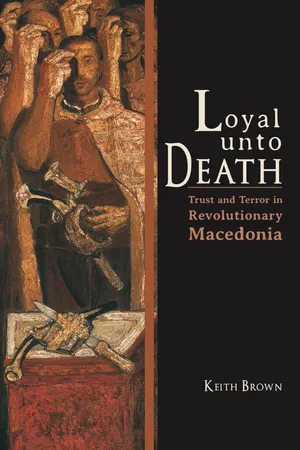
- 282 pages
- English
- ePUB (mobile friendly)
- Available on iOS & Android
eBook - ePub
About this book
Trusted by 375,005 students
Access to over 1.5 million titles for a fair monthly price.
Study more efficiently using our study tools.
Information
Topic
HistoriaSubtopic
Historia de Oriente MedioCHAPTER ONE
Terminal Loyalties and Unruly Archives:
On Thinking Past the Nation
“Why not Macedonia for Macedonians, as well as Bulgaria for Bulgarians and Servia for Servians?” (Gladstone 1897). This simple-seeming question, first posed by a former British prime minister with considerable knowledge of the Balkans, still remains controversial today. In its original formulation, it represented a continuation of Gladstone’s long advocacy for the rights of diverse Christian subjects of the Ottoman Empire. In the 1850s, he was welcomed by the Greek population of the Ionian islands as a champion of their interests; in the 1870s, he deplored Ottoman atrocities in Bulgaria; and in the 1890s, he denounced the empire’s treatment of Armenians. Yet whereas Greeks, Bulgarians, and Armenians—along with a number of other former Ottoman subject peoples in the Middle East—are now firmly identified with their own territorial nation-states, the precise status of Macedonians and their relationship with Macedonia has remained a source of contention.
Over the years, Gladstone’s question has consistently been amended to include a definite article and turned into a slogan—Macedonia for the Macedonians—that continues to underpin scholarly research on the region’s history and culture (Rossos 2008; Čepreganov 2008). But there is irony in this legacy. For by the time Gladstone posed his question on Macedonia—at a moment when Greece was preparing to go to war against Turkey on behalf of fellow Christians in Crete—he had already come to recognize that liberation from Ottoman rule was not a cure to all the region’s ills. Indeed, he prefaced the question by stating that “next to the Ottoman Government nothing can be more deplorable and blameworthy than jealousies between Greek and Slav, and plans by the States already existing for appropriating other territory” and followed it with the prediction that unless these peoples stood together in common defense, they would assuredly be “devoured by others.”
In some sense, then, Gladstone already provided one answer to his question. There would be no Macedonia for Macedonians, because existing, ambitious states would jockey for control of the Ottoman territory of Macedonia and usurp any aspirations its inhabitants might have. That was how history played out in 1912, when Greece, Serbia, and Bulgaria (as well as the tiny state of Montenegro) declared war on the Ottoman Empire and carved up the six vilayets, or provinces, that spanned the peninsula from the Sea of Marmara to the Adriatic coast of modern Albania. Gladstone’s caveats also foretold how quarrels would undo the allies. Bulgaria, which had gained the smallest slice of territory from the first round of fighting, then launched a self-destructive attack against its former allies, sparking the Second Balkan War. When the lines of demarcation were drawn, the territory on which the MRO had aspired to create an autonomous Macedonia was divided along national frontiers that, apart from revision during each World War, have endured until today.
The Legacy of Ilinden: Methodological Nationalism
The defeat of the uprising in 1903 brought an end to the fragile unity of the organization. It also served as ground zero for a set of acrimonious debates about nation and national identity in the region, which took on renewed significance after the establishment of a Macedonian republic within the framework of federal Yugoslavia in 1944. Since that date, historians in Bulgaria, Greece, and the Republic of Macedonia (both before and after its declaration of sovereignty in 1991) have produced a substantial scholarship centered on the status of the uprising and the identity of those who took part. Notwithstanding dialogue and disagreement over historical theory and methodology within each national tradition, three dominant narratives have emerged, drawing on distinct bodies of archival material, to make sense of the question that the facts of the buildup to Ilinden, and the uprising itself, generate.1
The most straightforward accounts are those produced by successive generations of Bulgarian historians, who can draw on both state archives and those of Macedonian organizations, many of which had their headquarters in Sofia. They link Ilinden, in the Monastir region, with the Preobraženie Uprising, in the vilayet of Adrianople, that began sixteen days later on August 19, 1903. Both, in this narrative, were aided by “progressive” forces in Bulgaria and led by Bulgarian military personnel who also provided the key leadership for the organization.2 The Christian inhabitants of Macedonia who joined the uprising were motivated by shared Bulgarian ethnonational consciousness, which they also expressed by adherence to the Exarchist Church. Language and religious belonging—in social scientific terms, “primordial sentiments”—were the motivating factors of identity and subsequent participation. This view persisted after the division of Macedonia in 1912–13, as Bulgaria continued to abet local resistance to Greek and, especially, Serbian rule in the Monastir region, on the grounds that the majority of the inhabitants were Bulgarian.
Greek historiography draws on official Greek military, religious, and state archives, as well as the memoirs of self-identified Greek residents of the Monastir area, Greek officials, and military personnel who served in what Greeks refer to as the “Macedonian Struggle” (Kazazes 1904; Dakin 1966; Kofos 1993). Many of these are preserved by organizations established in Thessaloniki after the First World War, dedicated to preserving a record of the region’s Greek heritage after it was occupied by Serbian forces. Where Bulgarian historiography elevates the significance of Ilinden by casting it as part of an orchestrated, larger uprising, Greek historians diminish it (Karakasidou 1997: 102). Skeptical of the depth or sincerity of local support, they suggest that those who took part were for the most part duped, bribed, or forcibly coerced into short-term participation, and deserted at the first opportunity. They acknowledge the existence of an organization, but deny it any genuine roots or support in Ottoman Macedonia: it was a tool of Bulgarian state interests and thus an external and illegitimate actor in a geographical region that, in this narrative, was a longstanding part of the Greek world (Mylonas 1947: 77–83). This view was operationalized by colonizing those parts of the Monastir vilayet that were incorporated into Greece after 1913 with refugees from Asia Minor (put in motion by the failure of Greece’s war of aggression against Turkey in the 1920s), and by systematic, aggressive efforts to assimilate the Slavic-speaking population (Karakasidou 2000; Carabott 1997).
Before World War II, Serbian historiography likewise emphasized Ilinden’s Bulgarian provenance and also sought to downplay its significance for the local population of the Bitola region, who were simultaneously subjected to a campaign of Serbian national assimilation. After the creation of the Socialist Federal Republic of Yugoslavia, though, and the recognition of a Macedonian republic and people (narod) within it, Ilinden was recast (Brown 2003). The late nineteenth and early twentieth century became a major focus for the work of the newly established Institute of National History in Macedonia’s capital city, Skopje. Drawing primarily on archival materials and published accounts shared by Sofia during the brief entente between Bulgaria and Yugoslavia (1946–48), Skopje’s national historians presented Ilinden as an early expression of Macedonian commitment to national liberation, also infused by proto-Yugoslav ideals of brotherhood and unity. They focused attention on those leaders who had espoused socialist ideals and had reached out to Macedonia’s Albanian, Turkish, and Vlah victims of Ottoman oppression and bourgeois (Greek) exploitation; those with obvious ties to Belgrade or Sofia (or both) were marginalized or cast as traitors (Brown 2003, 2004). Ilinden 1903 became part of a longer process of Macedonian national awakening, a precursor to the 1944 establishment (on the same date) of a Macedonian Republic quickly incorporated into Yugoslavia. This perspective survived the breakup of Yugoslavia, with the establishment of an autonomous, sovereign Republic of Macedonia represented as a third Ilinden (Brown 2000).
Divergent and seemingly incompatible though these narratives appear, they share a common frame of methodological nationalism (Wimmer and Glick-Schiller 2002; Chernilo 2007: 1–20). That is to say, in all three versions the nation-state occupies center stage as the agent of history, and all three assume that the establishment (or enlargement) of a nation-state must have been the ultimate goal of any organization that existed. For Bulgarian historians, again, the narrative is straightforward. The nation-state at the heart of Macedonia’s history is Bulgaria. The activities of the organization and its supporters sought to unite ethnic Bulgarians within the boundaries briefly established in 1878, after the Russo–Turkish War, but then redrawn by the other great powers. Ilinden was an expression of the will of the Bulgarian-speaking majority of Macedonia’s Christian population for freedom, and a united Bulgarian nation-state was the best provider and guarantor of that freedom.
Greek and Macedonian narratives share a central preoccupation with the primary significance of nations in history, but, in denying the straightforward Bulgarian version, are forced in different and directly adversarial directions. For Greek historians, focused on the region’s Byzantine and Orthodox heritage and its inhabitants’ supposedly underlying Greek national identity, the idea that the organization enjoyed authentic mass support, or sprang from indigenous activism, was simply unthinkable. So although acknowledging that it was an expression of Bulgarian nationalism, Greek narratives depict the organization as a façade maintained by an alien elite. While the mro’s leaders claimed their goal was to liberate fellow nationals, this Greek narrative asserts that they sought to advance Bulgarian state interests by fostering instability and violence in Macedonia at the expense of the territory’s truly, deeply Greek population.
The same two ideas that are anathema to Greek historians—authentic mass support for the MRO and its roots in indigenous activism—are central to the post-Yugoslav Macedonian narrative. That puts Skopje’s historians, obviously, at odds with their Athens- and Thessaloniki-based counterparts. At the same time, though, they also fiercely contest the annexation of the organization’s story by Sofia and insist on the existence of a distinct Macedonian nation, and national consciousness, in the Ilinden period, which gave birth to and sustained the organization.
There is evidence in the historical record to support all three narratives. And all three have been articulated by diligent and conscientious historians, who are aware of the rival versions and seek to counter them. The effect of this heated debate, though, has been to focus the collective energy of scholars on a single point of contention: the national identity of Macedonia’s Christian inhabitants, especially those who were members of the organization or participated in the Ilinden Uprising. In its simplest form, much of the historical research on early twentieth-century Macedonia and its residents has come to be organized around the question “Who were they?”
But while this appears to be a legitimate, open historical question, it disguises a strongly presentist, politicized orientation in the debate. For what it really asks is, “Of which subsequent nation-state were these people members-in-waiting?” That was already an urgent question for Western journalists and diplomats in the early 1900s; Greek, Serbian, and Bulgarian ideologues were happy to provide their own answers. And those answers still have consequences today, where the question is still asked regarding the Slavic-speaking Orthodox majority of the (Former Yugoslav) Republic of Macedonia (Poulton 1995; Pettifer 1999; Roudometof 2002). A hundred years later, the two established EU member-states of Greece and Bulgaria have continued to pursue policies toward their neighbor shaped by their different perspectives on the historical standing of the Macedonian nation, while domestic politics within the Republic of Macedonia have been profoundly affected by the dissonance between people’s strong sense of national distinctiveness and the externally generated doubts cast on that distinctiveness. The struggle to establish a single, authoritative answer on the status of Macedonian national identity at the beginning of the century has profound existential consequences for the present.
Beyond Identity: Toward a History of Non-National Loyalties
Rather than focus on the presence or absence of national consciousness in the past, I seek here to move beyond unproductive methodological nationalism. Specifically, I argue that the Macedonian Revolutionary Organization’s emergence and reception among the Christian population of Turkey in Europe reveals not the presence or absence of national identity, but rather a process of the creation, interaction, and ...
Table of contents
- Cover
- Title
- Copyright
- Dedication
- Contents
- Acknowledgments
- Note on Transliteration and Pronunciation
- Note on Sources
- Chronology of Key Orienting Dates
- Introduction: The Archival Imagination at Work
- 1. Terminal Loyalties and Unruly Archives: On Thinking Past the Nation
- 2. The Horizons of the “Peasant”: Circuits of Labor and Insurgency
- 3. The Oath and the Curse: Subversions of Christianity
- 4. The Archive and the Account Book: Inscriptions of Terror
- 5. The Četa and the Jatak: Inversions of Tradition, Conversions of Capital
- 6. Guns for Sale: Feud, Trade, and Solidarity in the Arming of the MRO
- Conclusion: The Archival Imagination and the Teleo-Logic of Nation
- Appendix 1. Documents of the Macedonian Revolutionary Organization
- Appendix 2. Biographies from the Ilinden Dossier
- Glossary
- Notes
- Bibliography
- Index
- About the Author
Frequently asked questions
Yes, you can cancel anytime from the Subscription tab in your account settings on the Perlego website. Your subscription will stay active until the end of your current billing period. Learn how to cancel your subscription
No, books cannot be downloaded as external files, such as PDFs, for use outside of Perlego. However, you can download books within the Perlego app for offline reading on mobile or tablet. Learn how to download books offline
Perlego offers two plans: Essential and Complete
- Essential is ideal for learners and professionals who enjoy exploring a wide range of subjects. Access the Essential Library with 800,000+ trusted titles and best-sellers across business, personal growth, and the humanities. Includes unlimited reading time and Standard Read Aloud voice.
- Complete: Perfect for advanced learners and researchers needing full, unrestricted access. Unlock 1.5M+ books across hundreds of subjects, including academic and specialized titles. The Complete Plan also includes advanced features like Premium Read Aloud and Research Assistant.
We are an online textbook subscription service, where you can get access to an entire online library for less than the price of a single book per month. With over 1.5 million books across 990+ topics, we’ve got you covered! Learn about our mission
Look out for the read-aloud symbol on your next book to see if you can listen to it. The read-aloud tool reads text aloud for you, highlighting the text as it is being read. You can pause it, speed it up and slow it down. Learn more about Read Aloud
Yes! You can use the Perlego app on both iOS and Android devices to read anytime, anywhere — even offline. Perfect for commutes or when you’re on the go.
Please note we cannot support devices running on iOS 13 and Android 7 or earlier. Learn more about using the app
Please note we cannot support devices running on iOS 13 and Android 7 or earlier. Learn more about using the app
Yes, you can access Loyal Unto Death by Keith Brown in PDF and/or ePUB format, as well as other popular books in Historia & Historia de Oriente Medio. We have over 1.5 million books available in our catalogue for you to explore.