"A unique and intriguing point of entry into the dialogues and a variety of concerns from metaphysics and epistemology to ethics, politics, and aesthetics." —Eric Sanday, University of Kentucky
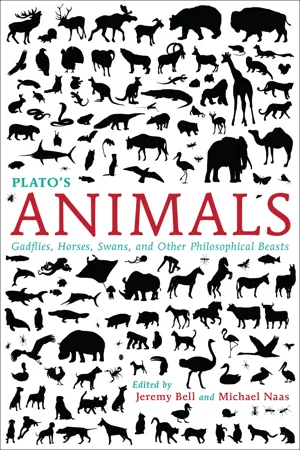
Plato's Animals examines the crucial role played by animal images, metaphors, allusions, and analogies in Plato's dialogues. These fourteen lively essays demonstrate that the gadflies, snakes, stingrays, swans, dogs, horses, and other animals that populate Plato's work are not just rhetorical embellishments. Animals are central to Plato's understanding of the hierarchy between animals, humans, and gods and are crucial to his ideas about education, sexuality, politics, aesthetics, the afterlife, the nature of the soul, and philosophy itself. The volume includes a comprehensive annotated index to Plato's bestiary in both Greek and English.
"
Plato's Animals is a strong volume of beautifully written paeans to postmodern themes found in premodern thought." —
Notre Dame Philosophical Reviews
"Shows readers of Plato that he remains significant to issues currently pursued in Continental thought and especially in relation to Derrida and Heidegger." —Robert Metcalf, University of Colorado, Denver
"Will provide fertile ground for future work in this area." —Jill Gordon, author of
Plato's Erotic World
eBook - ePub
Plato's Animals
Gadflies, Horses, Swans, and Other Philosophical Beasts
- 270 pages
- English
- ePUB (mobile friendly)
- Available on iOS & Android
eBook - ePub
About this book
Information
Topic
PhilosophiePART I
THE ANIMAL OF FABLE AND MYTH
1 Making Music with Aesop’s Fables in the Phaedo
AT THE BEGINNING of the Phaedo, Socrates contemplates the relationship between pain and pleasure after having been released from the shackles that had bound his legs: “‘What a strange thing, my friends, that seems to be which men call pleasure! How wonderfully it is related to that which seems to be its opposite, pain, in that they will not both come to a man at the same time, and yet if he pursues the one and captures it he is generally obliged to take the other also, as if the two were joined together in one head’” (Phaedo 60b).1 This makes him think of Aesop: “‘And I think,’ he said, ‘if Aesop had thought of them, he would have made a fable telling how they were at war and god wished to reconcile them, and when he could not do that, he fastened their heads together, and for that reason, when one of them comes to anyone, the other follows after. Just so it seems that in my case, after pain was in my leg on account of the fetter, pleasure appears to have come following after’” (60c). Here Cebes interrupts Socrates, having remembered that Evenus had asked him to find out why Socrates had been composing poems—“metrical versions of Aesop’s fables [λόγους] and the hymn to Apollo”—while awaiting his execution in jail (60d). Socrates answers that it was to test the meaning of certain recurring dreams that said, “Socrates, make music and work at it [μουσικὴν ποίει καὶ ἐργάζου]” (60e). To this point, Socrates had thought these dreams were encouraging him to do what he was already doing, since “philosophy was the greatest kind of music and I was working at that” (61a). But just in case the dreams really meant that he should make music in the ordinary sense, he thought he should compose some verses (61a). So first he composed a hymn to Apollo whose festival was causing the delay in his execution, and after that, “considering that a poet, if he is really to be a poet, must compose myths [μύθους] and not speeches [λόγους], since I was not a maker of myths [μυθολογικός], I took the myths [μύθους] of Aesop, which I had at hand and knew [προχείρους εἶχον καὶ ἠπιστάμην], and turned into verse [τούτους ἐποίησα] the first I came upon [ἐνέτυχον]” (61b).
Socrates downplays his choice of Aesop. He is quite serious about following the message of his dreams “to make music,” but the choice to “make music” out of Aesop seems to be one of convenience: a poet must compose myths; Socrates doesn’t do this; Aesop’s myths were “at hand”; off he went. But there is good reason not to take Socrates too seriously here. In addition to Plato’s artistry, which makes any seemingly offhand remark in his dialogues suspect, there is Socrates’s claim that he does not compose myths when he had himself just created one about the nature of pain and pleasure. This alone should make us pause and wonder why, really, Socrates chose Aesop’s fables to make into music. And it’s not at all obvious; on the surface Aesop was no particular favorite of Socrates or Plato; he is mentioned in only one other dialogue in the Platonic corpus, in Alcibiades I, where the fable “The Lion and the Fox” is used to point to the Spartan’s hidden love of wealth.2
Others have considered this question. Compton, for example, has argued that Socrates chose Aesop because Plato wanted to remind his readers of their parallel lives and deaths, that Plato was “assimilating Socrates to Aesop.”3 The similarities between them as they are portrayed in the works of Plato and the Life of Aesop are indeed striking. While the version of the Life of Aesop that survives was likely not written until the first century CE, there is evidence that it was based on a number of stories about Aesop’s life and death that were widely known in the time of Socrates.4 The portrayal of Aesop in Aristophanes and Herodotus is consistent with the later story, as is a representation of Aesop on a fifth-century BCE Attic cup.5 The parallels are these: both are extremely ugly (indeed both are compared to satyrs); both are righteous critics of an unjust city; both are found to be intolerable by members of this unjust city and are consequently brought to trial on trumped-up charges; both, in their defenses, use animal parables to criticize their accusers; both prophesy doom for the city after they receive their death penalties; both comply with their death penalties; and both have a relationship with Apollo. Compton concludes:
That these parallels are not accidental is shown by Plato’s having Socrates versify Aesop in the last days of life. Versifying beast fables would seem almost a trivial thing to do, taken at face value, but our respect for Plato’s conscious and subtle artistry will not allow us to leave it at that. Immediately before we learn that he is versifying Aesop and the hymn to Apollo, he tells a fable that he describes as Aesopic. . . . Socrates makes up Aesopic fables and (re-)writes Aesop’s fables. . . . [Socrates] is being assimilated to Aesop by Plato, and surely Aesop’s death is being adumbrated here, in the dialogue of Socrates’ death, the Phaedo.6
Edward Clayton takes this line of thought a step further.7 He agrees with Compton that Plato means for us to see the similarities between the lives of Aesop and Socrates, but he invites us to notice the differences as well. For example, while both are righteous critics of a city, Socrates criticizes the Athenians for thinking they know when they don’t and being too fond of money, reputation, and physical pleasures. Aesop, on the other hand, criticizes the people of Delphi because they don’t honor and pay him after his performance. Socrates can compel others to goodness because of the beauty of his own soul; Aesop’s intelligence and good advice can help people to get on in the world and solve some of their practical problems. Socrates’s motives in talking to others are pure; he is attempting “to turn people from injustice to justice and vice to virtue.”8 Aesop, however, always seems to be motived by self-interest, whether by his desire for freedom when he was a slave, or for money and fame at other times.9 Socrates is nearly always immune from pains and pleasures of the body, whereas Aesop has sex with his master’s wife nine times.10 In prison, awaiting his execution, Socrates is remarkably calm, even happy; Aesop is far from tranquil and, on the way to the cliff from which he is to be thrown, tries to escape his death by seeking sanctuary in a shrine to the Muses. Finally, Socrates never wavers in his service to Apollo. Aesop, however, neglects to properly honor Apollo when building a shrine to the Muses.11 Plato’s purpose, then, in having Socrates versify Aesop at the beginning of the Phaedo is to remind readers of their parallel lives, and through the comparison, notice the differences. Clayton’s conclusion: Plato wants us to see that it is Socrates whom we should emulate, not Aesop. Socrates is wise and good; “Aesop is a good man, but he is no philosopher.”12
I do not disagree with Compton or Clayton as far as they go (although the characterization of Aesop that Clayton points to makes it difficult to see Aesop as a “good man”). It is clear both that there are surprising parallels between their lives as found in these texts and that there are differences that Plato may have wanted us to think about at the beginning of the Phaedo. But there is an omission in both. The arguments of both Compton and Clayton rest almost entirely on a comparison of Socrates’s life as found in certain Platonic dialogues with Aesop’s as found in the Life of Aesop. There is very little mention, and no detailed study, of the fables themselves. Granted, it is difficult to know the “message” of Aesop since the history of each fable involves a complicated story of transmission and rewriting by various compilers at different times. And for the most part one cannot know whether a particular fable is “genuine” or invented later and merely ascribed to Aesop. But if one wants to understand why Socrates chose Aesop to versify, the fables do need to be explored, if only with the modest goal of seeing whether there are general themes repeated in many myths, themes that could give us a hint about why Socrates chose Aesop. Indeed, Clayton himself (without much if any evidence) writes that there is one such general message, and it is at odds with the message of Platonic philosophy.
Clayton mentions the fables in the context of his enumeration of the various ways that Socrates and Aesop are different. He seems to be in the same camp as Blackham and Rothwell, who believe that overall the fables have a political message.13 As Clayton argues: “Their basic message is that the strong survive and the weak suffer, and the highest goal one can pursue is the preservation of one’s life in the face of a world that is hostile or at best indifferent.”14 Consequently, for the powerful, these “Might makes right” fables would “reinforce the rightness and naturalness of their power and actions and would allow them proudly to compare themselves to lions and other powerful predators able to impose their will on others with impunity.”15 The weak could identify with the weaker animals in the myths and find helpful advice about how to stay out of trouble.16 Thus, Clayton writes, “fables can reveal important truths and provide useful, practical advice for conducting one’s affairs, but they are not useful for bringing people to an understanding of virtue or vice, nor is that their purpose.” And so the message of the fables “is not the message found in the Socratic teachings.”17
If this is the message of the fables, it is indeed very different from Plato’s. But we need to be cautious about accepting this too quickly. First, it would be very strange for Socrates to put a fable with this message to music, even if all he was concerned to do was “make music in the common sense” by putting some fable “at hand” into verse. That general message—that “the politically strong survive and the weak suffer”—is antithetical to what Socrates had argued for in the Apology and Crito, and it is opposed to “the message” in the Republic and Gorgias where Socrates takes on Thrasymachus, Polus, and Callicles for holding that “Might makes right.” Imagine, for example, Socrates putting something like Hesiod’s “The Hawk and the Nightingale” into verse and dedicating it to the author of his dream; it seems more than a bit of a stretch. It seems like blasphemy.18 Having Aesop’s fables “at hand” or “in memory” would hardly be enough reason to choose them if that’s what they were about.
But there is an additional reason to be cautious: this view of the fables can be defended only by ignoring a large number of them. While there are a number of fables that, arguably, support the “Might is right” thesis,19 there are also many ethically themed fables that have a different moral. For example, in “The Hare and the Lion’s Justice” a good-tempered lion king creates peace between the powerful and weak by bringing all the wild animals to justice, making each pay penalty for what it had done to its prey.20 Admittedly, such images of justice are rare in the fables. More common (and more famous) are those fables that show the value of friendship and fellow-feeling between the powerful and the weak. In “The Shepherd and the Lion,” for example, a shepherd helps a lion who had a thorn stuck in his paw.21 Later, the lion returns the favor when he saves the shepherd, who has been convicted of a crime that he didn’t commit. Similarly, in another, a mouse accidentally runs over a sleeping lion and wakes him.22 The lion ...
Table of contents
- Cover
- Half title
- Title
- Copyright
- Contents
- Editors’ Introduction: Plato’s Menagerie
- Part I. The Animal of Fable and Myth
- Part II. Socrates as muōps and narkē
- Part III. The Socratic Animal as Truth-Teller and Provocateur
- Part IV. The Political Animal
- Part V. The (En)gendered Animal
- Part VI. The Philosophical Animal
- Part VII. Animals and the Afterlife
- List of Contributors
- Plato’s Animals Index
- Name and Subject Index
Trusted by 375,005 students
Access to over 1.5 million titles for a fair monthly price.
Study more efficiently using our study tools.
Frequently asked questions
Yes, you can cancel anytime from the Subscription tab in your account settings on the Perlego website. Your subscription will stay active until the end of your current billing period. Learn how to cancel your subscription
No, books cannot be downloaded as external files, such as PDFs, for use outside of Perlego. However, you can download books within the Perlego app for offline reading on mobile or tablet. Learn how to download books offline
Perlego offers two plans: Essential and Complete
- Essential is ideal for learners and professionals who enjoy exploring a wide range of subjects. Access the Essential Library with 800,000+ trusted titles and best-sellers across business, personal growth, and the humanities. Includes unlimited reading time and Standard Read Aloud voice.
- Complete: Perfect for advanced learners and researchers needing full, unrestricted access. Unlock 1.5M+ books across hundreds of subjects, including academic and specialized titles. The Complete Plan also includes advanced features like Premium Read Aloud and Research Assistant.
We are an online textbook subscription service, where you can get access to an entire online library for less than the price of a single book per month. With over 1.5 million books across 990+ topics, we’ve got you covered! Learn about our mission
Look out for the read-aloud symbol on your next book to see if you can listen to it. The read-aloud tool reads text aloud for you, highlighting the text as it is being read. You can pause it, speed it up and slow it down. Learn more about Read Aloud
Yes! You can use the Perlego app on both iOS and Android devices to read anytime, anywhere — even offline. Perfect for commutes or when you’re on the go.
Please note we cannot support devices running on iOS 13 and Android 7 or earlier. Learn more about using the app
Please note we cannot support devices running on iOS 13 and Android 7 or earlier. Learn more about using the app
Yes, you can access Plato's Animals by Jeremy Bell,Michael Naas in PDF and/or ePUB format, as well as other popular books in Philosophie & Philosophie ancienne et classique. We have over 1.5 million books available in our catalogue for you to explore.