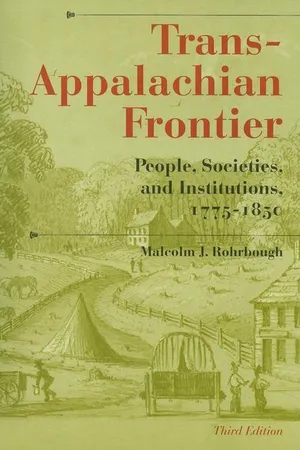
The first American frontier lay just beyond the Appalachian Mountains and along the Gulf Coast. Here, successive groups of pioneers built new societies and developed new institutions to cope with life in the wilderness. In this thorough revision of his classic account, Malcolm J. Rohrbough tells the dramatic story of these men and women from the first Kentucky settlements to the closing of the frontier. Rohrbough divides his narrative into major time periods designed to establish categories of description and analysis, presenting case studies that focus on the county, the town, the community, and the family, as well as politics and urbanization. He also addresses Spanish, French, and Native American traditions and the anomalous presence of African slaves in the making of this story.
Trusted by 375,005 students
Access to over 1.5 million titles for a fair monthly price.
The year 1775 opened on a static America. For one hundred and sixty-five years of permanent Anglo-American settlement, occupation of the continent had proceeded inland, but never rapidly. Indian peoples, political intrigue, imperial considerations, vast distances, and physical obstacles had all slowed the advance. After five generations, settlements had reached the mountain ranges that barred the way to the interior. Along the seaboard a well-developed commercial economy that had produced several wealthy, leisured, and cultured societies (with great differences among them) testified to the maturity of the colonies. An educated class had developed a high degree of political discourse. In that fateful year several of the cities along the eastern seaboard—and there were important urban centers—were in a ferment over the continuing quarrel with Great Britain. What had begun as a dispute about taxation and the payment of war debts had grown into a conflict over principle, calling into question the basic relationship between Great Britain and her colonies three thousand miles to the west. Inland from the great seaports, however (and not so far inland), life went on as it had for generations. The business at hand was scratching a living out of the soil, acquiring land, growing a few surplus crops or some livestock for market, always with a watchful eye on the dangers within the towering forests. Here life had changed little from that experienced by the first English settlers in the New World. Technological innovations—principally in firearms—provided a degree of security, but all around these people swelled the great forest, much as it had encompassed their ancestors before them. The immensity of the landscape everywhere dwarfed cabins and clearings, and the more so as one moved west to the great Appalachian range.
The year 1775 was also a time of momentous events. In the East armed conflict broke out against King George III. This clash directed the colonies upon a course that would lead to a great struggle for independence. At the same time that gunfire sounded across the Lexington Green, in the remote but inviting lands west of the mountains a group of promoters, speculators, fur traders, land-hungry settlers, and free spirits were beginning the settlement of the trans-Appalachian region. In a short time they would establish another Lexington. There is a sense of parallel new departures here. For the Americans west of the mountains, their intentions were equally dramatic and dangerous, and their determination just as great. Despite dangers from Indian peoples, official disapproval, isolation, and economic hardship, men and women embarked upon a venture in the interior of the continent so remote from the settled and secure portions of the colonies as to represent a new kind of frontier experience.
That this new departure in expansion to the West coincided with the outbreak of the American Revolution and a new departure in government raises the question of whether there was a connection between the two. In fact there was not. The first pioneers west of the mountains did think of themselves as engaged in a struggle for political and economic independence from proprietors and other colonial officials, but their interests were eminently practical. They were concerned with protection from the Indians, clear land titles, and good markets for their surplus crops. Whoever could provide these conditions—within reason—met their views of a good government, whether it be George III or George Washington. In truth, they did not long remain aloof, for the War for Independence came to the West as an Indian war. If there was one thing that the early pioneers agreed upon, it was the threat from the Indians, and the often-voiced sentiment that the Indians represented the British was enough to ally many frontier people with the independence movement in the East. Even so, it was a long time before the men and women of the western waters thought in terms of national allegiance. Immediately ahead lay a series of confrontations with Indian peoples, with states, and eventually with a new national government.
The establishment in 1775 of permanent settlements in that area known as Kentucky marked a dividing line in this long expansion to the West. Although it was carried out by men and women less interested in their contributions to establishing an independent nation than in their own prosperity and physical safety, nonetheless their actions opened the way to the interior of the continent. Even before the end of the Revolutionary War, boats began to drift down the Ohio. Singly and at first few in numbers, they only contrasted with the great river and the silent shores. They were the advance scouts of a surge of numbers, however, that in the next generation would settle the interior of the continent for the new nation, force the Indian peoples from their hunting grounds, press the Spanish into opening the Mississippi River, compel the English into a reluctant evacuation of the Northwest posts, and, in short, lay the basis of the Anglo-American occupation of the continent to the Mississippi River and even beyond. So rapid and persistent was this movement to the West during the years of the war itself that by the coming of peace, it was no longer possible to confine the settlements to the east of the mountains. To make good her claim, the new, independent American nation embarked on a military struggle against the Indian peoples of the Ohio Valley and their British allies. For the decade from 1784 to 1794, it was an equal contest. The Indians’ inability to unite in the face of the American advance balanced against the weaknesses of the new nation, suffering from severe financial burdens and internal divisions, hard-pressed to carry on a military campaign at a distance of several hundred miles from its sources of strength on the East Coast.
The pioneer people who crossed the mountains into Kentucky and Tennessee and their children and grandchildren who acted out the next stages knew a great deal about occupying new land, learned from their parents and created through years of experience in the woods and on the land. They knew how to fell a tree in a certain direction, how to build a log cabin, how to handle livestock, how to clear, plant, cultivate, and harvest. They also knew how to supplement their diet in the woods by hunting and fishing and how to trap fur-bearing animals whose skins would be useful in clothing the family. The women knew how to churn, bake, spin, weave, and sew. Above all, they knew how to raise their children to assist on the farm and how to give them the skills they would need for a similar life ahead. These might include the ability to read and write, or it might not. The pioneers also knew how to accept the demands of the land and the physical hardships that it imposed. Gradually, advances in technology came to the frontier people, and, if the requirements were the same, the tasks became somewhat easier. Better axes and stronger wagons for hauling families and produce and improved materials for constructing roads slowly made their influences felt. After 1815 came the steam engine, and with it an economic revolution for nation and frontier alike. Steam moved people across the water and, more important, upstream. It could run saws and millstones that in an earlier but still recent age had depended upon waterpower. These changes would affect the life of the frontier, but only gradually.
It was fortunate for the frontier people that they had skills and experience in dealing with the new landscape west of the mountains, for around them lay a world of vast, forested spaces. Natural forces of enormous power—great storms, fires, and floods—mixed with the promise of the land. The deep forests produced a pall of gloom that hung over travelers for days, and permanent settlers for much longer periods. People saw sunlight occasionally filter through the canopy of trees, but they rarely traveled or lived in it. Balanced against this melancholy, however, were beautiful clear streams of running water and a variety and abundance of bird and animal life. Added to the force of nature was the sense of distance and loneliness. The earlier settlers went west in small groups, but few could escape the feeling of having cast off from land and left a harbor to put to sea, without the prospect of a safe anchorage ahead. Behind lay family, friends, and society, those influences that offered the protection of a community against natural and human dangers; ahead lay the unknown.
In a manner strongly reminiscent of Marc Bloch’s description of the age of feudalism, the early Anglo-American settlers across the mountains were surrounded by powerful forces—human and natural—that they could not control.1 Babies died at birth, and pioneer peoples of all ages and stations succumbed to diseases that few understood and no one could cure. People ventured into the woods and never returned. The constant presence of injury and death, the sense of frailty and vulnerability, gave rise to both a fatalistic view of life and a strong religious fervor as men and women vented their frustrations at the presence of such impersonal and seemingly uncontrollable influences. They also gave rise to superstition and folk remedies in medicine and religion, for where fate seemed to play such a significant role in the lives of people, fate must be analyzed, appeased, evaded. These people lived close to the earth. The rhythm of the seasons conditioned their lives, with an agricultural cycle, hunting interludes, and natural catastrophes. At the same time, hostile Indian peoples who had mastered so much of the forbidding landscape harassed them. As the tillers of land in the Middle Ages stayed near the castle, the pioneers of the trans-Appalachian frontier huddled close to their forted stations, casting an anxious eye on the sky, and then on the great forest, even as they rejoiced in the promise of the land.
1.
THE STRUGGLE FOR SECURITY
In June of 1774 a group of land surveyors led by James Harrod laid out a settlement near the headwaters of the Salt River in that broad expanse of land south of the Ohio River known as Kentucky. This act was the culmination of the new, intense interest in that fertile region west of the mountains that made speculators and settler families alike disregard the official restriction of colony and crown and the dangers posed by a strong Indian presence. Like other Anglo-American groups wandering through Kentucky, Harrod’s group spent much time spying out the land and surveying promising tracts. On an especially attractive site near a salt lick, Harrod and his party laid out a town, built cabins, staked out lots, cleared land, planted a crop of corn, and after a sharp clash with the Shawnees, departed, leaving their preemptive marks on the surrounding countryside.1
Some time during the following autumn, a party of Indian hunters came upon the deserted settlement and destroyed it. In doing so, the Indians sought to erase a record of the intrusion on the landscape, which they rightly regarded as their hunting preserve. Already for a century and a half, Anglo-American settlers had been changing the landscape in their inexorable advance from the tidewater to the mountains. Now, after the treaty in 1763 that removed the French, these advance parties were increasingly west of the mountains. In their persistence and numbers, the Anglo-Americans were relentless in their expansion to the West and in their appetite for new lands that they seized and placed under cultivation. Indian resistance had been continuous, but however often the Indians destroyed the isolated cabins, drove off the livestock, laid waste the cultivated fields, and even killed the settlers, the Anglo-Americans continued to come. When members of Harrod’s party returned in March of 1775, they found others already at the remains of their site. The two groups began at once to rebuild. The result was a crude palisaded fort that endured. This structure may be considered the first permanent Anglo-American settlement in that broad reach of territory stretching from the Tennessee River to the Ohio River, already known as Kentucky.
James Harrod was not the first Anglo-American pioneer to visit the “land of the western waters,” as it was known from the watercourses draining toward the interior of the continent. Many others, including the celebrated hunter Daniel Boone, had been in and out of the region, especially since 1763. But Harrod’s expedition and improvements of 1774 represented a new benchmark in the permanence of the Anglo-American presence.
Traders promoting commerce in furs had been crisscrossing the mountains for a century, but since about 1750, new groups—hunters and especially land speculators—had become fascinated with the lands of the Virginia Colony that lay west of the mountains. The population in the English colonies, now grown to some two and a half million, intersected with imperial policies that had removed the French from the continent. Yet, even as the Treaty of Paris in 1763 seemed to open the interior of the continent to Anglo-Americans, an imperial proclamation declared it off limits. British policy makers had determined that the empire could not risk a war against the Indian peoples of the West in the interests of the land hunger of speculators or individual settler families. Amidst the outrage of thwarted speculative ambitions at every level, small parties now penetrated west of the mountains every year. These included both hunters from the western districts of Virginia and land agents spying out the opportunities associated with the recent French cession. Sometimes the two groups were one and the same, hunters in the employ of speculative groups.2
What they found west of the mountains was a new Garden of Eden. “Heaven was a Kentucky sort of place” was an often-heard response on reaching this new land, from speculators and settler families alike. Soft- and hardwood forests were interspersed with great stretches of canebrakes, and throughout, occasional open meadows. And within this natural setting was animal and bird life as rich as any seen on the continent by Anglo-Americans. The list included a roll call of the most attractive game on the continent: large herds of buffalo, bands of elk, groups of deer, bear, and flocks of wild turkeys that darkened the skies. The Kentucky country, as it was already known, was a hunter’s paradise. The attractions for investors and cultivators were equally strong.3
The riches of the Kentucky landscape—one of the great game preserves on the North American continent—drew hunters from both sides of the mountains. Word of its attractions had spread widely. In Kentucky, Anglo-American hunters from east of the mountains met Indian hunters from north of the Ohio. By the end of the seventeenth century, Iroquois raiding parties had dispersed the original Indian occupants from Kentucky and driven them to the south and west. In the first half of the eighteenth century, the Shawnee returned, and by mid-century they hunted annually in Kentucky. The two groups—the white hunters from east of the mountains and Indians from north of the Ohio—met in an uneasy truce. They understood one another in the broadest sense, and in a world in which game was plentiful, they managed a wary coexistence, broken by occasional confrontations as one side or the other overstepped the agreed-upon boundaries established by custom. This sense of wary common interest was driven by two ongoing circumstances. The first was the continuing trade in furs that had become universal on the trans-Appalachian frontier by mid-century. The economic and imperial focus of the trade had, for a century, been the French. Now, with the loss of French sovereignty in the Treaty of Paris, English traders filled the void in a business sense, if they sometimes lacked the affinity for cultural assimilation associated with the French. The second heretofore benign influence was the understanding that traders, trappers, and hunters did not have designs on the land. They intended to use the landscape, not to possess it. Thus, they shared the bounty of Kentucky with an unstated understanding that it would continue this way indefinitely into the future.4
For the three groups, the rich animal and bird life, the Indian hunters, and the Anglo-American hunters, these rules were about to change. Driving the transformation was the insatiable land hunger that had propelled Anglo-Americans west for a century and a half. Added to this instinct was the fabled reputation of the Kentucky country, mixed with the economic opportunities unleashed by the expulsion of the French from the interior of the continent. Investors of influence and capital—from the House of Commons to the House of Burgesses—now made plans to engross large tracts of lands west of the mountains.
Capitalists needed land-lookers, and for these skills, they turned to the hunters. These were the men who had been in and out of Kentucky—often every year—since mid-century. But this traffic in hunters and land-lookers increased markedly after 1763. The lands of the western waters—including the garden spot of Kentucky—were now part of British North America. The interior of the continent belonged to the king, and although he had issued a proclamation forbidding settlement west of the mountains, this directive could only be understood as temporary, designed to quiet the restlessness of Indian peoples. So in anticipation of inevitable changes in imperial policy, investors of energy and foresight moved to spy out the best lands for future acquisition.5
The settlement of Anglo-American settler families in Kentucky owed much to the ambitions of one of these entrepreneurs. Richard Henderson, a Virginian by birth but North Carolinian by choice, crafted a speculative scheme that would make him the head of a large proprietary colony in the trans-Appalachian West. He promoted the attraction of the lands west of the mountains to investors and organized a company, the Transylvania Company,...
Table of contents
Cover
Title Page
Copyright
Dedication
Contents
Acknowledgments
Abbreviations
A Note on Citations, Quotations, Maps, and Place Names
Introduction
Part I. Across the Mountains
Part II. The Widening Frontier, 1795–1815
Part III. The First Great Migration, 1815–1830
Part IV. The Enduring Frontiers
Part V. The Second Great Migration, 1830–1850
Part VI. The Trans-Appalachian West and the Nation
Notes
Bibliography
Index
Frequently asked questions
Yes, you can cancel anytime from the Subscription tab in your account settings on the Perlego website. Your subscription will stay active until the end of your current billing period. Learn how to cancel your subscription
No, books cannot be downloaded as external files, such as PDFs, for use outside of Perlego. However, you can download books within the Perlego app for offline reading on mobile or tablet. Learn how to download books offline
Perlego offers two plans: Essential and Complete
Essential is ideal for learners and professionals who enjoy exploring a wide range of subjects. Access the Essential Library with 800,000+ trusted titles and best-sellers across business, personal growth, and the humanities. Includes unlimited reading time and Standard Read Aloud voice.
Complete: Perfect for advanced learners and researchers needing full, unrestricted access. Unlock 1.5M+ books across hundreds of subjects, including academic and specialized titles. The Complete Plan also includes advanced features like Premium Read Aloud and Research Assistant.
Both plans are available with monthly, semester, or annual billing cycles.
We are an online textbook subscription service, where you can get access to an entire online library for less than the price of a single book per month. With over 1.5 million books across 990+ topics, we’ve got you covered! Learn about our mission
Look out for the read-aloud symbol on your next book to see if you can listen to it. The read-aloud tool reads text aloud for you, highlighting the text as it is being read. You can pause it, speed it up and slow it down. Learn more about Read Aloud
Yes! You can use the Perlego app on both iOS and Android devices to read anytime, anywhere — even offline. Perfect for commutes or when you’re on the go. Please note we cannot support devices running on iOS 13 and Android 7 or earlier. Learn more about using the app
Yes, you can access Trans-Appalachian Frontier, Third Edition by Malcolm J. Rohrbough in PDF and/or ePUB format, as well as other popular books in History & North American History. We have over 1.5 million books available in our catalogue for you to explore.