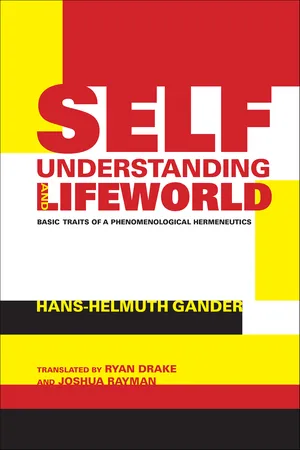
What are the foundations of human self-understanding and the value of responsible philosophical questioning? Focusing on Heidegger's early work on facticity, historicity, and the phenomenological hermeneutics of factical-historical life, Hans-Helmuth Gander develops an idea of understanding that reflects our connection with the world and other, and thus invites deep consideration of phenomenology, hermeneutics, and deconstruction. He draws usefully on Husserl's phenomenology and provides grounds for exchange with Descartes, Dilthey, Nietzsche, Gadamer, Ricoeur, and Foucault. On the way to developing a contemporary hermeneutical philosophy, Gander clarifies the human relation to self in and through conversation with Heidegger's early hermeneutics. Questions about reading and writing then follow as these are the very actions that structure human self-understanding and world understanding.
eBook - ePub
Self-Understanding and Lifeworld
Basic Traits of a Phenomenological Hermeneutics
- 426 pages
- English
- ePUB (mobile friendly)
- Available on iOS & Android
eBook - ePub
Self-Understanding and Lifeworld
Basic Traits of a Phenomenological Hermeneutics
About this book
Information
Topic
PhilosophieSubtopic
Philosophische HermeneutikPART ONE
IN THE NETWORK OF TEXTS: TOWARD THE PERSPECTIVE CHARACTER OF UNDERSTANDING
In writing the point is not to manifest or exalt the act of writing, nor is it to pin a subject in language; it is rather a question of creating a space into which the writing subject constantly disappears.
Michel Foucault
Every point of view is the apex of an inverted pyramid, whose base is indeterminable.
Fernando Pessoa
§ 3. Inception and Beginning: Toward a Forestructure of Understanding
One is to write one’s first sentence in such a way that the reader will want, without fail, to read the second sentence. So reads the advice that William Faulkner imparted to anyone who wishes to embark on the adventure of writing a text. Truthfully, this is no easy demand to fulfill, especially if one considers that—regarded from outside—at first something entirely arbitrary belongs to every beginning. And if it is adequate to satisfy the Faulknerian precept, it thus remains that such a beginning in every case possesses something compelling or seductive, though not compulsory in the strict sense.
Whether or not the starting point of a text can be justified is only to be decided through reading. For the reader whose own presuppositions the text can never divine, there stands its conclusion, which perhaps and in the best case with further development aids the decision whether or not the reader grants plausibility, indeed, the force of conviction, to the thoughts developed in the text by the author. In the question of reader recognition, a text or its author, seen correctly, may not finally be able to claim as much, insofar as concerns texts, as the so-called Holy Books or legal texts claim the force of the authoritative validity ascribed to them from their consent, indeed obedience. By contrast, for texts without such status and even those that one usually calls philosophical, the demand for consent falls away in advance. It develops itself or fails to develop on the reader’s side to the degree of his readiness to enter into discussion with what is there.
What is there presents itself as text—taking text quite conventionally as that corresponding to the particular form of notation of a determinate written language1—even if it is there as an image in the intended form of a complete totality of sense, and is thereby equally included in a network of subtextual and extratextual presuppositions which at most are no longer visible in the text itself. What is there has, observed more precisely, always already a type of prehistory. Thus, what we are concerned with is not at all a specific problem about texts; rather, it characterizes something that applies to everyone within the limits of possible human experience and which at the same time identifies the text itself as a part of the human realm of experience whose objectivations can be made accessible to us.
Martin Heidegger, among others, calls our attention to that which proximally can be addressed as sub- and extratextual prehistory in his first Hölderlin lecture (winter semester 1934/35), where he devotes his thinking to the entry point and the path of his discussions, differentiating inception [Anfang] from beginning [Beginn] and clarifying this difference in an everyday experience: “A new weather pattern, for example, begins [beginnt] with a storm, but its inception [Anfang] is the advance effect of the full transformation of the air ratios.”2 Beyond the phenomenally relevant level of this example, Heidegger indicates this difference such that the beginning “is that with which something rises up, the inception that out of which something springs forth.”3
Under Heidegger’s interpretation of inception as an ontologically originary occurrence that is inaccessible to us, it remains unseen in this lecture whether the perceived historical approach to being already indicated can form a corresponding transformation of the ancient metaphysical thought of arche, that is, of principium, which, taken as a supreme foundation, has supplied the ground of philosophy as first science since the Greeks. It is more important at this point, however, that the emphasis on inaccessibility to be sounded out within this difference—which now means the supra- and impersonal difference—between inception and beginning, is positively capable of delimiting, in the connection between author, text, and reader, the attempt to confine the causal derivation and deduction of a text out of personal motives to the problem of beginning, which itself now no longer appears as what is first in the sense of what lacks presuppositions.
In this sense, the differentiation of Heidegger’s difference, seen structurally, is enlightening in relation to the beginning, “as soon as it is left behind, it disappears into the progress of the occurrence,”4 while the inception “on the other hand, first comes to appearance in occurring, and is only fully there at its end.”5 If one suppresses the possible problem lying in the textured relation of inception and end, namely, that of always thinking an inverted teleology, which in fact Heidegger sees, for example, in the inceptual promise of metaphysics completing itself in Nietzsche, it still remains as an essential characteristic of this difference that the inception must not be thought as a discrete occurrence, but rather as a process seen as always already and still occurring and therefore not to be grasped.
With a view to this procedural character, every binding [Festlegung] of an occurrence to an inception point as original point connotes a construction. As such, in the intention of methodological clarifications of the matter, this binding fixes possible and perhaps even necessary points of approach and reference as full of sense, but must always again posit them under the reservation that it is provisional and therefore never capable of being made absolute.
In the inception, which displaces the beginning from itself and in contrast is not to be outstripped, it is a matter of discerning in the connection of interest between author, text, and reader the general and factical disposition out of which a text and its beginning—that is, the stipulated course of thought—achieve a form in which they can be read and received. In this form it comes to light why, for example, precisely this issue is to be approached and examined from this and not another perspective.
With a view to this particular philosophical attitude, Fichte famously and emphatically laid out the much-cited confession: “What one chooses for a philosophy depends on what one is as a human being: because a philosophical system is not dead furniture, which one could cast aside or take up at one’s pleasure, but rather it is animated by the soul of the human being who has it.”6 Günter Patzig rather laconically replied to this charged Fichtean pathos when he remarked in addition that one does not simply choose a philosophy, “but rather one grows gradually into philosophical conceptions. Also in those who sincerely philosophize, the influence of philosophic thoughts and arguments upon the development of their personality may actually be more important for what is illuminating and what seems significant to them than the influence of their individual temperament.”7 Of course, the personal inclinations respected by Patzig are not trivial to our interests and claim a not inconsiderable part of the development of our standpoint.8 But these inclinations themselves can be taken seriously only if they have gained their acuity in self-testing and from taking the influence of factors as they are predesignated in a serious measure by the academic milieu in which one gains one’s scientific experiences.
What in this sense plays a part in influences of the most various sort upon the formation of our ideas and our judgment can be apprehended hermeneutically as the forestructure of understanding. In this phrase, understanding does not only mean a way of bringing about knowledge in the foregrasping of still closer approximation, but rather the existential basic structure of our self- and world relation in which all understanding accordant with knowledge and interpretation is founded. Hermeneutics in this sense thus does not aspire to be a doctrine of method as much and at first as it designates a self-enlightenment of the understanding, which assumes the form of an interpretation [Interpretation], a laying out [Auslegung] of which Heidegger stresses that it is “not the taking notice of what is understood, but rather the working out of the possibilities projected in understanding.”9
This working out is not proximally theoretical-conceptual. It can become so, and if it takes up the question of the human existentially, as in Heidegger’s work, this laying out [Auslegung] becomes a hermeneutics of facticity, as is to be seen. More fundamental than the conceptual laying out is the pretheoretical way of being of this laying out in which the human being itself constantly moves. Even in what we assume to be the activity of simple looking, we register what is seen as something. This ‘as’ can be called the hermeneutical ‘as’ in distinction from the apophantic ‘as’ of the expression. It “composes the structure of explicitness; it constitutes the laying out,”10 which stands under three conditions of implementation in which the tripartite forestructure of pretheoretical and theoretical laying out [Auslegung] takes shape.
In this, the forehaving [Vorhabe], which also could be called pregivenness [Vorgabe], designates that which must already be pregiven to laying out, although not yet expressly, in order to fulfill itself. The laying out holding itself in this pregivenness is thereby led by a determinate insight that has it in view as foresight, about which what is understood and still shrouded is to be unconcealed in laying out. Thus, the foresight guides laying out as a prior sight of the particular concrete being laid out of the given in forehaving. Insofar as laying out holds itself in advance in a mode of language in which it addresses and conceives what is being laid out, it is determined as a third moment of the forestructure through the anticipation [Vorgriff] that is a preconception [Vorbegriff]. All three structural moments together compose the preunderstanding that constitutes the hermeneutical situation. Insofar as all laying out holds to the preunderstanding in a necessary dependence, in order to make this explicit a circular structure can be formed therein, which is referred to as the hermeneutical circle. This signifies a movement in whose completion understanding differentiates and clarifies itself.
It is important to see with regard to this preunderstanding that it is, following Heidegger, the “mode of being of particular beings,” which guides laying out [Auslegung] in the formation of its conceptuality, so that methodology and ontology may already show themselves as constitutively intertwined in this approach.11 Hans-Georg Gadamer grasps this prestructure of the understanding as a constitutive basic condition of all processes of understanding accordant with knowledge in the concept of prejudgment [Vorurteil]. After its discrediting by the Enlightenment, which as a consequence of its ahistorical ideal of reason tied the objectivity of knowledge to its lack of prejudgment, the latter now may again be rehabilitated in the careful distinction of legitimate and illegitimate prejudgments.12
Individual presuppositions, however they account for the process of socialization, belong accordingly to the genetic dispositions of a text. As a thought profile, it develops ways of seeing that, unwilling to stand only in the realm of the ‘null values’13 designated thus by Schleiermacher, raise a claim to validity, or rather, suppose it, which must redeem itself intersubjectively in a discursively enacted bond, admittedly not looking at the question whether this claim to validity can or cannot establish itself philosophically in a final grounding.14
§ 4. Approaching the Question of Interpretation: On the Relation of “Author-Text-Reader”
However, with the reference to the claim of validity raised within and by philosophical texts, we may be at the same time prevented from a possible misunderstanding that could be assumed with regard to the genetic disposition of the text, namely that the task is dictated to the reader of a text for its interpretation, that is, that the task is to reconstruct the meaning behind the text in the sense of striving for comprehension of the author’s individuality. This task signifies what the traditional hermeneutics of a Schleiermacher or Dilthey has classified as “psychological understanding,” and authors like E. D. Hirsch or Emilio Betti still argue within their tradition. And even if psychological components of understanding appear to be weakened in favor of a more linguistic orientation, as in the work of Hans Ineichen, the truth of the interpretation of a text, in the traditional sense, is still throughout constitutively bound to the fact that it primarily comprises “the sense intended by the author.”15 In contrast, Gadamer has provided evidence that in interpretation it is not a matter of a tripartite relation of text-reader-author, but rather a two-party relation between text and reader. For the primacy of authorial intention imposed by tradition, he reserves a still useful, though ultimately “reduced task.”16 For the intrasubjective intention of the author, according to its status, which can certainly seek to rule the understanding of a text normatively, is itself only to disclose from out of the present text so that it is the text itself; the response directed intersubjectively according to its intention unfolds to the reader as the “sense movement of understanding and interpreting [Auslegens].”17
For a reading of texts oriented exclusively to the immanence of the work, it would nonetheless not be about the word spoken, insofar as for a pure interpretation immanent to the work there neither is nor can be a presumed total exhaustion of meaning on the ba...
Table of contents
- Cover
- Title Page
- Copyright
- Dedication
- Contents
- Translators’ Introduction
- Preface
- Introduction
- Part One: In the Network of Texts: Toward the Perspective Character of Understanding
- Part Two: I and World: The Question Concerning the Ground of Philosophy
- Part Three: Self-Understanding and the Historical World: Basic Traits of a Hermeneutical Ontology of Facticity
- Bibliography
- Index
Trusted by 375,005 students
Access to over 1.5 million titles for a fair monthly price.
Study more efficiently using our study tools.
Frequently asked questions
Yes, you can cancel anytime from the Subscription tab in your account settings on the Perlego website. Your subscription will stay active until the end of your current billing period. Learn how to cancel your subscription
No, books cannot be downloaded as external files, such as PDFs, for use outside of Perlego. However, you can download books within the Perlego app for offline reading on mobile or tablet. Learn how to download books offline
Perlego offers two plans: Essential and Complete
- Essential is ideal for learners and professionals who enjoy exploring a wide range of subjects. Access the Essential Library with 800,000+ trusted titles and best-sellers across business, personal growth, and the humanities. Includes unlimited reading time and Standard Read Aloud voice.
- Complete: Perfect for advanced learners and researchers needing full, unrestricted access. Unlock 1.5M+ books across hundreds of subjects, including academic and specialized titles. The Complete Plan also includes advanced features like Premium Read Aloud and Research Assistant.
We are an online textbook subscription service, where you can get access to an entire online library for less than the price of a single book per month. With over 1.5 million books across 990+ topics, we’ve got you covered! Learn about our mission
Look out for the read-aloud symbol on your next book to see if you can listen to it. The read-aloud tool reads text aloud for you, highlighting the text as it is being read. You can pause it, speed it up and slow it down. Learn more about Read Aloud
Yes! You can use the Perlego app on both iOS and Android devices to read anytime, anywhere — even offline. Perfect for commutes or when you’re on the go.
Please note we cannot support devices running on iOS 13 and Android 7 or earlier. Learn more about using the app
Please note we cannot support devices running on iOS 13 and Android 7 or earlier. Learn more about using the app
Yes, you can access Self-Understanding and Lifeworld by Hans-Helmuth Gander, Ryan T. Drake,Joshua Rayman,Ryan Drake in PDF and/or ePUB format, as well as other popular books in Philosophie & Philosophische Hermeneutik. We have over 1.5 million books available in our catalogue for you to explore.