A critical look at the work of and philosophical influences upon the American Modernist composer.
Charles Ives (1874–1954) moved traditional compositional practice in new directions by incorporating modern and innovative techniques with nostalgic borrowings of 19th century American popular music and Protestant hymns. Matthew McDonald argues that the influence of Emerson and Thoreau on Ives's compositional style freed the composer from ordinary ideas of time and chronology, allowing him to recuperate the past as he reached for the musical unknown. McDonald links this concept of the multi-temporal in Ives's works to Transcendentalist understandings of eternity. His approach to Ives opens new avenues for inquiry into the composer's eclectic and complex style.
"A trenchant and intellectually expansive reading of Ives's relationship to time by connecting several compositions?and indeed, the composer's larger conceptualization of the past, present, and future?to the Emersonian concept of the "everlasting Now." This book is a wonderfully written, important contribution to scholarship on the music of Charles Ives." —Gayle Sherwood Magee, author of
Charles Ives Reconsidered "McDonald investigates both the temporal and spatial effects of multidirectional motion, as well as its ramifications for understanding some of the larger philosophical issues that are raised in Ives's music." —
Music & Letters, May 2015 "McDonald brings together analytic and personal factors to sharpen the image of the composer in convincing ways. . . . This book . . . deserves a close reading. The bibliography provides a select list of scores and recordings as well as articles, books, catalogues, and unpublished commentaries. This book is recommended for college and university libraries and for readers with a music theory background." —
Music Reference Services Quarterly
Trusted by 375,005 students
Access to over 1.5 million titles for a fair monthly price.
In his aesthetic history of Ives, J. Peter Burkholder divided Ives’s life and compositional career into six periods (1985: 43–44). These continue to provide a useful and influential means of thinking about Ives’s artistic development. The music of the first two phases, “boyhood” (1874–94) and “apprenticeship” (1894–1902), was relatively traditional. As Burkholder described, Ives composed primarily “sentimental parlor songs, pieces for his father’s band, and organ and chorus pieces” during his Danbury youth and “large romantic works in the mold of his teacher [Horatio] Parker” while at Yale and during his first years in New York (1985: 43). Seeking to serve justice to the eclecticism that characterized Ives’s music from early on, however, Burkholder also stressed Ives’s early experimentalism, inherited from his father. As Burkholder noted, the radical techniques that the young Ives was developing often found their way into pieces that are not generally considered experimental: “Ives later incorporated many of the ideas he had first developed in his ‘memos in notes’ into his music for public performance, first in his church music. … Yet in these pieces, the new techniques were often less rigorously handled than in the experimental works, for in his concert music Ives was concerned not with technique for its own sake but rather with musical and emotional effects” (1985: 49).
The notion that Ives, in his more conventional early works, employed experimental techniques in limited, strategic ways toward expressive ends is useful for making sense of the idiosyncratic blend of convention and experiment that often characterizes these pieces. It would be natural to understand this interplay between traditional and innovative compositional techniques as merely the byproduct of a composer developing his own distinctive musical voice, but, as Burkholder suggested, this aspect of Ives’s development was more purposeful: from an early stage, and more and more throughout his career, Ives used the tension between tradition and innovation as a means of expression.
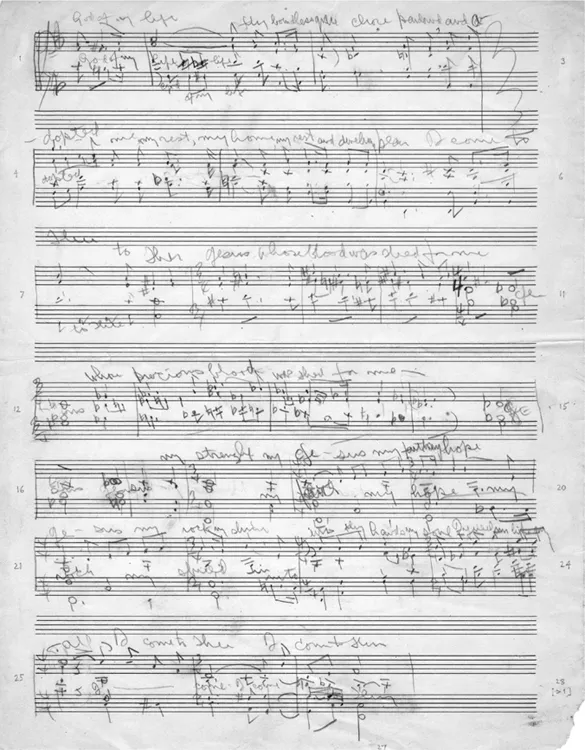
An excellent example is I Come to Thee, a short devotional piece for SATB choir which Ives composed around 1896–97, or possibly as early as 1889 (Sinclair 1999: 289–90). My analysis is based on Ives’s pencil sketch and ink score (f5927–32); John Kirkpatrick’s critical edition (Ives 1983) takes some problematic liberties with these sources, as I discuss below. The first page of the pencil sketch, which contains Ives’s setting of the first two stanzas, is reproduced in Example 1.1.
Example 1.1. I Come to Thee, pencil sketch (f5927).
The text derives from a hymn by Charlotte Elliott:
God of my life! Thy boundless grace Chose, pardoned, and adopted me; My rest, my home, my dwelling-place! Father! I come to Thee.
Jesus, my hope, my rock, my shield! Whose precious blood was shed for me, Into Thy hands my soul I yield; Saviour! I come to Thee.
Spirit of glory and of God! Long hast Thou deigned my guide to be; Now be Thy comfort sweet bestowed! My God! I come to Thee.
I come to join that countless host Who praise Thy name unceasingly; Blest Father, Son, and Holy Ghost! My God! I come to Thee.
Elliott’s hymn adopts a similar theme as “In the Sweet Bye and Bye,” the faithful anticipation of union with God in heaven, but from an individual rather than collective perspective. Each of the first three stanzas juxtaposes past and present tenses; the fourth uses only the latter. The implied trajectory is from the past (the persona was chosen, Jesus’s blood was shed for her, etc.), to the present (“I come to Thee”), to the future (the imminent union) and, ultimately, eternity (“praise Thy name unceasingly”).
The structure of the hymn implies a simple strophic setting: each stanza scans similarly and ends with the words of the title. Ives did not set out to compose a straightforward hymn, however, but instead to construct his own idiosyncratic form. Thus he was not wedded to the original text. Whereas he took few liberties with Stanzas 1, 3, and 4, Ives reordered and built upon the lines of Stanza 2, discarding the original rhyme scheme in the process. His version places greater weight on the stanza in relation to the others and emphasizes in particular the name of Jesus and his act of self-sacrifice:
Jesus, whose blood was shed for me, Jesus, whose precious blood was shed for me, Jesus, Jesus, my strength, my faith, my hope, my rock, my shield, Into Thy hands my soul I yield, my life, my all, I come to Thee, I come to Thee.
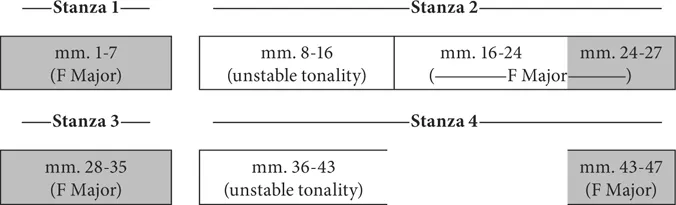
The adventurousness of Ives’s musical setting of this stanza stands apart from the others as well. Overall, Ives’s setting of the hymn rests fairly comfortably in the familiar chromatic tonal idiom of nineteenth-century Protestant hymns, with F major an unequivocal tonal center. But Ives’s intention to depart from the associated musical conventions of such hymns is evident by the end of the first stanza. Rather than affirming F major with a tonic cadence at the end of the textual refrain, as one would expect in a traditional strophic setting, the titular words are set to a half cadence (m. 7), implying, perhaps, a consequent phrase. The music of the second stanza (mm. 8–27) then veers away from that of the first in its tonality and proportions. F major is temporarily abandoned in favor of harmonic ambiguity and unusual chromatic voice leading (mm. 8–16), and the duration of the entire stanza is about three times that of the first. But the music of Stanza 2 turns out to be an aberration: the remainder of the piece is stylistically consonant with the opening phrase. Stanza 3 (mm. 28–35) reprises the music of Stanza 1, and whereas the fourth stanza strays from F major, it is not marked by the harmonic and melodic eccentricities of the second and its proportions are extended only slightly. Figure 1.1 summarizes the overall form of the piece, giving a sense of its skewed proportions; passages that are essentially identical musically are shaded and aligned vertically.
Figure 1.1. Form of I Come to Thee.
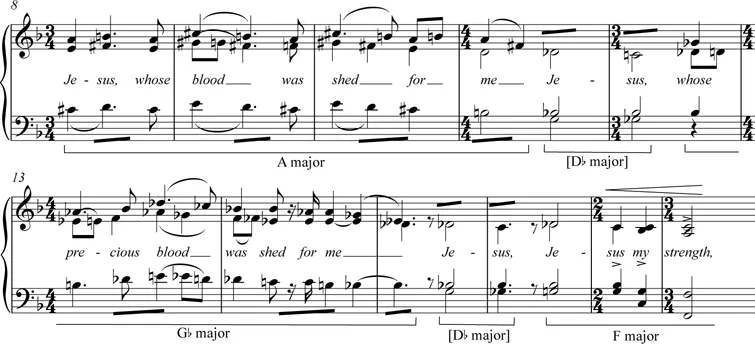
From his early works onward, Ives’s musical forms tended to be situational, determined less by preexisting musical conventions than by the form of the ideas or experiences he wished to express. This attitude shaped Ives’s approach to text setting as well; his setting of I Come to Thee seems to have been informed not by the abstract form of the text itself, but rather by the meaning of the words. For instance, Ives clearly structured the piece around the arrival of the line “Blest Father, Son, and Holy Ghost!” in Stanza 4, where the members of the holy trinity, isolated in Stanzas 1–3, are brought together. This line is sung in mm. 39–41 and immediately repeated in mm. 41–44, where the piece reaches its registral apex (m. 42), as well as its highest dynamic (fff and fastest harmonic rhythm (mm. 42–43). Mm. 8–16 hardly seem to belong in the same composition as this grandiose and gaudy climax. The passage is transcribed in Example 1.2, along with the subsequent transition back to F major in mm. 16–18. The horizontal slashes in most of the measures were Ives’s means of notating the absence of one of the voice parts from the texture. In this passage, Ives seems to have been drawn to the fleeting reference to the crucifixion, featured prominently in his recasting of the text of Stanza 2, as shown above. The convoluted chromaticism evokes the passion, and the descending semitonal gestures of mm. 11–12 and 15–17 respond with cries of lament.
Example 1.2. I Come to Thee, mm. 8–18, with key annotations.
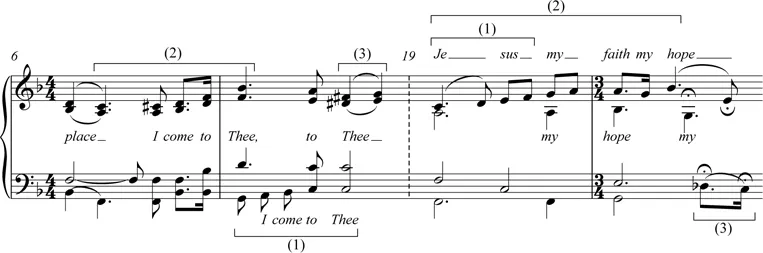
The episode is not only musically anomalous but actually set off from the rest of the piece as though parenthetical. The A-major music at m. 8 shifts abruptly away from the F-major half cadence that ends m. 7, but a much more conventional continuation can be generated by simply eliminating mm. 8–18 and proceeding directly from m. 7 to m. 19, where F-major tonality returns. Numerous musical connections make this alternative version logical and satisfying. These are outlined in Example 1.3, which juxtaposes the final two measures of Stanza 1 (mm. 6–7) with mm. 19–20; a dotted barline indicates the hypothetical connection between these passages. As highlighted by numbered brackets on the example, the latter two measures take up the ascending stepwise bass of m. 7 (1), echo the ascending minor seventh C to B
in the soprano and the rhythm of “I come to Thee” (2), and echo the accented chromatic neighbor that decorates the arrival on the dominant in m. 7 (3). These connections are so prominent in the recomposed version that it is easy to conceive of this version as having actually existed at some earlier stage in Ives’s compositional process. At this hypothetical stage, Ives would not have yet decided to alter the text of Stanza 2—it would begin with the words “Jesus, my hope, my rock …” essentially as they appear in mm. 19–20—and the music of mm. 19–27 would provide a consequent phrase to balance that of mm. 1–7.
Embedded within the interpolation of mm. 8–18 is another, shorter interpolation, Ives’s setting of the word “Jesus” in mm. 11–12. This particular utterance of Jesus’s name is set off both melodically and harmonically. The soprano momentarily drops out, replaced by the bass, creating a void where the melody had been. Kirkpatrick, in his edition, felt it necessary to correct this oddity, adding a melody in an “implied” organ part. As he explained in his commentary, “The two sources have no organ notes at all, but in m. 11–12 and 15–18 the quartet clearly sings accompanying chords that require organ phrases, which probably varied the soprano phrase in 10–11” (1983: 3). The chords that Kirkpatrick refers to are as disorienting as the absence of the soprano line. As indicated in Example 1.2, they imply the key of D
major, a complete non sequitur in the A-major context established in mm. 8–11 and an apparent tonal dead-end. The pair of chords can be heard as a tonal displacement of a normative progression: transposing the pair of chords up a minor sixth would create a straightforward path to a reprise of m. 8 as a consequent phrase via a modified descending-fifths progression. Not only are the chords harmonically disruptive, but they are metrically disruptive as well, inserting four beats into a 3/4 scheme; in a normalized version of the passage, beat 2 of m. 11 would proceed directly to beat 3 of m. 12. Even the word “Jesus” is superfluous in this context: it could be omitted without sacrificing the coherence of the text.
Example 1.3. I Come to Thee, linear and motivic connections between mm. 6–7 and 19–20.
The music reels after this disruption. The melodic motion immediately reverses course, slithering upward until returning to the same chord that...
Table of contents
Cover
Title
Copyright
Contents
Preface
Acknowledgments
Introduction: Ives and Time
Part I: Three Dualities
Part II: Contexts and Methodologies
Notes
Bibliography
Index
Frequently asked questions
Yes, you can cancel anytime from the Subscription tab in your account settings on the Perlego website. Your subscription will stay active until the end of your current billing period. Learn how to cancel your subscription
No, books cannot be downloaded as external files, such as PDFs, for use outside of Perlego. However, you can download books within the Perlego app for offline reading on mobile or tablet. Learn how to download books offline
Perlego offers two plans: Essential and Complete
Essential is ideal for learners and professionals who enjoy exploring a wide range of subjects. Access the Essential Library with 800,000+ trusted titles and best-sellers across business, personal growth, and the humanities. Includes unlimited reading time and Standard Read Aloud voice.
Complete: Perfect for advanced learners and researchers needing full, unrestricted access. Unlock 1.5M+ books across hundreds of subjects, including academic and specialized titles. The Complete Plan also includes advanced features like Premium Read Aloud and Research Assistant.
Both plans are available with monthly, semester, or annual billing cycles.
We are an online textbook subscription service, where you can get access to an entire online library for less than the price of a single book per month. With over 1.5 million books across 990+ topics, we’ve got you covered! Learn about our mission
Look out for the read-aloud symbol on your next book to see if you can listen to it. The read-aloud tool reads text aloud for you, highlighting the text as it is being read. You can pause it, speed it up and slow it down. Learn more about Read Aloud
Yes! You can use the Perlego app on both iOS and Android devices to read anytime, anywhere — even offline. Perfect for commutes or when you’re on the go. Please note we cannot support devices running on iOS 13 and Android 7 or earlier. Learn more about using the app
Yes, you can access Breaking Time's Arrow by Matthew McDonald in PDF and/or ePUB format, as well as other popular books in Media & Performing Arts & Music. We have over 1.5 million books available in our catalogue for you to explore.