As an Official Army Photographer, "Mac" Fleming's assignment was to take motion pictures of significant wartime events for the US Army. In the pouch intended to carry his first-aid kit on his belt, he instead carried a small personal camera, which he used to take pictures of the people and places that interested him, capturing in his field notes details of the life he observed. From these records, Fleming has assembled this absorbing private chronicle of war and peace. Assigned to the European Theater in February 1945, he filmed the action from the battle for the Remagen Bridge across the Rhine, to the fighting in the Hartz Mountains, on to the linkup with the Russian forces at the Elbe River. After the armistice, Fleming helped document how the Allied Expeditionary Force established a military government in Germany to cope with masses of POWs, establish control of the country, deal with the atrocities committed by the German army, and help thousands of newly released slave laborers return home to Poland, France, and Russia. He also recorded how the army provided rest, recreation, and rehabilitation to the remaining US soldiers and sent them home by truck, train, and ship. Awaiting shipment home, Fleming explored postwar German town and country life and toured some famous castles and historic spots. The foreword by historian James H. Madison describes the important role of photography in war and the special contribution of Fleming's photographic diary.

- 200 pages
- English
- ePUB (mobile friendly)
- Available on iOS & Android
eBook - ePub
About this book
Trusted by 375,005 students
Access to over 1.5 million titles for a fair monthly price.
Study more efficiently using our study tools.
Information
Part I.
THE WAR:
A CHRONOLOGICAL STORY
1
BATTLE FOR THE REMAGEN BRIDGE ACROSS THE RHINE RIVER
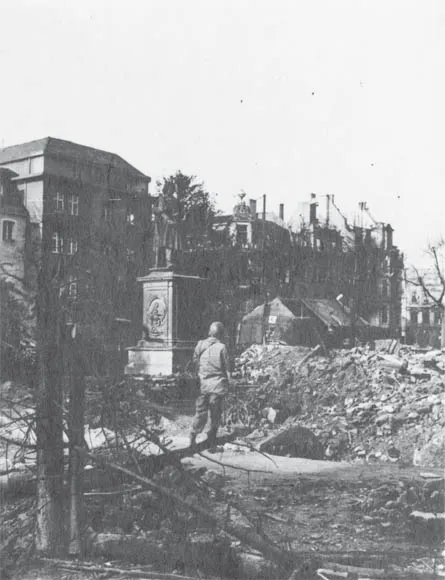
Statue of Beethoven amid the ruins of his native city, Bonn. Official pictures of this by Sig C got quite a spread in US papers.
That’s T/3 Kitzero standing there, he’s an army photographer like me.
Less than a block from this statue was the photo shop basement where by match light I located the 40 rolls of size 127 film without which this would have been among the last photos for me.
Bonn, Ger—14 March ’45
Verichrome Film
Verichrome Film
I have chosen to write in the clipped style of my field notes. “Sig C” means Army Signal Corps.
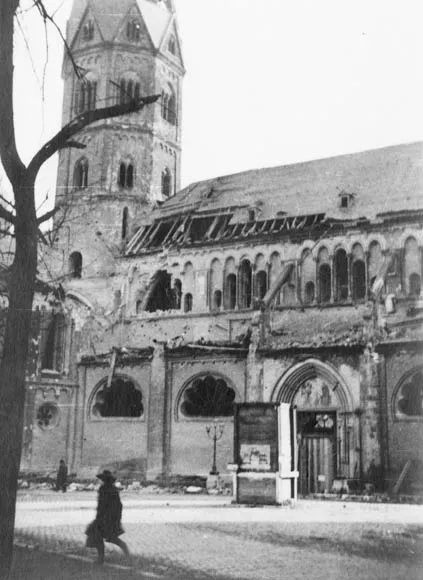
Partially ruined cathedral of which I was to see many, later. The Germans found them too effective as OPs.
Bonn, Ger—14 March ’45
OPs are observation posts.
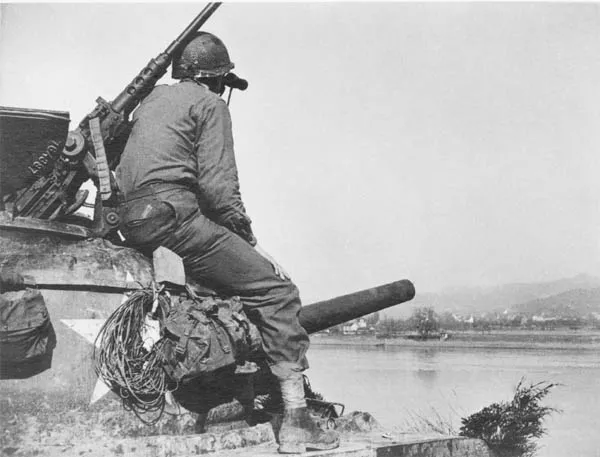
Unusual position for a Sherman Tank, but the tanker was hunting an unusual prey. The army, still jittery about the newly won Remagen Bridge, feared the enemy might destroy it by a one-man submarine or floating mines. So that’s what this tanker is looking for. Also searchlights were even used to watch the river by night.
Near Remagen, Ger—16 March ’45
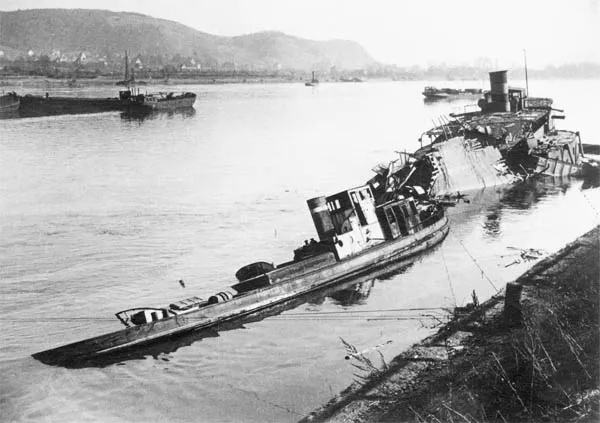
Wreckage of a ferry boat on the west bank of the Rhine. Several communication cables dip into the water nearby. Some, if not these, were fired across by signalmen. The strong current and drifting objects kept breaking these lines so they were finally weighted and sunk to the bottom.
Near Remagen, Ger—16 March ’45
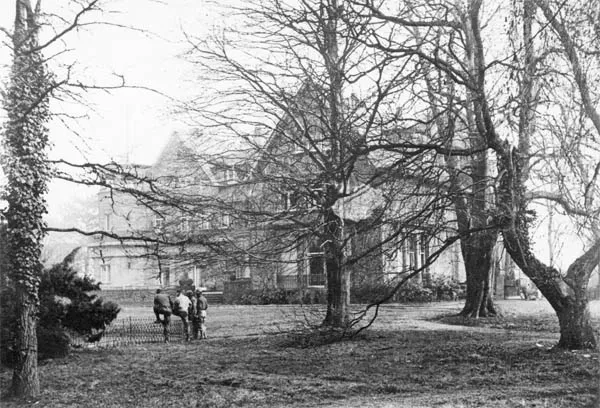
The first CP of 1st Inf after they crossed the Rhine. This mansion had belonged to a certain Hinkel who at first was rumored to be the plane manufacturer. It turned out that he made soap. Anyway, the place was luxuriously furnished so we knew him to be a good Nazi.
We often ate here with Hq Co instead of Signal, especially when we heard they were having chicken or steak. Nice to lean on the back wall & watch the Rhine go by, too.
Unkel, Ger—17 March ’45
“CP of the 1st Inf” means Command Post of the First Infantry Division. “Hq Co” means Headquarters Company.
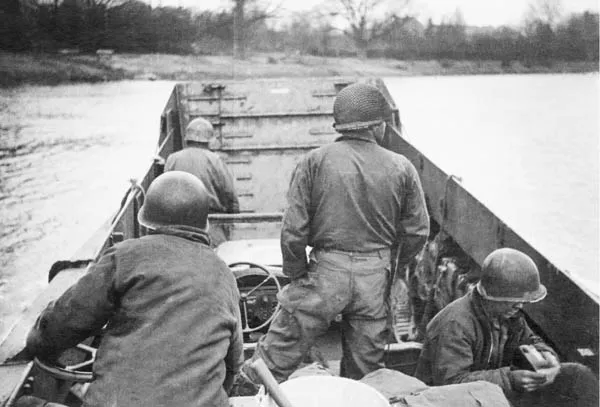
Our Peep takes a ride across the Rhine in an LCVP, courtesy of the US Navy. They said we were the first to cross the Rhine thus with a vehicle. There were other ferry services being improvised too, like the one made of three heavy pontoons fastened together and powered by several outboard motors.
Near Unkel, Ger—17 March ’45
“Peep” is an endearing name for an Army Jeep. An LCVP is a Landing Craft, Vehicle, Personnel.
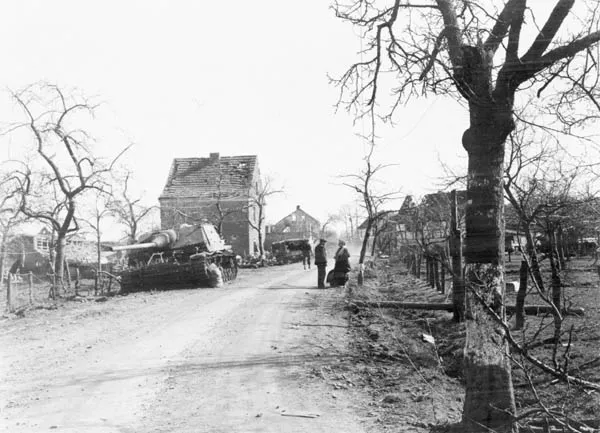
ETO HQ 45 22052 19 Mar
Credit: US Army Signal Corps
Photog-M Fleming 165 Signal Photo Company.
Civilians of Himberg, Germany, walk down the main street carrying their belongings, past a knocked-out German tank. The town fell to troops of the 1st Division, 1st US Army.
Himberg, Germany
I took this one with an Army Speed Graphic Camera. The film was flown to England for processing, like all our army film, motion or still, because of its intelligence value. This print, with the above labeling was returned to tell me how well I was doing: focus, exposure, subject matter, caption, etc. It also clearly credits me and my photo company.
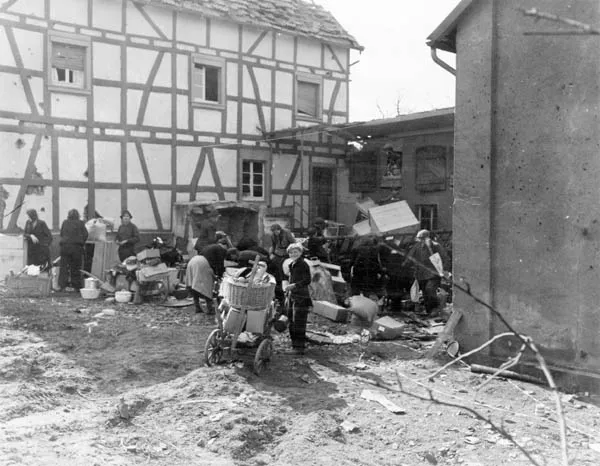
ETO HQ 45 22050 19 Mar
Credit: US Army Signal Corps
Photog-M Fleming 165
Russian and Polish civilians go through all the goods in a German-owned corner store at the edge of Neichen, Germany, in the 1st Division Sector, 1st US Army. The store had been hit by shell fire, and deserted by its owner.
Neichen, Germany
See note for previous photo.
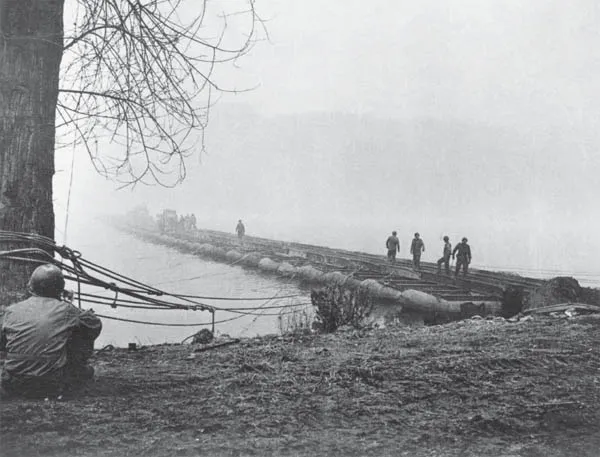
East end of a Treadway Bridge across the Rhine, the third thus far. Being built out simultaneously from both shores the center sections are last to be floated into place. I couldn’t complete my movie story of these last links yesterday because the Engineers were afraid that the floating wreckage from the Remagen Bridge, which had just fallen, would puncture the floats. Boats were busy steering big timbers through the open way midstream.
This bridge was built in about twenty hours by the 294th & 297th Eng. Bns. It has a 40-ton load limit, which means that it can handle even a medium tank.
Near Unkel, Germany—19 March ’45
“Eng. Bns.” means Engineering Battalions.
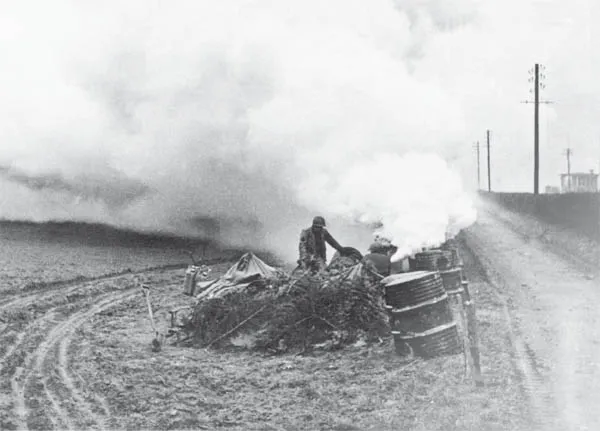
A Mechanical Smoke Generator, M/2. This is one of several covering the bridge-building operations so as to make them invisible to air observation. A changing wind made this difficult from the shores, so a couple of the generators were put on boats which could maneuver easily and keep the smoke properly directed.
This contrivance burns a special oil at 900° F, really a ...
Table of contents
- Cover
- Half title
- Title
- Copyright
- Dedication
- Contents
- Foreword
- Acknowledgments
- Note from the Author
- Introduction
- Prelude: A Photographer in Training
- Part I. The War: A Chronological Story
- Part II. The Peace: A Topical Story of Military Occupation
- Afterword
Frequently asked questions
Yes, you can cancel anytime from the Subscription tab in your account settings on the Perlego website. Your subscription will stay active until the end of your current billing period. Learn how to cancel your subscription
No, books cannot be downloaded as external files, such as PDFs, for use outside of Perlego. However, you can download books within the Perlego app for offline reading on mobile or tablet. Learn how to download books offline
Perlego offers two plans: Essential and Complete
- Essential is ideal for learners and professionals who enjoy exploring a wide range of subjects. Access the Essential Library with 800,000+ trusted titles and best-sellers across business, personal growth, and the humanities. Includes unlimited reading time and Standard Read Aloud voice.
- Complete: Perfect for advanced learners and researchers needing full, unrestricted access. Unlock 1.5M+ books across hundreds of subjects, including academic and specialized titles. The Complete Plan also includes advanced features like Premium Read Aloud and Research Assistant.
We are an online textbook subscription service, where you can get access to an entire online library for less than the price of a single book per month. With over 1.5 million books across 990+ topics, we’ve got you covered! Learn about our mission
Look out for the read-aloud symbol on your next book to see if you can listen to it. The read-aloud tool reads text aloud for you, highlighting the text as it is being read. You can pause it, speed it up and slow it down. Learn more about Read Aloud
Yes! You can use the Perlego app on both iOS and Android devices to read anytime, anywhere — even offline. Perfect for commutes or when you’re on the go.
Please note we cannot support devices running on iOS 13 and Android 7 or earlier. Learn more about using the app
Please note we cannot support devices running on iOS 13 and Android 7 or earlier. Learn more about using the app
Yes, you can access From War to Peace in 1945 Germany by Malcolm L. Fleming in PDF and/or ePUB format, as well as other popular books in History & World War II. We have over 1.5 million books available in our catalogue for you to explore.