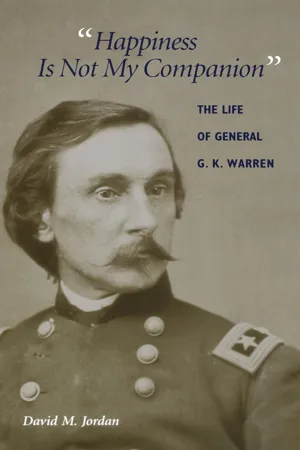
The valorous but troubled career of the Civil War general best known for defending Little Round Top and averting a Union defeat at Gettysburg.
The lieutenant colonel of a New York regiment and rising star in the Army of the Potomac, Gouverneur K. Warren performed heroically at Gettysburg. For his service at Bristoe Station and Mine Run, he was awarded command of the Fifth Corps for the 1864 Virginia campaign.
But Warren's peculiarities of temperament and personality put a cloud over his service at the Wilderness and Spotsylvania and cost him the confidence of his superiors, Grant and Meade. He was summarily relieved of his command by Philip Sheridan after winning the Battle of Five Forks, just eight days before Appomattox. Warren continued as an engineer of distinction in the Army after the war, but he was determined to clear his name before a board of inquiry, which conducted an exhaustive investigation into the battle, Warren's conduct, and Sheridan's arbitrary action. However, the findings of the court vindicating Warren were not made public until shortly after his death.
For this major biography of Gouverneur Warren, David M. Jordan utilizes Warren's own voluminous collection of letters, papers, orders, and other items saved by his family, as well as the letters and writings of such contemporaries as his aide and brother-in-law Washington Roebling, Andrew Humphreys, Winfield Hancock, George Gordon Meade, and Ulysses S. Grant. Jordan presents a vivid account of the life and times of a complex military figure.
- 416 pages
- English
- ePUB (mobile friendly)
- Available on iOS & Android
eBook - ePub
About this book
Trusted by 375,005 students
Access to over 1.5 million titles for a fair monthly price.
Study more efficiently using our study tools.
Information
CHAPTER ONE
COLD SPRING AND
WEST POINT
A MALE CHILD WAS BORN ON JANUARY 8, 1830, to Phoebe and Sylvanus Warren, in the village of Cold Spring, New York, on the eastern shore of the Hudson River. The Warrens named their newborn son, the fourth of what would be twelve children, Gouverneur Kemble Warren, after a close friend who was one of the most distinguished citizens of Putnam County.
Gouverneur Kemble was a substantial citizen indeed. Born in New York City in 1786 and an 1803 graduate of Columbia College, Kemble had gone to Spain in 1816 to study methods of casting cannon. A fledgling casting industry had been set up by a group of local men in 1814, but the flowering of the business awaited Kemble’s return from Europe. When he came back in 1818, he established the West Point Foundry, the lone industry in Cold Spring, where for the first time in the United States cannons were cast with any degree of perfection. A local historian called the foundry “the life of Cold Spring Village . . . and . . . it may be said, it feeds all, clothes all, and supports all.”1
The foundry, in which Sylvanus Warren also made a fruitful investment, made Kemble’s fortune, and he became the most influential Democrat in Putnam County, one who would serve two terms in the United States House of Representatives. Kemble, a lifelong bachelor, was also famed for his stag dinner parties, at which General Winfield Scott, hero of the 1812 and Mexican wars, was a frequent guest. Much would be hoped for from a newborn babe with a namesake of such exalted status.2
The baby Gouverneur arrived with some advantages, including a sturdy old New England heritage. His great-great-grandfather Samuel Warren was born in Boston in 1720 or earlier, became a physician, and came in about 1740 to Philipstown, New York, where he married and had two sons. No one seemed to know quite what it was, but there was apparently some kind of trouble or disgrace which caused Samuel to leave Boston.3
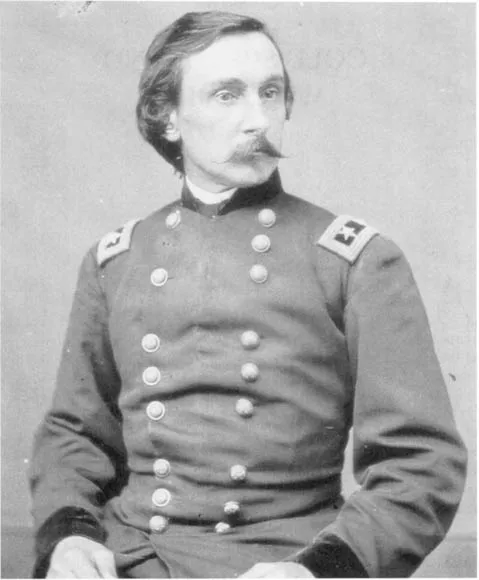
Gouverneur Kemble Warren. National Archives.
After his wife died, Samuel married again and moved on. His elder son, also named Samuel, sired a child named John Warren in 1765. Samuel, little more than twenty years old, was accidentally killed shortly afterward when he was thrown out of an overturning wagon. John, young Gouverneur’s grandfather, was said to aspire “to no higher distinction than that of a plain, practical farmer, which he was,” a man who “never gave just cause of offense to his neighbor.” Though originally trained as a blacksmith, he farmed and also maintained a famous tavern on the Albany Post Road.4
Sylvanus, the youngest of John Warren’s seven children, grew up in Cold Spring to become a solid and respected member of the community, a learned man, a prominent citizen, and a close friend of author Washington Irving. Sylvanus was associated with his friend Kemble in Democratic party affairs, working in support of the latter’s successful campaign for a seat in Congress in 1836 as well as for his reelection in 1838. In 1839 Kemble suggested to Warren that he apply for the position of assistant U.S. marshal for taking the 1840 census, and both Kemble and Irving were instrumental in Sylvanus’s securing the position. When Washington Globe publisher Amos Kendall needed subscribers to ensure the success of his paper, the organ of Jacksonian Democracy, Congressman Kemble was among those guaranteeing a certain number, and he immediately called upon his friend Warren “to assist in procuring subscriptions among our friends in the county.”5
Sylvanus Warren was a big fish in the rather small pond that was Cold Spring. The town was named for a cooling spring at which George Washington had allegedly slaked his thirst, but it had not grown much since that time. In precolonial days, its site had been a fishing ground for the Wappinger Indians, but in 1697 a twelve-square-mile tract was granted by King William III to a wealthy New York merchant named Adolph Philipse. When the legislature in 1788 passed an act dividing the counties of New York State into towns, the area became Philipstown. Not until 1846 was Cold Spring carved officially out of Philipstown as a separate village.6
In 1817, fresh from his Spanish training in the casting of cannon, Gouverneur Kemble and a partner bought from the Philips family 178 acres of solid land, 27 acres of marsh, and the right to use the waters of Margaret Brook. A year later the West Point Foundry Association was incorporated and the foundry itself established on the site. Because of the quality of its product, the foundry in 1820 secured its first of many government contracts, and the town’s prosperity was assured. In 1835 Captain Robert Parrott, the renowned ordinance engineer and inventor, resigned from the army to become the foundry’s superintendent. Just upstream and across the river from West Point, Cold Spring faced the formidable Storm King Mountain on the western bank of the Hudson. Indeed, Kemble’s cannons were tested by firing them at the face of the mountain across the water.7
Sylvanus Warren was married to the former Phoebe Lickley, and by all accounts the marriage was a satisfactory one. The Warren family lived in a comfortable though not luxurious house on Fair Street, seventy-five feet north of Main Street, just up the hill from the river, and here young Gouv and his brothers and sisters grew up. The Warren children had the advantages of a small-town, outdoor kind of life. Their basic necessities were well taken care of, and their parents inculcated in them a taste for literature and learning. Gouv was the eldest of the six Warren children who survived childhood, and he was looked up to by all of them.
Sylvanus Warren did the best he could for his children, and he arranged to send Gouv across the river to the care of a tutor named Kinsley, who specialized in the classics and mathematics. Here the youngster was well schooled in the fundamentals, and he later wrote, “I think I always applied myself as well as a boy could.”8
It soon became apparent that young Gouverneur had an aptitude for science and mathematics. As the time approached to consider the further education of this bright young man, and how his talents could be properly developed, a solution appeared very close by, at the military academy at West Point. The academy’s curriculum, strongly influenced by the Corps of Engineers, was attuned more to the development of engineers than of soldiers, and it offered a fine opportunity for Gouverneur Warren.
Sylvanus Warren’s political activities over the years, the connections and friendships he had made, primarily through ex-congressman Kemble, were now to pay off. After the appropriate inquiries were made, the proper strings pulled, the right political IOUs cashed, a letter was sent on January 28, 1846, from local congressman William W. Woodworth to Secretary of War William L. Marcy (himself a good New York Democrat serving in the Polk administration) nominating young Warren for appointment to the military academy from the eighth district of New York.9
On March 5, 1846, Secretary Marcy dispatched a letter to the young man, advising him of his conditional appointment as a cadet, and on April 2, Gouv wrote formally back to Marcy “to inform you of my acceptance of the same.” On the same document was the assent of Sylvanus Warren for his minor son and his permission to young Gouverneur “to sign articles by which he will bind himself to serve the United States, eight years unless sooner discharged.”10 Eight years would stretch eventually into thirty-six, years which would bring distinction, renown, achievement, ignominy, and heartbreak.
Gouverneur made the short trip across the river and up onto the great plain above the Hudson, entering the academy on July 1, 1846, not yet quite sixteen and a half. He was of medium height with a slight but wiry build. He successfully underwent the rigors of the encampment on the plain and the admission examination, and was soon accorded the status of a full-fledged cadet. Warren applied himself to his studies, and at the end of his year as a plebe he stood sixth in his class of eighty-nine, performing well in mathematics and English grammar, somewhat more poorly in French. He incurred only four demerits for violations of the Code of Discipline and stood eighteenth among the whole corps of cadets on the Conduct Roll. Warren’s third-class, or sophomore, year saw him move up to second on his class roll, behind Frederic E. Prime, also of New York, who had led the class in its plebe year as well. He held his own in mathematics and French and was fourth in the class in drawing. Gouverneur’s low total of eleven demerits stood him thirty-third on the Conduct Roll. He particularly enjoyed his introduction to Plato and the Greeks.11
There was a major flap in March 1848, when the third-year class put itself on the line to prevent the expulsion of one of its members, Henry C. Bankhead, for alcohol abuse. In exchange for leniency for Bankhead, the class members pledged themselves neither to bring onto nor drink on the post any intoxicating liquor, nor to partake of any when away from West Point “unless absent by authority for a longer period than three days.” Warren signed the pledge on the morning of March 19; “my principal reason for signing it,” he wrote, somewhat self-righteously, “was, that independent of its saving Bankhead, it will have the effect of making the members of our class sober men, when they get to be first-class-men, which is far from being the case with the present first class.” Bankhead, saved by his peers, would years later perform valuable service on Warren’s Fifth Corps staff.12
Gouverneur had admitted in early January that he had nine demerits, “which is considerable more than I had last. But we are more exposed this year to reports, and there is but one man above me who has less than myself.” He told a story of being reported by one of the cadet captains, “evidently . . . out of some ill feeling, though what it was I could not tell, for I had never condescended to speak to the contemptible puppy.” Warren went to the commandant and accused the captain of prejudice (not unlikely, if Warren’s obvious feelings were made manifest), succeeding in having the reports removed from his record.13
In his junior year, with the class of 1850 now reduced by attrition to fifty-seven members, Warren moved into the first position, doing well in philosophy, chemistry, and drawing, while Prime dropped to third, stymied by drawing class. Gouv’s four demerits for the year moved him up to twenty-first on the Conduct Roll.
In the following spring, Warren was alarmed to learn that his mother was ill, although it was to prove a passing malady. “Sickness in our family,” he wrote to her, “always causes me apprehension, especially when it attacks Poppy or yourself . . . [L]et me beseech you do not over exert yourself . . . preserve your health at all hazard.” As for himself, he assured her, “I am doing very well in my studies and never enjoyed better health in my life.”14
Finally, as a first classman, Gouverneur had the academy at his feet. He graduated second in his class, behind young Prime, out of forty-five new officers, with excellent marks in engineering, ethics, artillery, and infantry tactics, and class leadership in mineralogy and geology. Gouv’s twenty-five demerits for the year dropped him to sixty-sixth on the Conduct Roll, as his final year witnessed a perhaps-to-be-expected slackening of deportment.
In his first-class year, Warren came under the tutelage of the formidable Dennis Hart Mahan, the professor who instructed the budding soldiers in engineering, fortifications, and military tactics. The demanding Mahan stressed celerity of movement and common sense as the cardinal military virtues, and he felt that the progress of military technology increased substantially the importance of defensive field fortifications. Mahan’s idea of offensive tactics was not the traditional frontal assault but the turning maneuver. Most of the textbooks and treatises on military doctrine in use for many years were written by Mahan, and his influence on decades of West Point graduates was immense. Warren, one of his brightest students, absorbed Mahan’s teachings as the core of his own military thought, both in his senior year in college and through later reinforcement as a fellow faculty member.
As graduation neared, Gouverneur wrote to his father about finances. He had come to the conclusion, he said, “that it was wrong for me to be any longer a source of expense to you and that I ought to return to you whatever assistance you had afforded me since I became a Cadet.” He calculated that in his first three years and the furlough following he had cost his father $256.50, with another $26 for his first-class year, or a total of $282.50. “This I intend to repay you as soon as I am able, and having once fairly made the resolution I shall keep it. The time however may be somewhat distant as I shall have to incur new debts which it will be necessary to pay up first.” This, the future officer allowed, would start him “with some weight on my shoulders but it may lead me to contract economical habits.” Another problem was that his postgraduation furlough would soon be upon him, and he did not “have the heart to deny myself all the pleasures I have promised myself on this occasion, even though they should be at the expense of some future privations.” Lest Sylvanus be led to believe his hitherto strait-laced son was about to launch himself into a life of debauchery, Gouv said he would spend his furlough at home, but he wanted to have a horse at his disposal so he could go where he pleased. He hoped Sylvanus would put up half the cost of the horse; he would put up the other half, and his father could then sell the animal after the furlough was ended.15
The elder Warren furnished Gouverneur money to pay off his debt, buy a horse, and purchase the outfit he would need to get started in the regular army. Gouv was touched by “the evident interest and affection for me by which” the offer was dictated. Still, he was determined to repay his father for all financial assistance. “I cannot have a free conscience on the subject,” he wrote, “nor feel like a man till I do.” Besides, there were his younger brothers and sisters to think of. “I should be guilty of injustice to them if I did not all in my power to procure them equal advantages” to his own.16
And ...
Table of contents
- Cover
- Half title
- Title
- Copyright
- Dedication
- Contents
- Preface
- 1. Cold Spring and West Point
- 2. Topographical Engineer
- 3. Into the West with Harney
- 4. The Black Hills
- 5. The Explorer Becomes a Soldier
- 6. On the Virginia Peninsula
- 7. From Second Manassas to Fredericksburg
- 8. With Hooker
- 9. To Little Round Top
- 10. The Aftermath of Gettysburg
- 11. Second Corps Interlude
- 12. Fallout, 1863–1864
- 13. Into the Deep, Dark Woods
- 14. Bloody Spotsylvania
- 15. Around Lee’s Right
- 16. Standoff at Petersburg
- 17. The Mine and the Railroad
- 18. West to Peebles’ Farm
- 19. To the End of 1864
- 20. Beginning of the End
- 21. To the White Oak Road
- 22. All Fools’ Day
- 23. A Soldier’s Good Name
- 24. An Engineer, Again
- 25. Newport
- 26. The Court Begins
- 27. The Court Resumes
- 28. The Lawyers Have Their Say
- 29. The Frustration of Waiting
- 30. Where Malevolence Cannot Reach
- Notes
- Bibliography
- Index
Frequently asked questions
Yes, you can cancel anytime from the Subscription tab in your account settings on the Perlego website. Your subscription will stay active until the end of your current billing period. Learn how to cancel your subscription
No, books cannot be downloaded as external files, such as PDFs, for use outside of Perlego. However, you can download books within the Perlego app for offline reading on mobile or tablet. Learn how to download books offline
Perlego offers two plans: Essential and Complete
- Essential is ideal for learners and professionals who enjoy exploring a wide range of subjects. Access the Essential Library with 800,000+ trusted titles and best-sellers across business, personal growth, and the humanities. Includes unlimited reading time and Standard Read Aloud voice.
- Complete: Perfect for advanced learners and researchers needing full, unrestricted access. Unlock 1.5M+ books across hundreds of subjects, including academic and specialized titles. The Complete Plan also includes advanced features like Premium Read Aloud and Research Assistant.
We are an online textbook subscription service, where you can get access to an entire online library for less than the price of a single book per month. With over 1.5 million books across 990+ topics, we’ve got you covered! Learn about our mission
Look out for the read-aloud symbol on your next book to see if you can listen to it. The read-aloud tool reads text aloud for you, highlighting the text as it is being read. You can pause it, speed it up and slow it down. Learn more about Read Aloud
Yes! You can use the Perlego app on both iOS and Android devices to read anytime, anywhere — even offline. Perfect for commutes or when you’re on the go.
Please note we cannot support devices running on iOS 13 and Android 7 or earlier. Learn more about using the app
Please note we cannot support devices running on iOS 13 and Android 7 or earlier. Learn more about using the app
Yes, you can access "Happiness Is Not My Companion" by David M. Jordan in PDF and/or ePUB format, as well as other popular books in History & Historical Biographies. We have over 1.5 million books available in our catalogue for you to explore.