
- English
- ePUB (mobile friendly)
- Available on iOS & Android
eBook - ePub
Mastering the Flute with William Bennett
About this book
"This volume offers an invaluable insight into how to achieve the hallmark [William] Bennett-school sound." ? Pan
For the first time the exercises and teaching methods of world-renowned flutist William Bennett are featured in one workbook. After more than a decade of study with Bennett and many of his students, Roderick Seed has documented the tools that have made Bennett known for his ability to give the flute the depth, dignity, and grandeur of the voice or the stringed instrument. Topics range from how to overcome basic technical difficulties, such as pitch control, to the tools for phrasing, prosody, tone, and intonation needed for playing with different dynamics and ranges of expression. Advanced musicians will find useful exercises and techniques in this book that will deepen their knowledge and enjoyment of making music and help them in their quest to master the flute.
"An extremely valuable resource for flute players, covering a wide range of technical and musical issues and revealing the ideas developed over Bennett's decades-long career." ? Music Teacher
"Bennett's principles of musical expression are rooted in the physics of sound as well as an awareness of compositional construction . . . The principles of phrasing assembled here are applicable to all musicians, whatever their instrument or voice." ?Kathryn Lukas, Professor of Music (Flute) at Indiana University Jacob's School of Music
"[Seed's] knowledge of the material is impressively thorough. Mastering the Flute with William Bennett is an invaluable resource for flute players." ?Karen Evans Moratz, Principal Flute in the Indianapolis Symphony Orchestra and author of Flute for Dummies
Trusted by 375,005 students
Access to over 1.5 million titles for a fair monthly price.
Study more efficiently using our study tools.
Information
Subtopic
MusicONE
Finding a Sound
FLUTES ARE OFTEN known for being easy instruments to start on. Many people can find a sound of some sort by simply blowing across the embouchure hole, much like blowing across an empty water bottle. But how does it work?
A sound is made when air is blown across the mouth hole. There is then a fluctuation of the airstream above and below the outer edge. Some air goes below the outer edge and travels into the bore of the flute, setting up a series of oscillations down the instrument, which then leads to a sound being created.
Finding Where the Note Speaks
To practice finding a sound, we can find where the flute “speaks,” or the point where air becomes sound. To do this, we need to train our lips to be flexible. Let’s start without the flute:
Blow on your hand and imagine gently blowing out a single candle (not ten!). To blow out a candle, our airstream needs to be focused and well directed.
Is the column of air focused or does it spread out? It should be focused. Air that is too spread out will result in an unfocused sound. Aim the airstream to the middle of your hand.
Now, can you move the airstream up and down by using your lower lip or jaw? Bring the lower lip forward to move the airstream up and bring the lower lip back to move the airstream down. Allow your jaw to move slightly in accordance with the lower lip. To help, you can think of the words “oo” (jaw forward) and “ah” (jaw back). Feel the air move gradually up and down. Is the air moving steadily or is it shaky? Try to keep it steady.
Focus on blowing gently up and down. Resist the urge to bring your lips into a smile. Have a look in the mirror and watch your lower lip. Try not to move your head up and down while doing this.
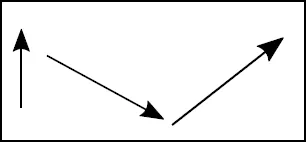
Your lips should be round and the air should have a clear direction. Try doing the same movement with your lips, but squeezed into a smile. Compare how little the air can move up and down when your lips are tight with how far it can move when your lips do not have this undue tension.
Now try the same with the flute. Finger the note C2. Start by blowing above the embouchure hole so that all you can hear is air (no sound). Slowly bring the airstream down like you did on your hand and listen carefully.

EXAMPLE 1.1. Finding where the note speaks.
Follow these steps, referring to the points in example 1.1:
Blow up so there is no sound and slowly bring the airstream down until air becomes sound.
This is the point where the note speaks.
Blow up again from point b until there is no sound again.
Where does the sound begin? When you find that point, start again and repeat the process. Once you have found that point many times, try to reduce the time it takes to find it by starting from a position closer to the speaking point. However, make sure you start from point a each time (where there is no sound). The more you practice this, the closer point a will get to point b. This is training for your lip muscles and the basis for “soft attack,” which we will look at in chapter 4.
Messa di voce exercise
Try to play from the speaking point of the note and hold it for 8 beats. You can increase the volume of sound slightly so that you are blowing freely. Then allow the sound to fade again. This is what many singers and string players practice—it’s called messa di voce (“placing of voice”). Try example 1.2 below. Once you are comfortable with the low notes at the beginning, apply the same approach to the harmonics, remembering to keep the fingering the same. Take your time and repeat where necessary. Breathe between each note so that you practice the process of beginning the note from above each time. Try to keep the dynamic within the range of pianissimo to mezzo piano.

FIGURE 1.2. Finding where the note speaks.
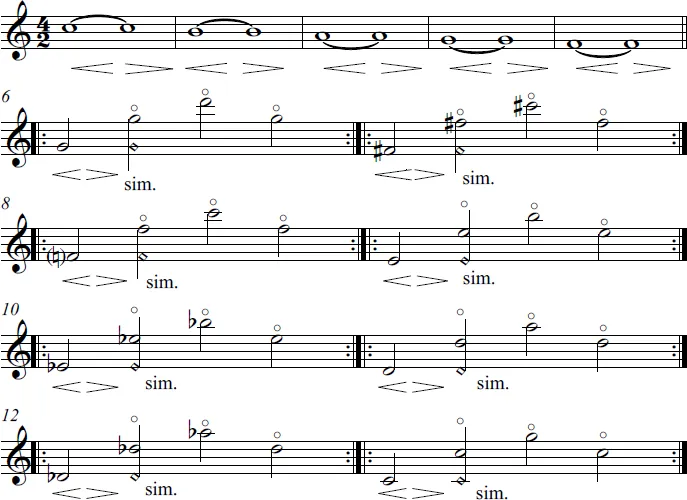
EXAMPLE 1.2. Messa di voce exercise.
TWO
Harmonics in Tune
Tone
Tone
ONCE YOU HAVE found a sound, the next step is to develop it so that it can be resonant and vibrant.
To get a large, full sound, we do not actually need to use a lot of air. This is a common misconception. When the harmonics are in tune, the sound will ring and project to the back of any concert hall, even in a soft dynamic. Many people blow too hard in order to get a big sound, but this is not an efficient way of producing a full enveloping sound.
Harmonics in Tune
So, what does it mean when we say harmonics in tune?
Every note on every instrument has its own harmonic series, made up of the fundamental (the note that is played) and the overtones. On flutes, the basic harmonic series for low C (for example) is as follows:

EXAMPLE 2.1. The harmonic series for the note C.
To find a harmonics in tune tone, we need to make sure all of the harmonics are in their right place. Practically speaking, we can only check the second and third harmonics (the octave and the 5th above that).
Position of the Headjoint
First, the position of the headjoint (how far it is pulled out) needs to be considered. Each flute has its own in-tune position, depending on its make and scale. Some flutes are pitched at A = 440 Hz while others may be A = 442 Hz or A = 444 Hz. The in-tune position can be found by doing this simple exercise:
First, tune the octave.
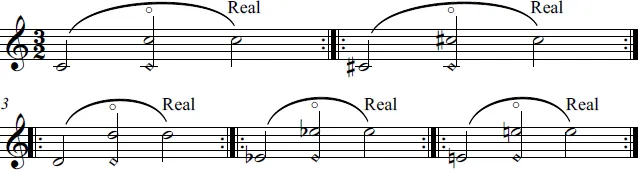
EXAMPLE 2.2. Exercise for tuning the octave to find an in-tune position.
It is necessary for the column of air to double in speed to make the note go up the octave from C1 to C2, but try to achieve this by slightly raising the jet of air with a very subtle pressure change in the lips (don’t simply blow twice as hard!). When you have managed to get the C2 this way, then change your fingers to make the real fingering for C2. Listen carefully to the pitch. How does it compare with the pitch of the harmonic fingering? It should be the same. If the real note is flatter than the harmonic, then push in the headjoint. If the real note is sharper than the harmonic, pull out the headjoint. Don’t be tempted to adjust with your lips after hearing a difference in pitch.
Next, tune the 5th above the octave. Always start from the bottom and work your way up to the next harmonic without force. Please note that the third harmonic, because it is a 12th above the fundamental (compound perfect 5th), should be a very small degree sharper than the real fingering. Your goal is to make sure that the harmonic is only slightly sharper than the real fingering. Please see chapter 8 on intonation.
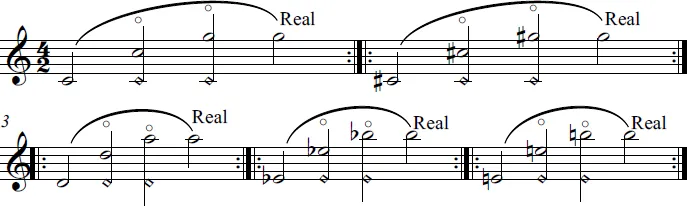
EXAMPLE 2.3. Exercise for tuning the next harmonic to find an in-tune position.
Again, using example 2.3, compare the pitches of the harmonic and real fingerings of all the notes. Make note of any notes that are out of place. The position of your headjoint where the real fingering pitches match the harmonic pitches is you...
Table of contents
- Cover
- Title Page
- Copyright
- Dedication
- Contents
- Foreword
- Acknowledgments
- Introduction
- 1. Finding a Sound
- 2. Harmonics in Tune Tone
- 3. Reaction in the Sound
- 4. Attacks, Articulation, and Repeated Notes
- 5. Prosody: “Elephants and Taxis”
- 6. Harmonics Exercises
- 7. Shakuhachi Exercise for Embouchure Control
- 8. Intonation Exercises
- 9. Flexibility Exercises
- 10. Other Exercises: Whistle Tones and Vocalizes
- 11. Approaching Melodies
- Bibliography
- Index
Frequently asked questions
Yes, you can cancel anytime from the Subscription tab in your account settings on the Perlego website. Your subscription will stay active until the end of your current billing period. Learn how to cancel your subscription
No, books cannot be downloaded as external files, such as PDFs, for use outside of Perlego. However, you can download books within the Perlego app for offline reading on mobile or tablet. Learn how to download books offline
Perlego offers two plans: Essential and Complete
- Essential is ideal for learners and professionals who enjoy exploring a wide range of subjects. Access the Essential Library with 800,000+ trusted titles and best-sellers across business, personal growth, and the humanities. Includes unlimited reading time and Standard Read Aloud voice.
- Complete: Perfect for advanced learners and researchers needing full, unrestricted access. Unlock 1.5M+ books across hundreds of subjects, including academic and specialized titles. The Complete Plan also includes advanced features like Premium Read Aloud and Research Assistant.
We are an online textbook subscription service, where you can get access to an entire online library for less than the price of a single book per month. With over 1.5 million books across 990+ topics, we’ve got you covered! Learn about our mission
Look out for the read-aloud symbol on your next book to see if you can listen to it. The read-aloud tool reads text aloud for you, highlighting the text as it is being read. You can pause it, speed it up and slow it down. Learn more about Read Aloud
Yes! You can use the Perlego app on both iOS and Android devices to read anytime, anywhere — even offline. Perfect for commutes or when you’re on the go.
Please note we cannot support devices running on iOS 13 and Android 7 or earlier. Learn more about using the app
Please note we cannot support devices running on iOS 13 and Android 7 or earlier. Learn more about using the app
Yes, you can access Mastering the Flute with William Bennett by Roderick Seed in PDF and/or ePUB format, as well as other popular books in Media & Performing Arts & Music. We have over 1.5 million books available in our catalogue for you to explore.