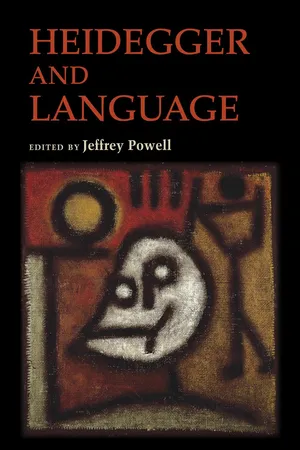
The essays collected in this volume take a new look at the role of language in the thought of Martin Heidegger to reassess its significance for contemporary philosophy. They consider such topics as Heidegger's engagement with the Greeks, expression in language, poetry, the language of art and politics, and the question of truth. Heidegger left his unique stamp on language, giving it its own force and shape, especially with reference to concepts such as Dasein, understanding, and attunement, which have a distinctive place in his philosophy.
Trusted by 375,005 students
Access to over 1.5 million titles for a fair monthly price.
We shall begin with a letter. It dates from the winter months of 1950 and is addressed from Heidegger to Hannah Arendt.1 The letter reflects, as such a letter might, on the passage of time, on renewed affections, on political circumstances. But at the top of the letter, before it is even begun, before its addressee’s name is inscribed, are the following words:
Beethoven, op. 111, Adagio, Conclusion.
Just that, no more: then, the letter itself. It is almost as if the music, summoned by its inscription, were hovering over the discourse of the letter. As if the music might enclose the words that are to be thought. Beyond and before those words, the music might be both their source and their destination—a presence both silent and resounding, enfolding everything that is spoken. From out of this possibility, a question looms up: a question about music itself, about the kinds of connections it might maintain with language. More specifically still, we might find a way to pose a question regarding the status of music in Heidegger’s discourse, of its presence or absence, its elision or its inclusion.2
Immediately, the evidence marshals itself against such an undertaking. If we wanted to summarize the objections, we might listen to Philippe Lacoue-Labarthe, who tells us that “Heidegger’s attention to music is, we know, practically nil,” and continues: “allusions and references to music are extremely rare, and mostly conventional.”3 Now, the assertion concerning the absence of extended discussion of music in Heidegger’s work is undeniably correct: after all, even his most massive contribution to the understanding of the artwork makes only the most meager and fleeting direct references to music. Further, and more compelling still, the longest and most specific of these apparently rare and slight engagements would seem to speak with unequivocal negativity of a dominance of music within the field of art. In the Nietszche lectures, and in sympathy with Nietszche’s rejection of Wagner, Heidegger writes with a kind of fury of “the domination of art as music, and thereby the domination of the pure state of feeling—the tumult and delirium of the senses… the plunge into frenzy and disintegration into sheer feeling as redemptive.”4 If one were to conclude, as Lacoue-Labarthe does, that, insofar as it represents Heidegger’s lengthiest explicit address to musical experience as such, this passage is clear evidence of Heidegger’s negative attitude to music in general, then no amount of anecdotal support, it would seem, can resist the conclusion that music simply does not play a significant role in Heidegger’s thinking.
Certainly, our endeavor must recognize this silence. From the outset, the absence of explicit engagement must be acknowledged. Music is not “addressed” by Heidegger as a topic, as a realm of human experience: it never becomes the subject of a discourse. Lacoue-Labarthe suggests that for the history of philosophy music has played the role of “rebel object par excellence… continuously and silently indicating a limit to philosophy, a secret menace to its full deployment.”5 In that sense, to refuse to engage music would be simply to play out again structures laid out by ancient ambivalence. The question, then, becomes the following: is Heidegger’s lack of engagement simply another manifestation of that kind of suspicion, a holding-at-arms-length, a necessary blind spot?
The force of the “no” with which we intend to answer that question can be supplied by a moment from one of Heidegger’s own texts: a passage crucially overlooked by Lacoue-Labarthe.6 Toward the end of the lecture-course Der Satz vom Grund, Heidegger addresses directly a new “tonality” (Tonart) with which he invites us to listen to the words “nichts ist ohne Grund” such that a different inflection might occasion a “leap” (Sprung) into a different kind of hearing, one that might allow the ist and the Grund to play in resonance with one another. It is only, says Heidegger, if we are able to push through the polyvalence of the word Satz, such that it includes its musical sense (Satz as musical “movement”), that we might “achieve for the first time a full relation to the Satz vom Grund.”7 A kind of thinking is to be made possible in this hearing, then, a thinking that is possible only in and through a kind of music. There is an intimacy of thought and music, here, that steps beyond “influence” or “inspiration.” It is not that, under the influence of music, one might be provoked to think different kinds of thought, which could be then detached from their musical inspiration. Rather, an utterly new possibility of thinking is engendered here, one that cannot be detached from the resounding together (Einklang) of the words themselves, one in which thinking is not so much to become musical, as music is to become a kind of thinking.
If music is to make possible a kind of thinking, then clearly the relation of thinking and music will not be such that music can ever become a “subject” of that thinking. Rather, if music is to be uncovered, is to be found at work in Heidegger’s texts, its operation will be brought to light only in pointing to a kind of play, an oscillation in which one might glimpse, briefly, the movement of a changing register of thought.8 This will mean stepping beyond merely “exposing” the absence of an explicit engagement with music in Heidegger’s thinking, and then attributing this lack either to accidental oversight or inadequate consideration. Rather, music will belong to thought precisely in such a way as to preclude its becoming an object of that thought. The silence that governs the presence of music in Heidegger’s thinking will, then, belong to the very core of that presence. It is within the reflections on language that the play of a modality governed by the silent presence of music might be brought to light. What will be addressed here, then, are certain operations within the texts that seem to gesture toward an opening within which this play can be seen. And the first and most transparent locus of such an opening will be the emergence of song.
Song
What is song? What does it mean for the word that it is changed into song? Stretched out along the time of its utterance, drawn out of itself into a resonance that overwhelms the opposition of sound and sense, the word that shifts register into song undergoes a transformation that reaches toward a fundamental experience of voice, toward the encounter of language and time. Heidegger’s sense of this transformation is manifest at different moments within his reflections on Rilke, on Hölderlin, on Stefan George. The shift is witnessed in each case from within the idiom of the dialogue Heidegger has engaged; the transformation of word into song is encountered, not imposed. Hence, the context of each encounter must be understood within the structure from which it emerges. The contextual immanence of these moments renders impossible any project that would seek to articulate a unitary understanding of this transformation, to extrapolate a single sense from its different occasions. Rather, what would be demanded is that we allow the different senses of this transformation to play in resonance with one another, precisely to echo and resound together.
Such a resounding can orient itself around the transformation of word into song that is explicit in Heidegger’s reflections on Stefan George. The shift is occasioned by a particular experience of the word, echoing out of a narrative poem, “Das Wort.” The experience is one of collapse: the disruption, the dislocation of a rhythm that sustains the relation of word and thing. The poet-narrator of George’s verse is one who experiences a kind of process in this relation: the process of naming. He speaks, in mythic voice, of “wonders from afar or from dreams” that he brings to the “border” (Saum). An impatient waiting is described, a hovering at the limit, at the edge of language (and we must hear, in this border/limit, Heidegger’s sense of Grenz,
that from out of which thought gathers itself), as he offers his dark treasure to the “grey norn,” the source of names. But this process, the rhythm of this naming, is suddenly interrupted, dislocated. In George’s narrative the poet returns from a journey with a “treasure rich and delicate,” for which no name can be found. In this disturbance of the rhythm of searching, attending, naming, Heidegger writes: “another, higher, rule (Walten) of the word glances abruptly at the poet.”9 Why? Because in the absence of word, the treasure itself vanishes, precipitating an utter disorientation, one that shatters the rhythm of his relation to language, that brings him face to face with “the terrifying… the undreamed-of.” The poet, whose connection to language is bound up in the process of discovery, retrieval, and naming, must abandon this prior orientation. He must suffer the de-stabilization of the link between word and thing, which becomes inverted in such a way as to bind them together with a wholly unexpected force. Suddenly, word becomes something other than a name for what is already present. In the treasure’s vanishing is revealed a different order: “no thing,” he learns, “may be where word breaks off.” The poet will henceforth speak from out of this disorientation, this fracture, out of an experience of the word that is bound up with loss, with mourning (Trauer), with “abandonment” (Verzichten). And to speak from out of such a loss is to sing:
Because the word is shown in a different, higher rule, the relation to the word must also undergo a transformation. Saying attains to a different articulation, a different μέλος, a different tone…. For this poem is a song.10
It is thus that a kind of music enters the scene: in the face of an abyssal disruption of language as naming, a new kind of utterance is engendered, an utterance in which the familiar orientations of sound and sense are displaced and re-configured. Song is the locus of this displacement, an utterance that speaks out of fracture and loss. Music will enter into la...
Table of contents
Cover
Title Page
Copyright
Contents
Introduction
One: Heidegger’s Ontological Analysis of Language
Two: Listening to the Silence: Reticence and the Call of Conscience in Heidegger’s Philosophy
Three: In Force of Language: Language and Desire in Heidegger’s Reading of Aristotle’s Metaphysics Θ
Four: The Secret Homeland of Speech: Heidegger on Language, 1933–1934
Five: The Logic of Thinking
Six: Giving Its Word: Event (as) Language
Seven: Heidegger’s Poietic Writings: From Contributions to Philosophy to Das Ereignis
Eight: Poets as Prophets and as Painters: Heidegger’s Turn to Language and the Hölderlinian Turn in Context
Nine: Truth Be Told: Homer, Plato, and Heidegger
Ten: The Way to Heidegger’s “Way to Language”
Eleven: Is There a Heidegger—or, for That Matter, a Lacan—Beyond All Gathering?
Twelve: Heidegger and the Question of the “Essence” of Language
Thirteen: Dark Celebration: Heidegger’s Silent Music
Fourteen: Heidegger with Blanchot: On the Way to Fragmentation
Contributors
Index
Frequently asked questions
Yes, you can cancel anytime from the Subscription tab in your account settings on the Perlego website. Your subscription will stay active until the end of your current billing period. Learn how to cancel your subscription
No, books cannot be downloaded as external files, such as PDFs, for use outside of Perlego. However, you can download books within the Perlego app for offline reading on mobile or tablet. Learn how to download books offline
We are an online textbook subscription service, where you can get access to an entire online library for less than the price of a single book per month. With over 1.5 million books across 990+ topics, we’ve got you covered! Learn about our mission
Look out for the read-aloud symbol on your next book to see if you can listen to it. The read-aloud tool reads text aloud for you, highlighting the text as it is being read. You can pause it, speed it up and slow it down. Learn more about Read Aloud
Yes! You can use the Perlego app on both iOS and Android devices to read anytime, anywhere — even offline. Perfect for commutes or when you’re on the go. Please note we cannot support devices running on iOS 13 and Android 7 or earlier. Learn more about using the app
Yes, you can access Heidegger and Language by Jeffrey Powell in PDF and/or ePUB format, as well as other popular books in Philosophy & Language in Philosophy. We have over 1.5 million books available in our catalogue for you to explore.