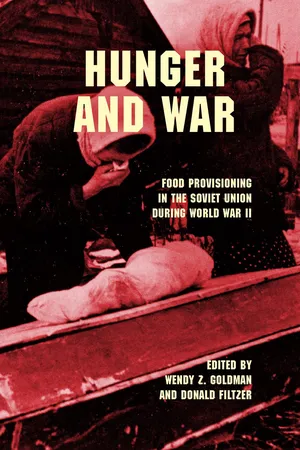
Drawing on recently released Soviet archival materials, Hunger and War investigates state food supply policy and its impact on Soviet society during World War II. It explores the role of the state in provisioning the urban population, particularly workers, with food; feeding the Red army; the medicalization of hunger; hunger in blockaded Leningrad; and civilian mortality from hunger and malnutrition in other home front industrial regions. New research reported here challenges and complicates many of the narratives and counter-narratives about the war. The authors engage such difficult subjects as starvation mortality, bitterness over privation and inequalities in provisioning, and conflicts among state organizations. At the same time, they recognize the considerable role played by the Soviet state in organizing supplies of food to adequately support the military effort and defense production and in developing policies that promoted social stability amid upheaval. The book makes a significant contribution to scholarship on the Soviet population's experience of World War II as well as to studies of war and famine.
eBook - ePub
Hunger and War
Food Provisioning in the Soviet Union during World War II
- 392 pages
- English
- ePUB (mobile friendly)
- Available on iOS & Android
eBook - ePub
Hunger and War
Food Provisioning in the Soviet Union during World War II
About this book
Trusted by 375,005 students
Access to over 1.5 million titles for a fair monthly price.
Study more efficiently using our study tools.
Information
ONE
NOT BY BREAD ALONE: FOOD, WORKERS, AND THE STATE
In the factory canteen, as a rule, there is a system of replacements, in other words, they may tear off the coupon for grain from the workers’ ration cards but they give them cabbage or stewed turnips, or very, very rarely potatoes, and then most of those are frozen. The workers are dying from hunger and malnutrition. We have special zemlianki (earthen dugouts) of death where about five to seven sick people are dying each day. Often, we have seen cases where workers die in the shops and at the gates of the factory.
Handwritten letter of complaint from Ivan Aleksandrovich Bednov, worker in ammunition Factory No. 62, Cheliabinsk, March 16, 1943.1
WHEN GERMANY ATTACKED THE SOVIET UNION ON JUNE 22, 1941, the country mobilized for total war. Throughout the summer and fall, as one town after another fell to the Nazi blitzkrieg, the Soviet leadership ordered the evacuation of factories, workers, grain, and raw materials to safer areas in the east. The rail networks were strained to the utmost: boxcars sped west to the front with Red Army soldiers, and then east to the rear with machinery and evacuees. Workers frantically dismantled machinery under a hail of German bombs, loaded it on trains, and reassembled it weeks later in industrial towns hundreds of miles from the front. Often production resumed in bare fields under open skies. Millions of people, mobilized from all over the country, were transported east to work in the defense industry.
The Soviet state faced enormous tasks: not only did it have to wage war against an undefeated and seemingly invincible army; it also had to provide millions of evacuees and newly mobilized workers with food, housing, clothing, and medical care. Moreover, all these tasks had to be accomplished within severe constraints. The newly industrialized economy was beset by shortages and imbalances even before the war began, and the Germans quickly occupied the nation’s prime farmlands. As the Germans conquered more territory, Soviet leaders realized that central state stocks could not feed the Red Army and provide the population with all the food it needed to survive.
The Soviet state was not the first to confront this crisis of provisioning. Indeed, history shows that hungry citizens on the home front have overthrown more than one regime struggling to finance a war.2 In France, years of war created the fiscal crisis that led to revolution in 1789. In Germany, women’s food protests merged with the rebellions of workers, sailors, and other groups to bring down the Kaiser in 1918. In Russia, women’s bread riots toppled the tsar in February 1917 and helped bring the soviets to power in October. In each of these moments, hungry people lost faith not only in their leaders but in the very systems they represented.3 Yet despite the terrible food shortages in the Soviet Union, the experiences of the February and October revolutions were not repeated in World War II. The hunger was fiercer and more widespread, yet there were no mass protests, food riots, or rebellions against the Soviet state. On the contrary, state food policy proved remarkably effective in organizing scarce resources and promoting popular support.
A complex, multi-tiered economy developed in response to the competing demands of the military and the labor force. The economic system that emerged differed from the grain requisitioning of War Communism, the market exchange of the New Economic Policy (NEP), and the developing state retail trade network of the 1930s. A highly centralized rationing system delivered food to the civilian population while a parallel decentralized system of subsidiary farms, local purchasing, gardens, and collective farm markets supplemented the basic ration and produced essential consumer items. Historians, analyzing this multi- tiered structure, differ sharply about the role of the state. Some argue that the state largely abandoned provisioning the home front in order to concentrate resources on the military. William Moskoff, for example, notes that the state’s strategy was “to oblige the civilian population to rely upon itself.” Other historians assert the opposite. U. G. Cherniavskii, for example, stresses that the state remained the single largest food provider to the urban population as it deliberately developed and incorporated other supplementary sources.4
This chapter brings new archival evidence to bear on the role of the state, the hierarchies of rationing, the struggle over food distribution, and conditions in the factories. It seeks to answer several questions. First, what policies did the state adopt to ensure that workers received food? Second, how did these policies function in practice? And finally, how important was the state to the production, allocation, and distribution of food? The chapter argues that the food situation for workers was far worse than either Western or Russian historians have recognized to date. Starvation, so well documented in the besieged city of Leningrad, could also be found to a lesser degree in other towns.5 Hunger and starvation-related mortality existed throughout the country. During the war’s grimmest years, many workers subsisted on bread and gruel. Central food stocks, distributed through the rationing system, were simply insufficient to provision the Red Army and ensure adequate nutrition on the home front. At the same time, the state actively sought and organized additional sources of food beyond the ration. State, party, and union organizations played an essential role in provisioning. They struggled to provide food to the groups they represented and organized collective initiatives that enabled workers to participate actively in supplementing the ration. Indeed, it was this very combination of state-sponsored collective efforts and individual participation that allowed the country to manage and survive the terrible food shortages of the war years.
PROVISIONING FOOD: A GENERAL OVERVIEW
The Soviet state had considerable experience with economic crisis and mass hunger, and had resorted to rationing several times in its short history. Throughout the Civil War years, it employed requisitioning and rationing to guarantee food to workers and the Red Army. During the upheavals of collectivization and industrialization in the early 1930s, it again rationed basic foodstuffs as it struggled to eliminate private middlemen and develop a comprehensive network of state retail stores.6 The state’s decision to use rationing had always been the consequence of extreme shortage and the need to ensure an affordable and stable supply of food to the cities. It never viewed rationing as a permanent or desirable feature of socialism. Rationing created multiple and false prices for the same item, contradicted Marx’s labor theory of value, weakened the role of money, and curtailed the assortment, availability, and circulation of goods.7 As soon as shortages began to disappear, in the aftermath of the Civil War and again in the early 1930s, the state abolished rationing in favor of a monetary system based on wages and retail trade. In January 1935, despite workers’ protests, the state eliminated bread rationing and encouraged citizens to use the new, “open-network” retail stores accessible to all consumers.8 “Closed-network” canteens and special parcels continued to provide meals and supplements to workers, white-collar employees, officials, students, and many other social groups, but town dwellers did a growing share of their food shopping in state retail stores.
The war, however, quickly undermined the relatively new system of retail trade. Large stocks of grain, sugar beets, and agricultural produce as well as poultry and herds were lost to the Germans.9 Collective farmers in the front-line zones abandoned the fall sowing and harvest. Rural officials poured kerosene over food stocks before fleeing, leaving little for Red Army troops.10 The Council for Evacuation (Sovet po Evakuatsii), created one day after the invasion, immediately began shipping food stocks and food-processing factories out of the front-line zones, but rescue efforts were not always successful. In some provinces, the desperate efforts to evacuate livestock failed; the cattle were driven off, and those that were shipped east died en route for lack of food and water.11
In areas not immediately overtaken by the Germans, the Council for Evacuation had greater success in rescuing food, machinery, and equipment. In Ukraine’s Stalino province, workers, peasants, and provincial party committee officials managed over several days in October 1941 to evacuate 4,210 out of 4,860 tractors, 1,300 out of 1,537 combines, as well as 69,400 head of cattle, 58,700 sheep, 45,600 horses, and 22,200 pigs. Almost 3,000 people, including agronomists, collective farm directors, veterinarians, mechanics, tractor drivers, and brigade leaders, struggled in pouring rain and deep mud to ship machinery and animals out of the province before the Germans marched in. Tons of grain, flour, and vegetables were evacuated, destroyed, or distributed to the peasants and Red Army.12
Yet by 1942, despite heroic efforts at evacuation, the overall picture was grim. About 70 percent of the food stocks in the front-line areas were either destroyed or lost to the Germans. The country’s total sown area was diminished by more than one-third, falling from 110.4 million acres of grain in 1940 to 67.3 million in 1942. Of the country’s 483,000 tractors in 1940, 180,000 were left behind in occupied territory.13 The quantity of grain consumed in 1942, as a result, was less than 50 percent of the figure for 1940.14 The loss of food-processing factories also damaged the food supply. Many were successfully evacuated, but their machinery was transferred to the defense industry. The Chimkent oil-extraction factory, for example, was transferred to the Commissariat of Rubber (NKRezinProm). The order was only countermanded after sharp protest from the head of the Commissariat of the Food Industry (NKPishchProm), who fought to preserve the last remaining factory that could extract cooking oil from Central Asian cotton seeds. The loss of the food factories, either temporarily to evacuation or more permanently to occupation or reassignment, resulted in a sharp decrease in all processed foods, including jams, oil, butter, margarine, meat and fish products, and canned vegetables, so important to the diets of urban consumers.15
Soon after the invasion, Soviet leaders responded to the losses in the occupied territories by slashing central state stocks of food for distribution to the retail trade network. A “mobilizing plan for the national economy” placed the country on wartime footing and replaced the figures for the third quarter (July-September) of 1941 of the third Five-Year Plan.16 Central state stocks were cut to 70 percent of the 1940 level for flour, 67 percent for grain, and a bare 34 percent for sugar.17 The planned volume of trade through state retail stores was cut by 12 percent overall to meet the needs of the army.18 On July 1, the army in the field was given permission to purchase food and fodder at state prices from collective farms in the front line areas.19
In contrast to the confusion and panic reigning on the battlefield, Soviet leaders immediately adopted a clear and firm food policy. Using the Commissariat of Trade (NKTorg), the state introduced a rationing system that gradually encompassed all urban inhabitants and rural waged workers. On July 18, the state introduced rationing in Moscow, Leningrad, and specific districts in their province...
Table of contents
- Cover
- Half title
- Title
- Copyright
- Contents
- Acknowledgments
- List of Terms and Abbreviations
- Introduction: The Politics of Food and War
- 1 Not by Bread Alone: Food, Workers, and the State
- 2 The State’s Pot and the Soldier’s Spoon: Rations (Paëk) in the Red Army
- 3 Queues, Canteens, and the Politics of Location in Diaries of the Leningrad Blockade, 1941–1942
- 4 Nutritional Dystrophy: The Science and Semantics of Starvation in World War II
- 5 Starvation Mortality in Soviet Home-Front Industrial Regions during World War II
- Bibliography
- Contributors
- Index
Frequently asked questions
Yes, you can cancel anytime from the Subscription tab in your account settings on the Perlego website. Your subscription will stay active until the end of your current billing period. Learn how to cancel your subscription
No, books cannot be downloaded as external files, such as PDFs, for use outside of Perlego. However, you can download books within the Perlego app for offline reading on mobile or tablet. Learn how to download books offline
Perlego offers two plans: Essential and Complete
- Essential is ideal for learners and professionals who enjoy exploring a wide range of subjects. Access the Essential Library with 800,000+ trusted titles and best-sellers across business, personal growth, and the humanities. Includes unlimited reading time and Standard Read Aloud voice.
- Complete: Perfect for advanced learners and researchers needing full, unrestricted access. Unlock 1.5M+ books across hundreds of subjects, including academic and specialized titles. The Complete Plan also includes advanced features like Premium Read Aloud and Research Assistant.
We are an online textbook subscription service, where you can get access to an entire online library for less than the price of a single book per month. With over 1.5 million books across 990+ topics, we’ve got you covered! Learn about our mission
Look out for the read-aloud symbol on your next book to see if you can listen to it. The read-aloud tool reads text aloud for you, highlighting the text as it is being read. You can pause it, speed it up and slow it down. Learn more about Read Aloud
Yes! You can use the Perlego app on both iOS and Android devices to read anytime, anywhere — even offline. Perfect for commutes or when you’re on the go.
Please note we cannot support devices running on iOS 13 and Android 7 or earlier. Learn more about using the app
Please note we cannot support devices running on iOS 13 and Android 7 or earlier. Learn more about using the app
Yes, you can access Hunger and War by Wendy Z. Goldman, Donald A. Filtzer, Wendy Z. Goldman,Donald A. Filtzer in PDF and/or ePUB format, as well as other popular books in History & Eastern European History. We have over 1.5 million books available in our catalogue for you to explore.