In an era bustling with international trade and people on the move, why has local food become increasingly important? How does a community benefit from growing and buying its own produce, rather than eating food sown and harvested by outsiders? Selling Local is an indispensable guide to community-based food movements, showcasing the broad appeal and impact of farmers' markets, community supported agriculture programs, and food hubs, which combine produce from small farms into quantities large enough for institutions like schools and restaurants. After decades of wanting food in greater quantities, cheaper, and standardized, Americans now increasingly look for quality and crafting. Grocery giants have responded by offering "simple" and "organic" food displayed in folksy crates with seals of organizational approval, while only blocks away a farmer may drop his tailgate on a pickup full of freshly picked sweet corn. At the same time, easy-up umbrellas are likely to unfurl over multi-generational farmers' markets once or twice a week in any given city or town. Drawing on prodigious fieldwork and research, experts Jennifer Meta Robinson and James Robert Farmer unlock the passion for and promise of local food movements, show us how they unfold practically in towns and on farms, and make a persuasive argument for how much they deeply matter to all of us.
- 230 pages
- English
- ePUB (mobile friendly)
- Available on iOS & Android
eBook - ePub
About this book
Information
ONE
Why Local and Why Now?
“Local” has emerged as one of the hottest food and cultural concepts in the United States in the nascent twenty-first century. Many people choose to buy local, read books written or published or bound locally, wear clothing made from homespun fiber or fashioned nearby, ride locally made bicycles, recreate locally, and build homes with locally sourced materials. Three-quarters of Americans say that they are highly influenced by labels that indicate food is “locally grown.”1 Food industry giants that regularly source from around the world, such as members of the National Restaurant Association, the largest food service trade organization, and Walmart, the largest US grocer, identify “locally grown” as a top food trend in recent years.2 The term’s ubiquity alone begs examination.
Benefits and Constraints
Our research—individually over the past two decades and more recently in collaboration—has involved hundreds of interviews, visits, and observations, and thousands of surveys with locally oriented farmers and customers in the United States. Our focus has been especially on people associated with farmers’ markets and CSAs in the Midwest and in the central Appalachian regions, but our own work and our reading of other scholars has ranged far beyond. We can identify several root reasons for the increase in interest in local food.
Economic Factors
Local food venues help to provide a measure of economic stability to a community. Farmers’ markets, for example, which are essentially an assemblage of small businesses, tend to boost nearby commercial enterprises: a study in Ontario, Canada, found that 50 percent of market customers also shopped at other businesses while en route to or from a market.3 Other communities in the United States, Canada, New Zealand, and Australia have also recognized that farmers’ markets can be tourist attractions that draw outside money into local economies. They promote markets as a way to experience a community’s unique agrarian surroundings, history, climate, and cuisine.4 Studies in Athens, Ohio, and the North Carolina Highlands, among other places, have found that their farmers’ markets can attract up to half of their customers from outside the immediate area.5 CSAs, too, strengthen the rural economy, stabilizing farmers’ incomes by creating ongoing purchasing relationships with consumers nearby. Similarly, food aggregation hubs, a new addition to local systems, help to build capacity by allowing farmers to grow more and sell more. Moreover, while the United States continues to produce prodigious amounts of commodity crops (such as corn, soybeans, wheat, and pork bellies), the country also benefits from the diversification of the local economy that occurs with demand for specialty agricultural products. Because these marketing arrangements decrease the likelihood that farmers will subdivide or sell their property, they also help preserve agricultural land and the force of people who know how to farm it.
A limitation of local food, however, is the perception, and sometimes the fact, that its cost is higher. For example, the public perceives farmers’ markets to have higher prices than supermarkets, and enrollment in CSAs often requires a big cash outlay. These impressions remain even though prices for in-season produce can be cheaper, some markets now accept government food subsidies, and some CSAs now offer lower-price subscription payments. Surveys show that farmers’ market and CSA customers tend to have higher incomes and more formal education than the general population of the area.6
On the farmers’ side, the economic balance sheet is always a challenge: “I can grow or raise just about anything that we have the climate and soils for—it is the market that is the problem,” says Tim Nickels, a fourth-generation farmer in western Kentucky. Although he can produce plenty of peaches and sweet corn, he has to find enough people to buy them at prices that cover his costs in doing business, which are especially high as he works on transitioning to more environmentally sustainable methods. Similarly, Paul Alexander, a local produce farmer in southern Indiana, feels challenged by having to be both farmer and marketer, doing the physical labor of reclaiming long fallow fields while simultaneously building a clientele. Those fields have a twenty-five-year seedbed of grasses and other undesirables that Alexander must battle in order to give his vegetable cash crops a chance. At the same time, he worries that the local population is too sparse to absorb all he can grow.
Social Factors
Such economic factors complement an array of social benefits that local food venues provide for communities, including developing social vitality, local culture and values, and human capabilities.7 The social nature of markets and CSAs supports new friendships, strengthens old acquaintances, and can enhance a feeling of belonging among vendors and consumers. Aggregation hubs—when they welcome small, local growers and identify their sources as such—support the same kinds of social belonging. Food hubs, though, are new developments in the local food infrastructure—aggregating, storing, processing, and distributing regionally to larger retail, commercial, and institutional customers—so research on them has begun only recently. Hubs that welcome small, locally oriented growers clearly provide a model for access to larger buyers. Still, the public nature of all of these venues means that local crops, crafts, and cuisines can be connected to the identities, creativities, heritages, and collective memory of those who live in a particular region.8
On the other hand, local food venues may seem to be inaccessible to people whose ethnicity, class, social position, and cultural preparation for the market experience differs from the majority of those participating.9 In addition, people with physical disabilities may find the exertion of an open-air shopping excursion at a farmers’ market or a pick-your-own farm prohibitive. Thus, certain sectors of the population can be more prepared for and more privileged in local food experiences.
An additional social factor hinges on the homespun notion of having fun on the farm, also known as agrileisure. Many families know firsthand the pleasure gained from picking strawberries, pumpkins, apples, or Christmas trees at a local farm, and the USDA has long promoted recreation as both an outcome of the agriculture experience and a means to diversify farm income. Coining the term, Ben Amsden and Jesse McEntee describe agrileisure as emerging “from the intersection of agriculture, recreation and leisure, and social change.”10 The hybrid word binds the “supply and demand sides of farm-based recreation and tourism with the processes of economic diversification, community development, and environmental and ecological sustainability.”11 In other words, the leisure gained by consumers of agricultural activities—such as regular market shopping, food security gleaning, CSA barbeques, and nose-to-tail cooking lessons—supports the viability of farms and farmers while also fundamentally transforming the economic, social, and ecological world we share. Agrileisure participants, including regular farmers’ market and CSA shoppers, act as engaged community members with a keen interest in food, agriculture, community development, or the social experience. Agritourists, on the other hand, are often one-time visitors who enjoy a hayride, overnight farm stay, or walk through a corn maze but who have no ongoing or “internally compelling love” for connecting to the agricultural world.
The central appeal of agriculture, of course, is its emphasis on consumption—food. Indeed, Daniel Thomas Cook argues that the pleasure of consumption alone makes it a leisure activity.12 The selection, preparation, and consumption of food in ways that strengthen families and friendships and perpetuate traditions are social activities often resulting in the pleasing, intuitively worthwhile, and faithful states of mind associated with recreation and leisure, respectively. James Farmer’s studies have found that some customers shop at farmers’ markets for recreation even more than for food.13 And Kallina Gallardo and her colleagues found that the entertainment and festive atmosphere at farmers’ markets significantly affect consumers’ choice of which market to shop.14 Further connecting the dots between the socioeconomic features of the farmers’ market and the academic notions of research and leisure, leisure scholar Amanda Johnson says that when farmers’ market customers buy for leisure, they also help to build and expand community.15 In short, the pleasurable act of eating, especially when associated with the lively contexts in which local food is found, results in powerful feelings that all health, welfare, and community advocates should appreciate and cultivate.
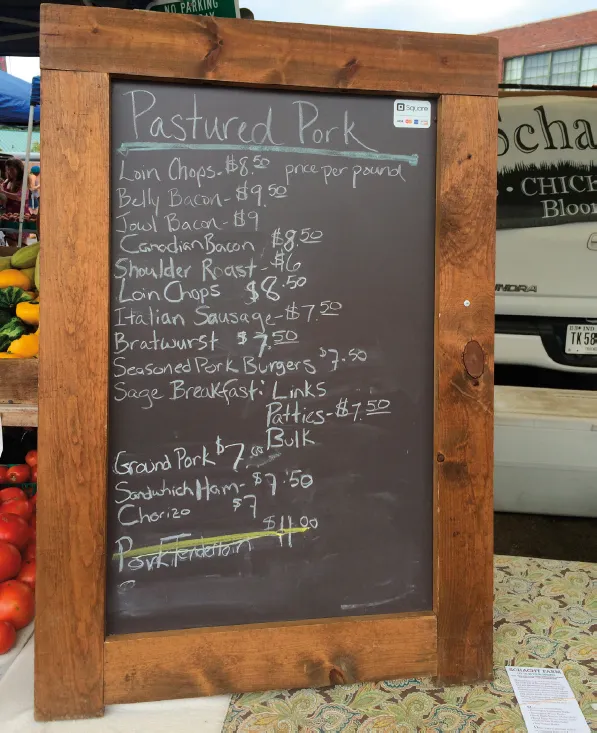
Figure 1.1. The meats available at this Bloomington, Indiana, farmers’ market stand evoke food and farming traditions. Photograph by Jennifer Meta Robinson
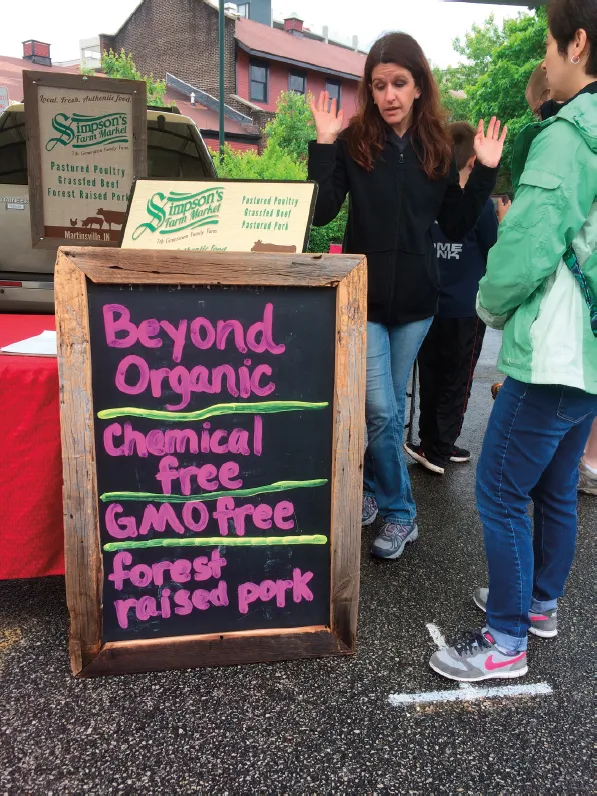
Figure 1.2. This stand markets its production methods so that customers know how their food was raised and can judge how well it aligns with their values. Photograph by Jennifer Meta Robinson
These connections are so powerful that they can be called “serious leisure”—when one remedies a lack of fulfillment in ordinary occupations (e.g., being a lawyer, homemaker, teacher, clerk) with leisure activities that are more meaningful, substantial, and engrossing to them (e.g., fly fishing, garage band guitar, fantasy football).16 Local food fans carry on serious leisure when they become deeply engaged with the styles and activities involved—visiting markets on vacation, timing entertaining to CSA deliveries, visiting a u-pick orchard to get peaches for drying, carrying special market totes, wearing a favorite market outfit. Food powerfully knits together discretion, necessity, pleasure, consumption, and context. So the discretionary time and effort spent on serious leisure with food (canning one’s own tomatoes, learning to bake bread, sourcing local food for a holiday meal, buying a mechanized apple peeler or cherry pitter) is impossible to disentangle from the necessity of what seems a simple chore of feeding one’s self and family. The pleasure and metaphysical sustenance of a Saturday’s u-pick apples baked into a fancy pie can “seriously” outweigh the convenient cheapness of one found in the frozen food aisle. These complex intersections help explain why people choose to eat locally, even with the extra time necessary for shopping, cooking, and eating this way.17
Environmental Factors
Regional production and distribution mean fewer goods are shipped long-distance. Typically, the shorter supply chain reduces fuel consumption and transportation pollution. In addition, produce grown for nearby consumption requires less emphasis on shelf life, which translates to fewer chemical additives, preservatives, and refrigeration costs. Overall, local food can be an important way to reduce agriculture’s carbon footprint.18
Local production also promotes more sensitivity to local and regional biodiversity.19 The demand for standardization by multinational food corporations, restaurant chains, and supermarket conglomerates has resulted in some crops being grown ubiquitously (e.g., wheat, soybeans, and corn throughout the Midwest) and in areas not naturally suited to them (e.g., rice in California’s dry Central Valley), while others (e.g., Aquadulce Fava Beans or Red Garnet Amaranth) become scarce. This homogenization process has caused many large-scale farmers to monocrop in only one or two high-yield crops that often require large amounts of synthetic pesticides, fertilizers, and preservatives, with their deleterious environmental consequences.20 Selling locally, on the other hand, small-scale operators often find their marketing niche by providing items that are not readily accessible at chain supermarkets.21 Moreover, CSAs that actively involve their shareholders in the process of growing and producing their own food foster knowledge of and affinity for the local landscape, potentially spreading conservation ethics to more people as they become inspired to plug into their local “foodshed.”22
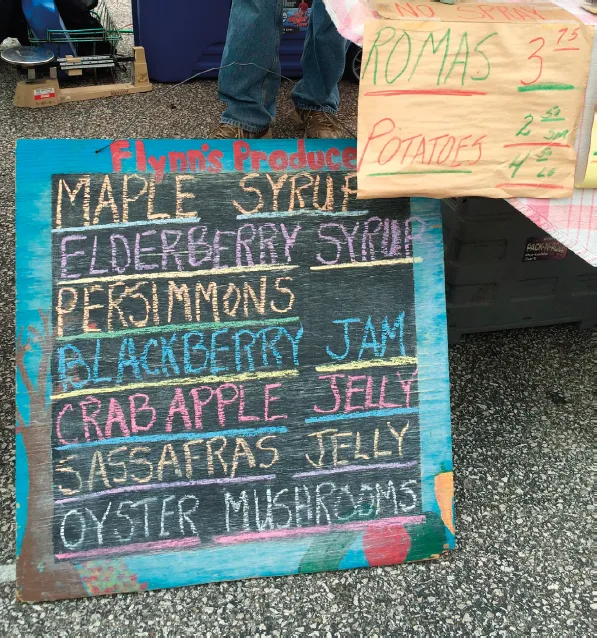
Figure 1.3. Making use of place-based knowledge, this vendor markets wild edibles of the south-central Indiana landscape. Photograph by Jennifer Meta Robinson
However, the environmental benefits of buying and selling local can be overstated. The costs and consequences of buying locally but out of season can be substantial. Winter lettuce that is field-grown in California but shipped to New York City may be more environmentally sound than choosing lettuce that is sourced closer to Manhattan but grown in a heated greenhouse.23 On the other hand, flying pineapples from Hawaii or melons from Argentina in January may never make environmental sense. In addition, sometimes smaller-scale growing can be less efficient than larger operations—by requiring more land or chemical inputs to grow a given quantity of food.24 To decide if local is environmentally sound requires considering seasonality and efficiencies of scale.
What Counts as Local?
On the surface, localism seems to be all about proximity—what is sourced nearby has more appeal than what is transported from far away. But defining local in terms of distance turns out not to be very definitive, even among its advocates. Noted author Barbara Kingsolver and her family experimented with eating locally f...
Table of contents
- Cover
- Title Page
- Copyright
- Dedication
- Contents
- Acknowledgments
- Introduction
- 1 Why Local and Why Now?
- 2 Understanding Farmers’ Markets
- 3 Understanding Community Supported Agriculture
- 4 What’s Next in Local Food?
- 5 Growing Capacity
- 6 A Systems Approach to Local Food
- Conclusion
- Bibliography
- Index
Trusted by 375,005 students
Access to over 1.5 million titles for a fair monthly price.
Study more efficiently using our study tools.
Frequently asked questions
Yes, you can cancel anytime from the Subscription tab in your account settings on the Perlego website. Your subscription will stay active until the end of your current billing period. Learn how to cancel your subscription
No, books cannot be downloaded as external files, such as PDFs, for use outside of Perlego. However, you can download books within the Perlego app for offline reading on mobile or tablet. Learn how to download books offline
Perlego offers two plans: Essential and Complete
- Essential is ideal for learners and professionals who enjoy exploring a wide range of subjects. Access the Essential Library with 800,000+ trusted titles and best-sellers across business, personal growth, and the humanities. Includes unlimited reading time and Standard Read Aloud voice.
- Complete: Perfect for advanced learners and researchers needing full, unrestricted access. Unlock 1.5M+ books across hundreds of subjects, including academic and specialized titles. The Complete Plan also includes advanced features like Premium Read Aloud and Research Assistant.
We are an online textbook subscription service, where you can get access to an entire online library for less than the price of a single book per month. With over 1.5 million books across 990+ topics, we’ve got you covered! Learn about our mission
Look out for the read-aloud symbol on your next book to see if you can listen to it. The read-aloud tool reads text aloud for you, highlighting the text as it is being read. You can pause it, speed it up and slow it down. Learn more about Read Aloud
Yes! You can use the Perlego app on both iOS and Android devices to read anytime, anywhere — even offline. Perfect for commutes or when you’re on the go.
Please note we cannot support devices running on iOS 13 and Android 7 or earlier. Learn more about using the app
Please note we cannot support devices running on iOS 13 and Android 7 or earlier. Learn more about using the app
Yes, you can access Selling Local by Jennifer Meta Robinson,James Robert Farmer in PDF and/or ePUB format, as well as other popular books in Politics & International Relations & Sustainable Development. We have over 1.5 million books available in our catalogue for you to explore.