A collection of essays examining the underlying causes of 2011's Arab uprisings in Tunisia, Egypt, Bahrain, Syria, and Yemen.
The 2011 eruptions of popular discontent across the Arab world, popularly dubbed the Arab Spring, were local manifestations of a regional mass movement for democracy, freedom, and human dignity. Authoritarian regimes were either overthrown or put on notice that the old ways of oppressing their subjects would no longer be tolerated. These essays from
Middle East Report—the leading source of timely reporting and insightful analysis of the region—cover events in Tunisia, Egypt, Bahrain, Syria, and Yemen. Written for a broad audience of students, policymakers, media analysts, and general readers, the collection reveals the underlying causes of the revolts by identifying key trends during the last two decades leading up to the recent insurrections.
"This is easily the best volume on the Arab uprisings yet published. The material is very strong and accessibly written, providing rich background on the political and economic contexts in the region prior to the uprisings as well as after the events of 2011 unfolded, based on substantive knowledge. . . . Ideal for students, policymakers, and general readers." —Jillian Schwedler, University of Massachusetts
"For anyone trying to understand the processes of popular revolt and mechanisms of repression,
The Arab Revolts is a good place to start." —Anthropology of Contemporary Middle-East and Central Eurasia
"This excellent collection of articles from
Middle East Report provides an unusually deep and wide analysis of the phenomena collectively known as the Arab Spring. . . . The articles are well written and accessible to students, as well as to general readers, and hold much interest to specialists in Middle East politics as well." —Review of Middle East Studies
"The editors of this exceptionally well-conceptualized collection have chosen writings that complement each other well. Each section begins with the present-day situation, and the subsequent essays describe the historical background of mass protests. At the end of each section is a writing that connects the historical themes back to the modern protest movements." —
Against the Current
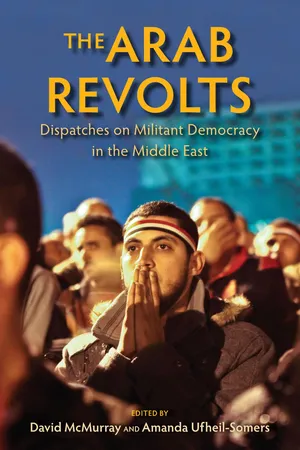
eBook - ePub
The Arab Revolts
Dispatches on Militant Democracy in the Middle East
- 272 pages
- English
- ePUB (mobile friendly)
- Available on iOS & Android
eBook - ePub
The Arab Revolts
Dispatches on Militant Democracy in the Middle East
About this book
Trusted by 375,005 students
Access to over 1.5 million titles for a fair monthly price.
Study more efficiently using our study tools.
Information
Topic
HistoirePART TWO
EGYPT
“The people want the fall of the regime!” Over the course of eighteen days in January-February 2011, Egyptians made this slogan world-famous. In Tahrir Square in downtown Cairo, and in cities and towns across the country, millions of Egyptians rose up to demand the resignation of Husni Mubarak from the presidency, an office he had occupied for thirty years. Improbably, and after many twists and turns, they succeeded. Though the fuse of Arab revolt may have been lit by the events in Tunisia, it was the fall of Mubarak that fanned the flame.
Much of the groundwork for the Egyptian revolt was laid during the previous eight years of labor, student, and peasant strikes. Labor activism in Egypt has a long history, but a wave of strikes during the 2000s inaugurated a new era of militancy among Egyptian workers and professionals. Wildcat strikes in both public and private companies won a variety of concessions on pay, worker safety, and pension benefits. The cumulative pressure of thousands of strikes in a few short years led the state to raise the monthly minimum wage by 400 percent in 2010—though at $70, it was barely subsistence-level income. This period also saw the founding of four independent trade unions, signaling an important break with the state-run Egyptian Trade Union Federation.
The early 2000s also saw an increase in political demonstrations against the Mubarak regime’s relationship to Israel and the United States in response to the wars in Afghanistan and Iraq, the physical re-occupation of the West Bank by the Israeli military, and Egypt’s participation in the blockade of Gaza. These issues united diverse coalitions of activists including students, professionals, labor, and Islamist groups. A mass protest held in Tahrir Square against the invasion of Iraq in 2003 was a key precursor to the Square’s occupation in 2011. Anti-war and Palestine solidarity activism spawned the Kifaya movement and other groups whose focus became domestic political reform.
As demonstrations took on an anti-government flavor, they were met with riot police and arrests. Yet the Mubarak regime tolerated a high degree of public dissent compared to other authoritarian regimes in the region. Egypt enjoyed a surprising level of press freedom and general access to media. There was little internet censorship and independent journals, magazines and satellite stations proliferated, though certain red lines limiting criticism of the government were enforced. Protests were usually confined to private spaces like universities and mosques, but the regime also worked to manage public demonstrations that did not target Mubarak or the government in order to give such frustrations a controlled outlet.
None of this relative openness negates the fact that Egypt was, and remains, a police state. Activists and journalists were arrested and tortured. The Interior Ministry oversaw a complex of police and intelligence agencies that dominated daily life, often by collecting protection money from local businesses, running drugs, and generally preying upon the population. The ministry also hired baltagiyya (plainclothes thugs) to terrorize protesters, intimidate voters, and otherwise supplement the organized violence of official security forces. Egypt’s military, though an important element of regime power, operated with a degree of independence from Mubarak and his National Democratic Party (NDP). Many military officers were local power brokers capable of waiving compulsory military service or easing interactions with the state for the right price.
The law was another tool of repression under Mubarak, used to cudgel dissenting political voices and to institutionalize the power of the executive branch. Civil society groups were heavily restricted by laws controlling their funding and the nature of their operations. Anti-terrorism laws gave cover to the regime’s attacks on Islamist groups such as the Muslim Brothers. (At other times, such as when the regime needed help containing popular protest, the Brothers often proved willing partners.) Constitutional amendments that strengthened Mubarak’s power and undercut opportunities for political pluralism passed the NDP-dominated parliament easily. Egypt’s semi-independent judicial branch provided a measure of resistance against the regime’s aggressive legislating, but successful suits were rare and relied on a constitution drafted under Mubarak’s predecessor Anwar al-Sadat.
An important legal victory for the opposition was mandated judicial supervision of elections beginning in 2000. Even with oversight, elections in Egypt were heavily scripted affairs: Sham opposition parties, ballot stuffing, and barricaded polling stations were par for the course. The only real opposition group in terms of popular base and organizational capacity was the Muslim Brothers, which was officially illegal. Brothers still managed to run for local and parliamentary elections as independents, and in 2005 won an unexpected eighty-eight seats (about 19 percent) in the People’s Assembly. After this upset, the regime ensured that the 2010 elections returned a more definitive victory for the NDP, with the party and its “independent” affiliates winning 90 percent of seats in the lower house.
Presidential elections in Egypt were one-candidate referendums until 2005. During the first multi-party poll, the same irregularities and interventions that characterized parliamentary elections returned almost 90 percent of the vote for Mubarak. The next presidential election was to be held in May 2011, with Mubarak expected to run again. From the late 1990s forward, there was also speculation that Mubarak’s son, Gamal, was being groomed to replace his father in the presidential palace. Gamal was integrated into the government and ruling party in various economic advisory roles, and was the public face of the regime’s campaign of privatization and economic restructuring. Public distrust of Gamal was thus not motivated only by fear that Egypt might become a jumlukiyya (republico-monarchy), like Syria under the Asads, but also of the continuing neoliberalization of the economy that had impoverished so many in the preceding two decades.
Structural adjustment policies and privatization schemes begun under President Sadat and expanded under Mubarak left most Egyptians suffering from rising prices and stagnant or falling wages. Cutbacks in government spending weakened the public education and health systems, increasing costs for families. Price supports for staples such as bread and fuel shrank continuously. Unemployment compensation ended in the early 1990s at a time when over 8 percent of Egyptians (at the official, undoubtedly deflated rate) were without formal work. Unemployment only twice dipped below that rate over the next twenty years. State-owned companies were sold at a steady clip, with 40 percent of public enterprises fully or partially privatized between 1993 and 1999. Privatization of land for industrial agriculture and real estate development saw the consolidation of large tracts of land under wealthy families and corporations, both domestic and international. Traditional commons such as the lakes of the Nile Delta have also been subject to various enclosure schemes. Many of these reforms redounded to the benefit of high-ranking NDP members, the military (which operates a variety of industrial, energy, shipping, and real estate companies) and the business elite, while millions of ordinary Egyptians fell deeper into poverty.
The prospects for democratic reform in post-Mubarak Egypt are yet unknown. The military council that took power after Mubarak’s departure moved to insulate its authority from any elected government through unilaterally-applied constitutional amendments that weaken the presidency and give the military veto power over the new national charter. The military was not able to engineer the presidential election of June 2012 for its preferred candidate, but the Muslim Brothers’ acceptance of a largely disempowered presidency may be a more decisive victory in legitimizing the brass’s backstage governing.
7. THE PRAXIS OF THE EGYPTIAN REVOLUTION
If there was ever to be a popular uprising against autocratic rule, it should not have come in Egypt. The regime of President Husni Mubarak was the quintessential case of durable authoritarianism. “Our assessment is that the Egyptian government is stable and is looking for ways to respond to the legitimate needs and interests of the Egyptian people,” said Secretary of State Hillary Clinton on January 25, 2011.1 With these words, Clinton gave voice to a common understanding of Egypt under Mubarak. Government officials, pundits, and academics, foreign and domestic, thought the regime was resilient—not because it used brute force or Orwellian propaganda, but because it had shrewdly constructed a simulacrum of politics. Parties, elections, and civic associations were allowed but carefully controlled, providing space for just enough participatory politics to keep people busy without threatening regime dominance.
Mubarak’s own party was a cohesive machine, organizing intramural competition among elites. The media was relatively free, giving vent to popular frustrations. And even the wave of protest that began to swell in 2000 was interpreted as another index of the regime’s skill in managing, rather than suppressing, dissent. Fundamentally, Egypt’s rulers were smart authoritarians who had their house in order. Yet they were toppled by an eighteen-day popular revolt.
Three main explanations emerged to make sense of this conundrum: technology, Tunisia, and tribulation. Technological analyses celebrated young people who employed new media to defeat a stolid autocrat. By the second day of the Egyptian uprising, CNN correspondent Ben Wedeman was calling it a “very techie revolution.” In the following days, every major news outlet framed the uprising as the work of wired, savvy twenty-somethings awakening the liberating potential of Facebook, Twitter, and the writings of American intellectual Gene Sharp. “For the world’s despots, his ideas can be fatal,” asserted the New York Times of Sharp.2 A second category of explanation credited the Tunisian people’s ouster of Zine El Abidine Ben Ali in mid-January with supplying a shining example to follow. Esam Al-Amin notes that the Tunisian revolution “inspired Egyptians beyond the activists or elites.”3 A third theorem focused on the many tribulations afflicting Egyptians, particularly soaring commodity prices, positing that hardship finally pushed the population to rise up against oppression. “Food: What’s Really Behind the Unrest in Egypt,” one Canadian newspaper headlined its story.4
None of these explanations are false. All of them correspond to interpretations of events forwarded by the participants themselves. And each has an impeccable intellectual pedigree, harkening back to two influential traditions in the study of popular collective action. One is the dramaturgical model, identifying a cast of self-propelled characters, armed with courage and a new consciousness, who then make an uprising. The second is the grievance model, by which an accumulation of social troubles steadily diffuses among the population and finally reaches an unforeseeable tipping point. The two models call attention to distinct but equally important forces: specific actors and generalized complaints. But both are oddly without context. Because aggrieved and heroic people exist under every type of political system, the models do not explain when such people will band together to challenge the conditions they deplore.
Egypt’s momentous uprising did not happen because Egyptians willed it into being. It happened because there was a sudden change in the balance of resources between rulers and ruled. Mubarak’s structures of dominion were thought to be foolproof, and for thirty years they were. What shifted the balance away from the regime were four continuous days of street fighting, January 25-28, that pitted the people against police all over the country. That battle converted a familiar, predictable episode into a revolutionary situation. Decades ago, Charles Tilly observed that one of the ways revolutions happen is that the efficiency of government coercion deteriorates. That decline occurs “when the character, organization, and daily routines of the population to be controlled change rapidly.”5 The organization and daily routines of the Egyptian population had undergone significant changes in the years preceding the revolt. By January 25, 2011, a strong regime faced a strong society versed in the politics of the street. In hindsight, it is simple to pick out the vulnerabilities of the Mubarak regime and arrange them in a neat list as the ingredients of breakdown. But that retrospective temptation misses the essential point: Egyptians overthrew a strong regime.
Strong Regime, Strong Society
Like his predecessors, President Husni Mubarak deployed the resources of a high-capacity state to cement his power. He handily eliminated all threats to his rule, from a riot police mutiny in 1986 to an armed Islamist insurgency in the 1990s to an over-ambitious deputy, Defense Minister ‘Abd al-Halim Abu Ghazala, whom he sacked in 1989. He presided over the transformation of the economy from a command model with the state as primary owner to a neoliberal model with the state as conduit for the transfer of public assets to cronies. He introduced an innovation to the Egyptian authoritarian tradition as well, attempting to engineer the handover of presidential power to a blood relative, rather than a military subordinate. To manage social opposition to these big changes, Mubarak used the political arena to coopt critics and the coercive apparatus to deal with those who would not be incorporated.
Opposite this wily regime stood an ostensibly weak and fragmented society. Echoing the regime’s own arguments, workers’ protests, rural riots, electoral struggles, and any other forms of popular striving were explained away as economic, not political; local, not national; and defensive, not proactive. The little people had no politics. Thus spoke the political scientist and Mubarak loyalist ‘Ali al-Din Hilal to a US diplomat, who in a 2009 cable reported that Hilal said, “Widespread, politically motivated unrest was unlikely because it was not part of the ‘Egyptian mentality.’” Independent academics shared his view: “There could be a poor people’s revolt if the state fails to provide food. But we must bear in mind that Egyptians rarely explode and then only in specific cases, among them threats to their daily bread or national dignity.”6
The reality was that Egyptians had been practicing collective action for at least a decade, acquiring organizational experience in that very old form of politics: the street action. Egypt’s streets had become parliaments, negotiating tables, and battlegrounds rolled into one. To compel unresponsive officials to enact or revoke specific policies, citizens blockaded major roads with tree branches and burning tires; organized sit-ins in factory plants or outside ministry buildings; and blocked the motorcades of governors and ministers. Take this small event in the logbook of popular politics from January 2001, one of forty-nine protest events recorded that year by just one newspaper. Workers at the new Health Insurance hospital in Suez held a sit-in to protest the halt of their entitlement pay. State security officers and local officials intervened, prevailing upon the authorities to reinstate the pay and fire the hospital director.7 By 2008, there were hundreds of such protests every year, big and small. In June 2008, thousands of residents in the fishing town of Burg al-Burullus blocked a major highway for seven hours to protest the governor’s abrupt decision to halt the direct distribution of flour to households. Police used tear gas and batons to disperse demonstrators, and ninety people were arrested.8
If one classifies Egypt’s protests by the type of mobilizing structure that brings people out into the street, rather than the content of their claims, three sectors are salient,...
Table of contents
- Cover
- Title
- Copyright
- Contents
- Acknowledgments
- Introduction
- I. Tunisia
- II. Egypt
- III. Yemen
- IV. Syria
- V. Bahrain
- Contributors
- Index
Frequently asked questions
Yes, you can cancel anytime from the Subscription tab in your account settings on the Perlego website. Your subscription will stay active until the end of your current billing period. Learn how to cancel your subscription
No, books cannot be downloaded as external files, such as PDFs, for use outside of Perlego. However, you can download books within the Perlego app for offline reading on mobile or tablet. Learn how to download books offline
Perlego offers two plans: Essential and Complete
- Essential is ideal for learners and professionals who enjoy exploring a wide range of subjects. Access the Essential Library with 800,000+ trusted titles and best-sellers across business, personal growth, and the humanities. Includes unlimited reading time and Standard Read Aloud voice.
- Complete: Perfect for advanced learners and researchers needing full, unrestricted access. Unlock 1.5M+ books across hundreds of subjects, including academic and specialized titles. The Complete Plan also includes advanced features like Premium Read Aloud and Research Assistant.
We are an online textbook subscription service, where you can get access to an entire online library for less than the price of a single book per month. With over 1.5 million books across 990+ topics, we’ve got you covered! Learn about our mission
Look out for the read-aloud symbol on your next book to see if you can listen to it. The read-aloud tool reads text aloud for you, highlighting the text as it is being read. You can pause it, speed it up and slow it down. Learn more about Read Aloud
Yes! You can use the Perlego app on both iOS and Android devices to read anytime, anywhere — even offline. Perfect for commutes or when you’re on the go.
Please note we cannot support devices running on iOS 13 and Android 7 or earlier. Learn more about using the app
Please note we cannot support devices running on iOS 13 and Android 7 or earlier. Learn more about using the app
Yes, you can access The Arab Revolts by David McMurray, Amanda Ufheil-Somers, David McMurray,Amanda Ufheil-Somers in PDF and/or ePUB format, as well as other popular books in Histoire & Théorie et critique de l'histoire. We have over 1.5 million books available in our catalogue for you to explore.