Once a thriving, multiracial community, the Sophiatown suburb of Johannesburg was home to many famous artists, musicians, and poets. It was also a place where residential apartheid was first put into practice with forced removals, buildings bulldozed, and the construction of new, cheap housing for white public employees. David Thelen and Karie L. Morgan facilitate conversations among today's Sophiatown residents about how they share spaces, experiences, and values to raise and educate their children, earn a living, overcome crime, and shape their community for the good of all. As residents reflect on the past and the challenges they face in the future, they begin to work together to create a rich, diverse, safe, and welcoming post-Mandela South Africa.
- 202 pages
- English
- ePUB (mobile friendly)
- Available on iOS & Android
eBook - ePub
About this book
Information
1 Getting Acquainted with Neighbours on the Block
On a Sunday afternoon, 7 June 2009, 13 residents of the southern end of Good and Gold streets came together in a park that joined their two streets to discuss how they could get to know each other better and how together they might build a community on their streets that could better meet their needs. Seventeen days later, on the evening of 24 June 2009, 13 residents of Bertha Street convened at the nearby NG Kerk to discuss the same concerns.
The two meetings were the first fruits of a collaboration between University of Johannesburg organisers and Sophiatown residents. The initial meeting was organised by Judi Bennett and Clement Baai, residents of Good Street, and Dave Thelen and Tom Chapman, then coordinators of field work for the UJ Sophiatown Project. Judi and Clement distributed fliers inviting their neighbours to the Good and Gold streets meeting. Tom and Dave approached residents of Bertha Street as they arrived home from work in the evenings and invited them to the Bertha Street meeting. The organisers told residents that the conversations would centre on what people liked and disliked about life in Sophiatown, how they wanted to reshape that life and how they could get to know their neighbours better.
When the conversations began, few of the participants knew each other. Some had lived for decades in Sophiatown. Others had moved there quite recently. With Dave facilitating, the conversations revolved around concerns about getting to know neighbours better and making a difference in shaping the community’s future. Residents took the conversations in several different directions. Some spoke of their intimate hopes and fears about staying here. Others referred to how personal experiences in the nation and Sophiatown had shaped their perspectives on life here. They brought up experiences and perspectives they shared as well as those they disagreed about. But by the end of both two-hour meetings, most participants said that they felt that the conversations had brought them closer together and they looked forward to carrying this further at future meetings.
Block Group Meeting
Good and Gold Streets
7 June 2009*
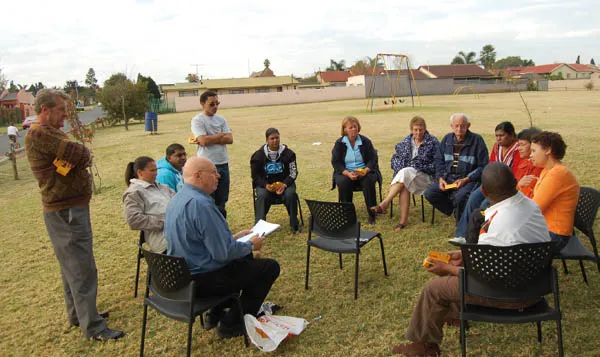
First meeting of Good and Gold streets block group
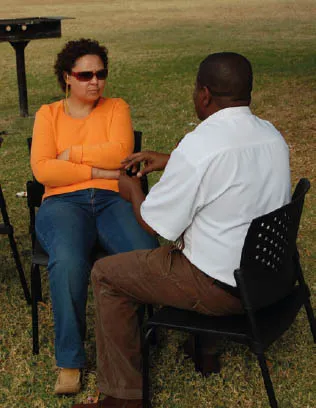
Elise and Clement in small group conversation
Dave Thelen: You’ve been talking with each other in small groups. Can you report now what you discussed in your group about what struck you as important when you were thinking about moving or leaving here, what you like about life here, what is less attractive?
Judi Bennett: Sarel, you and I have just about had the entire discussion without the microphone so we will have to start over again.
Sarel van der Berg: We moved in here about 1973. It’s a beautiful place to stay in. You could go to the shops and leave your door open. We did leave it open and nothing happened. Triomf was Telkom’s area. Most of the blokes in Telkom stayed in Triomf. Other owners were the police and bus drivers.
Elise: Clement and I spoke about how long we both have lived here and what we would like to see in the area, like a community centre – a recreation place for kids, adults, a library, that type of thing – where you don’t have to go out of the area to other areas to enjoy those facilities, but you can actually have it in the area.
Dave: And were there things you specifically liked here?
Clement Baai: We came from different areas. I said to Elise that my reasons for moving here were number one, affordability, number two, the place is very central. It’s quite safe. Look, there are some incidents, we heard about a few incidents, but it’s quite safe. And then also the history of this place.
Dave: What do you mean by that?
Clement: Look, we know how Sophiatown happened. We know it was Sophiatown first, Triomf, then again Sophiatown. We know about the Miriam Makebas, the Desmond Tutus. We know that this was the area where all the races lived together. And I just found out a few years ago that my house was a photo studio. We never knew, you understand. I was saying that you guys are walking on holy ground here. We know that Meadowlands people are coming from here. A certain part of Westbury and Newclare was born out of Triomf/Sophiatown. So I was saying to Bashni that a gathering like this is good in a sense that one of my daughters is in her son’s class. We’ve never formally introduced each other. Today we’ve met, you understand. And then through this gathering, our children are going to benefit. When I’m not here, if Auntie Bettie sees someone standing here in front of my gate, she should say, “Heya, what are you doing here? Clement is not here. Who are you?” I just found out the lady at the corner house passed away a month ago. I only found out a week after. When I went to go sympathise, the man said, “I didn’t know who to tell in the street.” Which is so sad.
Dave: Does that sound familiar to others?
Mervyn Naidoo: As Clement said we feel the same way. We’ve got kids in the same class and the same school, but we don’t know each other. There is no communication. Nobody wants to take the time to get to know your neighbour. We are four years in this area. What we found is that a lot of the white folks in the area are unfriendly. When we greet them they don’t greet back. It’s sad.
Judi: Well, Sarel and Bettie were talking about the old days when this park was a place their children played, with the little cars and etc. and what I noticed here is you don’t see that any longer. Inherently we are very similar and we would like to live our lives as they lived in Triomf and the areas I lived in. We have similar things in common. It seems that because we lived in different areas we have not found the common ground we have. I would also like to see the children play safely. I would like to see the children play in the street; and in the same way, I would like to see what Sarel saw in the past happen all over again, irrespective of the colour of the child. It just has to be the community that you want to see, the way you remember it.
Dave: How do you remember it? The same way?
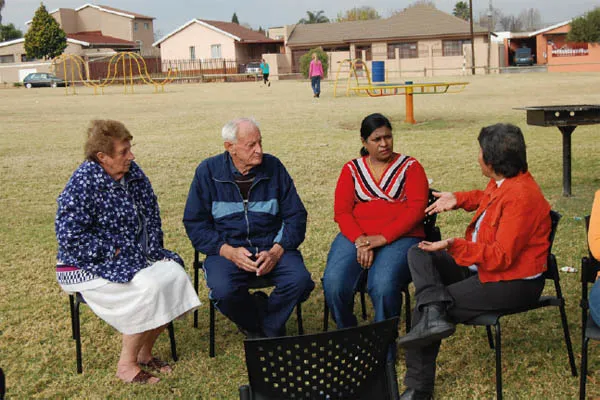
Sarel and his wife, Malie Moodliar and Judi in small group conversation
Bettie Pretorius: The same way as it was. We lived here now 28 years in this house. To me it’s still the same except the children can’t play outside. And now they can’t play rugby in the field.
Mervyn: The kids are scared of the hooligans. I wouldn’t allow our kids out of the gates if I’m not here. They play with the bikes on the road and it’s safe, but if we see the hooligans on the road we take them back in.
Clement: I was just saying to Elise about three weeks ago I came past here and there was a group of 15 school children sitting here. Boys and girls and they were drinking. I chased them away. The thing is they are not even from this area. So our children can’t come and play here. And then they have the audacity to say to me, “It’s my money. I bought the liquor with my money.” But the thing is, they won’t be allowed to go and buy. They get someone else to buy it for them. I believe that it is the car guards. These are the type of things that we must come up against. We can’t allow people to come and sit here. Look at this thing. Someone was sitting there and drinking.
Mervyn: We see it all the time. My neighbour, the pastor, gets his boy and comes and cleans up and it’s not right.
Judi: Whose responsibility is that in a sense? Firstly it’s against the law to drink in public, so we could have called the police. We could have had people make sure this is a no-go area. This is a park and this is what is allowed in a park. I think sometimes we tend to see things but don’t take responsibility. I want to stress the aspect, until we got to know each other, we didn’t know who was going to do it. Now that we do know each other we need to take responsibility for our own area, be a bit more proactive. These things don’t need to happen. I believe if those children know there is an area that those aunties and uncles are going to give you a hard time, they are going to avoid it. We take ownership of it. As adults we shouldn’t neglect our responsibility to teach children that what you are doing is wrong. Whether they accept it or not we still have to try.
Mervyn: I have actually tried to do that once when they abused the swings and they told me, “It’s not yours, go away.” You don’t want a confrontation because the parents can shoot you.
Judi: Now you mention something about someone going to take out a gun and shoot you; and we carry on living in this particular mindset. We also pass that on to our children. We become more and more drawn in, blocked in, and we are always afraid. Besides, if the guy came with a gun, ons moer and bliksem and donner. Take the gun away.
Mervyn: At the same time the neighbour doesn’t want to take a chance either.
Judi: That’s why we need to get to know each other. It’s not a matter of you just getting to know your neighbour. It’s sometimes a matter of seeing another person in the same way that you would see yourself and treat each other in the same way that you would want to be treated. And you find the old fashioned cliché, respect breeds respect. By knowing each other, we get to understand each other. Let’s go a little further.
Elise: It’s safer not to get involved but then you are going to let things happen.
Judi: But if you teach that to your child we’re going to eventually live in communities where everything is bricked in. We are going to have to press our fingers to open the gate. We will be bricked in. You might as well close down the park area and we’re not going to do anything about it because we’re not getting involved.
Mervyn: But the thing is we can’t do it alone.
Judi: No, I agree, and that is why we have to do it as a forum. He spoke about so many things that we’re not aware of. We didn’t know there was a committee in this area. So ba...
Table of contents
- Cover
- Half title
- Title
- Copyright
- Contents
- Map of Sophiatown
- Acknowledgments
- Introduction to the US Edition
- Chapter 1: Getting Acquainted with Neighbours on the Block
- Chapter 2: Visualising a Shared Place and Making a Shared Past
- Chapter 3: Making Family around Mealtimes
- Chapter 4: Becoming Neighbours and Creating Community
- Chapter 5: Experiencing Change
- Epilogue
Trusted by 375,005 students
Access to over 1.5 million titles for a fair monthly price.
Study more efficiently using our study tools.
Frequently asked questions
Yes, you can cancel anytime from the Subscription tab in your account settings on the Perlego website. Your subscription will stay active until the end of your current billing period. Learn how to cancel your subscription
No, books cannot be downloaded as external files, such as PDFs, for use outside of Perlego. However, you can download books within the Perlego app for offline reading on mobile or tablet. Learn how to download books offline
Perlego offers two plans: Essential and Complete
- Essential is ideal for learners and professionals who enjoy exploring a wide range of subjects. Access the Essential Library with 800,000+ trusted titles and best-sellers across business, personal growth, and the humanities. Includes unlimited reading time and Standard Read Aloud voice.
- Complete: Perfect for advanced learners and researchers needing full, unrestricted access. Unlock 1.5M+ books across hundreds of subjects, including academic and specialized titles. The Complete Plan also includes advanced features like Premium Read Aloud and Research Assistant.
We are an online textbook subscription service, where you can get access to an entire online library for less than the price of a single book per month. With over 1.5 million books across 990+ topics, we’ve got you covered! Learn about our mission
Look out for the read-aloud symbol on your next book to see if you can listen to it. The read-aloud tool reads text aloud for you, highlighting the text as it is being read. You can pause it, speed it up and slow it down. Learn more about Read Aloud
Yes! You can use the Perlego app on both iOS and Android devices to read anytime, anywhere — even offline. Perfect for commutes or when you’re on the go.
Please note we cannot support devices running on iOS 13 and Android 7 or earlier. Learn more about using the app
Please note we cannot support devices running on iOS 13 and Android 7 or earlier. Learn more about using the app
Yes, you can access Building a New South Africa by David Thelen,Karie L. Morgan in PDF and/or ePUB format, as well as other popular books in History & African History. We have over 1.5 million books available in our catalogue for you to explore.