"The most robust defense of historical counterfactuals to date . . . For those interested in this fascinating subject, Black's book is indispensable."—
Publishers Weekly (starred review)
What if there had been no World War I or no Russian Revolution? What if Napoleon had won at Waterloo in 1815, or if Martin Luther had not nailed his complaints to the church door at Wittenberg in 1517, or if the South had won the American Civil War? The questioning of apparent certainties or "known knowns" can be fascinating and, indeed, "What if?" books are very popular. However, this speculative approach, known as counterfactualism, has had limited impact in academic histories, historiography, and the teaching of historical methods.
In this book, Jeremy Black offers a short guide to the subject, one that is designed to argue its value as a tool for public and academia alike. He "demonstrates that, in skillful hands, counterfactual history is more than just fun; as one ingredient among many, it can be an extremely fertile source of explanation" (
History Today).
"[Black's] illustrative examples of 'what if' 'how,' and 'why' will make readers sit back and wonder."—
Kirkus Reviews
"With a unique methodology, Black performs a what-if analysis of history to show how little it takes to change the world's fate . . . This book provokes thought and speculation while also entertaining."—
Foreword Reviews
"A sparkling defense of the legitimacy and utility of counterfactual history?of what ifs?and the best single work on its subject available."—
Weekly Standard
- 254 pages
- English
- ePUB (mobile friendly)
- Available on iOS & Android
eBook - ePub
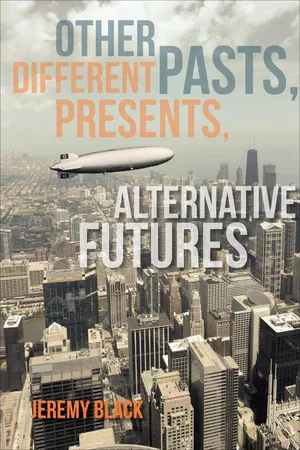
Other Pasts, Different Presents, Alternative Futures
About this book
Information
1
INTRODUCTION
It was the meteorite that landed in the Western Approaches to the English Channel on the night of June 5–6, 1944, that doomed the long-planned Anglo-American invasion of Normandy. No fleet, especially one with heavily laden landing-craft, could have survived the resulting tidal wave, which was funneled up the Channel to devastating effect. By leaving the Germans in control of France, the total failure of this invasion attempt enabled them to concentrate on resisting the advance of the Red (Soviet) Army and to do so beyond April 1945 when Berlin might otherwise have fallen. As a result, the United States had the opportunity in August 1945 to drop on Berlin one of the two atomic bombs that were ready. The U.S. needed to do so to show that it could play a major role in overthrowing Hitler. However, with no Anglo-American ground forces yet in Germany, the Soviets were able, amidst the ruins of the Nazi regime, to occupy most of it. A Cold War frontier on the Rhine followed, as did a Communist bloc benefiting from the resources and capacity of the Ruhr industrial belt and from the revival of the German economy after World War II.
Well no. The idea of the “meteorite that ate D-Day” is not very helpful. A meteorite could have landed then, and its impact would have been totally devastating; the same being true for example of the British forces under General William Howe preparing to land on Staten Island in July 1776, launching the campaign to regain control of the Thirteen Colonies. Storms that were not due to meteorites, but that were seen as providential by the successful defenders, wrecked a Chinese invasion of Japan in 1274, and badly damaged Spanish fleets sent against Algiers in 1541 and England in 1588.
In the case of possible meteorites, as opposed to storms, in 1776 and 1944, it is not particularly helpful to discuss such possibilities as they were not considered by contemporaries, nor, indeed, were they at all probable. There were no signs that such possibilities affected planning. In contrast, weather forecasting did affect planning, with the British getting the forecasting at least partly wrong, whereas the Germans correctly forecast the poor conditions but drew the wrong conclusion that the Allies would not risk an invasion in choppy seas.1
A crucial value of counterfactualism is that it returns us to the particular setting of uncertainty in which decisions are actually confronted, made, and implemented. The meteorite theory is not helpful as it does not illuminate this uncertainty. There is no comparison, for example, between such counterfactuals for 1776 and 1944, and considering the more plausible counterfactual of the Soviet Union not attacking Japan (as it in fact did in 1945) and the effect upon the Allies’ war with Japan, both in 1945 and subsequently.
Counterfactualism—conjecturing on what did not happen in order to understand what did, or, more precisely, the use of conditional assertions based on what is known not to have occurred—thus entails, or should entail, the disciplines of scholarship.2 This is the case whether we are considering specifically crafted counterfactuals or the way that historians use counterfactuals as part of the “tools of the trade.” Research to establish contemporary choices, and parameters and constraints, and informed analysis to assess them, are crucial, not least to the idea that “What was” and “What is” each incorporate “What might have been.” The question “why,” which is basic to history, cannot be adequately addressed without at least evaluating untaken roads.
More generally, discussions of historical causation are implicitly counterfactual, because they make assumptions, even though not usually articulated, as to what would have happened without the cause discussed. Aside from its role in history, counterfactualism also has a place in other disciplines, such as philosophy, sociology, political science, economics,3 theology, geography, and literature, although they lack history’s ability to act as a major subject of popular discussion as well as an academic discourse. In all subjects, counterfactuals offer a valuable logical tool, as well as play an important role in extending the grounded imagination.
As with other historical methods, however, there is no barrier in counterfactualism to less rigorous approaches, as all too many conversations in bars will reveal. These conversations about counterfactualism are relatively unhelpful, other than for establishing the content of public speculation. That might sound snooty or snobbish, which is not the intention, for this speculation, however misguided, is itself a matter of considerable interest as it can be a valuable guide to the public mood and can play a significant role in rumors.4 The interest in counterfactuals, indeed, might be seen as an instance of the more general practice of history, with an iceberg tip (professionals would argue) of more rigorous study above a large base of historical beliefs and interests held and pursued every day.
This situation is a reminder that counterfactualism is a tool, capable of use in many contexts, rather than a position or a school of thought. Indeed, a discussion of varied options and likely outcomes is frequently one of the ways in which past, present, and future are understood, explained, and, as it were, advocated. Humans seem powerfully inclined to explore counterfactual ways of reasoning: like family history, there is a genuine constituency for it. As a consequence, these processes are a matter for discussion by historians.5
Politicians repeatedly tap into counterfactual speculation when they ask voters to imagine different pasts, presents, and futures. Thus, in the 2008 campaign for the Democratic nomination for president, Barack Obama pressed Americans to envisage a Washington without lobbyists or a United States without poverty, while Hillary Clinton, his leading rival, warned them about inexperience when her advertisement asked voters, “Who do you want answering the phone?” in the middle of the night if there were a national emergency.6 The issue of inexperience represents a projection onto the unknown future of the situation in the present, a situation derived from the impact of the past. In turn, these concerns about the future provide a way to approach the present-day situation. Politicians communicate with the electorate in terms not only of what might and could be, but also of what might and could have been. Polling and policy presentation are linked to these alternatives. Moreover, psephology, the science of voting, draws heavily on counterfactuals.
All historians need to remember first that those in the past did not know what was going to happen, while we do, at least to a considerable extent, albeit an extent that varies greatly by individual and group. On the other hand, those in the past thought they knew what might happen, including what did not, while we do not know these thoughts, except indirectly through studying their records, which are frequently incomplete or nonexistent. Thus, part of our job should be trying to think of what possible outcomes were open at the time, in order to understand the thinking of those in the past, and, thereby, the reasons for how they acted. Counterfactualism provides a means to express real dilemmas, and understand both unfulfilled aspirations and lost moments of genuine crisis.
Linked to this is the consideration of the uses real historical actors have made of counterfactuals in order for us to explore not only their assumptions but also their political (and other) maneuvering. Counterfactuals, indeed, play an important role in political maneuvering and posturing,7 specifically with the calculation of the likely moves and responses of others. This use of counterfactuals is taken further with the subsequent reconstruction by historical actors of their choices in the light of what actually did happen. A choice that works out, even if made for the wrong reasons, is then justified based on the results. Similarly, as with Tony Blair’s justification in 2014 of the 2003 invasion of Iraq, a choice that comes out badly is reconstructed and excused or criticized, perhaps as determined by a more limited range of choices than in fact really existed when the choice was made. This very natural tendency to revise the history of individual choices in light of the results seriously complicates the historian’s inquiry into historical decision making. An understanding of the options available therefore is important to the historian. The discussion of these options in terms of counterfactuals is both central to the evaluation of choices and policies, and natural.
The capacity for choice itself is a characteristic of the human species, with the developed frontal lobes providing the opportunity for the exercise of this facility. One of the defining human characteristics, and a fundamental human activity, is also the ability to imagine things otherwise than they are. This is achieved in part by detaching oneself from the here and now, and thereby conceiving of both past and future, or, rather, pasts and futures.8 These processes are linked, as memory helps humans plan for the future, including how best to respond to future outcomes. The capacities employed in anticipating the future are broadly similar to those used when remembering the past (and amnesiacs tend to lose both). This is unsurprising as similar parts of the brain are activated.9
Such activity does not entail strain, but rather an imaginative effort. Counterfactualism, both by those directly involved and by others, can be seen as an aspect of this effort, not least because considering alternative pasts helps explain the past and, thus, fix memory. Counterfactualism in terms of alternative expositions is also an aspect of the close relationship for humans between history and story, and unsurprisingly so because of humans’ interest in, and need for, telling stories as a way to process experience.10
Counterfactualism is not simply a subject of the past. It is as much the topic of discussion and planning now about both present and future. Indeed, in one respect, counterfactualism is an aspect of the process by which cultures produce versions of reality that prepare us for, protect us from, or conceal the social reality just ahead in what we call the future.11 The concept of premediation, defined by Richard Grusin in 2010 as an anticipation, not by “getting the future right” ahead of time, but “by making futurity present,” is relevant.12 Thus, some products of culture, including counterfactual works but also those that lack any explicit or implicit counterfactual element, anticipate, and seek to anticipate, what will be the issues of the future.13 Counterfactualism is about futurology as well as about considering the past; and aside from conceptual and methodological parallels, both are linked. Much of the methodology and vocabulary associated with the counterfactual approach take on their potency precisely because they are not employed solely for discussion about the past, but, instead, take a more central role in consideration of the future. Business planners assess the nature of the market, psephologists consider the result of the next election, strategists consider how best to implement policy and to plan for policy choices, and so on. The exposition of alternative explanations about the past and present provides a key means of considering possible future trends.
A good example is provided by those, debating military procurement, who focus on possible threat-environments. For example, criticizing, in 2008, the British plan for two big aircraft carriers for the Royal Navy, Sir Michael Quinlan, permanent undersecretary of state at the Ministry of Defence from 1988 to 1992, accepted a counterfactual—“Recovering the Falklands [in 1982] would have been impossible without them,” continuing, “But the scenario where carriers are essential is narrow.” He subsequently offered both the cost-benefit analysis frequently seen in counterfactual exercises and the attempt to rank alternatives—albeit, as is generally the case, through assertion as much as clarification:
Without the US, an operation dependent upon carriers yet not too tough for us has to fit a tight specification. . . . The task must be one that cannot be done, in the 2020s and 2030s, by systems such as unmanned aircraft [drones]. . . . And the operation must be so important to Britain that we cannot stand aside, as we have done for many conflicts.
No one can prove that this scenario could never arise. But against its likelihood and importance we have to weigh its costs. . . . Abandoning the carriers would be painful for the Royal Navy, constituency and industrial interests, and procurement relationships with France. But in hard times for defence these are secondary considerations. The prime criterion must be strategic utility as compared with alternative resource uses.14
In the event, the option of canceling the carriers was in large part foreclosed by the high cancellation costs written into the contracts that were signed, allegedly in order to satisfy the constituency interest of the then prime minister, Gordon Brown. These costs helped ensure that the incoming government did not abandon the project.15 Quinlan’s use of the past (in the shape of drawing attention to the fact that Britain has stood aside in many conflicts) in order to support an assessment for the future is common, and reflects on the somewhat misleading nature of attempts to divine the future from the past. Moreover, it is instructive to see the stance adopted by a former senior civil servant who had been heavily involved in planning.
From such perspectives of present practicality, the likely consequences of past counterfactuals, for example of the Romans not invading and conquering much of what became Britain in the first century AD, may seem inconsequential and a distraction. Maybe so, but counterfactualism highlights the thesis that the most important lesson to learn from the past is indeterminacy;16 and, therefore, that history is of value precisely because it can teach this lesson. That approach to history is a major theme of this book. The emphasis on indeterminacy can be combined with an argument about the very difficulty of knowing the past.17
There is also a serious danger with counterfactualism, and one that has encouraged some of the bitter criticism that has been made of the process. It is all too easy to transform the “What if?” into “If only,” and to employ the latter to encourage a nostalgic approach that urges, explicitly or implicitly, a rewriting of the past in order to make another version seem not only possible but also, in part as a result, legitimate and desirable. Thus, aside from entertainment, the past becomes an aspect of present discontents and battles, feeding into a divisive empowerment through historicized grievance.
A good current example of this rewriting is provided by the regret, voiced and encouraged by Vladimir Putin and his allies in the 2000s and 2010s, about the collapse of the Soviet Union in 1990–91.18 In their counterfactualism, Russia would have been stronger, and Eurasia more stable—from their point of view—had this collapse not occurred. This assertion is then e...
Table of contents
- Cover
- Half title
- Title
- Copyright
- Dedication
- Contents
- Preface
- List of Abbreviations
- 1 Introduction
- 2 A Personal Note on Life and Times
- 3 Types of History
- 4 Power and the Struggle for Imperial Mastery
- 5 The West and the Rest
- 6 Britain and France, 1688–1815
- 7 Counterfactualism in Military History
- 8 Into the Future
- 9 Skepticism and the Historian
- 10 Conclusions
- 11 Postscript
- Notes
- Selected Further Reading
- Index
Trusted by 375,005 students
Access to over 1.5 million titles for a fair monthly price.
Study more efficiently using our study tools.
Frequently asked questions
Yes, you can cancel anytime from the Subscription tab in your account settings on the Perlego website. Your subscription will stay active until the end of your current billing period. Learn how to cancel your subscription
No, books cannot be downloaded as external files, such as PDFs, for use outside of Perlego. However, you can download books within the Perlego app for offline reading on mobile or tablet. Learn how to download books offline
Perlego offers two plans: Essential and Complete
- Essential is ideal for learners and professionals who enjoy exploring a wide range of subjects. Access the Essential Library with 800,000+ trusted titles and best-sellers across business, personal growth, and the humanities. Includes unlimited reading time and Standard Read Aloud voice.
- Complete: Perfect for advanced learners and researchers needing full, unrestricted access. Unlock 1.5M+ books across hundreds of subjects, including academic and specialized titles. The Complete Plan also includes advanced features like Premium Read Aloud and Research Assistant.
We are an online textbook subscription service, where you can get access to an entire online library for less than the price of a single book per month. With over 1.5 million books across 990+ topics, we’ve got you covered! Learn about our mission
Look out for the read-aloud symbol on your next book to see if you can listen to it. The read-aloud tool reads text aloud for you, highlighting the text as it is being read. You can pause it, speed it up and slow it down. Learn more about Read Aloud
Yes! You can use the Perlego app on both iOS and Android devices to read anytime, anywhere — even offline. Perfect for commutes or when you’re on the go.
Please note we cannot support devices running on iOS 13 and Android 7 or earlier. Learn more about using the app
Please note we cannot support devices running on iOS 13 and Android 7 or earlier. Learn more about using the app
Yes, you can access Other Pasts, Different Presents, Alternative Futures by Jeremy Black in PDF and/or ePUB format, as well as other popular books in History & History of Education. We have over 1.5 million books available in our catalogue for you to explore.