A study of how the world is experienced through Christian philosophy and phenomenology.
How does Christian philosophy address phenomena in the world? Felix Ó Murchadha believes that seeing, hearing, or otherwise sensing the world through faith requires transcendence or thinking through glory and night (being and meaning). By challenging much of Western metaphysics, Ó Murchadha shows how phenomenology opens new ideas about being, and how philosophers of "the theological turn" have addressed questions of creation, incarnation, resurrection, time, love, and faith. He explores the possibility of a phenomenology of Christian life and argues against any simple separation of philosophy and theology or reason and faith.
"Ó Murchadha makes abundant and timely references to the philosophical tradition from Plato through Heidegger, but also, perhaps more so, to the post-Heideggerian developments sometimes considered together and at once as "the theological turn" in phenomenology. He is equally at home in the Christian theological traditions from Paul to Barth and von Balthasar." —Jeffrey Bloechl, Boston College
"The book is engaging, well-written and, from this reviewer's point of view, generally convincing. It constitutes an impressive and original contribution to both the philosophy of religion and has very much to offer to those interested in phenomenology and phenomenological analysis." —
Modern Theology
"As an explication of how Christian belief can transform the meaning of the world . . . this book shows its greatest worth. Here it does as compelling a job as any in bringing out the novelty of Christianity before it became overly familiar and overwritten." —
Philosophical Quarterly
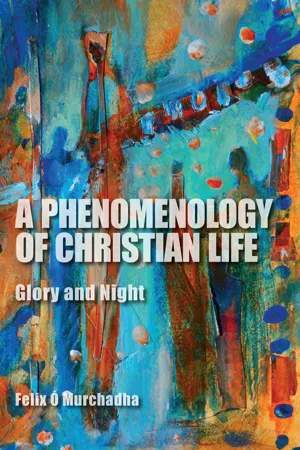
- 272 pages
- English
- ePUB (mobile friendly)
- Available on iOS & Android
eBook - ePub
About this book
Trusted by 375,005 students
Access to over 1.5 million titles for a fair monthly price.
Study more efficiently using our study tools.
Information
Topic
PhilosophySubtopic
Phenomenology in Philosophy1 Desire and Phenomenon
ONLY WHERE THERE is desire for the phenomenon is existence a question. ‘Existence’ is the rupture of essence, where the nature of a being is a subsequent narration of its prior vocation and mission. Existence ruptures essence where phenomena seduce. Existence is vocational, is being led forth and led out by the call of the phenomenon. Existence is desire. Existence is not needy; an existent does not preserve itself but sacrifices itself through the vulnerability of its being in the face of the radiance of phenomena. Existence is being toward an other. No being fully exists, no being can fully be toward, can fully be as being called by the phenomenon. But, conversely, to be is to exist, to be at all is to be vulnerable toward the seductive power of phenomena.
Existence is threatened by degradation and tempted by dissolution. In its material being it is bound by endless drives to satiation which threaten to anaesthetize it in a limbo of self-forgetfulness; its spiritual being is tempted toward a Gnostic escape in angelic peacefulness. In both trajectories existence loses itself.1 In its being-called, existence finds itself in worldly movement; the hierarchical structure of worldly being, however, depresses it. The worldly hierarchy is an order of attachments, which depresses existence by binding it in its needful valuations to possession.2 Desire for the phenomenon discloses a place in the world beyond the hierarchies of the world: a being in the world, but not of the world. It is a place of mission, where the affirmation of self is subject to the acceptance of a sending (missere).
Phenomenon names the primordial attraction of entities for desire. Phenomenon is the happening of that entity for an existent. This primordial attractiveness is beauty fundamentally and pre-hierarchically.3 Beauty draws out love and inspires praise. Love of beauty is fundamental to education; only through love can an existent be led out (ex-ducere) to things. Education begins there, begins with the beauty of the phenomenon. In appearing, the phenomenon appears as itself; as itself, in its self-revealing form, the phenomenon is beautiful.4 Appearance as appearance is beauty. The appearance of a thing is that thing as it calls, as it allows itself to be called (named).5 In appearing, the thing gives its name, not as a tool for signification, but rather as a word to be said in reverential praise. Desire is the response of praise. Appearing to existence, the phenomenon mutely utters a greeting and in such greeting calls its own name, and in invoking that name existence does not apply a general concept, but addresses it with words which are proper names. Desire speaks in proper names. In placing its tongue around the word it responds to the phenomenon in its beauty. Desire, love, and education all belong inseparably to the seduction of the phenomenon.
Phenomenon is singular, worldly, yet non-hierarchical. Phenomenology as the logos of phenomenon is a discourse unlike any other. It speaks not to describe, propose, command, or promise. It speaks rather to invoke the hidden source, the original epiphany, of appearance. That source is prior to language, as it expresses without concepts; it is prior to the self of the existent, as it calls that self forth, and this priority is temporal, is that of a time which is the source of chronological time. Phenomenology in order to speak this source requires therefore a triple dispossession of language, of self, and of time. This triple dispossession is phenomenology as desire. In desire it responds to the gift of phenomenon which is not outside language, time, and self, but outside each understood as possession. Phenomenology in that sense neither describes nor prescribes, it prays.
Phenomenology as prayer—is this not a contradiction, is this not to place phenomenology beyond logos? But prayer is logos under epoché—logos which is neither true nor false (Aristotle, De Interpretatione, 4.17a3–4). The language of phenomenology is neither affirming nor negating, because it lets that which appears appear in-itself. The in-itself is not subject to statements, but subjects them. The in-itself appears only in words of praise, and such praise is originary logos. With this logos science begins, i.e., with the desire to see things appear as they are—as they are in and of themselves; reason in its claim to self-sufficiency both hides and discloses this desire: in seeking grounds, it stops only before that which needs no grounds, the causa sui. The question, ‘what is ‘x’?,’ is already derivative. Indeed, the question as interrogation is already a fall from existence as desire. Before the question, appearance is calling for question. But this calling is a calling to be questioned as it is. To be questioned as it is is to be questioned in no other terms than what this calling reveals itself to be. This is revelation in the full Judeo-Christian sense. Appearance as revelation is responded to by “let thy will be done” and more fundamentally by “hallowed be thy name.”
This chapter will explore the inner relation of phenomenon and existence as desire. The first section will discuss existence and desire. The second section will explore beauty in relation to existence manifest as faith and mission. The third section will go on to show how existence understood as desire is conceived in a Christian and non-Platonic sense. The final section will discuss the mode of discourse about phenomenon and existence and show that this discourse is beyond the dichotomy of philosophy and theology.
Existence and Desire
Existence is a Christian term,6 because it expresses the irreducibility of a being to its essence. The existent—the being understood in respect of this irreducibility—stands forth in and of itself and is responsible for itself.
Existentia first translated huparzis and was defined in line with the etymology of the latter prae-existens substantia, pre-existing substance. But while such pre-existing substance may be present in god, to the extent to which there is existence outside of god such existence is only in relation to a source which it cannot make present. Existence is always belated; it refers to that which was never present to it and to which as such return is in principle impossible. However, this immemorial source is significant to it not through a nostalgic longing—as this source is not simply lost, but never possessed—but rather as a movement from the source which it discovers in itself. To exist is to have always already been moved; an existent is a being-affected. This being-affected is experienced in desire. To desire is to be moved prior to any decision or any choice. It is to experience the phenomenon as that toward which I am moved. Action is the taking up—or refusal to take up—this movement. Such a taking up (or its refusal) reveals a source which is prior to me, prior to any freedom, which, far from negating such freedom, first makes it possible. Understood not in abstraction as an absence of determination—an impossible concept—but rather as the movement of existence, freedom knows itself as a gift.7 As a power to initiate which does not initiate itself, freedom is the experience of capacity in incapacity. Freedom discloses itself thus as the power of the epoché, the power of suspension in the movement of desire itself, of movement toward the world without being possessed by the world.8 But such suspension is not primarily of belief in the being of the world, but rather suspension of my need for the world. If belief is in play here (and in the next section we will see to what extent it is), it is a belief in the being of the world as that which satisfies my needs. Such a belief, however, does not see the phenomenon, sees nothing beyond itself. In desire the existent experiences itself in relation to that which moves and affects it, but is always too late to capture the source of its being affected. That source shines through the phenomenon, but does so precisely by withdrawing from sight. In such a withdrawal the phenomenon places itself out of play and in the same moment places the needy self of the existent out of play. The epoché here effected is a mutual withdrawal of existent and phenomenon within the movement of desire. The reduced existent desires. But such a desire in responding to the phenomenon in its withdrawal sees not the world as its correlate, but rather an excess of world in the world. Nothing in the world can satisfy desire, not because it is insatiable, but because it is not hungry:9 desire is not appropriative and as such moves beyond the proper of self and of world. Desire moves toward that which, in the self-giving of the phenomenon, gives itself by putting itself out of play in terms of the economy of the world.
What is not put out of play, though, is existence itself. In putting the economy of the world out of play existence reveals itself to itself as play. No longer taken up by the world, existence finds itself there for no worldly reason, but as a unique opening toward the world. This opening is given as being put in play.10 In this sense, existence finds itself in a movement which it must accept. Existence is this acceptance, an acceptance of a free movement which it can neither initiate nor complete. But no existent can persevere in such constant acceptance (in the postlapsarian condition with the exception of the incarnate godman, that is at least the Christian claim), and must constantly lapse into refusal.11
As Heidegger tells us, existence is ecstatic,12 is being toward: toward other people and other things. This movement is a movement in the world, but as a movement of desire it comes back to itself in the epoché, comes back to an interiority that turns away from the world. Such a turning is modesty. In modesty the existent turns its body from the world not out of disgust, but rather in a self-reflexive movement of desire. Modesty states, as Mounier puts it, “my body is more than my body.”13 My body turned toward the world, my body which can serve another's need, is less than my body; my body exceeds such need, my body desires and can be desired.14 In this sense modesty must be clearly distinguished from shame. In shame existence discloses itself not in its excess, but in its nothingness, i.e., its being held captured by the gaze which sees the existent in its body as nothing more than a function of its need. Shame is a feeling of lack of worth in relation to an imperious gaze, which lays claim to the whole of the existent;15 it is overcome not primarily through a reversal of the transcending act of the other's gaze (as for Sartre), but by a reassertion of modesty through the (literal or metaphorical) wrapping oneself in clothes. Such a clothing of oneself is not so much an attempt to hinder the other's gaze, but to excite the other's desire in place of the appropriative drive of his needs.16 Immodesty too, which itself can be a self-clothing in response to shame,17 as the throwing of the essentially hidden toward the light18 hides itself in its very self-exhibition.
The intimacy of my being becomes shared with another, however, in love, where two turn together from the world into the interiority of their own privacy, their intimacy à deux. Here modesty gets slowly stripped away as the two strive to become one flesh. As one flesh they share a common turning from the world and show the world a common exteriority, hiding from the world their shared carnal being.19
An existent which experiences itself in modesty—or in its immodesty—is one for whom a turning away from the world is constitutive of its being. But such a turning is not from the world tout court, but from the superficial exteriority of beings in the world existing as mere beings of the world. This turning is a movement of wakefulness.20
Existence can be wakeful or slumbering. An existence which is only one of need slumbers. This is so because to exist in need alone is to exist toward the other in the homogeneity of the existent's own being. For such an existence the other is nothing except what serves its own ‘interests.’ But even those interests are not present to it because they are prescribed in the spontaneity of its own being. While other entities are nothing to it except as they satisfy its needs, it too is nothing to itself outside of the systems of relations in which it is inscribed. In that sense the slumber of existence does not equate with an absence of consciousness or self-consciousness.21 A conscious existent lost in the satisfaction of its own need is slumbering though conscious. Wakefulness is attentive, attending—waiting (attendre)—on its ‘object’ such that it reveals itself to itself as being attentive. While consciousness loses itself in its object—is consciousness of its object—existence awakes in the experience of desire. Without desire the directedness of existence toward phenomena is one which informs phenomena. That which appears is ‘informed’ by the one grasping it. As such ‘information’ is never new, nor does it come from without; rather it is that with which slumbering existence impregnates phenomena in order in turn to appropriate them to itself. An existence which lives off information is one which can be found in the rocks in the riverbed, the trees in the forest, and in the Internet café. It is an existence for which appearance is two-dimensional, without depth. Depth is only in the self-appearance of that which appears, that is, an appearance in excess of the surface of its appearance. It is the resistance to any in-forming, which existence only encounters when its desire for that self-appearance is excited. When it is so excited it encounters the appearing in its appearance not at the surface of its being, but as a depth which cannot be informed, as that which hides itself from the world.
But for the most part existents relate to entities within relations of need. No being in the world is without need, that is, without relation to other entities for its being. ‘Substantial difference’ is generated out of such relations—this is what the revolution in science from Galileo to Darwin has taught us from physics to biology. The essence of a being is formed by that need, and in that sense every essence is itself relational, is itself a function of the relation of beings to one another. Need functions within systems of information. The properties of food (calories, fat content, carbohydrates, etc.), for example, are absorbed within an organism and pass information to that organism, which fulfill or fail to fulfill its needs. The more sophisticated the being the more relations of need it enters into. The apogee of this we find in the human being, for whom the earth and all upon it functions as information, as fulfillment of need. In that sense the human being is in essence—but not in existence, not in desire—all that is.
Desire is possible only in the relaxation of need: a being directed toward its needs is blind to the call of the phenomenon: its essence swallows up its existence. It is for this reason that ascetics attempt to limit their needs toward nil in order to feel desire completely.22 Desire responds not to the apparent in the phenomenon, but to that which hides. In giving itself, a being precisely turns itself away, hides itself behind the apparent. To be a self is to be modest. Desire is for this self, for the self-revealing of its own hiddenness. Existence as desire responds to such modesty and in that response the only attitudes possible are prayerful reverence or blasphemous obscenity. Desire is reverential because it encounters that which appears in the excess of its appearance; its obscene, blasphemous violence is a fleeing from this reverence.23
In desire, existence is wakeful; it is attentive to the self-revelation of the other and in turn sees itself in its own reverential attitude as an existent. In desiring the other being in itself, the existent understands its existence as submission to the other. In its being sent toward the other and below the other, it experiences itself as subject to the other. Only through subjection can it be in the presence of the self-giving of the other, a self-giving which is complete precisely to the extent to which the self remains hidden. The wakefulness of existence is one which is attentive to an origin which can never be retrieved, to an origin which remains beyond its powers and which it cannot see, but for which it is seen.
If wakefulness is attention, is a reverential dispossession in the face of appearance, then the wakeful existence is ultimately that of the person. In Mounier's words: “Personal being is generosity.”24 Personal being opens itself up to the other. Generosity is the response of desire. The person is not the mask of the theatre, not the purely external disguise through which the voice speaks (persona), but rather the openness to the other being in its appearance. This openness is one of self-giving which sacrifices the self not in the sense of annihilating it, but rather in the sense of allowing the other being to come to speech through it. Generosity is speaking not to affirm or assert oneself, but to bring the other to appearance also for itself: to allow the other—and not alone the other ‘person,’ but anything—to reveal the articulation of its own being.
Desire is for the being in itself, in its self-revelation. Self-revelation is revelation of the self in its own manifestation of being. To be a self is to be in a singular way. It is then the being of the being, that which makes it what it is, which appears and which leads forth the desire of the existent: in each case singular, attracting desire. Clearly we cannot here be talking of generalizable properties. The curves of a woman's body may attract my desire, but so too the straight lines of a geometrical figure. What attracts desire in each case is different, and that which is generalizable—any woman with such and such curves or any geometrical figure with straight lines—is precisely not that which attracts my desire. In each case it is not the general quality which attracts my desire—at most that can excite my needs. I desire this appearing thing, this appearing person, which expresses itself or herself in and through such and such a quality. Something irreplaceable, at least now at this instance, seduces me in my existence and educates me not about general qualities, not about anything I can delimit in my experience, but rather about that which in my experience transcends that experience and any possible experience.
Desire is toward the transcendent and the singular at once. It is the singular being which attracts and excites desire, but it does so in transcending any particular quality it may have. Particular qualities, empirical objects of consciousness, are generalizable, but as such substitutable. Yet desir...
Table of contents
- Cover Page
- Title Page
- Copyright Page
- Dedication Page
- Contents
- Preface
- Acknowledgments
- Introduction: Christianity and Philosophy
- 1: Desire and Phenomenon
- 2: Light and Dark
- 3: Glory and Being
- 4: Night, Faith, and Evil
- 5: Incarnation and Asceticism
- 6: Creation
- 7: Aion, Chronos, Kairos
- 8: Thinking Night and Glory
- Notes
- Bibliography
- Index
- About the Author
Frequently asked questions
Yes, you can cancel anytime from the Subscription tab in your account settings on the Perlego website. Your subscription will stay active until the end of your current billing period. Learn how to cancel your subscription
No, books cannot be downloaded as external files, such as PDFs, for use outside of Perlego. However, you can download books within the Perlego app for offline reading on mobile or tablet. Learn how to download books offline
Perlego offers two plans: Essential and Complete
- Essential is ideal for learners and professionals who enjoy exploring a wide range of subjects. Access the Essential Library with 800,000+ trusted titles and best-sellers across business, personal growth, and the humanities. Includes unlimited reading time and Standard Read Aloud voice.
- Complete: Perfect for advanced learners and researchers needing full, unrestricted access. Unlock 1.5M+ books across hundreds of subjects, including academic and specialized titles. The Complete Plan also includes advanced features like Premium Read Aloud and Research Assistant.
We are an online textbook subscription service, where you can get access to an entire online library for less than the price of a single book per month. With over 1.5 million books across 990+ topics, we’ve got you covered! Learn about our mission
Look out for the read-aloud symbol on your next book to see if you can listen to it. The read-aloud tool reads text aloud for you, highlighting the text as it is being read. You can pause it, speed it up and slow it down. Learn more about Read Aloud
Yes! You can use the Perlego app on both iOS and Android devices to read anytime, anywhere — even offline. Perfect for commutes or when you’re on the go.
Please note we cannot support devices running on iOS 13 and Android 7 or earlier. Learn more about using the app
Please note we cannot support devices running on iOS 13 and Android 7 or earlier. Learn more about using the app
Yes, you can access A Phenomenology of Christian Life by Felix Ó Murchadha in PDF and/or ePUB format, as well as other popular books in Philosophy & Phenomenology in Philosophy. We have over 1.5 million books available in our catalogue for you to explore.