How and why has government gotten bigger? "Should be a compulsory assignment for any seminar on modern political culture." —
The Journal of American History
American government has evolved over the generations since the mid-nineteenth century. The changing character of these institutions is a critical part of the history of the United States.
This engaging survey focuses on the evolution of public policy and its relationship to the constitutional and political structure of government at the federal, state, and local levels. A new chapter in this revised and updated edition also examines the debate about "big government" in recent decades.
"A marvelous multidisciplinary synthesis that builds on the findings of historians of national, state, and local government, along with those of economists and political scientists, to provide a coherent account of the rise of modern American governing structures." —
Journal of Interdisciplinary History
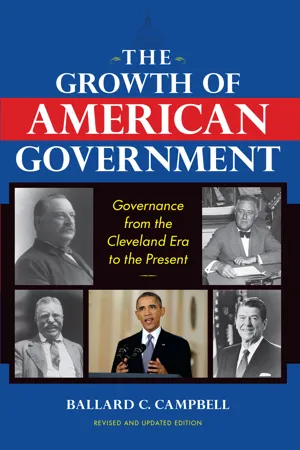
eBook - ePub
The Growth of American Government
Governance from the Cleveland Era to the Present
- 400 pages
- English
- ePUB (mobile friendly)
- Available on iOS & Android
eBook - ePub
The Growth of American Government
Governance from the Cleveland Era to the Present
About this book
Information
1

Governing the Cleveland Era
AMERICANS FACED A PERIL, Grover Cleveland warned in his annual message of 1887. This danger, the president continued, threatened widespread disaster and a “brood of evil consequences.” Phrased in such foreboding terms, the peril must have seemed formidable. The modern mind envisions horrors on the scale of a 9/11 attack or the unchecked spread of a virulent flu. But those were not the kind of hazards that Cleveland saw. His menace was surplus revenue, and the source of the problem was a tariff, which the president repudiated as a “vicious, inequitable, and illogical source of unnecessary taxation.”1
Viewed from our own time, Cleveland’s alarm seems quaint and a bit puzzling. Chronic deficits have been government’s normal way of operating since the 1930s. Modern critics complain about excessive spending and mounting debt. Cleveland fretted about government having a surplus of cash. He recognized that government had to collect some revenue, for no public regime can survive without a reliable income. Benjamin Franklin captured the essence of this truism long ago in his observation that “nothing is certain but death and taxes.”
Cleveland may have overdramatized government’s affluence, but he wasn’t an impulsive alarmist. His reputation rests solidly on his caution and integrity. These qualities appealed to Democratic politicians, who nominated him for president on three successive occasions, and to voters, who elected him to the White House in 1884 and 1892. Assumptions about government in those years contrasted markedly with attitudes prevalent in our time. Examination of these older ideas helps to make sense of Cleveland’s apprehension of surplus revenue. A good place to begin is with the president’s own analysis.
The abundance of dollars in the Treasury, Cleveland argued in his 1887 annual message, tempted “unnecessary and extravagant appropriations” and stimulated “a habit of reckless improvidence not in the least consistent with the mission of . . . our Government.” To this the president added a more specific objection. The surplus subtracted from private flows of funds in the “channels of trade.” Turning the Treasury into a “hoarding place” also increased pressures to deposit public funds in commercial banks. Both uses of money were bad because they promoted “too extensive a commingling” of private and public interests. “The functions of our National Treasury,” Cleveland explained, “should be few and simple.”
The president also disliked the method by which the tariff raised public funds. Tariffs were taxes on goods imported from other countries. These levies applied to some four thousand different items at the time that Cleveland denounced tariff policy as a “perversion of governmental powers.” According to the president, these duties overcharged consumers for the “necessaries of life” under the guise of protecting American producers from foreign competition. Cleveland did not oppose private enterprise or even tariffs per se. He objected to using the tariff to favor special interests. The tariff, he explained, tempted local and selfish groups to devise schemes of “public plunder that were . . . reckless of the welfare of the entire country” and rewarded them with immense profit. The charge that uses of public power bestowed special favoritism was not new in 1887. The criticism was a staple of America’s traditional political philosophy.
Cleveland ended his annual message, unique in its exclusive focus on a single issue, with a plea to Congress for lower tariff rates. If they put patriotic duty before partisanship, lawmakers could reform the tariff, he predicted. Congress did not sidestep the subject. The House of Representatives heard 151 speeches strung over fifty-one days on the Mills bill, which contained the Democrats’ version of tariff reform. Leading Republicans, including future president William McKinley, took turns ridiculing the president’s “free trade” position. Protective tariffs, they trumpeted, created national wealth, raised American wages, transformed potential foreign profits into Treasury receipts, and thus promoted the glory of the nation.2 Yet in the end the debate may not have changed a single vote. Democrats marshaled all but two of their slender majority in the House to pass the Mills bill over united Republican opposition.
Returning to work after the 1888 election, senators took up the tariff issue with as much partisan ardor as their colleagues in the House had exhibited. The clerk called the roll of senators 112 times for recorded votes on tariff questions, most of which were amendments on specific items, ranging from duties on brooms, bricks, and bibles to taxes on macaroni, matches, and marble. Repeatedly, Republicans united against a solid phalanx of Democrats. Even the motion to put Bibles on the “free” list engendered a straight party-line vote. Eventually, Senate Republicans enacted their own bill, which the House ignored as the 50th Congress closed. The president had suffered a double defeat, both by razor-thin margins. He failed to win tariff reform and he saw the presidency slip away to a Republican. His successor, Benjamin Harrison (1889–1893), went on to approve record-high tariff duties.

A thousand miles west of Washington, where cows and corn dominated the Midwestern landscape, another political storm brewed. There, Republicans had thrown down a challenge: “Iowa has no compromise with the saloon,” they stated flatly in their 1887 state platform. The Grand Old Party had labored through the 1880s to rid the Hawkeye state of Demon Rum, yet increasingly stiffer prohibition (antiliquor) laws had failed to board up the saloons. Many Iowans continued to visit illicit holes-in-the wall for a glass of beer or harder spirits. Enforcement of the state antiliquor rules hinged on local support. Where Germans and Irish abounded and the Democrats had strongholds, county sheriffs winked at violations of the law. Republicans expressed outrage at these transgressions. “True Americans are law-abiding,” the Republican governor thundered, implying that Democrats were not. Democrats refused to concede the point. The problem, they retorted, lay with fanatical prohibitionists who sought to impose their own code of values on others and had pressured Republicans into serving as their political front. The American way, Democrats said, was personal liberty and local self-rule.
These charges and countercharges reverberated in the state capitol at Des Moines throughout the 1880s. Prohibition had the state on edge, yet neither political party wavered in its position on the issue. Republicans argued that standards of community decency justified uniform social regulation. In the absence of comprehensive control the saloon would fester as the incubator of anarchy and harlotry. Democrats rejected statewide codes of morality, which they said trampled the principle of local self-determination. Although the sustained intensity of Iowa’s struggle over liquor was rarely matched elsewhere, the question divided policy makers in most states during the Cleveland years.3 And it percolated down to the very foundation of the American political order—the cities, towns, and villages.
Arlington, Massachusetts, was one of these communities. Situated seven miles northwest of Boston, Arlington was a small rural town about to blossom into a bedroom suburb. The catalyst of this metamorphosis was the electric trolley, which first went into commercial operation the year that Cleveland attacked the tariff. Two years later the machine came to Arlington, laying a convenient transportation link to Boston via the intervening city of Cambridge. The trolley unleashed a building boom in Arlington, as developers turned vacant land into affordable homes for buyers and renters. The lure of living in quiet spaciousness within commuting distance of jobs in the city caused the town’s population to triple to 15,000 by 1915. The new suburbanites flooded into a community that had taken its stand against the saloon. Massachusetts law allowed localities to decide the fate of alcoholic beverages, and Arlington voted by a two-to-one margin in 1887 to keep the dramshops out of town. Arlingtonians stuck with their decision for over a century.
The tracks that cut through the heart of Arlington traversed unpaved and often muddy streets. Most roads in America of the Cleveland era were in similar or worse condition. As Congress debated the tariff in the spring of 1888, farmers in Wisconsin were leveling ruts left by fall rains, winter ice, and narrow-gauged wagon wheels. Under state law each of Wisconsin’s 1,300 towns (the smallest unit of general-purpose government) was divided into road districts under the supervision of a locally elected overseer. Towns levied a road tax on residents, but the law allowed them to satisfy this obligation with a day or so of labor. This latter option was the most popular by far, in Wisconsin as in most of rural America. The working-out system not only allowed farmers to avoid paying road taxes in money, but also afforded an opportunity to catch up on local gossip when neighbors gathered for this spring ritual. It was silly to take this work too seriously, for summer rains and the knifing effects of wagon wheels soon returned the roads to their usual condition.4
City streets were in only slightly better shape. American law allowed municipal residents whose property abutted a thoroughfare to petition city hall if they desired street improvements (such as gravel paving). City officials contracted the job to private firms and billed abutters for the work. Many city dwellers preferred to keep their streets in a pristine state. Besides the financial saving, some urbanites opposed paving for social reasons. Improved streets induced heavier traffic, which was a hazard to children and neighbors who used their thoroughfare for play and socializing.5
Birmingham, Alabama, had a ready supply of workers to keep its streets clean and in repair. City officials bound jail inmates in chains and set them to labor ten hours a day on the streets. Southern justice provided endless candidates for this “free” labor. The police preyed upon the city’s black population and made arrests for petty offenses, such as violation of the city’s vagrancy laws. A vagrant, according to the 1891 ordinance, was a person “who habitually walks and rambles upon the streets at unreasonable hours of the night, or who habitually loafs and loiters about disreputable places.” If this provision seemed vague, the law contained other criteria that translated into the same offense.6
The county sheriff had a personal stake in enforcing justice, Birmingham style. Instead of receiving a salary, sheriffs derived their income from fees for making arrests and fines levied on the guilty. People unable to pay were sentenced to hard labor; convictions for gambling drew a hundred days. The sheriff could lease convicts to coal and iron companies in the county, a practice that the Birmingham police also followed. To keep up with industrialists’ steady demand for cheap labor, the sheriff hired deputies by private arrangement. The chief duty of these assistants was to conduct dragnets among the idle class, as the black community was stereotyped. In Birmingham as elsewhere in Dixie, law was an instrument of oppression of the underclasses.
Chain gangs in Birmingham, the rites of road work in Wisconsin, the spat over liquor in Arlington and Iowa, and the wrangling over tariffs in Washington are remnants of America’s governmental past. These episodes may seem to lack a common thread, but they were manifested facets of the classical pattern of governance in the United States. The political design laid at the country’s founding unfolded around a fundamental idea—that government threatened liberty. Keeping government local and divided was a key to protecting this freedom. Restrictions on uses of civic power was the hallmark of the republican polity.
A republic is a government whose power derives from the consent of the governed. The rationale for locating ultimate political authority in the people arose from the fear of placing all sovereignty in a single ruler, such as a king. Most adherents of republican government believed that vesting power in the hands of self-perpetuating officials inevitably threatened people’s most precious possession, their “unalienable rights.” The axiom that liberty could not survive in an absolute monarchy was conventional wisdom in America when Thomas Jefferson summarized the principles of republicanism in the Declaration of Independence. To document the point, Jefferson listed twenty-seven instances of tyranny by the king of Great Britain. These charges reflected keystones of republican thinking. The Crown had disallowed colonial laws necessary for the public good. He had withdrawn the right of representation in the legislature. He sent “swarms of officers to harass our people,” and he imposed “taxes on us without our consent.” The monarch had denied Americans trial by jury. These transgressions, Jefferson concluded, deprived Americans of “life, liberty, and the pursuit of happiness.”
Americans of the Revolutionary Era believed that rulers were innately inclined to misuse their authority. This proclivity was rooted in human nature, they said, because self-interest tempted governors to appropriate power for personal purposes at the expense of the general good. Government, not private concentrations of power, was believed to be the prime threat to liberty. American independence from English control did not remove this danger. Liberty was at risk in colonial empires as well as in monarchies because the temptation to pervert power was inherent in human behavior. Yet the survival of freedom also required that the government maintain order. Herein lay the dilemma inherent in republicanism: governmental power was both necessary and dangerous.
One solution to this impasse was cultivation of a virtuous citizenry whose civic responsibility was to monitor closely the official exercise of power. But Jefferson and like-minded statesmen counseled an additional safeguard. Republics had to construct their government in such form as would minimize harm to the public good. Three objectives guided their thinking. First, power holders should be made accountable to citizens, principally through the mechanism of regular elections. Second, political power should be divided among several units of government. And third, these arrangements must be anchored in formally written compacts. The process of composing these fundamental charters began in 1776 when Americans transformed their colonies into state governments by adopting constitutions. After a few years of experimentation these first republican governments assumed features that Americans intuitively recognize as parts of democracy: separate branches that allowed checks and balances between power holders, a legislature of two bodies composed of elected representatives, and specific prohibition on uses of power, such as those contained in bills of rights.
These early state constitutions reflected republican insistence on explicit limitations on political power. This principle produced a second equally momentous decision: to divide power among many governments. This dispersion of authority was manifested in the semiautonomous status of each of the original states. The addition of a strong central government in 1787 carried the idea a step further. The authors of the Constitution of the United States, which established the Federal government, sought to create an independent authority that would temper the purported excesses of the state governments and simultaneously guarantee their existence.7 The new national constitution, said James Madison, a major architect of its construction, established a governmental system of mixed nature that contained “many coequal sovereignties.”8 From the start, the American plan of politics provided for two official locations of authority: the states and the general government.
In establishing two tiers of government, the Constitution of the United States offered, in Madison’s opinion, a double security for the rights of the people.9 This federal scheme (or “federalism” for short) did not eclipse the authority of the states, but it did limit it through selective prohibitions. The states were integrated into a jurisdictional arrangement that awarded predominant authority over certain subjects to the central government. This dual allocation of power, which recognized the existence of two centers of political authority and divided civic responsibilities among them, became the structural arch of the republican constitutional order.
Leaders paid homage to the link between federalism and liberty throughout the republican era. “The essential principles of our Government,” Thomas Jefferson said in his 1801 presidential inaugural address, balanced “the support of the State Governments in all their rights, as the . . . surest bulwarks against anti-republican tendencies” with “the preservation of the General Government in its whole constitutional vigor.” Jefferson’s successors in the White House, from Ma...
Table of contents
- Cover
- Half title
- Title
- Copyright
- Dedication
- Contents
- Figures
- Tables
- Preface
- Acknowledgments
- Introduction
- 1. Governing the Cleveland Era
- 2. The Course and Causes of Growth
- 3. The Transition Era
- 4. The Great Depression and Economic Policy
- 5. The Managed Economy since the New Deal
- 6. The New Income Security
- 7. The New Equality
- 8. Paying for Modern Government
- 9. The New Faces of Power
- 10. The Reagan Era and the Restrained Polity
- 11. The Debate over “Big” Government
- Notes
- Bibliography
- Index
Trusted by 375,005 students
Access to over 1.5 million titles for a fair monthly price.
Study more efficiently using our study tools.
Frequently asked questions
Yes, you can cancel anytime from the Subscription tab in your account settings on the Perlego website. Your subscription will stay active until the end of your current billing period. Learn how to cancel your subscription
No, books cannot be downloaded as external files, such as PDFs, for use outside of Perlego. However, you can download books within the Perlego app for offline reading on mobile or tablet. Learn how to download books offline
Perlego offers two plans: Essential and Complete
- Essential is ideal for learners and professionals who enjoy exploring a wide range of subjects. Access the Essential Library with 800,000+ trusted titles and best-sellers across business, personal growth, and the humanities. Includes unlimited reading time and Standard Read Aloud voice.
- Complete: Perfect for advanced learners and researchers needing full, unrestricted access. Unlock 1.5M+ books across hundreds of subjects, including academic and specialized titles. The Complete Plan also includes advanced features like Premium Read Aloud and Research Assistant.
We are an online textbook subscription service, where you can get access to an entire online library for less than the price of a single book per month. With over 1.5 million books across 990+ topics, we’ve got you covered! Learn about our mission
Look out for the read-aloud symbol on your next book to see if you can listen to it. The read-aloud tool reads text aloud for you, highlighting the text as it is being read. You can pause it, speed it up and slow it down. Learn more about Read Aloud
Yes! You can use the Perlego app on both iOS and Android devices to read anytime, anywhere — even offline. Perfect for commutes or when you’re on the go.
Please note we cannot support devices running on iOS 13 and Android 7 or earlier. Learn more about using the app
Please note we cannot support devices running on iOS 13 and Android 7 or earlier. Learn more about using the app
Yes, you can access The Growth of American Government by Ballard C. Campbell in PDF and/or ePUB format, as well as other popular books in Politics & International Relations & Political History & Theory. We have over 1.5 million books available in our catalogue for you to explore.