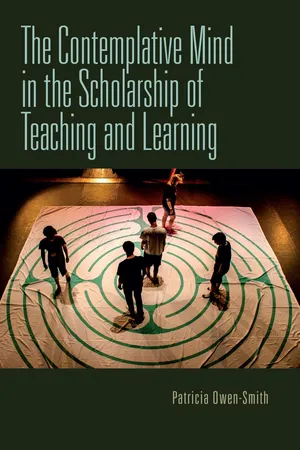
In The Contemplative Mind in the Scholarship of Teaching and Learning, Patricia Owen-Smith considers how contemplative practices may find a place in higher education. By creating a bridge between contemplative practices and the Scholarship of Teaching and Learning (SoTL), Owen-Smith brings awareness of contemplative pedagogy to a larger audience of college instructors, while also offering classroom models and outlining the ongoing challenges of both defining these practices and assessing their impact in education. Ultimately, Owen-Smith asserts that such practices have the potential to deepen a student's development and understanding of the self as a learner, knower, and citizen of the world.
- English
- ePUB (mobile friendly)
- Available on iOS & Android
eBook - ePub
The Contemplative Mind in the Scholarship of Teaching and Learning
About this book
Trusted by 375,005 students
Access to over 1.5 million titles for a fair monthly price.
Study more efficiently using our study tools.
Information
Topic
EducationSubtopic
Higher Education1 A Historical Review
There’s always been a conflict between the exterior, social self and the interior, private one. The struggle to reconcile them is central to the human experience, one of the great themes of philosophy, literature, and art.
—William Powers, Hamlet’s Blackberry
DEFINITIONS OF EDUCATIONAL practices, pedagogy, and epistemology, as well as accompanying criticisms, derive from their respective historical and cultural contexts. Contemplative and SoTL perspectives are no exception. These perspectives’ histories yield critical information and understanding about their place in higher education and their relationship with one another. Contemplative education and SoTL both have ancient roots despite being often considered innovative and new. For example, many of today’s questions, debates, and perspectives about the role of higher education, specifically in current analyses and evaluations of contemplative modes and SoTL, are the same as those that began in ancient Rome. Training for an occupation or profession versus training for personal and intellectual fulfillment; the role, responsibility, and relationship of the university to the broader society; and the place of interior and spiritual dimensions of learning are just a few of the discussions that began many centuries ago. These same debates and questions also frame the integration of contemplative and SoTL modes explored in this chapter.
As noted in the introduction, SoTL began in 1990 with the Carnegie Foundation’s publication of Ernest Boyer’s (1990) Scholarship Reconsidered: Priorities of the Professoriate. Lee Shulman, who followed Boyer as president of the Carnegie Foundation, expanded Boyer’s notion from the scholarship of teaching to the scholarship of teaching and learning. Boyer’s and Shulman’s conceptions of teaching and learning, and later senior scholar Pat Hutchings’s, were the basis for the launch of the Carnegie Academy for the Scholarship of Teaching and Learning (CASTL) in 1998, whose major mission was to support teaching and learning initiatives. While these developments are relatively new, the narrative inherent in Boyer’s and Shulman’s work is one that began over three hundred years ago when attention to and questions about teaching and learning began in the United States (Fuhrmann and Grasha 1983). SoTL is often defined as centered on “problem posing” about an issue of teaching or learning (Cambridge 2000) and constructed around an “ethic of inquiry” and a “taxonomy of questions” (Hutchings 2000, 2, 4). Central to such definitions is the role and significance of “reflective critique” and a “critical self-reflection” that lead to transformative learning (Musolino and Mostrom 2005, 52).
The Center for Contemplative Mind in Society began its development in 1991, giving birth to its academic program in 2008, the Association for Contemplative Mind in Higher Education (ACMHE). However, contemplative education began as early as the fifth century BCE with the Sophists, or teachers of wisdom (Lucas 1994), and flourished in the monastic and cathedral schools of the twelfth century CE. Like SoTL practitioners, contemplative educators describe intellectual examination as “inquiry into the nature of things” (Barbezat and Bush 2014, xiii). Tobin Hart (2004) expands this definition to include how we know as opposed to what we know, and Arthur Zajonc describes contemplative education as a venue for a deeper understanding of subjects and ways of living (Kaleem 2014).
Questions about teaching and learning in the construction of knowledge, therefore, are an integral part of the evolution of higher education and clearly echoed in SoTL and ACMHE. While the elements of and context for questions raised by SoTL and contemplative educators are dissimilar in some important ways, they are nevertheless derived from many shared conceptions of learning as a process of inquiry that is holistic and integrative, and each is circumscribed by criticisms that are, more often than not, similar in tone. Zajonc, former director of the Center for Contemplative Mind in Society, of which the ACMHE is part, and Lee Shulman, former president of the Carnegie Foundation for the Advancement of Teaching, from which SoTL emerged, are remarkably alike in terms of their understanding of the integration of exteriority and interiority in the learning process. Zajonc emphasizes the need for an education that understands the learner holistically:
By seeing the cultivation of human experience as the basis of education, we multiply our ways of knowing (“epistemology”) and enrich our understanding of the world (“ontology”)…. If we could expand the worldview that supports education, we can find no better place to begin than by opening ourselves to the full scope of human experience…. Parallel to the universe of our experience is a comparably rich world of inner experience. Taken together they constitute of world of human experience. (2010, 60–61)
In a somewhat different manner, Shulman also speaks of the significance of the learner’s both internal and external experience in his notion of “serious learning,” or one that is based on the relationship between students’ meaning construction and prior or native understanding:
Any new learning must, in some fashion, connect with what learners already know…. [I]t is what I mean by “getting the inside out.” As teachers, unless we can discover ways of getting the inside out and looking jointly at their prior knowledge with our students, taking seriously what they already know and believe, instruction becomes very difficult. (1999, 12)
These understandings play a critical role in contemplative and SoTL perspectives of teaching and learning. While there is little doubt that SoTL and contemplative education have followed parallel, disconnected trajectories and that their emphases are dissimilar, they have a striking relationship. Both the disconnections between contemplative and SoTL perspectives and their relationship have the potential to deepen what each sees as its central mission and goals. The following exploration of these histories reveals how they have been disengaged from one another and at the same time embedded within one another.
While contemplative practices such as prayer, meditation, and silence are universal and rooted in virtually all spiritual and religious traditions, many of those that endured through time emerged from Asian philosophy and centered on meditative practices. Buddhism and Taoism were developed by intellectuals who were also yogis and contemplatives trained to value knowledge achieved through practices such as ethical discipline, sustaining attention, emotional alteration, and cultivation of wisdom (Walsh 1989). Because Buddhist institutions of higher learning were the most numerous and their educational practices most fully developed, the Buddhist influence on contemplative education was the most profound. The Buddhist study of the mind through the examination of thought, emotion, and consciousness contributed significantly to the methodology and content of the Buddhist “inner sciences” curriculum (Zajonc 2010). Robert Thurman notes that the Buddhist goals of empowerment and liberating transformation in an educational context have remained constant and carefully preserved through the years in the mountains of Tibet (cited in Buell 1999), and they endure in the villages of Southeast Asia. Therefore, a split between monasticism and education did not occur in Buddhist civilizations as it did in the West, and this history becomes important in understanding the circuitous trajectory of the contemplative in Western intellectual inquiry.
In the West, contemplative activity as critical to learning also began in monastic schools and in the Greek philosophers’ notion of insight as the heart of knowledge. However, when European universities established themselves as alternatives to the monasteries and the cathedral schools of the twelfth and thirteenth centuries, a critical shift took place in the curriculum. This shift was intensified with the text-centered emphasis of Renaissance humanism and the evolution of the disciplines associated with the Enlightenment and scientific revolution (Buell 1999). The contemplative curriculum of the monasteries was replaced by one that emphasized logic and science. Contemplative activity at that point became the domain of monastic and religious life and, therefore, separated from the university. Contemplation as an important dimension of inquiry and knowing was considered to be a threat to the integrity of the modern university. Committed students of the contemplative life left the universities of Oxford and Cambridge in search of institutions that provided a contemplative hospitality that for the most part was religious (Stock 2012). Contemplative knowing that centered on interiority, spirituality, empathy, and wisdom was lost in favor of Aristotelian logic, contributing to the split between contemplative practices and academic study that we still see today. Zajonc observes that by the sixteenth century the forces of science and the Industrial Revolution began to shape education in significant ways and led to a “myopic vision of science and industry” (2010, 59).
Shulman (2004b) extends Zajonc’s observation by pointing out that the psychologists and educational theorists William James, G. Stanley Hall, E. L. Thorndike, and John Dewey were the first American scientists to acknowledge internal processes in learning. However, by the turn of the nineteenth century they had succumbed to the influence of C. Lloyd Morgan’s canon of 1894, which moved away from the psychological study of mental processes in learning. This shift transformed the discipline of scientific psychology in America, resulting in James’s definition of psychology as the “science of mental life” (1890, 1) and John B. Watson’s and later B. F. Skinner’s emphasis on the science of behavior. This dismissal of interiority and internality as foundational for learning dominated learning theories during the first half of the 1900s. The consequences of this myopic vision have been profound for academic institutions, resulting in a nineteenth-century perspective of knowledge as objective and education as reducible to teaching students how to manipulate that knowledge. Mirabai Bush refers to this split as producing “a compartmentalized, fragmented way of learning and teaching, a dualistic alienation of body from mind, emotion from intellect, humans from nature, and art from science” (2011a, 223–224). Like Bush, Shulman (2004b) refers to this as an abandonment of introspection in the study of learning.
A few contemplative practices, or a secular spirituality, did exist in early Western intellectual history. Montaigne, Seneca, and Augustine were among the earliest contemplatives in their practice of reflection and self-inquiry. In her review of American contemplative education, Bush notes that William James might well have been the first American contemplative with the publication of his Principles of Psychology (1890) and his position that “the faculty of voluntarily bringing back a wandering attention, over and over again, is the very root of judgment, character, and will…. An education which should improve this faculty would be the education par excellence. But it is easier to define this ideal than to give practical directions for bringing it about” (Bush 2011b, 185).
Two significant occurrences provided fertile ground for more recent developments in contemplative education and SoTL. First, the gradual opening of Tibet that began in the 1970s allowed Western access to the Buddhist inner sciences curriculum in ways that were impossible in previous years. This accessibility offered a methodology for articulation of the contemplative and its integration into classroom practices and resulted in a heightened consciousness regarding social responsibility and citizenship. Interest in the expanded consciousness movement at Harvard in the 1970s (inspired by William James’s writings), a vital element in the development of contemplative education, emerged from this political change. This movement later influenced the work of Daniel Goleman, whose book Emotional Intelligence (1995) became seminal in the academic community, and Richard Davidson, who established the laboratory for functional brain imaging and behavior and the laboratory for affective neuroscience at the University of Wisconsin. In fact, Goleman’s concept of emotional intelligence was central to twenty-seven articles appearing in the Journal for the Scholarship of Teaching and Learning between 2012 and 2015.
While universities such as John F. Kennedy University (founded in 1964), the California Institute of Integral Studies (1968), and Maharishi University of Management (1971) focused on contemplative perspectives, Naropa University, founded in 1974, represents the first academic institution based on a Buddhist vision of contemplative education. Naropa emphasizes three modes of inquiry that make up a contemplative education: traditional academics, or third-person inquiry; experiential learning, or second-person inquiry; and contemplative, or first-person inquiry. In recent years a contemplative curriculum has been integrated into other universities, such as the University of Michigan, Brown University, and Lesley University. They model the integration of Eastern teaching philosophies seen in contemplative education and the Western educational traditions and practices that became the focus of SoTL. The University of Michigan’s Center for Research on Learning and Teaching, the oldest teaching center in the United States, is firmly grounded in SoTL practices. Its program in creativity and consciousness studies, which examines and envisions the relationship between creativity and the growth of consciousness, exemplifies integration of exterior and interior ways of knowing and investigation. The Contemplative Studies Initiative at Brown University is committed to contemplative scientific research through its Clinical and Affective Neuroscience Laboratory, Translational Neuroscience Laboratory, and the Laboratory for Cognitive and Perceptual Learning. Brown has distinguished itself in effectively integrating third-person study with critical first-person study in its teaching methods and in its research labs. Lesley University’s Center for Teaching, Learning, and Scholarship, also informed by SoTL, includes SoTL practices in investigating contemplative dimensions. This center’s Journal of Pedagogy, Pluralism and Practice promotes “interdisciplinary thinking and [encourages] a more diverse dialogue across multiple fields of study.” Many of the articles published by this journal highlight contemplative dimensions of body, mind, spirituality, identity, reflexivity, pedagogical imagination, and moral awareness. Lesley also offers a master’s degree and a graduate certificate in mindfulness studies.
Several of today’s signature pedagogical practices in higher education also integrate contemplative practices, and virtually all emerged during this same critical time period. The service learning model, dedicated exclusively to campus-based civic engagement and reflection, was formalized in 1969 and remains an important venue for the development of social justice. Cara Meixner observes that the contemplative practices of reflection, mindfulness, and social action encourage learners to “locate self by serving others” (2013, 317).
Like the service learning pedagogy, inquiry-based learning was also recognized in the 1960s, as new curricular design was proliferating. Embedded in an inquiry model is the notion of “deep structure learning” through experiential reflection and self-directed analysis (Roberts 2002). Similarly, the servant leadership movement in higher education that began in the 1970s resulted in the burgeoning of leadership programs and courses on most campuses today. Servant leadership programs and their accompanying practices are dedicated to developing learner characteristics that are consistently investigated in both SoTL and contemplative education: listening, empathy, awareness, stewardship, civic reflection, critical analyses, and compassionate and ethical understanding with action.
Respective programs that incentivized these particular practices also emerged. The Contemplative Practice Fellowship Program, established by the Center for Contemplative Mind in Society in 1997, was the earliest effort to reinforce the contemplative dimension of teaching and learning in higher education and craft a multidisciplinary curriculum that would include and encourage contemplative study. Central to the program was the creation of “new forms of inquiry and imaginative thinking to complement critical thinking” that will support “a more just and compassionate direction for society” (Bush 2010). The Carnegie Academy for the Scholarship of Teaching and Learning (CASTL) began in 1998, one year after the Contemplative Practice Fellowship Program. CASTL gave birth to the Carnegie Scholars Program, whose mission was to advance a scholarship of teaching and learning through individual faculty projects that would “investigate not only teacher practice but the character and depth of student learning that results (or does not) from that practice” (Hutchings and Shulman 1999, 13). Both the Contemplative Practice Fellowship and the Carnegie Scholars Programs from their inception were dedicated to the public dissemination and critical evaluation of the scholarship produced.
The second event critical to the growth of contemplative education and SoTL was the call for educational reform that began in the 1960s. This development was in part a response to Skinner’s radical behaviorism and its emphasis on antimentalism and refusal to rely on nonobservable events as explanations for behavior (Richelle 1993). As the recognition grew that both internal and external events contributed to learning, revised educational theories proliferated. Central to these revisions was an expansion of ways of understanding that would include not only the cognitive but also the affective, moral, and spiritual development of students. The constructivist theory of Jean Piaget (1977) and Lev Vygotsky (1978); critical pedagogy of Paulo Freire (1970); transformative learning theory of Jack Mezirow (1981); feminist theories advanced by Carol Gilligan (1982), Mary Field Belenky and colleagues (1986), and bell hooks (1994); experiential or holistic learning theory of David Kolb (1984); and developmental theories of Robert Kegan (1982) and William Perry (1970) led to a burgeoning of questions about who students are and how they learn. These questions also led to a narrative that emphasized the growth of the whole person. Terms such as connected knowing, interiority, and engagement with the self and others introduced a new vocabulary in higher education. Pedagogies derived from these theoretical constructs began to appear in classrooms across the country.
The constructivist theorists and developmental scientists Piaget (1977) and Vygotsky (1978) posit that knowledge is constructed rather than transmitted and that it is derived from one’s personal meaning-making and interpretations of subjective experiences. While Piaget is often associated with cognitive stages of development, he also discussed the “affective unconscious,” arguing that while a person might be conscious of her or his thought content, there is often an ignorance of the functional and structural explanations that restrict and restrain that content. Piaget observed that with such an occurrence “there is no access to the internal mechanisms that direct [an individual’s] thinking” (1977, 64). Vygotsky identified dialogue within a social context as of particular importance in the construction of learning and saw the development of “tools of the mind” as a necessary antidote to knowledge controlled and constructed by the environment. Vygotsky observed,
Every function in the child’s cultural development appears twice: first, on the social level, and later, on the individual level; first, between people (interpsychological) and then inside the child (intrapsychological). This applies equally to voluntary attention, to logical memory, and to the formation of concepts. All the higher functions originate as actual relationships between individuals. (1978, 57)
Current understanding of integrative and holistic learning is fixed not only in the philosophy of Plato and the theory of Dewey but also in the constructivist and cognitive theories of Piaget and Vygotsky.
The themes of cognitive development articulated by Piaget and Vygotsky are also reflected in Freire’s critical pedagogy, whereby “knowledge emerges only through invention and re-invention, through the restless, impatient, continuing, hopeful inquiry human beings pursue in the world, with the world, and with each other” (1970, 72). Freire emphasizes pedagogical practices that lead to curiosity, self-empowerment, and transformation of the individual. For Freire, one cannot become human when inquiry, dialogue, and praxis are absent.
Influenced by Freire’s (1973) concept of “conscientization” and critical consciousness, Mezirow’s (1981) transformative theory centers on meaning-making and a “meaning perspective” as essential to transformative learning. In the past two decades, Mezirow has refined and revised his original theory of 1981. These revisions and further refinements mirror some of the changes in other theoretical conceptions of teaching and learning, specifically the holistic view of the learner. For example, in 1985 Mezirow expanded his emphasis on the...
Table of contents
- Cover
- Title Page
- Copyright
- Dedication
- Contents
- Acknowledgments
- Introduction: Envisioning the Contemplative Commons
- 1 A Historical Review
- 2 Contemplative Practices in Higher Education
- 3 Challenges and Replies to Contemplative Methods
- 4 Contemplative Research
- 5 The Contemplative Mind: A Vision of Higher Education for the Twenty-First Century
- Coda
- References
- Index
Frequently asked questions
Yes, you can cancel anytime from the Subscription tab in your account settings on the Perlego website. Your subscription will stay active until the end of your current billing period. Learn how to cancel your subscription
No, books cannot be downloaded as external files, such as PDFs, for use outside of Perlego. However, you can download books within the Perlego app for offline reading on mobile or tablet. Learn how to download books offline
Perlego offers two plans: Essential and Complete
- Essential is ideal for learners and professionals who enjoy exploring a wide range of subjects. Access the Essential Library with 800,000+ trusted titles and best-sellers across business, personal growth, and the humanities. Includes unlimited reading time and Standard Read Aloud voice.
- Complete: Perfect for advanced learners and researchers needing full, unrestricted access. Unlock 1.5M+ books across hundreds of subjects, including academic and specialized titles. The Complete Plan also includes advanced features like Premium Read Aloud and Research Assistant.
We are an online textbook subscription service, where you can get access to an entire online library for less than the price of a single book per month. With over 1.5 million books across 990+ topics, we’ve got you covered! Learn about our mission
Look out for the read-aloud symbol on your next book to see if you can listen to it. The read-aloud tool reads text aloud for you, highlighting the text as it is being read. You can pause it, speed it up and slow it down. Learn more about Read Aloud
Yes! You can use the Perlego app on both iOS and Android devices to read anytime, anywhere — even offline. Perfect for commutes or when you’re on the go.
Please note we cannot support devices running on iOS 13 and Android 7 or earlier. Learn more about using the app
Please note we cannot support devices running on iOS 13 and Android 7 or earlier. Learn more about using the app
Yes, you can access The Contemplative Mind in the Scholarship of Teaching and Learning by Patricia Owen-Smith in PDF and/or ePUB format, as well as other popular books in Education & Higher Education. We have over 1.5 million books available in our catalogue for you to explore.