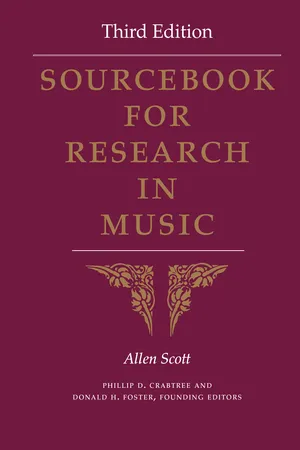
Since it was first published in 1993, the Sourcebook for Research in Music has become an invaluable resource in musical scholarship. The balance between depth of content and brevity of format makes it ideal for use as a textbook for students, a reference work for faculty and professional musicians, and as an aid for librarians. The introductory chapter includes a comprehensive list of bibliographical terms with definitions; bibliographic terms in German, French, and Italian; and the plan of the Library of Congress and the Dewey Decimal music classification systems. Integrating helpful commentary to instruct the reader on the scope and usefulness of specific items, this updated and expanded edition accounts for the rapid growth in new editions of standard works, in fields such as ethnomusicology, performance practice, women in music, popular music, education, business, and music technology. These enhancements to its already extensive bibliographies ensures that the Sourcebook will continue to be an indispensable reference for years to come.
- 508 pages
- English
- ePUB (mobile friendly)
- Available on iOS & Android
eBook - ePub
Sourcebook for Research in Music, Third Edition
About this book
Information
CHAPTER ONE
Introductory Materials

As a preliminary to the bibliographies that constitute the main body of this volume, this chapter presents some general information pertaining to research in music. First there is a list of standard English terms that relate to the scholarly study of music or to general bibliography and library research, with definitions. Next follow lists of such terms in the three other most important languages of research in music, German, French, and Italian, together with English equivalents. The final lists are general outlines of the music classification numbers in the two standard library cataloging systems in North America, the Library of Congress Classification system and the Dewey Decimal Classification system.
1.1 COMMON ENGLISH BIBLIOGRAPHICAL TERMS
The terms that follow have been brought together because of their application to scholarship in general and the scholarly study of music in particular. Some (e.g., abstract, anthology, catalog, discography) will be quite familiar and are generally known, while others might be confusing (congress report, journal, magazine, periodical). Many, even most, are likely to be less familiar because they are new or relate to the study of books (codex, foliation, incunabula, siglum, watermark), manuscripts (autograph, choirbook, holograph), printing (colophon, facsimile, frontispiece), research libraries (archive, carrel, microforms, serial, stacks), or scholarship (collate, historical set, iconography, Urtext). Some are technical or specialized enough so that they are not to be found in most dictionaries. For further information and other terms, see Michael Levine-Clark and Toni M. Carter, eds., A.L.A. Glossary of Library and Information Science, 4th ed. (Chicago: American Library Association, 2012); Jean Peters, The Bookman’s Glossary, 6th ed., rev. and enl. (New York: R. R. Bowker, 1983); and Willem Elbertus Clason, ed., Elsevier’s Dictionary of Library Science, Information and Documentation in Six Languages: English/American, French, Spanish, Italian, Dutch and German, 2nd ed. (Amsterdam, London, and New York: Elsevier, 1992).
abstract—a summary of a book, article, etc.; also called a précis (e.g., Dissertation Abstracts, RILM Abstracts).
anthology—a representative collection of selected musical or literary works or excerpts.
archive—a place in which public or institutional records are systematically preserved, or a repository of any documents or other materials, especially those of historical value.
arrangement—a reworking of a musical composition so that the performing forces, the musical content, or the form are substantially different from the original (compare edition, definition c, and transcription).
autograph—a document (music manuscript, letter, etc.) written or signed in a person’s own h...
Table of contents
- Cover
- Title Page
- Copyright
- Dedication
- Contents
- Preface to the Third Edition
- Acknowledgments
- 1. Introductory Materials
- Part 1: Sources of Literature about Music and Musicians
- Part 2: Sources of Music and Recordings
- Indexes
Trusted by 375,005 students
Access to over 1.5 million titles for a fair monthly price.
Study more efficiently using our study tools.
Frequently asked questions
Yes, you can cancel anytime from the Subscription tab in your account settings on the Perlego website. Your subscription will stay active until the end of your current billing period. Learn how to cancel your subscription
No, books cannot be downloaded as external files, such as PDFs, for use outside of Perlego. However, you can download books within the Perlego app for offline reading on mobile or tablet. Learn how to download books offline
Perlego offers two plans: Essential and Complete
- Essential is ideal for learners and professionals who enjoy exploring a wide range of subjects. Access the Essential Library with 800,000+ trusted titles and best-sellers across business, personal growth, and the humanities. Includes unlimited reading time and Standard Read Aloud voice.
- Complete: Perfect for advanced learners and researchers needing full, unrestricted access. Unlock 1.5M+ books across hundreds of subjects, including academic and specialized titles. The Complete Plan also includes advanced features like Premium Read Aloud and Research Assistant.
We are an online textbook subscription service, where you can get access to an entire online library for less than the price of a single book per month. With over 1.5 million books across 990+ topics, we’ve got you covered! Learn about our mission
Look out for the read-aloud symbol on your next book to see if you can listen to it. The read-aloud tool reads text aloud for you, highlighting the text as it is being read. You can pause it, speed it up and slow it down. Learn more about Read Aloud
Yes! You can use the Perlego app on both iOS and Android devices to read anytime, anywhere — even offline. Perfect for commutes or when you’re on the go.
Please note we cannot support devices running on iOS 13 and Android 7 or earlier. Learn more about using the app
Please note we cannot support devices running on iOS 13 and Android 7 or earlier. Learn more about using the app
Yes, you can access Sourcebook for Research in Music, Third Edition by Allen Scott in PDF and/or ePUB format, as well as other popular books in Media & Performing Arts & Music Theory & Appreciation. We have over 1.5 million books available in our catalogue for you to explore.