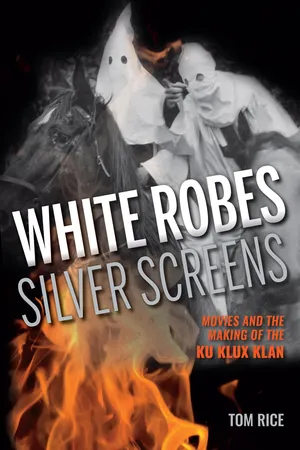
The Ku Klux Klan was reestablished in Atlanta in 1915, barely a week before the Atlanta premiere of The Birth of a Nation, D. W. Griffith's paean to the original Klan. While this link between Griffith's film and the Klan has been widely acknowledged, Tom Rice explores the little-known relationship between the Klan's success and its use of film and media in the interwar years when the image, function, and moral rectitude of the Klan was contested on the national stage. By examining rich archival materials including a series of films produced by the Klan and a wealth of documents, newspaper clippings, and manuals, Rice uncovers the fraught history of the Klan as a local force that manipulated the American film industry to extend its reach across the country. White Robes, Silver Screens highlights the ways in which the Klan used, produced, and protested against film in order to recruit members, generate publicity, and define its role within American society.
- 328 pages
- English
- ePUB (mobile friendly)
- Available on iOS & Android
eBook - ePub
About this book
Trusted by 375,005 students
Access to over 1.5 million titles for a fair monthly price.
Study more efficiently using our study tools.
Information
ONE
Re-Birth
THE BIRTH OF A NATION AND THE GROWTH OF THE KLAN
The Ku Klux Klan has become a serious menace to American Institutions. A careful investigation has revealed that the ease with which Klan solicitors are able to sell memberships is directly attributable to the romantic color cast about the Klan name by your motion picture The Birth of a Nation. Whatever we may think of the Klan of 1865, we must agree that the Klan of 1923 is far from romantic or heroic. We feel that it is your duty to use your tremendous power to undo the damage unwittingly done [to] the country when your [film The] Birth of a Nation was shown and we call upon you to cooperate with all good American citizens to stamp out this growing evil. May we have an expression of your personal opinion of the Klan and such assurance as you feel necessary that you will take steps to tear away the mantle of heroism in which you once dressed the nightriders [?]
Telegram written by W. N. Kramer, publisher of The Spotlight, to David W. Griffith, 10 January 1923
On 10 January 1923, W. N. Kramer, the publisher of Spotlight, an anti-Klan newspaper in Minneapolis, wrote these words to D. W. Griffith, challenging him to respond to his earlier work and to “paint the Ku Klux Klan in its true light.”1 Kramer argued that Griffith’s representation of an idealized historical Klan in The Birth of a Nation was now helping Kleagles (Klan “solicitors”) to sell memberships for a new incarnation of the Ku Klux Klan, which had formed in Atlanta in 1915 and had now spread throughout the country. While Spotlight, like most historians subsequently, referred to the film’s initial release, Griffith’s film had, by 1923, become a prominent and prototypical component of the modern Klan’s publicity. The group utilized The Birth of a Nation throughout the decade, whether arranging its own screenings, making very public appearances at cinemas showing the film, or using the discussions surrounding the film to define and promote itself within American society. The Klan would closely reference and rework particular images from the film, and when it began producing, distributing, and exhibiting its own pictures in the 1920s, Birth would become a touchstone for this “Klan cinema.”
The Klan’s engagement with Birth was intended in part to connect the modern incarnation to the long-disbanded historical group represented on-screen. It partly achieved this by “dressing” the modern group in the theatrical robes of Dixon and Griffith’s historical fantasy. Indeed, the costume adopted by Griffith on-screen would serve as an emblematic connection to, and advertisement for, a new modern group. In this instance, Spotlight rather generously exonerated Griffith of responsibility for the film’s afterlife – the telegram refers to “damage unwittingly done” – but it still acknowledged a film completely transformed by the modern Klan and, what’s more, now outlined the filmmaker’s “duty” to reassert his authorial control and, in Klan parlance, to unmask the modern night riders.
At the same moment in January 1923, Thomas Dixon, the author of The Clansman, the novel and play on which The Birth of a Nation was based, spoke in New York at the invitation of the American Unity League, a largely Catholic group devoted to the eradication of the reemergent Klan. Dixon used the speech to offer his “outspoken contempt” for the modern group. “The Klan assault upon the foreigner is,” he stated, “the acme of stupidity and inhumanity. We are all foreigners except the few Indians we haven’t killed.”2 Dixon was also seeking financing at this time for a film based on his 1907 novel The Traitor, which he claimed in the stock promotional circular would “strike a deadly blow” to the organization. In direct response to this “anti-Klan film,” a Klan group planned a picture of its own, Armageddon. Their preferred director for the project was D. W. Griffith.3
By 1923 both sides of the Klan divide were seeking out, using, and critiquing Griffith and Dixon. Their work was discussed in relation to the modern Knights of the Ku Klux Klan, although, perhaps unsurprisingly, both rejected any direct responsibility for their perceived progeny. “It may be flattering,” Griffith wrote shortly afterward, “to find out that the present Klan has copied the picture so closely, but it is not a welcome thought to me, that I have been in any way responsible for the spread of this order.” When Dixon learned in 1922 that a local branch of the Klan in Baltimore had taken his name (“Thomas Dixon Klan Number One”), he stated that he knew nothing about this and “am opposed to it root and branch.” The Baltimore Afro-American newspaper, commenting on Dixon’s response, described this as “another example of a Southern Aristocrat denying his own child.”4
This notion that The Birth of a Nation had spawned a new national, socially active Klan was, by 1923, widely and uncritically endorsed. Spotlight stated categorically that “Birth of Nation [had] established [the modern] Klan in [the] U.S.,” and argued that this “single motion picture is practically the only agent” in its growth. When the National Association for the Advancement of Colored People (NAACP) telegraphed Kansas governor Jonathan M. Davis in the same year, urging him to prevent the film from being exhibited in his state, it justified its protests by similarly arguing that the film “is largely responsible for [the] present day revival of the Klan.”5
These traditional causative arguments, which suggest that a single film engineered one of the most prominent social and political organizations in American history, oversimplify what is a far more complex, stuttering, and far-reaching history. By 1923, Birth had become a central component of and generative text for a modern Klan, with the Klan looking to use the film, in varied ways, not simply at its formation in 1915, but as the group developed and grew in the 1920s. While there is an enormous amount of literature on Birth and its initial spectacular theatrical success, what remains less well known is the film’s afterlife during the 1920s in smaller theaters – some owned by the Klan – and other kinds of spaces. As the Klan reappropriated the film – becoming something of a “textual poacher,” to borrow Henry Jenkins’s phrase – it pulled, stretched, and deepened the divides occasioned by the film’s initial release.6 This text, made malleable by promotional devices fashioned by Dixon when the original play first toured in 1905 and by Griffith upon the film’s release a decade later, was now reworked and maneuvered as it became politically useful to this conservative group. As such, this chapter not only examines the role of the film in the rebirth of the Klan but, moreover, of the Klan in the rebirth of the film during the 1920s.
The Spotlight telegram also showcases the media’s role in the fiercely contested growth of the Klan, published as it was in one of the emerging anti-Klan newspapers, a response, in turn, to the rapid growth of the Klan press. This chapter traces the proliferation of Klan media across the nation, from Atlanta in 1905 to Ohio two decades later. In examining the shared contexts in which the film and the modern Klan emerged in Atlanta, I consider how both Dixon’s play and the subsequent film responded to, negotiated, and engendered social, political, and racial tensions within the city. After considering how these traveling national productions contributed to a new, local Klan in Atlanta, I then examine how Klan leaders, Kleagles (recruiters), and local groups used Birth as a promotional and recruiting vehicle as the order enjoyed a rapid and spectacular spread across the nation during the first half of the 1920s. The story begins, however, in Atlanta in 1905.
ATLANTA 1905: BEGINNINGS
On Monday, 30 October 1905, Thomas Dixon walked onto the stage at the Grand Opera House during the Atlanta premiere of his new play, The Clansman. Before the final act – entitled “The Ku Klux Klan” – Dixon offered a defense of his work, providing his own historical take on the Reconstruction Klan of the 1860s by recalling his father’s time as a member of the organization. The Atlanta Constitution reported that Dixon was “cheered for several minutes by the audience and he was several times interrupted by applause.”7
These audience reactions attest to Dixon’s showmanship and also, more strikingly, to the mounting racial tensions that his work both responded and contributed to. The cries of “lynch him,” emanating from white members of the audience during the staged trial of the African American named Gus, were reportedly met by hisses and taunts from the balcony where the segregated African Americans watched. The Atlanta Independent, an African American weekly, claimed that the situation had become so tense that the management kept the house lights on throughout the performance and stopped the sale of soda bottles for fear that they would be hurled around the theater. Further reports explained that “every suggestion of equality is met with howls of approval from the third gallery and storms of hisses from every other section of the house.”8
The theater was presented within the press as a site of racial confrontation, a site through which contemporary racial fears were channeled and as a microcosm of society at large. The Clansman opened with an election in which inebriated African Americans discuss exactly how they intend to engage in voter fraud. The issue of racial equality and, more specifically, black enfranchisement would become the defining issue of the 1906 Democratic primary in Atlanta, foregrounded and championed by the former populist Tom Watson and the victorious candidate Hoke Smith. Dixon described his play not as a “reminiscence” but as a “prophecy,” and was quick to use his own personality both to generate publicity and to engineer a connection between his historical work and the contemporary situation.9 In January 1906 he sent an open letter to African American leader Booker T. Washington, who was about to go onstage at a fundraising event for the Tuskegee Institute in New York’s Carnegie Hall. “In response to your appeal for funds,” Dixon wrote, “I hereby offer to contribute $10,000 from the profits of ‘The Clansman’ to Tuskegee Institute, provided you give complete and satisfactory proof that you do not desire social equality for the Negro, and that your school is opposed to the amalgamation of the races.”10
Washington did not respond to Dixon, but this was largely immaterial for Dixon. We see here Dixon’s confrontational and divisive racial politics used as part of the play’s promotional strategies, strategies that would be reapplied a decade later when The Clansman was adapted for the screen. When Dixon was challenged on the historical veracity of his play, he proposed submitting his work to a “jury of the American Historical Society” and offered a thousand dollars if the verdict went against him. In a rhetoric later famously used by Griffith, Dixon claimed that he had “sworn documentary evidence” for every incident referenced and had “mastered the contents” of more than 4,000 books.11 However, it was not simply the view of history offered by Dixon that was problematic, but the ways in which this history was represented through the live performance.
The Clansman brought the spectacle of a just and heroic Klan into the theater, offering two distinct modes of Klan representation, which would prefigure, and be reimagined in, the Klan’s later on-screen appearances.12 The Clansman’s final act opens with the shrouded figures dashing across the stage on horseback. Advertisements highlighted the excitement generated by the Klan’s ride to the rescue, promoting a “thrilling story of the Ku Klux Klan” and a “stupendous dramatic spectacle.” As with The Birth of a Nation, which would advertise the 18,000 people and 3,000 horses involved in the production, the scale of this display was prioritized often at the expense of the narrative. Posters for The Clansman noted the “Forty Principals. Two carloads of scenery. Army of supernumeraries and horses” on the stage.13 Despite the play’s title, which suggests an individual Klan protagonist, the play’s denouement encouraged audiences to position themselves alongside a collective mass of largely anonymous robed figures.
Aside from the concluding sequence of the Klan in action, “mounted, masked and costumed” and riding in vengeance, The Clansman also displayed the more private rituals of the group. A scene inside the “cave of the invisible kingdom,” where Klansmen gathered around a fiery cross for the “trial” of Gus, offered theater viewers access to the “unseen” nighttime ceremonial activities of the group and foreshadows later screen appearances of the Klan that would promise to show the inner workings of the secret organization.14 Even the New York Dramatic Mirror, in its critical bashing of this “peculiarly obnoxious melodrama,” acknowledged that “one must admit that the night meeting of the Klan was an impressive stage episode.” “It is no wonder,” the review concluded, “that nervous women have been hysterical at that point of the performance.”15
The reactions to the Klan sequences, not just from “nervous women,” hint at the ways in which the staging invited audiences to respond collectively and viscerally to the group activities of the Klan. A review of a performance in South Carolina saw “the spirit of the mob” within the audience, while Dixon would use similar language when dismissing the critical and institutional opposition to his play, describing the audience as the “supreme court of public opinion.”16 There are clear parallels with the reception of the film a decade later, as the play invited debates on the social impact of stage entertainment at a moment when, with the proliferation of Nickelodeons, these discussions were extended to moving pictures. While initially the discussions speculated on the ways in which the play might incite racial violence, by the play’s second season in the latter half of 1906, a more prescriptive approach was adopted and the play was banned or withdrawn in a number of areas, chief among them Atlanta. A closer look at the aborted staging of the play in Atlanta in 1906 reveals an early recognition of and concern for the social impact that Dixon’s work (and ...
Table of contents
- Cover
- Half title
- Title
- Copyright
- Contents
- · Acknowledgments
- · Preface
- 1 Re-Birth: The Birth of a Nation and the Growth of the Klan
- 2 The Battle: Censorship, Reform, and the Klan’s Campaign against the Film Industry
- 3 Klan Cinema: The Klan as Producer and Exhibitor
- 4 On Mainstream Screens: The Film Industry’s Response to the Klan
- Epilogue
- · Notes
- · Bibliography
- · Index
Frequently asked questions
Yes, you can cancel anytime from the Subscription tab in your account settings on the Perlego website. Your subscription will stay active until the end of your current billing period. Learn how to cancel your subscription
No, books cannot be downloaded as external files, such as PDFs, for use outside of Perlego. However, you can download books within the Perlego app for offline reading on mobile or tablet. Learn how to download books offline
Perlego offers two plans: Essential and Complete
- Essential is ideal for learners and professionals who enjoy exploring a wide range of subjects. Access the Essential Library with 800,000+ trusted titles and best-sellers across business, personal growth, and the humanities. Includes unlimited reading time and Standard Read Aloud voice.
- Complete: Perfect for advanced learners and researchers needing full, unrestricted access. Unlock 1.5M+ books across hundreds of subjects, including academic and specialized titles. The Complete Plan also includes advanced features like Premium Read Aloud and Research Assistant.
We are an online textbook subscription service, where you can get access to an entire online library for less than the price of a single book per month. With over 1.5 million books across 990+ topics, we’ve got you covered! Learn about our mission
Look out for the read-aloud symbol on your next book to see if you can listen to it. The read-aloud tool reads text aloud for you, highlighting the text as it is being read. You can pause it, speed it up and slow it down. Learn more about Read Aloud
Yes! You can use the Perlego app on both iOS and Android devices to read anytime, anywhere — even offline. Perfect for commutes or when you’re on the go.
Please note we cannot support devices running on iOS 13 and Android 7 or earlier. Learn more about using the app
Please note we cannot support devices running on iOS 13 and Android 7 or earlier. Learn more about using the app
Yes, you can access White Robes, Silver Screens by Tom Rice in PDF and/or ePUB format, as well as other popular books in History & North American History. We have over 1.5 million books available in our catalogue for you to explore.