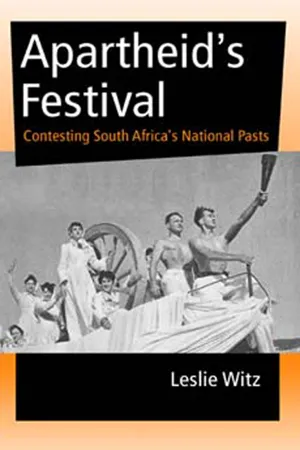
Apartheid's Festival highlights the conflicts and debates that surrounded the 1952 celebration of the 300th anniversary of the landing of Jan Van Riebeeck and the founding of Cape Town, South Africa. Taking place at the height of the apartheid era, the festival was viewed by many as an opportunity for the government to promote its nationalist, separatist agenda in grand fashion. Leslie Witz's fine-grained examination of newspapers, brochures, pamphlets, and advertising materials reveals the expectations of the festival planners as well as how the festival was engineered, historical figures were reconstructed, and the ANC and other anti-apartheid organizations mounted opposition to it. While laying open the darker motives of the apartheid regime, Witz shows that the production of local history is part of a global process forged by the struggle between colonialism and resistance. Readers interested in South Africa, representations of nationalism, and the making of public history will find Apartheid's Festival to be an important study of a society in transition.
- 344 pages
- English
- ePUB (mobile friendly)
- Available on iOS & Android
eBook - ePub
About this book
Information
1 Van Riebeeck’s Pasts
When stories are recounted about the past of Jan van Riebeeck, the Dutch commander at the Cape of Good Hope between 1652 and 1662, they tell of his birth in Culemborg, his family background, his early days under the tutelage of his grandfather, the mayor of Culemborg, his apprenticeship as a surgeon, his joining the Dutch East India Company and being posted to Batavia, his becoming a merchant and administrator in the East Indies and then being sent home by the Company for misconduct, his marriage to Maria de la Quellerie, and his assignment to set up a refreshment station at the Cape. Over the next ten years there are accounts of his administrative duties, his encounters with the local populations, and his dealings with various Company officials, all of which terminate in 1662 when he departs for Malacca and his past at the Cape comes to an end.1
So much has been said and written of this past—some would say far too much—that it has become more than merely a set of stories about an individual’s past. It has been accorded the status of being significant, of providing a context for a moment that is marked in different ways as the beginning of South African history: the beginning of apartheid, the beginning of colonialism, and the beginning of “western civilization” in southern Africa. The life stories that lead to this starting point, and the narratives of initial encounters set around the instance of proclaimed import, have been made so meaningful that the Professor of history at the University of Stellenbosch, H. B. Thom, could confidently assert, in introducing the 1952 edition of Van Riebeeck’s diary, “Of the latter part of his life, little need here be said.”2
To make this past into history, though, meant more than merely according it significance. A narrative had to be built up and gaps filled in, especially when these gaps were glaringly apparent. On one level this involved the historian in the metaphorical guise of detective, ferreting through archives, sifting through clues, and discovering missing links. One of Van Riebeeck’s biographers, C. Louis Leipoldt, for instance, claimed that he had read all the relevant papers “printed and written” that were located at the archives in Cape Town, the Hague, and Batavia. But history did not merely fall into place through the process of discovery. The historian as storyteller had to take over, weaving the found and selected information into a good tale that reads well, giving the world “a formal coherence past ‘reality’ never had.” In this process of reconstruction conjecture took over, and assumptions were derived from a sketched-out context, couched in a language of probabilities and possibilities. School “undoubtedly played an important part in his [Van Riebeeck’s] training” wrote Leipoldt; one “may assume that [he] was taught Latin and perhaps a little Greek”; “probably ... [his] grandfather ... took care that the youngster should be properly grounded”; and “probably his own temperamen” led him to choose the profession of surgeon. Leipoldt was so convinced that the context into which he had selected to write Van Riebeeck was crucial that he had “no shadow of a doubt that the liberal atmosphere in which he was privileged to pass his childhood left an enduring mark upon him, and that he reacted favourably to the cultural stimuli, whatever these might have been.”3
Associated with this according of significance to Van Riebeeck’s past and the construction of meaningful narratives of his life was the emergence of a series of historical debates. Was he born in 1618 or 1619? Was he nobly born, as Leipoldt claimed, or a lowly Company bureaucrat, as the Cape Colony’s official historian, George Theal, suggested? Was he dismissed from the service of the Company for large-scale corruption or for merely augmenting his small salary? Was he really so interested in the Cape, or was it a stepping-stone to further his career? Was he indeed the author of his diary, or had administrative officers at the Cape written it? Was Van Riebeeck an “advocate of extreme and iniquitous measure” against the local Khoi population, or was his harshness infrequent and “made under extreme pressures and exceptional circumstances”? These debates, more than asserting difference, reflect an agreement over the “constitute requisites for debate”: “knowledge, language, relevance, polarity, closure.” There is a consensus that Van Riebeeck’s past is important, that it is an issue of contestation, and that some form of truth about this past can ultimately be discovered in an undetermined future which will set the debate to rest. Its location as debate elevates it into the realm of critical discourse, seen as an integral element of the historical craft where the evidence can make one view “more veridical than the other.”4
Van Riebeeck’s past was therefore made into history by its being marked off as significant, through the construction of historical narratives around his life, and by the forging of related debates. This corresponds with the distinction between the past as “all that happened” and history as the according of significance to certain events in that past. The use of the passive voice would indicate that this signification occurred almost naturally, by a process of elimination and osmosis. In the academic world it is largely the historian or the professional chronicler who determines what should be the facts of history, facts which “other historian” then either accept or reject on the basis of the interpretation offered. What this formulation overlooks is that history is also very often made in the public domain, both in being authored by those who do not form part of the guild and by its authority being affirmed through public evaluation. There is more of a “shared authority” between the public domain and the academy in the constitution of historical “authorship and interpretive authority.”5
In the making of Van Riebeeck it was this “shared authority” which changed his past into history. A central argument in this book is that a key moment around which this transformation occurred was the festival organized in 1952 to commemorate the three hundredth anniversary of Van Riebeeck’s landing at the Cape of Good Hope. A range of academics, artists, dramatists, curators, dancers, athletes, and musicians meshed together in producing history which relied for its authority on public approval and intellectual scrutiny. Yet this moment was not one of beginning, where history was virtually created from the “sands of time.” As “the world/the past comes to us always already as stories,” so Van Riebeeck had acquired a series of histories before 1952. This chapter looks at those past histories, their constructions and meanings. It examines how Van Riebeeck and his past started to become history through commemorative events, school textbooks, and the publication of the daily journal of the Dutch East India Company at the Cape (Van Riebeeck’s diary). The implication of treating each of these as discrete historical productions is that it does not pit one form of history against another in terms of its success or failure as a mobilizing agent but rather looks at how different forms of history perform different functions and interact with one another.6 With other moments of Van Riebeeck’s past appearance, these histories—in commemorations, schoolbooks, and the diary—offered, respectively, a tradition of ritual, an abbreviated past, and a historical authenticity. Those who organized his past in 1952 were able to draw on all these histories and their different offerings, incorporating, rearranging, and discarding elements from these various forms to fit in with the plans for the festival.
Commemorating the Past
The ritual acts associated with ceremonies of commemoration are generally seen as moments in which a shared or common identity is asserted. This identity is based on attempts to establish, through the ceremony, a collective memory where an “original narrative” usually built on the themes of “struggle, sacrifice, and victory” becomes the cohesive mechanism for community formation. This implies a notion of “spatial continuity” where the “commemorative ceremon” bounds a community into memory, in the dual sense of setting its limits and forging a singular identity. A sense of “remembering together” can become so powerful that what is shared is no longer the event itself but the memory of the commemorations.7
More than establishing spatial boundaries, these ceremonies also position individuals into communities as temporal entities. Time becomes part of a wider framework, where individual change, in its uniqueness and constant transformability, is “transcended ... by ensuring the preservation of collective memory.” People are brought into the community through historic time with its markers that signify before and after. This is not to argue that in commemorative ceremonies identities become fixed in the same time and with the same characteristics. Instead, they continually change and mutate “through the transformation of collective memory.” It is precisely because of this transformability that commemorations, which evoke the past and construct and resurrect it for collective memory, are such a powerful force in constituting historical knowledge.8
Deriving information from the daily register of the Dutch East India Company at the Cape, it would appear that, on the whole, the commander had very little time for commemorative ceremonies in his period of residence from 1652 to 1662, even at the time of his arrival and landing. As with most “founder” and “discoverer” it was the first sight of land to possess/settle/inhabit which was regarded as the moment of significance and which did involve some sort of ceremonial activity. When the chief mate sighted Table Mountain on 5 April 1652, Van Riebeeck praised God, hoisted the flags of the Dromedaris, fired a gun, and rewarded the sailor with “four Spanish reals in specie.” It was the “active gaz” on the land that was crucial, because it sought to turn claims into rights. Once the eye had been cast on the land as a supposedly rightful possession, then what was to follow in a seemingly seamless progression would be the naming and appropriation.9
The landing the following day, which later would become the central focus of the origin narratives, was barely remarked on in the journal and was accorded no significance as a first primarily because it was not one, either of European founding or settlement. The Cape, over the previous century, had become a frequent stopover route for ships traveling to the east, and indeed Van Riebeeck had spent eighteen days there when returning to the Netherlands from Batavia in 1648. Moreover, the English had established a settlement at Table Bay in the 1620s, although the crown never formally recognized it. It is little wonder then that, shortly after sighting Table Mountain on 5 April, Van Riebeeck sent two scouts ahead to “find out what ships—and how many— might be lying at anchor in the roadstead at Table Bay” Clearly there was an expectation that other ships from Europe, particularly the Portuguese and perhaps the English, would be at anchor. When the scouts reported, however, that there were no other ships, the Goede Hoop and the Dromedaris entered the bay and the captain was sent ashore to pick up post from previous Dutch ships that had stopped over and to acquire “some green” for nourishment. It was only in the evening of the following day (7 April 1652) that Van Riebeeck finally went ashore, with no ceremony, “to consider more or less where the fort should be built,” and then returned to the Dromedaris, which was to be both home and operational base for the next few weeks. Not until 24 April did he finally set up camp on the shore, without any fuss or bother. “We went ashore with all our baggage and family to stay there in a make-shift wooden hut—rather roughly constructed for the time being—in order that the work may proceed more satisfactorily.”10
What was important for Van Riebeeck was to carry out his duties as a “servant of higher masters,” God and the Dutch East India Company. The instructions to Van Riebeeck, whom the Company in no way regarded as either a discoverer or founder, had been to establish a fort so as to secure the revictualing station, and it was the ceremonies and identities established around the construction and occupation of this fort which were of prime importance in the first two years of settlement. Positioned between the sea in the northeast and the Fresh River in the west, this fortification signified possession against potential enemies—other European traders and the local Khoi inhabitants— who could threaten the Company’s ability to secure a permanent refreshment station along a profitable trading route. In this vision Van Riebeeck defined the various identities along an insider/outsider frontier, with the fort and its inhabitants—the servants of the Company and of God—setting the bounds of inclusion/exclusion. The first ceremonies that took place more than a month after landing were therefore associated with establishing the identity of the fort and its inhabitants. On Sunday, 12 May, in a square in the incomplete fort, “the first sermon, and the Lord’s Supper was celebrated,” and three days later the fort was named Goede Hoop “in accordance of our instruction of our Lords and Masters [of the Dutch East India Company] .”11
Only two years later, on 6 April 1654, once the fort had been completed and the initial settlement was able to secure itself against outsiders, did Van Riebeeck commemorate the landing. This ceremony is crucial as it sets up the genealogy for future celebrations of the landing, giving them a tradition to resurrect rather than a past to invent. The journal recorded the following:
We have ... resolved, and also for the first time begun to celebrate this 6th day of April in the name of the Almighty, and henceforth to set it aside for all time as a day of thanksgiving and prayer, so that our descendants may never forget the mercies we have received at the Lord’s hands, but may always remember them to the Glory of God.12
Leipoldt refers to this moment as “the first public holiday” in South Africa; Thom noted, in a footnote to the diary, that “also the following two years Van Riebeeck celebrated the day of landing”; and when Van Riebeeck’s day was commemorated in the twentieth century, reading this extract from the journal became a central feature of the proceedings. Yet it would seem that the landing was commemorated in 1654 because of the problems the settlement was experiencing at the time, particularly the scarcity of food and the concern over when the return fleet would arrive with relief. Indeed, before commenting on the day of prayer, the diary entry for 6 April 1654 is concerned that there is a lack of food “to fill the hungry bellies of the men.” At this moment of intense stress, it seemed necessary to hold a small-scale ceremony, involving a prayer meeting, to give thanks, at least, to their “safe arrival.” Also notable about this initial ceremony in 1654 is that, in as much as it commemorates the “safe arrival,” it also locates the happenings in terms of the identity being established around the fortification, linking the landing with the construction of the fort “through the Holy guidance of God” the former facilitating the latter and the spatial ordering of the settlement in physical and cognitive terms.13
After this initial ceremony the diary records four further occurrences of this day of prayer—in 1655, 1656, 1659, and 1660—during Van Riebeeck’s time as commander at the Cape. They all seem to have been low-key affairs, usually involving a prayer meeting led by a minister whose ship happened to be in the bay at the time. One must assume that in other years the ceremonies did not take place or that no minister was available at the time or that they were not recorded in the Company journal. In any case it would seem to indicate that, far from being important annual gatherings at which an identity based on landing or founding was inscribed into shared memory as a moment of “joy and gratitude” which the commander had “so piously instituted,” they were insignificant when compared to attempts to secure the viability of the refreshment station for their Lords. A far greater moment of “joy and gratitude” was when the return fleet visited the shores of the Cape, bringing with it supplies for the station. Once the cargo had been unloaded and the ships had departed the Cape, the commander would issue orders for the Company servants to take a holiday and be treated with wine, food, and tobacco. This holiday is recorded in the diary as an “annual custom,” indicating that rather than founding a settlement on 6 April it was maintaining a sometimes very precarious revictualing station that was more important for the Company’s officials at the Cape.14
One hundred years later, according to Drie Eeue: Die Verhaal Van Ons Vaderland [Three centuries: The story of our fatherland}—a five-volume history of South Africa written specially for the Van Riebeeck tercentenary—there was much more enthusiasm for commemorating the landing than there had been in the early days of the settlement. Attempting to secure a direct lineage for a shared memory among a community identified as the “white race,” the author of volume 1, Anna Boeseken, uses the Journal of Cape Governors (the Dag Register) as her primary source to relate how the first centenary of the landing was remembered with a series of prayer meetings throughout the Cape Colony, which by this time had extended some three hundred kilometers from the Castle (which had replaced the original fort) on the shores of Table Bay. In churches from Stellenbosch to the Swartland, this history tells us, services were held on Saturday, 8 April 1752, to thank God for the landing, for peace, and for the produce of the land, and that there were now “enough white” in the colony. Cast as a moment of divine intervention to parallel the events some hundred years previously, the weather conditions described in the Dag Register with almost monotonous regularity are transformed into a metaphor for the commemoration. The black storm clouds that had gathered earlier in the day gave way to bright sunlight [the landing of whites?] as shots were fired from the Castle and from ships in Table Bay. The brief description of the festivities ends with the Dutch governor, Ryk Tulbagh, who had just assumed his duty at the Cape, hosting a dinner for the “most distinguished officials, citizens and visiting foreigner” at the Cape.15
This description of the commemoration on 8 April 1752 is similar to Theal’s in the second volume of his History of South Africa, first published in 1888. Relying mainly on a directive from the Political Council, which governed the Cape, he notes that the day was observed in churches “by the Europeans in South Africa as a day of thanksgiving to Almighty God for the undisturbed...
Table of contents
- Cover
- Half Title
- Title Page
- Copyright Page
- Table of Contents
- Acknowledgments
- List of Abbreviations
- Introduction: Journeys, Festivals, and the Making of National Pasts
- 1. Van Riebeeck’s Pasts
- 2. “We Build a Nation”: The Festival of Unity and Exclusion
- 3. Contesting Van Riebeeck’s Nation
- 4. “’n Fees vir die Oog” [A Festival/Feast for the Eye]: Looking in on the 1952 Jan Van Riebeeck Tercentenary Festival Fair
- 5. Local and National Pasts: The Journeys of the Mail Coach “Settlers” through the Eastern Cape
- Conclusion: Post Van Riebeeck
- Notes
- Bibliography
- Index
Trusted by 375,005 students
Access to over 1.5 million titles for a fair monthly price.
Study more efficiently using our study tools.
Frequently asked questions
Yes, you can cancel anytime from the Subscription tab in your account settings on the Perlego website. Your subscription will stay active until the end of your current billing period. Learn how to cancel your subscription
No, books cannot be downloaded as external files, such as PDFs, for use outside of Perlego. However, you can download books within the Perlego app for offline reading on mobile or tablet. Learn how to download books offline
Perlego offers two plans: Essential and Complete
- Essential is ideal for learners and professionals who enjoy exploring a wide range of subjects. Access the Essential Library with 800,000+ trusted titles and best-sellers across business, personal growth, and the humanities. Includes unlimited reading time and Standard Read Aloud voice.
- Complete: Perfect for advanced learners and researchers needing full, unrestricted access. Unlock 1.5M+ books across hundreds of subjects, including academic and specialized titles. The Complete Plan also includes advanced features like Premium Read Aloud and Research Assistant.
We are an online textbook subscription service, where you can get access to an entire online library for less than the price of a single book per month. With over 1.5 million books across 990+ topics, we’ve got you covered! Learn about our mission
Look out for the read-aloud symbol on your next book to see if you can listen to it. The read-aloud tool reads text aloud for you, highlighting the text as it is being read. You can pause it, speed it up and slow it down. Learn more about Read Aloud
Yes! You can use the Perlego app on both iOS and Android devices to read anytime, anywhere — even offline. Perfect for commutes or when you’re on the go.
Please note we cannot support devices running on iOS 13 and Android 7 or earlier. Learn more about using the app
Please note we cannot support devices running on iOS 13 and Android 7 or earlier. Learn more about using the app
Yes, you can access Apartheid's Festival by Leslie Witz in PDF and/or ePUB format, as well as other popular books in History & African History. We have over 1.5 million books available in our catalogue for you to explore.