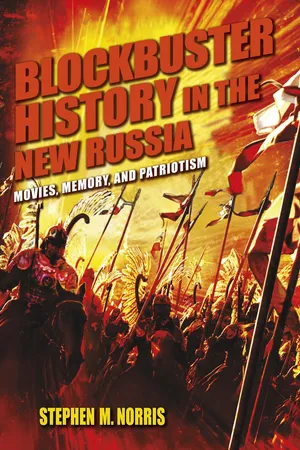
Seeking to rebuild the Russian film industry after its post-Soviet collapse, directors and producers sparked a revival of nationalist and patriotic sentiment by applying Hollywood techniques to themes drawn from Russian history. Unsettled by the government's move toward market capitalism, Russians embraced these historical blockbusters, packing the American-style multiplexes that sprouted across the country. Stephen M. Norris examines the connections among cinema, politics, economics, history, and patriotism in the creation of "blockbuster history"—the adaptation of an American cinematic style to Russian historical epics.
- 406 pages
- English
- ePUB (mobile friendly)
- Available on iOS & Android
eBook - ePub
About this book
Trusted by 375,005 students
Access to over 1.5 million titles for a fair monthly price.
Study more efficiently using our study tools.
Information
INTRODUCTION
Multiplexing Russia
The renovated October Theater on Moscow’s New Arbat Street is a nice place to watch a film. Owned and operated by the Karo Group, Russia’s largest multiplexer, October houses eleven state-of-the-art cinema halls, Karo’s offices, a video store, restaurants, and other commercial outlets. You can sit and have gelato or grab a cocktail before you watch your movie.
The theater is also a battleground. October has clearly made the transition from a Soviet-era movie house into a post-Soviet multiplex, but in making this change, October and its fellow Karo multiplexes have become sites of contestation. These theaters are not just entertainment centers: they are the foci of heated debates about Russian national cinema, post-Soviet politics, and the state of patriotism.
Founded in 1997, Karo Film first renovated the crown jewel of Russian cinema halls, the Rossiia [Russia] Theater on Moscow’s Pushkin Square. In 2000 it opened the first-ever Russian multiplex at Moscow’s first Ramstore (the Turkish-based mega supermarket chain). A year later, Karo unveiled its first multiplexes in St. Petersburg and Nizhnii Novgorod. By 2008, the company had built in Samara, Kazan´, and Kaliningrad, as well as in Moscow suburbs such as Podolsk and Mytishchi. The company boasts that it runs 34 modern multiplexes with 165 cinema halls, serving a capacity of 38,000. In total, 1.55 million Russians watch films on Karo screens each month.1
These statistics are impressive, all the more so given the state of Russian cinema in 2000. The Soviet film industry was once one of the world’s largest, putting out 150 films per year. Soviet citizens once went to the movies more than any other people on earth—twenty times per annum per capita in the 1960s and 1970s.2 By 1996, average cinema attendance in the former Soviet Union had fallen thirty- to fortyfold: only one in four Russians went to the movies once per year. By then, American and European films made up 75 percent of the movies shown on Russian screens. The state of Russian film, therefore, reflected the state of Russia itself: dilapidated, chaotic, and wistfully recalling its glory days.
In 1996, however, the situation changed. Paul Heth of Eastman Kodak opened the first state-of-the-art cinema in Moscow. Heth named the cinema—located in an old movie hall near Pushkin Square—Kodak KinoMir, or Kodak Cinema World. The Cinema World model suggested that multiplexes could get Russians back to the movies: the theater sold out for nearly two years straight and the first film screened there, the Nicolas Cage blockbuster The Rock, brought lines of cinemagoers.3 It was right after Kodak’s success that Leonid Ogorodnikov founded Karo and funded the renovation of the Rossiia, which was renamed Pushkin Theater.
“In the early nineties,” Ogorodnikov states, “no one believed that the cinema industry could recover: all the cinemas were empty. Some were furniture parlors, others were car shops.”4 Buoyed by Heth’s success, Ogorodnikov got into the cinema business and plunged into the Rossiia project. The renovated Pushkin opened for the Moscow International Film Festival in 1997. Said Ogorodnikov, “[W]e analyzed the financial results [of Pushkin’s renovation] and came to the conclusion that [it] could be interesting and lucrative. So we decided to focus on theaters.” He admitted, “[W]e didn’t study this business: no one in the country held such knowledge.”5 By 2000, the Pushkin Theater had been visited by four million people, making it the most popular site to watch a film in Russia.
The multiplex alone could not get Russians back to the theaters. Nice halls with Dolby surround sound represented steps in the right direction, but what appeared on screen had to meet the spectators’ expectations. “While choosing the repertoire for our Company,” Ogorodnikov stated, “we first look at the commercial expediency and commercial potential of the movie.” Karo Film held the Russian premieres of Hollywood blockbusters such as Titanic and Pearl Harbor. In September 1999, the company signed an agreement with Warner Brothers to distribute their films, which included the Matrix series, the Harry Potter series, and The Lord of the Rings trilogy.6 The initial success of Karo and the return of the Russian spectator to theaters came through screening Hollywood blockbusters in American-style multiplexes. Even popcorn and cola—quintessential American movie treats, but unavailable in Soviet movie houses—“became an indispensable feature of a modern Russian cinema visit.”7
Hollywood blockbusters may have brought people back, but they also served as the impetus for patriotic renewal. The perceived threat that American cinema posed for Russian culture loomed large in the minds of filmmakers and government officials. Some in the film industry pushed for quotas on the number of American films to be screened. Ogorodnikov and others opposed the idea, stating categorically, “you cannot improve the Russian cinema industry by implementing any quotas.”8 Improvement instead came through adapting Hollywood techniques to Russian themes. Karo Film got into this game and set up a production company that makes the corporation not just the largest multiplexer in Russia, but also a significant financial backer of Russian movies.
Their formula has worked. In 2000 the country had just 78 modern screens housed in fifty-five theaters. In 2008, the number of state-of-the-art screens in Russia surpassed 1,500.9 That year, the head of the Federal Agency for Culture and Cinematography declared that 2,500 new screens would open each year thereafter.10 Russian cinema enjoyed a much-discussed revival in the early 2000s, largely because of the appearance of “Russian” blockbusters such as Timur Bekmambetov’s Night Watch, which debuted at the Pushkin Theater and smashed box-office records in 2004. Other blockbusters followed, beginning a debate about the relationship between the new Russian cinema of Karo and its competitors and whether or not this cinema was really “Russian” at all. Critics argued that the Karo formula essentially replaced “Russian cinema” with Hollywood-style blockbusters.
The new blockbuster, as Oleg Sul´kin has argued, combined American styles with Russian content: “Russian filmmakers realized they couldn’t make a pure genre picture. Their films continue to be guided by the notion that a film must have an idea, a message, convey the national spirit somehow.”11 Success—and by 2008 Russian films made up nearly 40 percent of the market—came by merging the past with contemporary patriotism. Mikhail Shvydkoi, who in 2000–2004 served as the minister of culture, and afterward as director of the Federal Agency for Culture and Cinematography, promised that his agencies would fund “films of a patriotic and historical nature” and “films for children.” These films, he stated, would “send a particular message to the Russian people: that Russia is once again in the ascendant, and that family values and hard work can conquer all.”12 The key for Shvydkoi, in other words, was to create blockbuster history.
After the success of Night Watch, a fantasy epic based on a popular series of novels set in 1990s Moscow, Russian cinema increasingly looked to the past. In 2005, the action-detective epic The Turkish Gambit, which was set during the Russo-Turkish War of 1877–78, broke the record for the highest-grossing film in Russian history. Just a few months later, the Afghan War picture Ninth Company shattered its records. When Vladimir Putin watched the film at a private screening, he declared the Russian film industry “reborn.”13 This rebirth came about because enough Russian filmmakers and film producers wanted to develop “audience-friendly films” for Russian consumers. At the same time, the leading lights of the Russian film world wanted to make movies with a “Russian” content. They found that Hollywood blockbusters, in order to appeal to a worldwide market, tended to ignore the past. The days of the American historical epic exemplified by Gone with the Wind had long since vanished—when Hollywood made blockbuster history, it tended to be with epics such as Troy or romantic dramas such as Titanic. The Hollywood blockbuster that dominates worldwide box offices does not attempt to ask questions or provide meaningful answers about history.14 In the view of many Russian critics and filmmakers, “Hollywood blockbuster” means fancy special effects, a sophisticated marketing campaign, and an empty plot. Blockbusters by nature do not educate, they entertain, and in doing so establish American cultural hegemony. At the same time, Hollywood blockbusters are popular worldwide, a fact that everyone in the Russian industry acknowledged and many envied. To combat Hollywood’s influence, critics believed, Russian film had to become more like Hollywood blockbusters. It had to become a business that could also appeal to domestic consumers.15 The key lay in the past.
Blockbuster History in the New Russia examines the links between economics, politics, history, memory, patriotism, and cinema in the New Russia. The birth of blockbuster history—or the way American cultural practices could be adapted to make Russian historical epics—parallels the rise of Putin and the resurgence of Russian political nationalism. These links and processes, as this book argues, are far from coincidental but not always connected, for what Leonid Ogorodnikov discovered in his 1997 business plan was precisely what Vladimir Putin discovered to be useful in his presidential administration: patriotism and the past sell.
RUSSIAN THEATERS OF MEMORY
Karo’s multiplexes and the blockbuster histories screened inside function as theaters of memory. Films serve as a powerful medium that shape individual and group memories of the past. This memory work is complex and sometimes contradictory—films are read in multiple ways by different audiences and groups. Historical films in particular subvert pre-existing narratives as often as they reinforce them.16 In this significant role, movies offer a performance of the past and past memories. Like all performances, they require behind-the-scenes production beforehand, they offer certain stories about the past when they appear, they receive reviews after this occasion, and then become the subject of water cooler, online, and other forms of discussions. This process of remembrance begins with the people who produce cinematic memories and ends with the people who make sense of the memories they see onscreen. In the case of post-Soviet cinematic remembrance, the behind-the-scenes production developed out of a host of particular perceptions that shaped the 1990s. Remembering the past was not about getting it right; in the zero years (as Russians frequently refer to the 2000s) Russian remembrance used the past as a means of projecting present-day pride.
This process of historical remembrance has not taken place within a vacuum. All over the former Soviet empire national cinema traditions reasserted themselves by making historical blockbusters. Most of these cinematic acts of remembrance explored pasts that communist governments had censored. Most also used the past to illustrate how Soviet control had harmed the “real history” of the country in question. Post-Soviet cinematic narratives directly responded to the Soviet memory project: the Bolsheviks took power in 1917 believing that they were following the laws of history. Because of this ideological stance, officials began to oversee the creation of new historical narratives in a process one historian has called “the rapid ‘Bolshevizing’ of revolutionary memory.”17 Soviet historians had to follow certain scripts when writing about the past—and so, too, did filmmakers, authors, and artists. By the Stalin era, cinema had become the medium of history itself and, more than any other media form, created historical myths and provided the “right” historical interpretations to the past.18 The result of this state memory project was, as Aleksandr Solzhenitsyn argued rather forcefully, that “what we remember is not what actually happened, not history, but merely that hackneyed dotted line they have chosen to drive into our memories by incessant hammering.”19 History over the course of the Soviet period became an evolving state memory project.
Across the former Second World, filmmakers and film audiences attempted to overturn the Soviet memory project, to unmake and remake historical memories, transforming socialist-era narratives about the past into postsocialist plots.20 Filmmakers frequently mined the past to create new national narratives that in part blamed the ills of the twentieth century on Russia. In the Czech Republic, for example, Jan Svěrák’s 2001 Dark Blue World told the story of Czech pilots who had fought for the British Air Force during World War II and who had later been imprisoned by communist authorities for this service. Coming on the heels of Svěrák’s Academy Award–winning Kolya, Dark Blue World had the largest budget in Czech film history and earned $2 million at the domestic box office.21 Andrzej Wajda reinterpreted the past for present-day audiences in several postcommunist films, most notably his 1999 adaptation of the Polish epic Pan Tadeusz and his 2007 Katyń, which focused upon the 1940 murder of Polish officers by Soviet NKVD agents (Wajda’s father was among those murdered). The massacre had long been the source of antagonistic relations between Poland and the Soviet Union. Wajda’s film debuted on September 17, the anniversary of the Soviet invasion of Poland in 1939. “I think my film shows how the lie about Katyn was brought to Poland with the Red Army and the communist administration,” he commented, “and how this lie—that the Polish officers were murdered by the Germans—lingered for so many years.” The Polish president, Lech Kaczynski, attempted to use the film’s debut to score domestic political points at the expense of relations with Russia.22 The film made $13.5 million in Poland, making it the highest-grossing domestic film of all time.23 The Czech and Polish pattern was replicated across the former Soviet space: films that revised World War II narratives enjoyed particular popularity and frequently cast nationalities as double victims of both Nazi and Soviet systems.24
In the new Russia, the process of remembrance began from the same point but took a different p...
Table of contents
- Cover
- Half title
- Title
- Copyright
- Dedication
- Contents
- Preface
- Acknowledgments
- 1 Introduction: Multiplexing Russia
- Part 1. The Russia that We Lost
- Part 2. The Price of War
- Part 3. Back in the USSR
- Part 4. Fantasy Pop History
- Notes
- Index
Frequently asked questions
Yes, you can cancel anytime from the Subscription tab in your account settings on the Perlego website. Your subscription will stay active until the end of your current billing period. Learn how to cancel your subscription
No, books cannot be downloaded as external files, such as PDFs, for use outside of Perlego. However, you can download books within the Perlego app for offline reading on mobile or tablet. Learn how to download books offline
Perlego offers two plans: Essential and Complete
- Essential is ideal for learners and professionals who enjoy exploring a wide range of subjects. Access the Essential Library with 800,000+ trusted titles and best-sellers across business, personal growth, and the humanities. Includes unlimited reading time and Standard Read Aloud voice.
- Complete: Perfect for advanced learners and researchers needing full, unrestricted access. Unlock 1.5M+ books across hundreds of subjects, including academic and specialized titles. The Complete Plan also includes advanced features like Premium Read Aloud and Research Assistant.
We are an online textbook subscription service, where you can get access to an entire online library for less than the price of a single book per month. With over 1.5 million books across 990+ topics, we’ve got you covered! Learn about our mission
Look out for the read-aloud symbol on your next book to see if you can listen to it. The read-aloud tool reads text aloud for you, highlighting the text as it is being read. You can pause it, speed it up and slow it down. Learn more about Read Aloud
Yes! You can use the Perlego app on both iOS and Android devices to read anytime, anywhere — even offline. Perfect for commutes or when you’re on the go.
Please note we cannot support devices running on iOS 13 and Android 7 or earlier. Learn more about using the app
Please note we cannot support devices running on iOS 13 and Android 7 or earlier. Learn more about using the app
Yes, you can access Blockbuster History in the New Russia by Stephen M. Norris in PDF and/or ePUB format, as well as other popular books in History & Russian History. We have over 1.5 million books available in our catalogue for you to explore.