An analysis of the relationships between law, custom, gender, marriage and justice among northern Tanzania's Maasai communities.
When, where, why, and by whom is law used to force desired social change in the name of justice? Why has culture come to be seen as inherently oppressive to women? In this finely crafted book, Dorothy L. Hodgson examines the history of legal ideas and institutions in Tanzania—from customary law to human rights—as specific forms of justice that often reflect elite ideas about gender, culture, and social change. Drawing on evidence from Maasai communities, she explores how the legacies of colonial law-making continue to influence contemporary efforts to create laws, codify marriage, criminalize FGM, and contest land grabs by state officials. Despite the easy dismissal by elites of the priorities and perspectives of grassroots women, she shows how Maasai women have always had powerful ways to confront and challenge injustice, express their priorities, and reveal the limits of rights-based legal ideals.
"This is a book that only Dorothy Hodgson could have written, with her decades of work in Tanzania, vast networks in Maasailand, and deep ethnographic knowledge, combined with her deftness in working through more theoretical work on gender and human rights. Closely argued, conceptually sharp, and engagingly written." —Brett Shadle, author of
Girl Cases: Marriage and Colonialism in Gusiiland, Kenya, 1890-1970
"Dorothy Hodgson asks a number of important and clearly articulated questions, and provides thoughtful answers to them using a hybrid of historical and anthropological methodologies that combine in-depth case studies with more empirically-informed macro-level reflection. A concise and useful resource in the undergraduate as well as the graduate classroom." —Priya Lal, author of
African Socialism in Postcolonial Tanzania: Between the Village and the World
"
Gender, Justice, and the Problem of Culture makes a significant contribution to the study of law in East Africa and elsewhere among colonized peoples, and it should be required reading not only for academics interested in such matters but for activists and policymakers." —
American Anthropologist
"Hodgson's book is both rich in detail and broad in its implications for understanding struggles for justice for marginalised groups. It deserves the attention of students and scholars of African studies, anthropology, history, political science and women's and gender studies." —
Journal of Modern African Studies
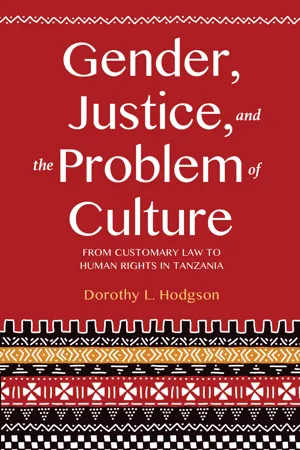
eBook - ePub
Gender, Justice, and the Problem of Culture
From Customary Law to Human Rights in Tanzania
- 204 pages
- English
- ePUB (mobile friendly)
- Available on iOS & Android
eBook - ePub
Gender, Justice, and the Problem of Culture
From Customary Law to Human Rights in Tanzania
About this book
Information
CHAPTER 1
Creating “Law”
Colonial Rule, Native Courts, and the Codification of Customary Law
HISTORIANS, ANTHROPOLOGISTS, AND OTHER SCHOLARS of gender in Africa have long looked to the implementation and interaction of colonial and customary legal regimes as rich sites through which to explore colonial gender productions and contestations. Some scholars have examined how colonial efforts to codify customary laws caused previously fluid and dynamic considerations and decisions to become fixed, written legal principles that reinforced the power and privileges of elder men over women and junior men, especially in the realms of marriage, divorce, bridewealth and adultery (Chanock 1985; Mbilinyi 1988; Schmidt 1990; Kanogo 2005; cf. Shadle 1999, 2006). Others have documented how some African women took advantage of new colonial judicial bodies to circumvent customary mechanisms for dispute resolution (Byfield 2001; Lovett 2001). Few of these studies, however, take a step back to consider what the colonial insistence on creating and naming a discrete field of social relations as the realm of “law” meant for the complex ideas and practices of gendered justice and dispute resolution among Africans: How did the colonial codification of customary law and creation of legal institutions like native courts marginalize other understandings of justice, including those deployed by women? What were the gendered consequences of reinforcing androcentric forms and forums of “law,” which are predicated on principles of individual rights, secularism, rationality, and neutrality, for alternative conceptions of justice premised on ideas of morality, respect, and social interdependence?
To explore these questions, this chapter examines the mechanisms of gendered justice and dispute resolution that existed among Maasai in the late 1800s. It examines the creation and implementation of customary law and colonial legal institutions and its consequences for not just relations between and among men and women, but for broader Maasai ideas and practices of justice, respect, and morality in which women and the (primarily female-identified) Maasai divinity Eng’ai were significant.
MAASAI IDIOMS OF GENDER JUSTICE
As Martin Chanock (1985) argued years ago, it is notoriously difficult for contemporary scholars or policymakers to describe ideas of justice, practices of dispute resolution, and other aspects of what we call “law” and “justice” for African societies prior to colonial conquest and control. For societies like Maasai who did not keep written records, there are two primary sources for this information. The first source, oral histories with African men and women, are rich but problematic, shaped as they are by memory, perspective, nostalgia, affect, and other influences (White, Miescher, and Cohen 2001). The second set of sources are the accounts and reports of European travelers, missionaries, and early colonial officials, all of which are partial, interested, and often contorted by racist and sexist assumptions about the lives of Africans. One of the most problematic assumptions was of course that all Africans lived in discrete, self-contained social groups called “tribes” led by “chiefs” in which their cultural ideas, social networks, political structure, religious beliefs, dominant modes of livelihood, and language were isomorphic. The other challenge was that by the time these Europeans wrote their reports, the ideas and practices they were writing about had already changed, sometimes quite dramatically, in response to colonial interventions—such as forced removal of Africans from their territories, violent “pacification,” disease, and new commodities—and other historical events like slavery, the ivory trade, drought, disease, migration, and warfare.
All these problems complicate any effort to describe “Maasai idioms of justice” in the early colonial period. The ethnic term “Maasai” only emerged in the discourses of Europeans in the late 1800s to describe Maa speakers who relied primarily on pastoralism as their dominant mode of production, in contrast to Maa speakers who relied on farming (Il Lumbwa, Arusha) or gathering and hunting (Il Torobo) (Bernsten 1980; Hodgson 2001a, 25). Even as Maa-speaking herders began to adopt the name themselves and embrace a sense of belonging to a larger collective social body called “Maasai,”1 their well-documented practices of intermarriage, adoption, and assimilation and their dispersed geographical presence and movements troubled any clear attribution of who was a “Maasai” and thus what was or was not considered a “Maasai” practice or idea. Moreover, when first the Germans then the British arrived in Tanganyika (as Tanzania was called at the time), Maasai were recovering from a series of devastating livestock and human disease outbreaks (a period they called emutai—“the disasters”) that had killed much of their livestock, wiped out entire families, and produced dramatic social, economic, and political upheaval (Waller 1988; Hodgson 2001a, 36–39). Finally, as discussed in the introduction, early European accounts of “the Maasai” were full of images of them as either fierce, primitive savages at the bottom of the social evolutionary ladder or an obsessive fascination and admiration of them as proud, independent “warriors” (Hodgson 2001a). These images, some of which persist until the present, shaped ideas about and interventions into Maasai lives, including colonial efforts to understand customary law and develop judicial institutions, processes, and procedures.
Thus to describe “Maasai” idioms of justice as of the late 1800s and early 1900s is to presume a much more coherent, stable set of practices and ideas than probably existed. Nonetheless, in what follows, I draw on critical and contextualized readings of the available (if problematic) historical evidence to present an overview of ideas of “law” and “justice” among people who identified or were identified as Maasai during this particular historical moment, with the understanding that these practices and ideas were themselves dynamic historical products, not some idealized, never-changing, “precolonial” tradition. Whatever their origins and identifications, groups of people had to share certain common ideas, values, practices, and institutions in order to live, love, and labor together.
The evidence suggests that as of the late 1800s and early 1900s, Maasai, like many other African societies at the time, had no understanding of “law” as a discrete field of social relations, especially one that denied the centrality of the sacred to daily life.2 As Moritz Merker, a German administrator, remarked in 1904, “Legal consciousness is very little developed among the Masai” (1910 [1904], 212). In the Maa language, there was no term for “law” as a social field, just a word (enkitanapata, pl. inkitanapat) for distinct rules and commandments that people were supposed to follow in daily life to demonstrate and maintain relations of respect (enkanyit, see below) (Mol 1977, 94). A dispute or a case was called an enkiguena (pl. inkiguenat), a term that also meant a meeting of elders—the very forum used to resolve most public disagreements (Mol 1977, 94). The closest Maa word for “justice” was esipat (pl. isipat), which was derived from the verbs asip (to tell the truth) and asipa (to be true, to be evident) and thus actually meant “truth” or “true statement” (Mol 1996, 373; 1977, 94).
Instead, as I have discussed elsewhere (Hodgson 2005), most transgressions were interpreted by Maasai as disruptions of or challenges to the moral order, an order constituted through their relationship with their predominantly female divinity, Eng’ai. Since Eng’ai “was understood in feminine terms as the divine principle that created, supported, and nurtured life on earth” (Hodgson 2005, 22), Maasai women saw themselves, and were perceived by men, as closer to Eng’ai. Women’s closeness to Eng’ai was expressed and experienced in many ways, including their shared power to produce and nurture human life. The closeness was not just metaphorical but material; Maasai men and women believed that Eng’ai was present in them through their oltau, their heart and spirit. Oltau was at once a unique, inner essence bequeathed to each person by Eng’ai, an agentive force, and the locus of moral value (Hodgson 2005, 213–15). A person’s oltau could influence his or her actions, and people could improve or worsen their iltauja (the plural of oltau) through their practices, in part by “opening” or “closing” their iltauja to Eng’ai. Significantly, although both men and women embodied Eng’ai though their oltau, women’s oltau was characterized as closer and more attuned to Engai’s directives and moral sensibilities. Therefore women prayed throughout the day to Her, thanking and entreating Eng’ai for the continued protection, preservation, expansion, and prosperity of their family and herds. Since Maasai believed that She could also be harmful and vengeful if angered by their actions (Hodgson 2005, 23; Merker 1910 [1904], 205–6), women also prayed for forgiveness for any slights or transgressions.
Daily life for Maasai men and women was predicated on the values of mutual respect (enkanyit), reciprocity and social interdependence (osotua), and leading a good and holy (sinyati) life in the present so that Eng’ai would bless them with good health, children, and cattle: “The focus of their beliefs and practices was thus maintaining the complementarity between Eng’ai and humans, between the sky and the earth, and correcting—through daily prayers and ceremonies of reconciliation and forgiveness—any transgressions or disturbances that occurred to this relationship. These transgressions ranged from the relatively minor (lies or insults) to the fairly common (cattle theft from other Maasai) to the major (sexual intercourse between a man and a pregnant woman, or murder), and were dealt with accordingly” (Hodgson 2005, 62).
As a code of respect, enkanyit structured gender and age relations in terms of rights, responsibilities, and proper relationships through a set of shared and clearly understood expectations and prohibitions about proper greetings, practices, postures, diet, sexual partners, and more. Certain practices—like a father sleeping with his real or classificatory daughter—were harshly forbidden (enturuj) and very rare, while others were publicly condemned but fairly common (a “warrior” [olmurran] sleeping with a married woman). Following the rules and code of conduct central to enkanyit, especially in terms of realizing one’s responsibilities to other people, particularly one’s dependents, juniors, and less fortunate family and friends, was central to being seen as living a good and holy (sinyati) life. But these were, of course, ideals; the reality of individual reputations and relationships, challenges to dominant interpretations about how to properly express enkanyit, and so forth were far more messy and complicated.
As with most pastoralist groups, men and women relied on one another, their extended families, affinal relations, neighbors, age mates, lineage mates, and other social networks for information, access to resources (such as grazing land, water, and salt licks), political stability, and risk management in an environment marked by extreme microlocal differences in rainfall, disease, and vegetation. The exchange of bridewealth (and other gifts), marriage, polygyny, male age sets, ritual feasts and celebrations, and the birth of children were thus central to forging and maintaining bonds between families, homesteads, lineages, and clans (Hodgson 2001a, 2005). Individuals had relationships with one another, but these ties created and expressed larger social connections and obligations between their relevant social groups (kin, lineages, clans, age sets). These ties were, in turn, modulated by the values of enkanyit, osotua, and sinyati.
Conflicts, disputes, and transgressions were handled in a variety of ways depending on the age, gender, and relationship of the parties involved and the nature of the offense. In the case of inappropriate or disrespectful behavior by individuals, men and women expressed their contempt through symbolic actions like spitting on the ground in front of the offending person (which inverted the normative meaning of spitting as an act of blessing) (Hollis 1905, 315–16; Merker 1910 [1904], 122) or verbal curses such as “May Eng’ai trouble you!” (Mikinjirie Eng’ai!) or “May a wild animal devour you!” (Tananga naisula!) (Merker 1910 [1904], 109–10; Hollis 1905, 344). But people within certain close relationships—such as husbands and wives, parents and children—had to be careful about such curses, or even insults, as the consequences were powerful. If, for example, a husband insulted his wife by calling her a sexually explicit term (which men and boys and even young girls and boys often used to tease each other), she could move back to her natal home and return her bridewealth (Merker 1910 [1904], 110). Similarly, if a mother cursed her son by striking her stomach and saying, “You were born in this,” he was said to sicken, and could only recover if his mother made a fiber rope to hang around his neck (Hollis 1910, 478; cf. Bianco 2000).
Transgressions that affected groups of people—such as cattle theft or bridewealth disputes—were usually heard by groups of elder male homestead and age-set leaders (ilaigwenak) from the relevant area, clan, or section. After lengthy prayers to Eng’ai, they would listen to all parties in the disputes (women were usually represented by male relatives but could directly address the male elders), each of whom invoked Eng’ai as a claim to be telling the truth. The elders then took turns sharing their perspectives on the case until they reached a consensus. They considered all aspects of the dispute: the relationship and responsibilities of the parties in terms of Maasai codes of enkanyit; their entanglement in wider social networks such as age sets, lineages, marriage, and patron-client relations; longer histories of relations between the parties and their relatives; and other facets of the social context and history that seemed relevant. If needed, they resorted to ordeals to force people to reveal the truth.3 These lengthy meetings were then closed by another round of prayers to Eng’ai (Merker 1910 [1904], 218–20). Their goals were less to decide who was right and who was wrong than to seek compromises (usually involving some form of compensation through the transfer of cattle) that were satisfactory to all parties involved and would restore harmonious social relations between the disputing parties and with Eng’ai (what legal anthropologists call “restorative justice”).4
For especially egregious moral transgressions such as the murder (loikop) of another Maasai, the penalties depended on whether the death was accidental or premeditated and on the gender, age, marital status, and parental status of the killer and victim.5 They could include what colonial administrators called “blood revenge” if an adult man ...
Table of contents
- Cover
- Title Page
- Copyright
- Dedication
- Contents
- Acknowledgments
- Introduction: Gender, Justice, and the Problem of Culture
- 1 Creating “Law”: Colonial Rule, Native Courts, and the Codification of Customary Law
- 2 Debating Marriage: National Law and the Culture of Postcolonial Rule
- 3 Criminalizing Culture: Human Rights, NGOs, and the Politics of Anti-FGM Campaigns
- 4 Demanding Justice: Collective Action, Moral Authority, and Female Forms of Power
- Conclusion: Gender Justice, Collective Action, and the Limits of Legal Interventions
- Bibliography
- Index
Trusted by 375,005 students
Access to over 1.5 million titles for a fair monthly price.
Study more efficiently using our study tools.
Frequently asked questions
Yes, you can cancel anytime from the Subscription tab in your account settings on the Perlego website. Your subscription will stay active until the end of your current billing period. Learn how to cancel your subscription
No, books cannot be downloaded as external files, such as PDFs, for use outside of Perlego. However, you can download books within the Perlego app for offline reading on mobile or tablet. Learn how to download books offline
Perlego offers two plans: Essential and Complete
- Essential is ideal for learners and professionals who enjoy exploring a wide range of subjects. Access the Essential Library with 800,000+ trusted titles and best-sellers across business, personal growth, and the humanities. Includes unlimited reading time and Standard Read Aloud voice.
- Complete: Perfect for advanced learners and researchers needing full, unrestricted access. Unlock 1.5M+ books across hundreds of subjects, including academic and specialized titles. The Complete Plan also includes advanced features like Premium Read Aloud and Research Assistant.
We are an online textbook subscription service, where you can get access to an entire online library for less than the price of a single book per month. With over 1.5 million books across 990+ topics, we’ve got you covered! Learn about our mission
Look out for the read-aloud symbol on your next book to see if you can listen to it. The read-aloud tool reads text aloud for you, highlighting the text as it is being read. You can pause it, speed it up and slow it down. Learn more about Read Aloud
Yes! You can use the Perlego app on both iOS and Android devices to read anytime, anywhere — even offline. Perfect for commutes or when you’re on the go.
Please note we cannot support devices running on iOS 13 and Android 7 or earlier. Learn more about using the app
Please note we cannot support devices running on iOS 13 and Android 7 or earlier. Learn more about using the app
Yes, you can access Gender, Justice, and the Problem of Culture by Dorothy L. Hodgson in PDF and/or ePUB format, as well as other popular books in Social Sciences & Gender & The Law. We have over 1.5 million books available in our catalogue for you to explore.