Driven by genocide, civil war, political instabilities, ethnic and pastoral hostilities, the African Great Lakes Region, primarily Uganda, Rwanda, Democratic Republic of the Congo, and Burundi, has been overwhelmingly defined by conflict. Kenneth Omeje, Tricia Redeker Hepner, and an international group of scholars, many from the Great Lakes region, focus on the interlocking conflicts and efforts toward peace in this multidisciplinary volume. These essays present a range of debates and perspectives on the history and politics of conflict, highlighting the complex internal and external sources of both persistent tension and creative peacebuilding. Taken together, the essays illustrate that no single perspective or approach can adequately capture the dynamics of conflict or offer successful strategies for sustainable peace in the region.
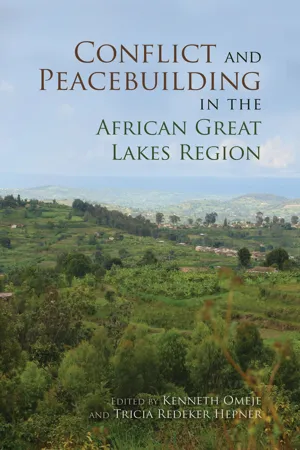
eBook - ePub
Conflict and Peacebuilding in the African Great Lakes Region
- 262 pages
- English
- ePUB (mobile friendly)
- Available on iOS & Android
eBook - ePub
Conflict and Peacebuilding in the African Great Lakes Region
About this book
Trusted by 375,005 students
Access to over 1.5 million titles for a fair monthly price.
Study more efficiently using our study tools.
Information
PART I
THE GREAT LAKES REGION
Challenges of the Past and Present
1 Understanding the Diversity and Complexity of Conflict in the African Great Lakes Region
Kenneth Omeje
FAR FROM THE influential Western-centric assumptions and international media propaganda that tend to regard African political conflicts as a resurgence of a malignant warrior spirit rooted in precolonial atavism, this chapter elucidates the diversity and complexity of the conflicts in the Great Lakes region. It places the multifaceted and interlocking conflicts and wars that have characterized the postcolonial experiences of the countries of Great Lakes in a historical perspective to illuminate why some have proved recurrent and persistent. I argue that although some conflicts date back to precolonial intergroup animosities, European colonial policies and politics most decisively account for the entrenchment and virulence of the conflicts and their structural underpinnings. With regard to the postcolonial phase, I contend that political conflicts in the Great Lakes region have largely been aggravated by different factions of postcolonial elites deliberately interposing their interests in the exploitative and unjust political, social, and economic institutions and structures inherited from the colonialists, as opposed to revamping the structures to serve the collective interests of the citizens. Furthermore, given the historical and geo-demographic interconnectedness of the people of the Great Lakes region, many of the deep-rooted and protracted conflicts have sprawling regional dimensions. The most significant in this regard is the Hutu-Tutsi imbroglio in the volatile Rwanda–Burundi axis, which I call the “conflict epicenter” on account of its widespread resonance and consequences for regional security.
Colonial Experiences and Structures of Political Violence
The Great Lakes region had mixed colonial experiences that laid the foundation for the nature of political conflicts plaguing the region in the postcolonial dispensation. Following the Berlin Conference of 1885–87 in which Africa was balkanized by contending European powers, three dominant colonizers emerged in the region. Burundi, Rwanda, and mainland Tanzania were colonized by Germany in what was originally known as German East Africa. The Belgians colonized the Democratic Republic of Congo (DRC), originally as a personal fiefdom (known as the Congo Free State) of the brutal Belgian monarch King Leopold II (1885–1908) and subsequently as a colony of the imperial government of Belgium. The British colonized the island of Zanzibar, Kenya, and Uganda. After the defeat of Germany in World War I and the relinquishing of German East Africa to rival European powers, mainland Tanzania (renamed Tanganyika) was ceded to the British as a trusteeship territory under the defunct League of Nations, while Burundi and Rwanda were awarded to the Belgians. The end of World War I in 1918 and its outcome in terms of control of colonies was such a major turning point in the history of the Great Lakes region that some analysts delineate two phases, the first corresponding to the pre-1918 dispensation of three colonial powers (Germany, Belgium, and Britain), and the second phase referring to the post-1918 dispensation of two colonizers (Belgium and Britain).
Notwithstanding the different historical dispensations, the purpose (and to a lesser extent, method) of colonization was essentially the same for all the colonial powers, including those that were not involved in the region, like the French, Spanish, and Portuguese. On the face of it, colonialism was constructed as a necessary humanitarian intervention conceived to save, guide, and civilize the Africans, who were derogatively referred to as the “natives”—a euphemism for inferior, uncultured, and primitive people. Mbembe (2001, 34–35) describes this purported claim of selfless humanitarian intervention as “the fiction of compassion and benevolence.” Intrinsic to the latter is a twofold practical objective: The first was obliteration of the natives’ “primitive” political, sociocultural, religious, legal, and economic structures. The second was imposition of the colonizers’ social, cultural, political, and economic values, and worldviews on the colonized, a process conceived as an upliftment to modernity. The two objectives were deliberately intended to conceal the primary purpose of colonialism—to secure overseas enclaves for natural resource and economic exploitation for the benefit of Western Europe (see Rodney, 1972).
Colonial Land Expropriation
The centrality of resource extraction led the colonial administrations to deliberately expropriate land as they desired. Various imperial statutes were introduced to legalize land expropriated for various purposes: cash crop production, exploration and mining, construction of residential areas for colonial officials, wildlife conservation reserve parks, cattle ranching, and so on. In a settler colony like Kenya, a greater percentage of the country’s arable land (mostly in the Rift Valley and Nairobi provincial areas) was expropriated by the colonizers for plantation agriculture and wildlife conservation purposes. In the process, nomadic pastoral groups like the Maasai lost a great part of their lands. In DRC, large scale expropriation was contrived for both mining and plantation agriculture. Throughout the region, the rate of colonial land grabbing was high and almost in all cases pastoral communities suffered the most. Hence, some of the problems of land pressure and related conflicts that have embroiled many pastoral communities in the region—a problem that has evidently been aggravated by climate change—go back to the nature, scale, and externalities of colonial land grabbing. However, among some Nilotic nomadic pastoralists, the history of land pressure and resource conflict goes back to the precolonial era because of their seasonal movements in search of greener pastures and water for their livestock—a lifestyle that seems to have a greater predilection for encroachment on supposedly open territorial lands claimed by other communities, both pastoral and sedentary (see Obika and Bibangambah, this volume).
The colonial land-grabbing policy was in all cases supported by a system that empowered the colonizers to coercively recruit and use the expropriated locals as cheap plantation, mining, and construction labor. Consequently, the bulk of the alienated labor, mostly previous small-scale cultivators of family and extra-family lands, were displaced and squeezed into congested suburbs in the emerging urban economies. These suburbs, which soon developed into deplorable slums, hardly had any cultivable lands. The desperate quest for colonial wage labor engendered by the new liberal market economy, the disproportionate land expropriation among certain communities, as well as the discriminatory preference that the colonizers showed for certain ethnic groups with regard to the scarce colonial casual jobs (e.g., the Baganda in Uganda; see Opongo, this volume) altogether triggered unprecedented mass migration, some of which was encouraged, especially among ethnic communities preferred for colonial service.
The large-scale colonial population displacement, movement, and resettlement had strong implications for land access and interethnic relations. Among these was the resettlement of various groups in the ethnic homelands of others, especially with regard to issues of land access/ownership and rights of indigeneity (an African customary right usually earned by virtue of being a member of an autochthonous ancestral community) as opposed to rights of citizenship (a nationality right acquired by having membership by birth or naturalization in a state) (see Moritz 2004).
Quite significantly, unexpropriated lands were mostly of marginal or no productive value. In a country like Kenya, for instance, these were mainly lands in (semi) arid areas. Colonial intervention was disruptively revolutionary: it unraveled the entire indigenous land-tenure system and distorted the geo-demographic landscape. In many parts of Africa, the injustices created by the colonizers’ land intervention were part of the core grievances that catalyzed nationalist struggles for independence and also helped mobilize and sustain the interests of grassroots populations in decolonization campaigns. There was a huge expectation among expropriated and landless peoples that the overthrow of the colonizers, leading to self-rule, would deliver, if not restore, justice on land. This was quickly dashed and scuttled, however; the political elites that inherited power from the colonialists at independence disingenuously replaced the departing colonizers and played up the ethnic card to divert attention and cover up continuing injustice.
Nowhere was this tendency more palpable than in the settler economy of Kenya where the first independence president, the legendary Jomo Kenyatta, usurped a large proportion of the agricultural land vacated by British colonizers and allocated most of the remainder to loyal ethnic Kikuyu aides and some of the veterans of the Mau Mau liberation war (see FIAN 2010, 17). A great part of the reallotted land is in traditional non-Kikuyu homelands, particularly in the lush Rift Valley province—the ancestral homeland of the ethnic Kalenjin and Maasai. The twenty-four-year reign of Daniel arap Moi, who succeeded Kenyatta as president in 1978, was a neopatrimonial dispensation that essentially politicized the land question in a self-serving manner. Moi used his control of state power to directly or indirectly acquire large tracts of land for himself and made similar patronage-driven allocations to members of his ethnic Kalenjin oligarchy. “To restore stolen land, the Kikuyu were evicted from areas where they had earlier settled; associated tensions thereafter had caused thousands of casualties and displaced more than 350,000 persons” (FIAN 2010, 17). Ramifying tension and violence have thus characterized land politics and attempts at reform in postcolonial Kenya.
Ethno-cultural Diversity, Colonial Rule, and Politicization of Identity
In a historical analysis of the conflicts in the Great Lakes region, Rwandan President Paul Kagame (2006) identified three key factors in colonial rule that account for post-colonial conflict. The first was the artificial national boundaries and administrative structures within states created by colonial rule that brought together different ethno-cultural groups unprepared to compromise their diversity, and conversely split apart others that were equally unprepared to compromise their unity. Secondly, the redrawing of the ethno-cultural map of Africa was compounded by the divide-and-rule and discriminatory policy of the colonialists in which certain groups were arbitrarily preferred and privileged over others. In fact, this policy was so efficiently contrived and manipulated that the colonizers used it as an instrument to create different ethnicities within some hitherto homogenous ethnic groups, including groups that had largely neutralized their identity boundaries. For example, in spite of divergent ethno-historical origins, the Hutu and the Tutsi made significant strides in dissolving their ethno-cultural and linguistic differences in the precolonial period. The colonizers not only (re)activated and solidified these boundaries but also split the Hutu and Tutsi into different contiguous states—Burundi, Rwanda, and, to a lesser extent, the DRC. Other examples of arbitrary splitting of homogenous groups across national and provincial boundaries abound. The ethnic Somalis were split into four different colonies that later became sovereign states: Kenya, Somalia, Djibouti, and Ethiopia; this has been the basis for repeated wars of irre-dentism in the Horn of Africa. The Luo were split into Sudan, Kenya, Tanzania, and Uganda, while the Maasai were partitioned into Kenya and Tanzania. The Karamojong cluster “tribes” were divided into Kenya, Sudan, and Uganda, and the Kakwa were separated into northwestern Uganda, southern Sudan, and northeastern DRC.
In Uganda, the ethnic Baganda, who were ostensibly favored by the British, were used in both the public and security services to subdue all other kingdoms (see Munene 2010). Within Kenya, the Kikuyu had an advantage because of their early contact with the colonizers and Christian missionaries, and their proximity to the administrative headquarters of Nairobi. In the cause of colonial service, however, they were encouraged to migrate from their ethnic domain in Central province to other parts of the country, especially the more strategic Nairobi and Rift Valley areas. This influx had severe implications for land tenure, later exacerbated by postcolonial resettlement of many landless Kikuyu veterans of the Mau Mau independence struggle in the ethnic Kalenjin homeland of the Rift Valley region. Similarly, the Belgian colonizers encouraged a steady influx of Banyarwanda (literally, people from Rwanda) into Congo (DRC) as guest labor in the vast plantations and mines, leading progressively to a large settlement of Kinyarwanda-speaking communities in the North Kivu region of DRC bordering Rwanda (Jourdan 2005, 3).
Within both Rwanda and Burundi, the Belgian colonizers favored the Tutsi over the Hutu, arrogating ethno-racial superiority to the minority Tutsi and setting the context for Hutu reprisals and/or ethnic wars at the dawn of independence and in subsequent years. Political instability in postindependence Rwanda and interethnic feuding between the Hutu and Tutsi both before and during the 1994 genocide aggravated the migratory influx. As a result, the Banyarwanda have greatly outstripped the indigenous Congolese populations in what should be the latter’s ancestral homeland. Today, a tripartite conflict faultline exists in North Kivu between the Banyarwanda and the minority indigenous Congolese communities, on the one hand, and within the Kinyarwanda-speaking community (between the Hutu and Tutsi), on the other. The rift between the Hutu and the Tutsi has been exacerbated, especially in the aftermath of the Rwandan genocide.
It is thus evident that colonialism not only dismembered various ethno-cultural groups into different states but also within each state. A characteristic unease was engendered and accentuated among the amalgamated ethnic groups, worsened by the divide-and-rule policy of the various colonial powers. Ethnic identity and discrimination became decisive factors in the allocation of, and competition for, public resources (Nnoli 1989). One deleterious effect in Rwanda, Burundi, Uganda, and Kenya is how the shifting ethnic balance of power was reproduced in the socioeconomic division of labor and access to political power.
The third factor identified by Kagame (2006) was the preoccupation of the colonial administration with exploitation and export of raw materials (extractive minerals and agricultural cash crops) for the economic benefit of Europe and at the expense of developing basic infrastructures and delivery of social services in the colonies. Economic production in the colonies was foremost to satisfy industrial development and consumption needs in the Western metropoles to the utter disregard of local needs and the regional market. DRC and Tanzania, to a lesser extent, mostly produced and exported solid minerals and agricultural resources (copper, diamonds, gold, timber, rubber, coffee, sugar cane, and palm oil) while other Great Lakes countries mainly exported typical colonial cash crops like tea and coffee. Hardly any development infrastructures such as long-distance road networks and railways were constructed either within or among colonies, save those that facilitated evacuation of primary commodities for export (e.g., the Kenya–Uganda railway). The colonial economic structure of producing primary raw materials for exports had overwhelming disadvantages that persisted after independence. It unduly exposed African economies to the volatility of the international commodity market, thereby not only inducing an occasional balance of payment crisis but also fundamentally limiting the options for trade, development, and economic decolonization for most countries (see Omeje 2008).
Throughout colonial history, one factor that contributed to societal fragmentation and conflict was the system of indirect administration using indigenous chiefs, Islamic clerics, and imposed traditional rulers otherwise known as “colonial warrant chiefs.” Indirect rule, as it is popularly known, was elevated to the status of a policy by the British but all colonial authorities practiced it to varying degrees because of the limited number of European personnel on the ground and the facade of legitimacy offered by using local surrogates. Indirect rule was preferred for resource extraction (taxes) and maintenance of law and order. But the practice was replete with local oppression and ethnic vendetta. Interethnic feuding was more prevalent in areas where the colonial authorities privileged certain groups and empowered them as indirect administrators and civil servants over others. In securing indirect rule, many chiefdoms were merged or territorially reconfigured for the administrative convenience of the colonizers. Indirect administrators were responsible for widespread acts of impunity, including arbitrary imposition of levies and taxes, land grabbing, unlawful arrest, detention and torture of innocent persons, operation of secret prisons, repression and persecution of subjects using their private (native) police, as well as gun-running and neopatrimonial corruption (see Mamdani 1996; 2001). There was sporadic resistance against indirect administration, especially in various parts of Zanzibar, Uganda, Burundi, and Rwanda.
Decolonization Struggles, Party Politics, and the Legacy of Colonial Divide-and-Rule
One of the most far-reaching consequences of the radicalization of ethnic consciousness and identity during the colonial era was in the evolution of party politics, which was partly tied to decolonization struggles. In most African colonies, multiparty politics was granted as a result of the nationalist struggle for expansion of the political space and ultimately independence. However, anticolonial nationalism either incidentally or by colonial design had profound ethnic dimensions. Similarly, some of the parties that emerged to compete for...
Table of contents
- Cover
- Title Page
- Copyright
- Contents
- Acknowledgments
- List of Abbreviations
- List of Foreign Terms
- Introduction: Conflict and Peacebuilding in the African Great Lakes Region
- Part I. The Great Lakes Region: Challenges of the Past and Present
- Part II. Case Studies of Conflict and Peacebuilding in the Great Lakes
- Part III. Social and Cultural Dimensions of Conflict and Peacebuilding in the Great Lakes
- Index
- List of Contributors
Frequently asked questions
Yes, you can cancel anytime from the Subscription tab in your account settings on the Perlego website. Your subscription will stay active until the end of your current billing period. Learn how to cancel your subscription
No, books cannot be downloaded as external files, such as PDFs, for use outside of Perlego. However, you can download books within the Perlego app for offline reading on mobile or tablet. Learn how to download books offline
Perlego offers two plans: Essential and Complete
- Essential is ideal for learners and professionals who enjoy exploring a wide range of subjects. Access the Essential Library with 800,000+ trusted titles and best-sellers across business, personal growth, and the humanities. Includes unlimited reading time and Standard Read Aloud voice.
- Complete: Perfect for advanced learners and researchers needing full, unrestricted access. Unlock 1.5M+ books across hundreds of subjects, including academic and specialized titles. The Complete Plan also includes advanced features like Premium Read Aloud and Research Assistant.
We are an online textbook subscription service, where you can get access to an entire online library for less than the price of a single book per month. With over 1.5 million books across 990+ topics, we’ve got you covered! Learn about our mission
Look out for the read-aloud symbol on your next book to see if you can listen to it. The read-aloud tool reads text aloud for you, highlighting the text as it is being read. You can pause it, speed it up and slow it down. Learn more about Read Aloud
Yes! You can use the Perlego app on both iOS and Android devices to read anytime, anywhere — even offline. Perfect for commutes or when you’re on the go.
Please note we cannot support devices running on iOS 13 and Android 7 or earlier. Learn more about using the app
Please note we cannot support devices running on iOS 13 and Android 7 or earlier. Learn more about using the app
Yes, you can access Conflict and Peacebuilding in the African Great Lakes Region by Kenneth Omeje, Tricia Redeker Hepner, Kenneth Omeje,Tricia Redeker Hepner in PDF and/or ePUB format, as well as other popular books in Politics & International Relations & Peace & Global Development. We have over 1.5 million books available in our catalogue for you to explore.