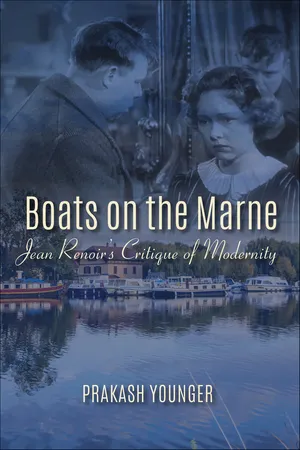
Boats on the Marne offers an original interpretation of Jean Renoir's celebrated films of the 1930s, treating them as a coherent narrative of philosophical response to the social and political crises of the times. Grounded in a reinterpretation of the foundational film-philosopher André Bazin, and drawing on work from a range of disciplines (film studies, art history, comparative literature, political and cultural history), the book's coordinated consideration of Renoir's films, writings, and interviews demonstrates his obsession with the concept of romanticism. Renoir saw romanticism to be a defining feature of modernity, a hydra-headed malady which intimately shapes our personal lives, culture, and politics, blinding us and locking us into agonistic relationships and conflict. While mapping the popular manifestations of romanticism that Renoir engaged with at the time, this study restores the philosophic weight of his critique by tracing the phenomenon back to its roots in the work and influence of Jean-Jacques Rousseau, who first articulated conceptions of human desire, identity, community, and history that remain pervasive today. Prakash Younger argues that Renoir's films of the 1930s articulate a multi-stranded narrative through which the director thinks about various aspects of romanticism and explores the liberating possibilities of an alternative paradigm illuminated by the thought of Plato, Montaigne, and the early Enlightenment. When placed in the context of the long and complex dialogue Renoir had with his audience over the course of the decade, masterpieces such as La Grande Illusion and La Règle du Jeu reveal his profound engagement with issues of political philosophy that are still very much with us today.
- 352 pages
- English
- ePUB (mobile friendly)
- Available on iOS & Android
eBook - ePub
About this book
Trusted by 375,005 students
Access to over 1.5 million titles for a fair monthly price.
Study more efficiently using our study tools.
Information
1

Genesis and Style of
the French Renoir
THE GENESIS OF THE FRENCH RENOIR: THE IDEAL OF MODERN POPULAR ART
“Contact with the public, you see . . . that’s the thing I would have liked to experience. That must be overwhelming, eh? When I think that it’s passed me by, well, it does something to me. Then I try to rack my brains, to work out what happened . . .”
Octave confesses his deepest anguish
to Christine in La règle du jeu
to Christine in La règle du jeu
THOUGH RENOIR’S POINT OF DEPARTURE as a cinephile has been obscured by the originality of his own achievement, it can be seen to have played a crucial role in his formation as a filmmaker. Of central importance is the ideal of the cinema as a modern popular art that he derived from silent American films, especially those of D. W. Griffith, Charlie Chaplin, and Erich von Stroheim.1 In describing his growing interest in the cinema, Renoir consistently draws a sharp contrast between the American filmmakers he loved and the French cinema of the time, which he found to be pretentious and boring.2 The first defining moment of this narrative is “the revelation of Charlot” that took place during World War I.3 This episode begins with the enthusiastic report of a friend in Renoir’s bomber squadron whose father, a Nobel Prize–winning scientist named Richet, had asserted that Charlot was a greater actor than Sarah Bernhardt and that through such films as his the cinema was going to play an important role in the development of nations. Back in Paris and determined to see a Chaplin film, Renoir had scarcely taken off his hat and coat before his elder brother, Pierre, asked him, “Have you seen Charlot?”
I told him what Professor Richet had said. “That doesn’t surprise me,” said Pierre. “Greatness attracts greatness”—and we went to see a Charlot “short” in a little theatre near the Place des Ternes. To say that I was enthusiastic would be inadequate. I was carried away. The genius of Charlot had been revealed to me. . . . I saw every film of his that was shown in Paris again and again, and my love of him did not grow less. I began to be interested in other films and became a fanatical cinema fan. Charlie Chaplin had converted me. I reached the point of seeing three feature films a day, two in the afternoon and one in the evening. The cinema was beckoning to me.4
Inspired by Charlot and American films, Renoir initially felt his future profession was beckoning to him from across an unbridgeable gulf.
The idea of working in the cinema did not occur to me. It seemed to me impossible to do anything worthwhile in France. Weren’t the American films I loved so much, and the actors who transported me, scorned and even totally ignored by most of our critics? How could I, who dreamed timidly of following in their footsteps, but never hoped to equal them, how could I have conceived of having the slightest chance in this pedestrian country of mine?5
At the time, the gulf between Renoir’s aesthetic values and those of the French society he inhabited was embodied in the fact that the American films he loved played only in the smaller, cheaper theatres, while the “pretentious nonsense” of French cinema and “totally ridiculous” Italian films played in the prestigious larger theatres.6 He quotes the professional assessment of the theatre-actor Pierre:
“The cinema doesn’t suit us [French],” he said. “Our burden of literature and drama is too heavy for us to follow that particular line. We must leave cinema to the Americans . . . the American cinema is essentially working-class. Between ourselves, I envy my colleagues over there who have that kind of public to work for—Irish or Italian immigrants who scarcely know how to read.”7
Though from a historical perspective these judgments may now seem rather sweeping, for our purposes they serve to introduce the political dimension of Renoir’s aesthetic ideals:
An essential element in the quality of any work of art is simply the quality of the public from whom the artist gets his living. Mack Sennett’s was an ideal public, a working-class public largely composed of newly arrived immigrants. Many of them knew very little English: the silent cinema exactly suited them. Today’s public is composed of the children of those primitive audiences. They come from the university; they live in a world of advertising, newspapers and weekly reviews; they behave according to the principles instilled in them by the most effective publicity media, the most “artistic” and the most entertaining. For their benefit the film factories churn out heroism or love or, worst of all, psychology.8
Though most of these remarks were first published in 1974, they ostensibly refer to critical judgments that Renoir and his brother made almost sixty years earlier; as such, they appear prescient of issues that critics and film historians would address much later. During the 1980s the rediscovery of a “cinema of Attractions” and the heated debates over the working-class composition of its audience all took place in the context of an existing consensus that the classical Hollywood cinema was essentially an apparatus of ideological conditioning.9 Many of these scholars drew their theoretical inspiration from Walter Benjamin’s seminal 1935 article “The Work of Art in the Age of Mechanical Reproduction.”10 As a result of their corrosive impact on traditional aesthetic categories, Benjamin argued that photography and the cinema could play two very different roles in modern life. On the one hand, they offered a means for the masses to liberate themselves through an aggressive defamiliarization of existing cultural values; throughout the essay Benjamin refers to Chaplin as a prime example of this revolutionary potential.11 On the other hand, the control of these technologies by the forces of capitalism and fascism tends to “violate” this potential, putting it to the task of reconstituting “ritual values” that alienate the masses from their own experience; in place of the lost aura of traditional culture, capitalism and fascism substitute “the phony spell” of stars and other commodities, using the new technologies as an unprecedentedly intimate means of ideological domination.12
It should be clear what Renoir’s comments share with this analysis. He contrasts the direct bond between an art and its public, exemplified by the aggressive defamiliarizations of Mack Sennett, with a cinematic apparatus that works in tandem with other technologies of ideological conditioning (“the most effective publicity media”) to reconstitute ritual values (“the most ‘artistic’”) by extracting a surplus from the distracted state of the audience (“the most entertaining”). In place of real love and heroism, this type of cinema offers an ersatz based, in the worst instances, on a false notion of human “psychology” that alienates the public from its own most intimate experiences. As a consequence, in what Renoir calls the “over-developed” nations, the “bourgeois way of life has made the worker himself into a bourgeois. A genuine proletariat is now only to be found in the under-developed countries. The Brazilian peon is a proletarian, but the worker for General Motors is not.”13
Renoir made this distinction between an authentic popular culture and one that is false or alienating throughout his life, and denunciations of the latter can be found throughout the range of his published writings. From his disgust with the debilitating myth of the poilu that flourished during World War I, through his scathing critiques of “bourgeois manias,” fascist rhetoric, and pornographic music hall spectacles during the 1930s, to his complaints about Hollywood, American Christmas celebrations, the “immense childishness” of post–World War II culture, and even the work of his nouvelle vague disciples, one gets the sense of a pronounced and persistent discontent with the political and cultural state of the world.14 Though an understanding of the reasons for this discontent will only start to emerge in later chapters, it is important to note the extent to which he felt it before his career even started and to preview the fact that his aesthetic and philosophic agenda would often be defined by an agonistic relation with existing tendencies in French culture.15
What exactly was it about silent American films that attracted Renoir? If part of the answer resides in their power to render contemporary experience through a defamiliarization of alienating cultural values, then another part can be grasped by recognizing the links between the American cinema and earlier popular traditions: “Old-fashioned melodrama was cunningly undermining its conquerors, the discursive plays and drawing-room comedies, the boulevard-theatre in general. Literary theatre occupied the centre of the road, but the cloak-and-dagger heroes were not done for and only awaited their chance to come out of hiding. This chance was what the American cinema gave them.”16 In Renoir’s view, the success and value of the silent American film derived from the fact that it resurrected old-fashioned melodrama and reconstituted the popular audience for that form; again, the implications of this view can be illuminated by briefly reviewing a relevant trend in film scholarship. Though interest in melodrama was already manifest in the rediscovery of Douglas Sirk during the late 1960s, Thomas Elsaesser’s 1972 article “Tales of Sound and Fury: Observations on the Family Melodrama” was the first comprehensive attempt to identify a genealogy that linked cinematic manifestations of the form with roots going as far back as medieval morality plays and popular gestes.17 Published four years later, Peter Brooks’s study of the melodrama hidden beneath the realist surface of nineteenth-century fiction defined it as a reaction to the “desacralization” of modern life, the popular symptom of “a renewed thirst for the Sacred” that had an integral kinship with romanticism.18 This work provided a broad context and support for the model that feminist and Marxist film scholars then used to recover the social contradictions masked by the ideological function of classical Hollywood narration.19 Working in a formalist and structuralist tradition, Rick Altman’s 1992 article “Dickens, Griffith, and Film Theory Today” put forward a dialogical model of classical Hollywood cinema that showed how its affective power derives from a tension between the historical time and practical concerns of linear narrative and the mythical time and moral concerns of melodrama.20 Taking Altman’s argument one final step further, Linda Williams in “Melodrama Revised” (1998) and Playing the Race Card (2001) jettisons the surface/depth hermeneutic that has generally governed the scholarly recovery of the form, arguing instead that melodrama is the fundamental mode through which Americans make moral sense of their historical experience.21 Drawing on evidence from a wide variety of domains (films, novels, stage plays, popular songs, television shows, and news coverage), she defines it in terms of familiar figures (a space of innocence, victim-heroes whose virtue requires recognition) and characteristic affects (produced by a dialectic of pathos and action); melodramatic texts are only artifacts of a pervasive process whereby the historical experience of marginalized groups—women, African Americans and other ethnic minorities, the lower classes—achieves cultural and political recognition.22
Though these scholarly concerns are only latent in Renoir’s comments on melodrama, they illuminate the cultural politics underlying his enthusiasm for American genre films. In addition to their powers of aggressive defamiliarization, these films provided their audience with the compelling figures it needed to make moral sense of contemporary experience; like scholars of melodrama, Renoir recognized that their social and aesthetic achievement is obscured by notions of literary quality and psychological realism and is grounded instead in the familiar relations they reestablished with the audience: the cloak-and-dagger heroes emerged from historical oblivion, vanquished the stale bourgeois culture that had presumed to supplant them, and triumphantly reunited a popular art and its audience.
From the time of his earliest cinephile enthusiasms on, the ideal of a modern and popular art shaped Renoir’s obsessive concern with the quality of his contact with the public. Few major directors have reflected as often and explicitly on this issue or assigned the audience as central a role in their creative process. Renoir generally identified different periods in his career in terms of paradigm shifts in his relations with the audience; as we shall see, the genesis of the “French Renoir” (André Bazin’s term for the films of the 1930s) was mainly a matter of discovering the cultural idioms and aesthetic strategies he believed would link him to the French audience of the time. This concern also shaped Renoir’s work within periods/paradigms, as the reception of his films explicitly influenced his creative decision making going forward.23 Renoir relied on previews in a way that was exceptional, driven by the belief that the audience could recognize something that he could not:
In every successful film there is one scene to which its success may be attributed; but it is impossible to tell in advance which scene this will be. It is a sort of key that opens a locked door. The key itself may be rusty or badly finished, but no matter; for me it opens that particular door. Without the film-maker realizing it, the scene puts the audience in touch with every character in the film, and thanks to it they come to life and become recognizable people. Their words and gestures, from being matters of indifference, become passionately interesting and the audience wants to know more about them.24
As the notion of the key scene suggests, the desired quality of immediate contact, of being in touch or meeting, is understood to elude the exact predictions and control of the filmmaker; this quality can be discovered only through a dialogue that entails creative pr...
Table of contents
- Cover
- Half title
- Title
- Copyright
- Dedication
- Contents
- Preface: The Enigma of La règle du jeu
- Acknowledgments
- Introduction: Jean Renoir, Cinephilosopher
- 1. Genesis and Style of the French Renoir
- 2. Escaping from Flaubert; or, Reflecting on Romanticism
- 3. Loving the Distance; or, Historical Experience and the Fruits of Reflection
- 4. La règle du jeu; or, Putting Modernity in Question
- Conclusion: Why La règle du jeu Matters
- Bibliography
- Index
- About the Author
Frequently asked questions
Yes, you can cancel anytime from the Subscription tab in your account settings on the Perlego website. Your subscription will stay active until the end of your current billing period. Learn how to cancel your subscription
No, books cannot be downloaded as external files, such as PDFs, for use outside of Perlego. However, you can download books within the Perlego app for offline reading on mobile or tablet. Learn how to download books offline
Perlego offers two plans: Essential and Complete
- Essential is ideal for learners and professionals who enjoy exploring a wide range of subjects. Access the Essential Library with 800,000+ trusted titles and best-sellers across business, personal growth, and the humanities. Includes unlimited reading time and Standard Read Aloud voice.
- Complete: Perfect for advanced learners and researchers needing full, unrestricted access. Unlock 1.5M+ books across hundreds of subjects, including academic and specialized titles. The Complete Plan also includes advanced features like Premium Read Aloud and Research Assistant.
We are an online textbook subscription service, where you can get access to an entire online library for less than the price of a single book per month. With over 1.5 million books across 990+ topics, we’ve got you covered! Learn about our mission
Look out for the read-aloud symbol on your next book to see if you can listen to it. The read-aloud tool reads text aloud for you, highlighting the text as it is being read. You can pause it, speed it up and slow it down. Learn more about Read Aloud
Yes! You can use the Perlego app on both iOS and Android devices to read anytime, anywhere — even offline. Perfect for commutes or when you’re on the go.
Please note we cannot support devices running on iOS 13 and Android 7 or earlier. Learn more about using the app
Please note we cannot support devices running on iOS 13 and Android 7 or earlier. Learn more about using the app
Yes, you can access Boats on the Marne by Prakash Younger in PDF and/or ePUB format, as well as other popular books in Mezzi di comunicazione e arti performative & Film e video. We have over 1.5 million books available in our catalogue for you to explore.