"Wake argues, the young Hegel experimented with using tragedy as a diagnostic tool to explain the rise and fall of religions and even history itself." —
Hegel Bulletin
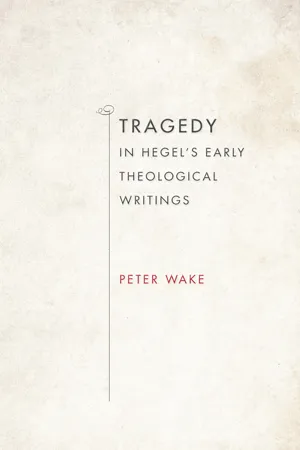
Tragedy plays a central role in Hegel's early writings on theology and politics. Hegel's overarching aim in these texts is to determine the kind of mythology that would best complement religious and political freedom in modernity. Peter Wake claims that, for Hegel at this early stage, ancient Greek tragedy provided the model for such a mythology and suggested a way to oppose the rigid hierarchies and authoritarianism that characterized Europe of his day. Wake follows Hegel as he develops his idea of the essence of Christianity and its relation to the distinctly tragic expression of beauty found in Greek mythology.
"Elegant. Combines the virtues of close reading of extraordinary subtlety with a wide-angle scope not only to Hegel's work as a whole, but also to the enduring value of the early work." —Cyril J. O'Regan, University of Notre Dame
"Wake's book is provocative and helpful because it sharpens appreciation of the complexity of the material in the ETW; it brings into focus tensions and contradictions in the texts. It contributes to the recognition of the subtlety and enduring importance of this early work." —
Notre Dame Philosophical Reviews
- 272 pages
- English
- ePUB (mobile friendly)
- Available on iOS & Android
eBook - ePub
Tragedy in Hegel's Early Theological Writings
About this book
Trusted by 375,005 students
Access to over 1.5 million titles for a fair monthly price.
Study more efficiently using our study tools.
Information
Topic
Theology & ReligionSubtopic
Philosophy of ReligionPART 1
Positivity and the Concrete Idea of Freedom
ONE
Positivity and Historical Reversal
In thinking, I raise myself above all that is finite to the absolute and am infinite consciousness, while at the same time I am finite self-consciousness, indeed to the full extent of my empirical condition. Both sides, as well as their relation, exist for me [in] the essential unity of my infinite knowing and my finitude. These two sides seek each other and flee from each other.… I am not one of the parts caught up in the conflict but am both of the combatants and the conflict itself. I am the fire and water that touch each other, the contact and the union of what utterly flies apart.
—Hegel, Lectures on the Philosophy of Religion
Positivität: Either Life or Death
It is apparent from his earliest writings that, for Hegel, religions live and die. In his pre-Jena writings, the model for religious life is consistently the Volksreligion of ancient Greece. The sign of death is what he calls “positivity” (Positivität), and this characterizes the religion of Hegel’s own time. Most concretely, the “positive” elements of a religion are its statues, creeds, dogma, codified moral laws, and theologies,1 but, for Hegel, “positivity” means, in essence, artificially fixing what is inherently fluid. More pointedly, it is a kind of fundamentalism, insofar as this term refers very narrowly to the naturalizing or essentializing of “contingent, historically conditioned traits.”2 “Positive” law, as opposed to “natural” law, is not self-given but is instead posited by a dominant, external authority. It gives rise, in turn, to a broadly legalistic caste of mind. When it is not simply an automatic adherence to the law, legalistic thinking reduces duties to a kind of calculus: “a dead letter is laid down as a foundation and on it a system is constructed prescribing how men are to act and feel” (W 1:181/P 137).3 A positive liturgy, then, is one that presents rituals and texts as if they were fixed and indisputable facts.4 The practices that Hegel associates with positive religion are an insult to life: “To mouth incomprehensible prayers, to read masses, to recite rosaries, to perform meaningless ceremonies, this is the activity of the dead. Man here attempts to become a sheer object [Objekt], to allow himself to be ruled entirely by something that is foreign.”5 In sum, “a positive religion is a contranatural or a supernatural one, containing concepts and information transcending understanding and reason and requiring feeling and actions which would not come naturally to men: the feeling are forcibly and mechanically stimulated, the actions are done to order or from obedience without any spontaneous interest” (W 1:217/P 167). The letter is, as Hegel writes, dead.
Among the most significant positive elements found in early Christianity was the emphasis placed on Jesus’s own personality. In The Positivity of the Christian Religion,6 written in 1795–1796 while employed as a Hofmeister at the von Steiger home in Bern, Hegel describes the effect of this emphasis pointedly: the authority of Jesus’s words was not based in the substance of what he says but on the fact that he said them. For Hegel, this misunderstanding was encouraged by Jesus’s adoption of the role of a messiah and, most importantly, by the fact that he performed miracles as a sign of his divine nature. Like a fetish, the positive aspects of a religion come to take the place of that which they were initially supposed to serve. The fetish that usurps the place of the divine is able to triumph only with the collapse of the fluidity between signifier (miracle) and signified (divinity), for meaning is established precisely through this fluidity. The opposition between signifier and signified may remain but in a fixed form, with no possibility of commerce between the two. The effect is that both terms lose their validity.7 Thus, the miracles that are meant to signify the divine nature of Jesus qua universal morality—Jesus is divine because of a potentiality he shares with all human beings—become fetishized when Jesus is judged to be divine because of the miracles that he performs. We might still acknowledge the opposition between miraculous acts and the divine, but divinity is now located in Jesus alone. As such, a living relation with the divine is lost for those of us who cannot perform these miracles. We can only look up to or kneel before an alien being, and this, for the young Hegel, is nothing short of death. Thus, the way to God through the miraculous seems to make the possibility of reaching the destination impossible.
The Positivity is guided by the overarching question of how Christianity, as a religion that Hegel understands at this point to be grounded in Jesus’s teaching of free virtue, falls prey to precisely the kind of tyranny that it was originally established to challenge. That is, how does a religion born of a struggle against positive faith become contaminated by, and ultimately overwhelmed by, positivity itself? The supposition of Hegel’s detailed response in the Positivity essay is, again, that a vital religious community must protect itself from positive elements. Hans-Georg Gadamer writes of Hegel’s later dialectic that it aims “to dissolve in spirit’s being at home with itself everything ‘positive,’ everything estranged and alien.”8 For the Hegel of The Positivity of the Christian Religion, it would seem that everything positive simply works to contaminate, corrupt, and undermine life. The dialectical thinking that dissolves everything positive in spirit is absent. What we wish to track, however, in our reading of Hegel’s early writings is the subtle emergence of the dialectical pattern of thought that conceives of living practices as arising from the incorporation of these positive elements.
Conviction and the Proper Name “Hegel”
Hegel’s investigation into the origins of the fall of Christianity into Positivity begins with an analysis of the essence of Christianity as a living religion. This analysis, in turn, begins with a rejection of the need for a confession of faith. In an attempt to uncover what Christianity is in itself, the convictions of the author, and his personality generally, are deemed irrelevant: “a dry sketch of that kind would have encouraged the opinion that the author regarded his individual conviction as something important and that his personality came under review along with the whole matter at issue” (W 1:105/P 68). Although Hegel is driven to investigate the origins of Christianity by the particular historical situation that he confronts and although this is determinative for why he looks back to this particular place and point in history (first-century Judea), he eschews the particularity of his own name and personality. By the very fact that Hegel discounts the relevance of a first-person declaration of faith, his text begins, in effect, by raising the question of the relation between faith and knowledge. He proceeds by first determining the essence of religion as such before asking whether Christianity conforms to this essence, but his general assumption throughout is that this essence is supplied by rational reflection alone. If, however, disinterested theoretical reflection can determine the character of the proper object of faith, what is the need for faith? Is it simply a nonreflective means of instilling the beliefs that reason alone could establish freely? And is it, then, simply a crutch for those unable, or unwilling, to employ their rationality? If so, what is to stop religious faith from functioning in the service of paternalistic deception and pacification? As Dostoevsky’s Grand Inquisitor confesses,
The most painful secrets of their conscience, all, all they will bring to us, and we shall have an answer for all. And they will be glad to believe our answer, for it will save them from the great anxiety and terrible agony they endure at present in making a free decision for themselves. And all will be happy, all the millions of creatures except the hundred thousand who rule over them. For only we, we who guard the mystery, shall be unhappy.9
By way of contrast with the tidy solution that sees reflection as the arbiter of rationally acceptable articles of faith, we should consider “The Oldest Program toward a System in German Idealism” fragment, written in the very first weeks of 1797, and so after the composition of the Positivity. The text is written in the first person, but, given that its authorship is a matter of debate, it is perhaps a collective “I,” an “I” that is “we”10:
we so often hear that the great mass of men must have a sensuous religion. Not only the great mass of men, but the philosopher too, needs it. Monotheism of reason and of the heart, polytheism of the imagination and art, that is what we need!
First, I shall speak here of an idea which, as far as I know, no human mind has ever entertained—we must have a new mythology; but this mythology must remain in service to the ideas, it must become a mythology of reason.
Until we make the ideas aesthetic, i.e., mythological, they will have no interest for the people; and, conversely, until the mythology is rational, the philosophers will perforce be ashamed of it. Thus the enlightened and unenlightened must at long last clasp hands; mythology must become philosophical, and the people rational, while philosophy must become mythological, in order to make the philosophers sensuous. Then eternal union will prevail among us. No more the contemptuous glance, no more blind quaking of the people before their sages and priests. (OP 12–13)
In “The Oldest Program,” we find neither a personal confession of faith nor a simple, Enlightenment defense of the capacity of theoretical reason to police religious doctrine, but instead a call for a future revolution in spirit characterized by a union beyond this disjunction, a union that would mark an end to positivity. As the poetic body of faith, the mythological must not be considered mere ornamentation but must instead play an essential role in achieving this union. To form the sensuous philosopher, the “polytheism of the imagination” is as crucial to the philosopher as is the “monotheism of reason” to the nonphilosopher. The author of the fragment writes, “The philosopher must possess as much aesthetic force as the poet,” and poetry “will again become what she was in the beginning—the instructress of humanity” (OP 11). The position of the sensuous philosopher, and sensuous reason, is not to stand apart from the people as wise men or secularized priests and relieve the weight of the painful secrets of their conscience with promises of heaven. The vision of the author of “The Oldest Program” is defined by both freedom and equality, as well as a faith that is immanent to the extent that it is directed toward “neither God nor immortality outside themselves” (OP 10). Is Hegel in agreement, at least implicitly, with this thoroughgoing reciprocity of reason and mythology in The Positivity of the Christian Religion? I will argue that he is not, or at least not resolutely so. A sign of his unwillingness to accept this reciprocity is the vehemence of his challenge to positivity itself. With the exclusion of the positive elements of religious practices, the possibility of producing a mythology that will be of interest to anyone other than the nonsensuous philosopher is greatly diminished.
We will return to the broadly Kantian Enlightenment position on the relation between faith and reason that Hegel advances in the Positivity essay. We will do so, however, by way of a circuitous route that skips from Hegel’s Bern writings (1795–1796) over “The Oldest Program” (1797) to a pair of essays, the Differenzschrift (1801) and Faith and Knowledge (1802), that were produced while Hegel was working with Schelling on the Critical Journal in Jena. We turn to these two essays in particular at this point because of the sharp criticisms they raise to this Kantian Enlightenment position. Thus, when we return, after a relatively brief stay in Jena, to Bern and the account of reason and faith that Hegel defends in the Positivity, we will do so fully cognizant of his own subsequent criticisms of it. Only then will we move forward again, in part 2 of the book, to an intermediary position between Bern and Jena. Geographically, this is Frankfurt. Conceptually, it is the point where Hegel adopts the position that, to borrow the words of “The Oldest Program,” “the idea that unifies all, [is] the idea of beauty.” It is a point where, I will argue, Hegel concurs with the assertion that “the supreme act of reason, because it embraces all ideas, is an aesthetic act; and that only in beauty are truth and goodness of the same flesh” (OP 10–11). We will find, in other words, Frankfurt-era writings by Hegel that corroborate, and elaborate on, the protospeculative position sketched in “The Oldest Program.” Further, we will see that Hegel builds on this position in The Spirit of Christianity and Its Fate when he argues that Greek tragedy is the model for the imaginative correlate of reason.
Faith and Knowledge in Modernity
Hegel’s first acknowledged publication, “Differenz des Fichte’schen und Schelling’schen Systems der Philosophie” (Jena, 1801), also known as the Differenzschrift, challenges the Kantian conceptualization of the relation between faith and reason presented in the Positivity essay by advancing one of his earliest philosophical defenses of the speculative principle of the unification of opposites. Indeed, he claims that speculative philosophy is the fulfillment of philosophy as such. He goes on to describe “speculation” in a way that shows the centrality of the sensuous reason heralded in “The Oldest Program” fragment:
The sole interest of [speculative] Reason is to suspend such rigid antitheses [reason and sensibility, intelligence and nature, absolute subjectivity and absolute objectivity]. But this does not mean that Reason is altogether opposed to opposition and limitation. For the necessary dichotomy is one factor in life. Life eternally forms itself by setting up oppositions, and totality at the highest pitch of living energy is only possible through its own re-establishment out of the deepest fission. What Reason opposes, rather, is just the absolute fixity which the intellect [Verstand] gives to the dichotomy [Entzweiung]. (W 2:21/D 90–91)
Speculative thought aims to achieve unification, but a unification that contains within itself difference and opposition. To assume that any opposition or limit is unchanging or fixed is an offense to speculative reason. As we will see, if “life” is the name that Hegel gives to this unification in Jena, in his earlier Bern writings, it was given the historical and geographical location of ancient Greece. The conclusions that Hegel will draw from his investigations into the historical development of Christianity, along with its relation to Greece, are summarized concisely in a subsequent passage from the Differenzschrift:
As a culture grows and spreads, and the development of those outward expressions of life into which dichotomy can entwine itself becomes more manifold, the power of dichotomy becomes greater, its regional sanctity is more firmly established and the strivings of life to give birth once more to its harmony become more meaningless, more alien to the culture as a whole. Such few attempts as there have been on behalf of the cultural whole against more recent culture, like the more significant beautiful embodiment of far away or long ago, have only been able to arouse the modicum of attention which remains possible when the more profound, serious connection of living art can no longer be understood. (W 2:23/D 92)
What Hegel calls “positivity” in Bern takes the philosophical form of Entzweiung, while “life” is conceptualized as speculative reason. Dichotomy insinuates itself into a living culture by way of the most peripheral aspects of it, thereby disrupting the harmony of the whole. While speculative reason is “speculative” insofar as it incorporates dichotomies within itself, the power of dichotomy can overwhelm. Greece is the ideal of unification, or “life” (“the more significant beautiful embodiment of far away or long ago”), insofar as it manifests a cultural whole that achieves, through “art’s all-embracing coherence,” the highest aesthetic perfection.11 The living union that Greece embodies ultimately flourishes through the proliferation of dichotomies, but to do so, it must avoid their rigid polarization.
We find the specific application of speculative reason to the opposition between faith and reason in a text titled Faith and Knowledge (1802), written a year after the Differenzschrift. In Faith and Knowledge, Hegel sets out his living, speculative relation of faith and reason by way of a contrast with the modern, nonspeculative idea of what he calls “practical faith.” This is a position established by Kant but pushed to its logical conclusion by Fichte, and it purports to resolve the conflict between faith and reason, religion and philosophy, fro...
Table of contents
- Cover
- Title Page
- Copyright
- Dedication
- Contents
- Acknowledgments
- List of Abbreviations
- Introduction: Monotheism of Reason and the Heart, Polytheism of the Imagination and Art
- PART 1 Positivity and the Concrete Idea of Freedom
- PART 2 The Spirit of Withdrawal
- Conclusion: Comedy, Subjectivity, and the Negative
- Notes
- Bibliography
- Index
Frequently asked questions
Yes, you can cancel anytime from the Subscription tab in your account settings on the Perlego website. Your subscription will stay active until the end of your current billing period. Learn how to cancel your subscription
No, books cannot be downloaded as external files, such as PDFs, for use outside of Perlego. However, you can download books within the Perlego app for offline reading on mobile or tablet. Learn how to download books offline
Perlego offers two plans: Essential and Complete
- Essential is ideal for learners and professionals who enjoy exploring a wide range of subjects. Access the Essential Library with 800,000+ trusted titles and best-sellers across business, personal growth, and the humanities. Includes unlimited reading time and Standard Read Aloud voice.
- Complete: Perfect for advanced learners and researchers needing full, unrestricted access. Unlock 1.5M+ books across hundreds of subjects, including academic and specialized titles. The Complete Plan also includes advanced features like Premium Read Aloud and Research Assistant.
We are an online textbook subscription service, where you can get access to an entire online library for less than the price of a single book per month. With over 1.5 million books across 990+ topics, we’ve got you covered! Learn about our mission
Look out for the read-aloud symbol on your next book to see if you can listen to it. The read-aloud tool reads text aloud for you, highlighting the text as it is being read. You can pause it, speed it up and slow it down. Learn more about Read Aloud
Yes! You can use the Perlego app on both iOS and Android devices to read anytime, anywhere — even offline. Perfect for commutes or when you’re on the go.
Please note we cannot support devices running on iOS 13 and Android 7 or earlier. Learn more about using the app
Please note we cannot support devices running on iOS 13 and Android 7 or earlier. Learn more about using the app
Yes, you can access Tragedy in Hegel's Early Theological Writings by Peter Wake in PDF and/or ePUB format, as well as other popular books in Theology & Religion & Philosophy of Religion. We have over 1.5 million books available in our catalogue for you to explore.