"Continues and adds to a rich conversation among American philosophers concerning the origins of pragmatism and its possibilities for the future." —William Gavin, University of Southern Maine
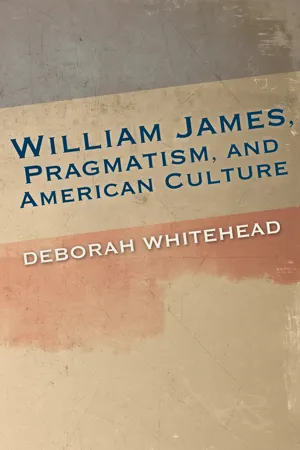
William James, Pragmatism, and American Culture focuses on the work of William James and the relationship between the development of pragmatism and its historical, cultural, and political roots in nineteenth-century America.
Deborah Whitehead reads pragmatism through the intersecting themes of narrative, gender, nation, politics, and religion. As she considers how pragmatism helps to explain the United States to itself, Whitehead articulates a contemporary pragmatism and shows how it has become a powerful and influential discourse in American intellectual and popular culture.
- 194 pages
- English
- ePUB (mobile friendly)
- Available on iOS & Android
eBook - ePub
William James, Pragmatism, and American Culture
About this book
Information
Topic
PhilosophySubtopic
Pragmatism in Philosophy1Varieties of Pragmatism
WRITING IN 1980, David Hollinger chronicled the history of pragmatism in the first half of the twentieth century and concluded that “if pragmatism has a future, it will probably look very different from its past, and the two may not even share a name.”1 At that time the focus was more on pragmatism’s past, and its future outside specialized philosophical studies was very much in question. Fifteen years later in 1995, Hollinger had revised this assessment to take account of the explosion of new interest in the writings of Charles Sanders Peirce, William James, and John Dewey and the tradition of thought they developed and represented: “Pragmatism’s name is invoked in a host of contexts, mostly by people who claim to be inspired by the classical pragmatists, and who see themselves as reaffirming doctrines inherited from them.”2
Since the early 1980s, the philosophical tradition of pragmatism has experienced a wide-ranging renaissance in the North American academy, after decades of marginalization by forms of analytic philosophy and logical positivism in which the widespread perception was that pragmatism was a “rather fuzzy-minded philosophic movement.”3 Following the publication of Richard Rorty’s Philosophy and the Mirror of Nature in 1979 and Consequences of Pragmatism in 1982, which together almost single-handedly resurrected pragmatism as a viable (anti-)philosophical orientation, other scholars in philosophy and fields such as legal theory, rhetoric and communication studies, literary criticism, theology and religious studies, social theory, and history have followed suit in applying pragmatism to their own disciplines.4
As evidenced by the wealth of recent monographs, anthologies, and dissertations on the subject, pragmatism has generated a great deal of interest for many both inside and outside the academy. Louis Menand’s Metaphysical Club (2001), a highly readable and engaging history of pragmatism’s development in post–Civil War American culture, became a best seller and won the Pulitzer Prize for History. Numerous collections of published conference papers, special issues of journals, and anthologies chronicle the (re)discovery of pragmatist ideas in many academic disciplines. And there is no shortage of contemporary political relevance: intellectual historian James Kloppenberg argued in Reading Obama that President Barack Obama’s writings and speeches demonstrate a markedly pragmatist approach to democratic politics.5
This proliferation of pragmatisms has been accompanied by terminological confusion. One of the most striking things about this pragmatist renaissance is that many are talking and writing about it, but there remains a distinct lack of agreement about exactly what pragmatism is. The popular usage of the term connotes any range of qualities from “problem solving” to “results oriented” to “cunning,” perhaps best summed up in the broadly defined sense of pragmatism as “politics without principles.” As an editor of an anthology on pragmatism’s resurgence commented,
As it is used in common speech, the qualities associated with “pragmatism” generally win our enthusiastic assent. Politicians and pundits see pragmatism as the essence of American politics—the art of the possible, rooted in our aversion to ideology and our genius for compromise. . . . Others condemn this kind of pragmatism as policy without principle, goal-oriented but lacking a moral anchor.6
Such a wide division of opinion on pragmatism—seeing it as either a welcome antidote to overly abstract thinking with its focus on problem solving or as a cynical, amoral instrumentalism—was also present at the beginning of pragmatism’s development, as were recurrent controversies over the meaning of the term. James himself had noted that critics frequently misunderstood pragmatism as being concerned with “action” in a crass physical sense and with “what works” practically:
Our critics treat our view as offering itself exclusively to engineers, doctors, financiers, and men of action generally, who need some sort of a rough and ready weltanschauung, but have no time or wit to study genuine philosophy. It is usually described as a characteristically american movement, a sort of bobtailed scheme of thought, excellently fitted for the man on the street, who naturally hates theory and wants cash returns immediately. (MT, 101)
James and his followers spilled much ink in an attempt to correct such mistaken assumptions, but the association of pragmatism with a general sense of what works in a practical and expedient sense persisted. The result is that today we are no more, and perhaps even less, clear about the term’s meaning than in James’s time. A look at some of the many contemporary varieties of pragmatism in journals and books illustrates this point.
The term “pragmatism” is widely contested in the academy. A survey of the literature shows that sometimes “pragmatic” is simply used as a synonym for “practical” or “strategic.”7 In other cases, it is taken negatively to refer to a “narrow instrumentalism.”8 Alternatively, pragmatism is understood to be a central part of the continuum of a broadly construed American philosophical tradition dubbed “classical American philosophy.” Definitions in this vein can run from the general, as in Charlene Haddock Seigfried’s definition of pragmatism as “a range of positions originating in the classical period of American philosophy that challenge the traditional philosophical privileging of theory at the expense of practice,” to the more specific.9 For example, John J. Stuhr states that pragmatism can be defined historically as a movement traced to the Metaphysical Club in Cambridge in the 1870s that regards the writings of Peirce, James, and Dewey as foundational, as well as thematically with characteristics such as an emphasis on the inseparability of theory and praxis, fallibilism, pluralism, and community.10 Similarly, John E. Smith has identified the “spirit of American philosophy” as consisting of three primary features:
First, the belief that thinking is primarily an activity in response to a concrete situation and that this activity is aimed at solving problems. Second, the belief that ideas and theories must have a “cutting edge” or must make a difference in the conduct of people who hold them and in the situations in which they live. Third, the belief that the earth can be civilized and obstacles to progress overcome by the application of knowledge.11
Smith notes that pragmatism is not necessarily coterminous with the broader tradition of American philosophy that he demarcates, but he finds that uniquely American “spirit” and “vision” in the writings of Peirce, James, and Dewey, whose pragmatism “clearly represents an indigenous and original philosophical outlook.”12
David Hollinger is critical of attempts to treat pragmatism as representative of American thought or an American philosophical tradition, declaring that “we will not understand pragmatism as an episode in American history so long as pragmatism is either stretched to cover all of America or confined to those of its formulations sufficiently fruitful philosophically to have found places in the history of Western philosophy.”13 The problem with the first formulation is that the complex thought of Peirce, James, and Dewey, for none of whom can pragmatism be said to exhaust the whole of their thought, is “flattened into a style of thought characterized by voluntarism, practicality, moralism, relativism, an eye toward the future, a preference for action over contemplation, and other traits of the same degree of generality.” These characteristics are present to some degree in the early pragmatists’ writings, but, according to Hollinger, scholars’ attempts to treat pragmatists as “representatives of America” tend to forestall analysis of the relationship between them and their historical and social contexts. However, when pragmatism is limited to what it can be said to have contributed to the Western philosophical tradition, it “is sharpened into a highly distinctive theory of meaning and truth to which the writings of other modern philosophers can be contrasted.” It is often construed as “an ideal type toward which the pragmatists strived, but which they failed to fully articulate,” leaving it to contemporary scholars to “fill in the holes” and hence “complete and clarify their arguments.”14 In both cases, Hollinger argues, the complex relationship between pragmatists, their ideas, and the American cultural milieu out of which they emerged is occluded. It would be more accurate, he says, to treat Peirce, James, and Dewey as representatives of a mode of thought broadly characteristic of their time and as contributing to that ethos through the broad circulation of their ideas.
In still other cases, pragmatism is seen as a constellation of ideas and attitudes constituting the zeitgeist of the post–Civil War generation in America.15 There are also historical definitions of pragmatism with reference to the writings of the so-called classical pragmatists Peirce, James, and Dewey and the degree of faithfulness to the spirit if not the letter of their ideas.16 There are others for whom pragmatism signifies a useful means of classifying and bracketing their own intellectual influences, whether or not related directly to the classical pragmatists.17 Some depict pragmatism as a late-modern or proto-postmodern theoretical framework, foreshadowing and complementing deconstructionism in “demonstrating the futility of many philosophical questions and thereby presaging the European poststructuralists of our era.”18 A kind of “zero-degree pragmatism,” defined as “simply antiessentialism with respect to traditional philosophical concepts like truth and reason, human nature and morality,” is proffered as a possible consensus-building device in feminist theory.19 Another understanding of pragmatism is that it amounts to “nothing more than antifoundationalism,” a kind of minimalist, zero-sum deconstructionism and linguistic skepticism.20 These are just a few of the current usages of the term.
The question becomes how to circumscribe the topic to take into account the widest possible range of interpretations and divergent meanings of pragmatism while still keeping the project manageable. If one takes pains to clearly set forth a certain definition of pragmatism at the outset as a means of delineating the topic, one is already taking a stance on what pragmatism is: a set of clearly definable philosophical propositions, a historical complex of ideas, a cultural mind-set, a postmodern assemblage of strategically deployable theoretical tools, or none of these.
My approach here is different. Rather than attempt to set out in advance a definition of pragmatism, I trace a deployment of the term going back to James and the beginnings of the classical tradition, attending to a series of particular textual tropes that reveal the intimate connections between American pragmatism and U.S. culture. Though pragmatism takes all of the forms I have just described and many others, I am not so much interested in pinning down the meaning of the term as in critically analyzing its uses. I think the meaning(s) of the term can be identified in and through an analysis of how pragmatism is deployed and for what ends. This method treats pragmatism itself more pragmatically by not essentializing it through a definition or foundationalizing it by identifying it as a monolithic tradition but rather attending to how it functions in particular textual formations.
Why Pragmatism? Why Now?
The late Richard Rorty can be said to have initiated the current pragmatist renaissance, with the provocative assertion in 1979 that, along with Ludwig Wittgenstein and Martin Heidegger, Dewey was “one of the three most important philosophers of our century.”21 While most philosophers at the time considered pragmatism to be, in Rorty’s words, “an outdated philosophical movement—one which flourished in the early years of this century in a rather provincial atmosphere, and which has now been either refuted or aufgehoben”—Rorty argued instead that pragmatism provided not only a preferable alternative to analytic and to Continental philosophy, which he critiqued as continuing to replicate the notion of “mind as mirror,” but indeed was their logical conclusion.22 “On my view,” he wrote, “James and Dewey were not only waiting at the end of the dialectical road which analytic philosophy traveled, but are waiting at the end of the road which, for example, Foucault and Deleuze are currently traveling.”23 The end of this road is the end of Western Philosophy, properly speaking—“capital P” philosophy and its notion of the correspondence “either of thoughts to things or of words to things.”24
Rorty’s version of neopragmatism is far from an uncontested one, of course. Putnam, West, Stout, Brandom, and other contemporary philosophers who have formulated their own neopragmatist frameworks have done so in response to and, more often than not, in criticism of Rorty’s provocative writings. In particular, they have been critical of Rorty’s interpretations of James and Dewey and his understanding of the relationship between philosophy and politics in contemporary liberal democratic societies.25 So, too, historians, legal theorists, literary critics, social theorists, and religious studies scholars have frequently taken Rorty’s interpretations as a starting point for their own diverse pragmatist explorations.26
As the sketch I offered in the previous section indicates, there is a great deal of contemporary scholarship on pragmatism in a number of fields, yet as West commented as far back as 1993, there remains a “relative absence of pragmatist accounts of why pragmatism surfaces now and in the ways and forms that it does.” West’s concern was the lack of attention to the “structural background conditions” of intellectual-cultural developments like the revival of pragmatism. Efforts to account for pragmatism’s renaissance, he argued, “must situate the nature of pragmatist intellectual interventions—their intended effects and unintended consequences—in the present historical moment in American society and culture.”27
West’s own view was that the revival of pragmatism was connected with the “crisis of purpose and vocation” in the humanities. Writing in 1993, he explained:
The recent hunger for interdisciplinary studies—or the erosion of disciplinary boundaries—promoted by neopragmatisms, poststructuralisms, Marxisms and feminisms is not only motivated by a quest for truth, but also activated by power struggles over what kinds of knowledge should be given status, be rewarded and be passed on to young, informed citizens in the next century. These power struggles are not simply over positions and curriculums, but also over ideals of what it means to be humanistic intellectuals in a ...
Table of contents
- Cover
- Half title
- Title
- Copyright
- Contents
- Acknowledgments
- List of Abbreviations
- Introduction
- 1 Varieties of Pragmatism
- 2 Genealogies of Pragmatism
- 3 Pragmatism and the American Scene
- 4 The Gender of Pragmatism
- 5 The Revival of Pragmatism
- Conclusion: Continuing the Argument
- Notes
- Bibliography
- Index
Trusted by 375,005 students
Access to over 1.5 million titles for a fair monthly price.
Study more efficiently using our study tools.
Frequently asked questions
Yes, you can cancel anytime from the Subscription tab in your account settings on the Perlego website. Your subscription will stay active until the end of your current billing period. Learn how to cancel your subscription
No, books cannot be downloaded as external files, such as PDFs, for use outside of Perlego. However, you can download books within the Perlego app for offline reading on mobile or tablet. Learn how to download books offline
Perlego offers two plans: Essential and Complete
- Essential is ideal for learners and professionals who enjoy exploring a wide range of subjects. Access the Essential Library with 800,000+ trusted titles and best-sellers across business, personal growth, and the humanities. Includes unlimited reading time and Standard Read Aloud voice.
- Complete: Perfect for advanced learners and researchers needing full, unrestricted access. Unlock 1.5M+ books across hundreds of subjects, including academic and specialized titles. The Complete Plan also includes advanced features like Premium Read Aloud and Research Assistant.
We are an online textbook subscription service, where you can get access to an entire online library for less than the price of a single book per month. With over 1.5 million books across 990+ topics, we’ve got you covered! Learn about our mission
Look out for the read-aloud symbol on your next book to see if you can listen to it. The read-aloud tool reads text aloud for you, highlighting the text as it is being read. You can pause it, speed it up and slow it down. Learn more about Read Aloud
Yes! You can use the Perlego app on both iOS and Android devices to read anytime, anywhere — even offline. Perfect for commutes or when you’re on the go.
Please note we cannot support devices running on iOS 13 and Android 7 or earlier. Learn more about using the app
Please note we cannot support devices running on iOS 13 and Android 7 or earlier. Learn more about using the app
Yes, you can access William James, Pragmatism, and American Culture by Deborah Whitehead in PDF and/or ePUB format, as well as other popular books in Philosophy & Pragmatism in Philosophy. We have over 1.5 million books available in our catalogue for you to explore.