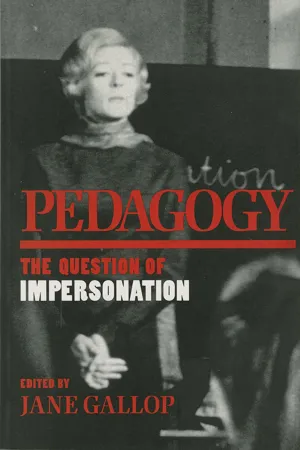
In this anthology, teachers and scholars examine the ways in which teaching is a performance that incorporates acts of impersonation.
Drawn from a conference on classroom dynamics, this anthology explores both the personal and performative aspects of teacher-student relationships. After David Crane's prefatory "postscript," George Otte recommends that students pretend, writing from various perspectives; Indira Karamcheti suggests putting on race as one can put on gender roles. Cheryl Johnson gets personal by playing the "trickster," and Chris Amirault explores the relationship between the teacher and "the good student."
While Karamcheti, Gallop, and Lynne Joyrich use theatrical vehicles to structure their essays, Joseph Litvak, Arthur W. Frank, and Naomi Scheman incorporate performance as examples. Madeleine R. Grumet theorizes pedagogy, while Roger I. Simon suggests that pedagogical roles can be taken on and off at will; Gregory Jay discusses the ethical side of impersonation; and Susan Miller denounces "the personal" as a sham.
- 192 pages
- English
- ePUB (mobile friendly)
- Available on iOS & Android
eBook - ePub
About this book
Information
Topic
Éducation1
Im-Personation
A Reading in the Guise of an Introduction
Jane Gallop
ON APRIL 15–17, 1993, the Center for Twentieth Century Studies of the University of Wisconsin-Milwaukee hosted a conference entitled “Pedagogy: The Question of the Personal.” The present volume represents the transformation of that event into a book. As such, a number of changes have occurred: some papers presented at the conference have not been included; a few of the essays here were not presented (although all authors were major participants in the conference); all of the papers have undergone various degrees of revision since the conference. Such changes are typical of collections which are not, strictly speaking, “conference proceedings” but rather belong to a related hybrid genre—publications which originate in but grow out of conferences. This introduction will not comment on such typical changes (although I recognize their inevitable local historical interest). The purpose of this introduction is rather to gloss a more singular, more dramatic alteration—the new title.
How and why did “the personal” become “impersonation”? What does this substitution say about the two terms? In attempting to answer these questions, I propose to link them, through the hybrid term “im-personation.” This introduction will try to theorize im-personation through reading its articulation in the essays collected here. But I want to begin by telling the how and the why of this change of garb. (A version of the first part of this story has already been told by David Crane.)
The semester of the conference, I taught a graduate seminar likewise entitled “Pedagogy: The Question of the Personal.” Other Center conferences have been accompanied by graduate courses and such a pedagogical enactment particularly suited this topic. During the weeks just preceding the conference, the seminar read essays by the speakers (not the ones they would present but others which the speakers chose as related). The night before the conference the class was discussing Lynne Joyrich’s article on Elvis impersonators and—in what for this class was not unusual behavior—began to play with applying the idea of impersonation in any direction we could make it go (vying for the honors of who could push it furthest). As we gathered in the hall for our mid-class break, we milked impersonation for all the fun we could get (beyond even our usual jocularity), moved by our excitement that the next day the people we had been reading would show up and talk to us in person. During our corridor impersonation shtick, Joyrich (who teaches at UWM) showed up and we couldn’t resist turning our class joke on the person who was, without knowing it, its author. Although Joyrich attempted to get us to tell her seriously what we thought of the essay, she was nonetheless clearly amused to find that our boisterousness was in fact some version of response to her essay. This encounter with an actual speaker on the very eve of the conference seemed a foretaste of the possible surplus pleasures of group attendance at this public event.
One of the prime pleasures here is the group feeling itself, marked in this narrative by an undifferentiated first-person-plural subject: we, the class. My version of the narrative avoids either individuated students or any differentiation between teacher and students. This construction of the undifferentiated class “we” is explicitly taken up in several of the essays that follow. Naomi Scheman, Chris Amirault, Susan Miller, and my own essay all confront the teacher’s desire to merge herself in the student group. Getting personal, or rather in this case social, playing a member of the class like any other, the teacher impersonates a student.
Crane’s version of this story, unlike mine, focuses on individuals telling jokes (in particular, him and me). While casting this as a story about individuals, Crane troubles over the way a class dynamic is betokened by a special relation between teacher and individual student. Crane’s worry finds its echo at the end of the book in Miller’s pointed critique of the evasion of the class as a class through narrative dyads where the teacher interacts with one student. Such dyads not only crop up throughout the volume but—as instanced in Crane’s and my story—are both unavoidable in and in fact constitutive of the present attempt to think pedagogy at the place where the personal becomes impersonation.
In considering the individual student, the teacher cannot help but take him, at least in part, as a token for the whole class of students. At the same time, any perception the teacher has of the class as a whole is necessarily focused and embodied by individual students.1 Crane wittingly navigates the contradictions of his token position in his preface; my attempt to tell the story founders against narrative conventions which force me to choose between a personal story about individuals or a group history. It feels unseemly to tell this as a story of my relation to David and inaccurate to tell it as an undifferentiated story about my relation to the class. However I tell it, it is, inextricably, both.
The morning of the second day of the conference, after Madeleine Grumet’s paper, I stood to ask about her “impersonation” of her student, referring to the thespian flair with which she had read her student’s papers. The question, although unremarkable to the public audience, was a private communication, a wink reassembling the class in the corridor where we had accosted Joyrich. “Impersonation” was a code word, an in-joke that could communicate effectively to select individuals dispersed among a larger public which remained unaware that any private communication had even occurred. The question was itself an impersonation: posing as a serious intervention, it was in fact meant as something else. Even though I was in public and had a formal obligation as conference coordinator to relate to the public as a whole, I performed the question as class clown, to make the students laugh (to give them pleasure, to make them like me), to tell them I was still thinking of them, still with them.
We talk a lot about students trying to please the teacher. Sometimes we discuss this matter-of-factly as a structural necessity; sometimes it seems scandalous and exploitative. But I want to draw your attention to this incident in which my professional behavior (in a context which included peers whom I very much wanted to impress) was motivated by my desire to please the students. I flag it not because I believe it an unusual occurrence but rather because it seldom appears in our writing. We all know (and loudly proclaim) that we must not care if our students like us if we are to do our duty as teachers. As embarrassing as the identity of “brownnose” might be for students, it can be—and frequently is—justified as what students must do to succeed professionally. A teacher trying to please students doesn’t have that rational, pragmatic excuse. I pause at this frequently experienced, generally denied scene of playing to the students, because I suspect it is a prime site where the personal tangles with impersonation.
I asked the question to make the class laugh, but it also must be said that I asked the question to make David laugh. In the jocular sociality of the class, David was my best audience, my best partner in repartee. When later I learned that David had been out of the room and not heard my question, I was disappointed.
That afternoon, after Cheryl Johnson’s paper, I asked a second “impersonation” question, referring to her impersonation of academic discourse in the definition of the Afro which closes her paper. Had David been in the room for the first, I might not have asked this second question. Yet this question was for me more serious, not just played for laughs. Johnson had begun by talking about masks and went on to warn us that she was a trickster. When her definition marked its comic exaggeration with the word “quadrangle” (used to define the shape of the comb used for Afros), I glimpsed in her paper a reflection about performance which rendered what might have been an impertinent question pertinent.
Johnson spoke in the last session of the second day. The next day, the last of the conference, I frequently found myself thinking in terms of impersonation. But it was no longer a joke. I asked Naomi Scheman about her evident pleasure in reading to us bell hooks’s scathing remarks about white feminists.2 While I may have used the word “impersonation” in my question, I was no longer trying to get my class to laugh. My intention now was to get speakers to talk about their dramatic taking on of other’s voices, what George Otte in this volume calls “in-voicing.” No longer merely an enjoyable bit of social silliness, “impersonation” had become for me a productive category of analysis.
After the conference, the class met for four more weeks. During those four class periods, the term “impersonation” was frequently heard. Although it still retained some of the pleasures of an in-joke, it was now also clearly a useful category organizing our discussions. When the final assignment for the semester asked each student to write about the course, Marsha Watson devoted a page to the word “impersonation.” I quote from her account:
One of the words that has been weaving through the second half of the class is “impersonation.” It has been both serious and comic; a topic for breaks as well as for papers; sometimes only appearing in a title, or in an off-hand comment in the middle of a discussion. First used in our classroom vocabulary late in the [semester], the concept now seems to me to have been undergirding the course from the start Rousseau impersonated a father, Bloom impersonated Socrates, Freire impersonated Christ, feminist teachers impersonated students….
I am fascinated by Watson’s idea that “impersonation” was “undergirding the course from the start.” No one had uttered the word until we read Joyrich three-quarters of the way through the semester. I who made up the syllabus and led class discussions had never thought of it. To illustrate that it was there from the start, Watson goes back and recaps our discussions of the books we read during the first half of the course, using the term “impersonation.” The term works, is surprisingly appropriate to the discussions we had where it was never mentioned. It is in fact more effective for unifying our various class discussions than terms we used at the time.
Watson goes on to propose that “the term ’impersonation’ caught hold in this course because of a view of pedagogy that we encountered in all our texts; a view that accepts that the aim of pedagogy is really reproduction.” Although she introduces “reproduction” as overarching explanation, it is also a reference to another of the texts for the course—Bourdieu and Passeron’s Reproduction in Education, Society and Culture.3 In Bourdieu and Passeron’s account, education involves, not only the specific case of the student as reproduction of the teacher, but the more general case of the student as impersonation of an educated person, taking on and reproducing the style and tastes of a class.4
“Watson brings in “reproduction” in order to explain why “’impersonation’ caught hold.” While the class’s concern with “reproduction” does not, to my mind, seem to sufficiently explain the peculiar effect of the term “impersonation,” I agree that the term “caught hold” with a vengeance that demands explanation. Furthermore I share Watson’s sense that “impersonation” not only “caught hold” but was “undergirding the course from the start.” This last idea is rich in epistemological implications. Her word “undergirding” connotes something that is hidden, not on the surface (hence the word was not in evidence, not used or even thought of) but structurally necessary to support what is on the surface. That a concept never considered should prove to have been a necessary structural support is surprising enough. But in our case, I want to draw attention to the accidental, marginal, and even silly derivation of this hidden structural principle.
Given the topic of the course, almost all the texts we read were about teaching. But since Joyrich had never written on pedagogy, when I asked her to recommend a relevant earlier paper, she chose the closest thing she had: an investigation into modes of knowledge. Because it was not at all about pedagogy, the paper on Elvis which introduced “impersonation” into the class was, of all the texts we read that semester, arguably the most marginal to the course.
Not only was our initial discussion of impersonation off the course’s topic; it was also not serious. Using Joyrich’s paper we could have had a considered dikussion of the meaning and implications of impersonation, but we did not. I suspect that impersonation “caught hold” in our class precisely because we made a joke of it.
Not every joke is so successful. Perhaps because impersonation, always already “undergirding the course,” was more than a joke—“both serious and comic, a topic for breaks as well as for papers,” as Watson says. Whereas “papers” are arguably the most serious business of a class, the site of requirement, anxiety, and evaluation, “breaks” are the most social, personable part. Standing around drinking pop, smoking, or snacking during break, the class members (both students and teacher) relate casually, socially, “as if we were just people,” rather than professionally. Yet a topic which could be “for breaks as well as for papers” crosses the line that would separate the social from the intellectual, the personal from the pedagogical, rendering that boundary porous and less decisive.
This double structure—“both serious and comic”—can be found not only in the odd effect of the word “impersonation” in our course; it also plays a major role in the professional performance that goes by the name impersonation. There are two major forms of such performance: Elvis impersonators and female impersonators.5 Elvis impersonators, Joyrich explains, have an odd epistemological status; they both are and aren’t believed, taken seriously as Elvis. While female impersonation is familiar stock comedy, Marge Garber demonstrates in Vested Interests how it can be understood as undergirding culture itself. Appreciating these two most organized forms as emblematic, I would argue that impersonation must be taken at one and the same time both as a joke and as serious. The general structure of impersonation would thus be not unlike the double structure Watson ascribes to the impersonation effect in our class.
By the end of the semester, I was convinced that “impersonation” was, for the class, both a great joke and a productive category. But when the semester and the class ended, I thought I was leaving impersonation behind. It was still a class joke and, however interesting it had become, you had to be there to get it.
I was sorry for that class to end. I felt considerable regret at the loss of the context in which the issues of the conference had grown more and more lively, complex, and fun. Despite my regret, by the end of May I had turned in my grades and read my student evaluations—the course was definitively over—and I turned to work on this book. George Otte’s paper had opened the conference, so I began my editorial reading there. Three-quarters of the way through his paper, I came upon the following:
If ventriloquism is dangerous for writing teachers, it may be just the thing for our students…. students are good at role playing, at in-voicing identities not their own.
Ventriloquism, role playing, in-voicing identities: I wrote...
Table of contents
- Cover
- Half Title
- Title Page
- Copyright Page
- Table of Contents
- Acknowledgments
- A Personal Postscript, an Impostured Preface
- 1. Im-Personation: A Reading in the Guise of an Introduction
- 2. Discipline, Spectacle, and Melancholia in and around the Gay Studies Classroom
- 3. Lecturing and Transference: The Undercover Work of Pedagogy
- 4. Scholae Personae: Masks for Meaning
- 5. Give Me a Girl at an Impressionable Age and She Is Mine for Life: Jean Brodie as Pedagogical Primer
- 6. The Good Teacher, the Good Student: Identifications of a Student Teacher
- 7. The Teacher’s Breasts
- 8. Face to Face with Alterity: Postmodern Jewish Identity and the Eros of Pedagogy
- 9. On Waking Up One Morning and Discovering We Are Them
- 10. Taking Multiculturalism Personally: Ethnos and Ethos in the Classroom
- 11. Disinfecting Dialogues
- 12. Caliban in the Classroom
- 13. In-Voicing: Beyond the Voice Debate
- 14. In Loco Parentis: Addressing (the) Class
- Contributors
- Index
Trusted by 375,005 students
Access to over 1.5 million titles for a fair monthly price.
Study more efficiently using our study tools.
Frequently asked questions
Yes, you can cancel anytime from the Subscription tab in your account settings on the Perlego website. Your subscription will stay active until the end of your current billing period. Learn how to cancel your subscription
No, books cannot be downloaded as external files, such as PDFs, for use outside of Perlego. However, you can download books within the Perlego app for offline reading on mobile or tablet. Learn how to download books offline
Perlego offers two plans: Essential and Complete
- Essential is ideal for learners and professionals who enjoy exploring a wide range of subjects. Access the Essential Library with 800,000+ trusted titles and best-sellers across business, personal growth, and the humanities. Includes unlimited reading time and Standard Read Aloud voice.
- Complete: Perfect for advanced learners and researchers needing full, unrestricted access. Unlock 1.5M+ books across hundreds of subjects, including academic and specialized titles. The Complete Plan also includes advanced features like Premium Read Aloud and Research Assistant.
We are an online textbook subscription service, where you can get access to an entire online library for less than the price of a single book per month. With over 1.5 million books across 990+ topics, we’ve got you covered! Learn about our mission
Look out for the read-aloud symbol on your next book to see if you can listen to it. The read-aloud tool reads text aloud for you, highlighting the text as it is being read. You can pause it, speed it up and slow it down. Learn more about Read Aloud
Yes! You can use the Perlego app on both iOS and Android devices to read anytime, anywhere — even offline. Perfect for commutes or when you’re on the go.
Please note we cannot support devices running on iOS 13 and Android 7 or earlier. Learn more about using the app
Please note we cannot support devices running on iOS 13 and Android 7 or earlier. Learn more about using the app
Yes, you can access Pedagogy by Jane Gallop in PDF and/or ePUB format, as well as other popular books in Éducation & Théorie et pratique de l'éducation. We have over 1.5 million books available in our catalogue for you to explore.