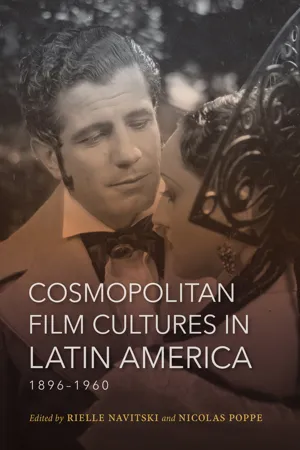
Cosmopolitan Film Cultures in Latin America examines how cinema forged cultural connections between Latin American publics and film-exporting nations in the first half of the twentieth century. Predating today's transnational media industries by several decades, these connections were defined by active economic and cultural exchanges, as well as longstanding inequalities in political power and cultural capital. The essays explore the arrival and expansion of cinema throughout the region, from the first screenings of the Lumière Cinématographe in 1896 to the emergence of new forms of cinephilia and cult spectatorship in the 1940s and beyond. Examining these transnational exchanges through the lens of the cosmopolitan, which emphasizes the ethical and political dimensions of cultural consumption, illuminates the role played by moving images in negotiating between the local, national, and global, and between the popular and the elite in twentieth-century Latin America. In addition, primary historical documents provide vivid accounts of Latin American film critics, movie audiences, and film industry workers' experiences with moving images produced elsewhere, encounters that were deeply rooted in the local context, yet also opened out onto global horizons.
eBook - ePub
Cosmopolitan Film Cultures in Latin America, 1896–1960
- 390 pages
- English
- ePUB (mobile friendly)
- Available on iOS & Android
eBook - ePub
Cosmopolitan Film Cultures in Latin America, 1896–1960
About this book
Trusted by 375,005 students
Access to over 1.5 million titles for a fair monthly price.
Study more efficiently using our study tools.
Information
Subtopic
Film History & CriticismPART I
The Silent Era: Between Global Capitalism and National Modernization
“The Lumière Cinematograph,” El Monitor Republicano (Mexico City), August 16, 1896
This unsigned account of one of the earliest exhibitions of moving images in Mexico City emphasizes not only the curiosity produced by the apparatus and its naturalistic reproduction of motion but also its proximity to other popular amusements, including the magic lantern and the circus, in a modernizing capital city.
THE NIGHT BEFORE LAST, on the top floor of the Plateros Drugstore (the second block of Plateros Street, number 9), an exhibition of the apparatus called the “Lumière Cinématograph” dedicated to the press of this capital took place.
The cinematograph is a type of magic lantern that projects a luminous cone onto a white screen placed in front of the spectators.
In the luminous field of the screen, scenes full of life and movement unfold, caught unawares by inventor’s photographic apparatus.
The night before last we viewed the following scenes: The Arrival of a Train, Rollercoasters, A Cavalry Charge, Card Party, The Baby’s Meal, Workers Leaving the Factory, The Sprinkler Sprinkled, Demolition of a Wall, and Swimming in the Sea.1
Each scene is more marvelous than the last.
In the arrival of the train, one sees the locomotive advance with all its natural movements, followed by the cars carrying the passengers, who disembark hurriedly and move away.
The scene is so natural that one almost seems to hear the noise of the train and the bustling of the passengers.
In the rollercoasters, a scene is shown similar to the one we saw in the pantomime A Baptism during Carnival at the Orrín Circus: a small boat that slides down a ramp and breaks the surface of the water, scattering it into a fine spray that envelops the vessel for a moment.
In the cavalry charge, one clearly sees the immense cloud of dust kicked up by the hooves of the horses, which envelops the field of operations in a dense haze.
In the card players, one can see the sometimes pensive, sometimes fevered attitude of the players, while the waiter approaches with a tray and bottles of beer and peeks behind the head of one of the players to see the cards in his hand, while a third player pours the beer from the bottles into the glasses.
The baby’s meal is a scene in the home of M. Auguste Lumière, inventor of the apparatus. One can see, seated at the table, M. Lumière on one side; his son, a young child, in the middle; and on the other side, Lumière’s wife M. Lumière gives sweets to the boy, while his wife serves coffee.
The exit from the Lumière factory shows the moment in which a large number of female workers leave the factory.
The gardener and the boy is a comic scene. The gardener waters the garden with a rubber hose; the boy steps on the hose and prevents the water from flowing. When the gardener inspects the mouth of the hose, the boy lifts his foot and the water shoots out, soaking the gardener’s face.
In the demolition of a wall, M. Lumière again appears, directing the operation: the wall falls and a cloud of dust envelops the workers.
In the bathers, they are seen on a beach diving into the sea; one observes the movement of the waves and the splashing of the water as the bathers tumble.
In all of these scenes, the movements are perfectly photographed: there is natural life and animation in them, and all of this produces the most marvelous effect.
Translated by Diana Norton and Rielle Navitski
RIELLE NAVITSKI is Assistant Professor of Theater and Film Studies at the University of Georgia. She is the author of Public Spectacles of Violence: Sensational Cinema and Journalism in Early Twentieth-Century Mexico and Brazil (Duke University Press, 2017).
DIANA NORTON is a PhD candidate at the University of Texas in Austin, currently writing her dissertation on Hispanidad and the star discourses of Hollywood and Latin American actresses in Spain.
NOTES
1. Editors’ Note: For clarity, we have used common English-language versions of the film titles. The titles used by the journalist differ slightly; we have preserved them in the wording of following paragraphs, in which the author briefly describes each of the films without referring to them by title.
Chapter 1
Gabriel Veyre and Fernand Bon Bernard, Representatives of the Lumière Brothers in Mexico
Aurelio de los Reyes
STUDYING THE HISTORY OF cinema in Mexico allows one to better comprehend its society, especially if one takes the beginnings of the medium as a point of departure, as it allows us to delve into the habits and mores, in the politics of church and state, given that as a mass phenomenon, both would regulate, police, and condition it. Fortunately, in the case of Mexico we have detailed knowledge about the arrival of the cinematograph thanks to the press, the historical archive of the capital, and the letters written by Gabriel Veyre, Lumière agent, to his mother. Since the publication of the first book of the author of these lines, Los orígenes del cine en México 1896–1900 (The Origins of Cinema in Mexico, 1896–1900), in 1972, research on the first years of cinema in Mexico has continued.
In early July 1896, Gabriel Veyre, a technician for the Lumière Cinématograph, and Claude Fernand Bon Bernard, a representative authorized to commercialize the apparatus in Mexico, Venezuela, the Guianas, and the Antilles, embarked from Le Havre for New York. Mexico City was their final destination and, after traveling five days by train from New York, they arrived on the twenty-fourth: “Overall, a very good trip. The five days we spent on the train were a little tiring and we slept soundly last night. I’ll do the same tonight. I hear from my window an orgue de barbarie [a barrel organ]; it reminds me of a peculiarity of the trip: near Laredo, nearing Mexico, there is also another tall tree called ‘organo,’ which means orgue…. de barbarie. Just like, without a doubt, like figs!”1
It is probable that Veyre and Bernard met each other and joined forces in Lyon. The cinematograph offered them the possibility of seeing the world, of crossing borders, of choosing adventure over stability.
Veyre came from a family of good social standing in Lyon, the city where the Lumière brothers invented the cinematograph. His father, a notary in Saint-Alban du Rhône (located in the department of Isère about thirty kilometers from Lyon) where he lived with his family, died in 1893. His employment gave him social status; Gabriel studied pharmacology because he had assumed the responsibility of providing for his mother, three brothers, and two sisters, but the cinematograph intervened in his life’s journey. Bernard, a mysterious character, appears to have descended from German residents of Santa Fe, New México. The reasons for his presence in France and the conditions of his association with Veyre are unknown.
They stayed at the Hotel de la Gran Sociedad on the Calle del Espíritu Santo, now known as Isabel la Católica, in the heart of Mexico City. On July 25, Veyre related his impressions of the trip and the beginning of his Mexican adventure to his mother.2 He told her that someone—he does not say who—referred them to Fernando Ferrari Pérez, who in turn introduced them to the “Commander-in-Chief of the Mexican army,” most assuredly Felipe Berriozábal, the secretary of war, who rented the mezzanine of the Plateros drugstore, located at Plateros 9, headquarters of the Mexican Stock Exchange, on their behalf. Before the first exhibition, they resolved various technical difficulties, including the low wattage of the electrical power. After six anxiety-filled days, Veyre combined two projector bulbs in order to achieve enough brightness to project the films with clarity. He notes that others who tried to commercialize a similar apparatus faced the same problem. It is probable that Veyre is referring to Edison’s Vitascope, which began its exhibitions in the Circo Orrín one month after Veyre and Bernard began their sessions. He writes, “Have faith, dear mother; trust and patience. This could be the beginning of the end of all our worries.”
On August 1, L’Echo de Mexique, the local French-language newspaper, acknowledged receipt of an invitation from the two gentlemen to attend an exhibition of the apparatus, previously displayed in the principal European capital cities, where it had provoked admiration and excitement.3 General Berriozábal promised to carry out some military exercises so that they could be recorded by the cinematograph, and to arrange for the invention to be exhibited for General Porfirio Díaz, president of the republic, who was offered the first film exhibition in Mexico on Thursday, August 6, at his residence, the Castillo de Chapultepec. The president, his wife, and some forty guests attended, “leaving incredibly pleased.” The hosts invited Lumière’s emissaries to dinner and, afterward, they continued viewing moving pictures “until one in the morning.”4
Veyre and Bernard, fearful that there would be no audience at a screening for the press and “scientific groups” scheduled for Friday, August 14, invited more than fifteen hundred people.5 So many people arrived that they did not know where to put them. “We predict a great success from their applause and shouts of ‘Bravo!’ and all the cries of ‘how lovely!’ ‘how lovely!’ The girls above all, as Joseph would say, and the boys applauded to the end. In short, a splendid debut evening.”6
It is not known what films were exhibited at the first showing because several sessions had to be held at thirty-minute intervals in order to keep up with demand. Each program consisted of eight different short films, which they tried to avoid repeating in the following session. A journalist from Gil Blas counted eleven: The Gardener and the Boy (L’Arroseur arrosé), The Card Players (Partie de cartes), The Arrival of a Train (L’Arrivée d’un train en gare de La Ciotat), Babies’ Quarrel (Querelle enfantine), Grass Burners (Les Brûleurs d’herbe), Child’s Play (perhaps Scène d’enfants), Imperial Procession in Budapest (likely Cortège de la couronne or Cortège du sceptre royal), A Plaza in Lyon (perhaps Place Bellecour), Bathing in the Sea (Baignade en mer), Baby’s Meal (Repas de bébé), and Rollercoasters (Montagnes russes sur l’eau).7 A reporter from El Monitor Republicano counted nine: The Arrival of a Train at La Ciotat Station, Rollercoasters, Cavalry Charge (perhaps Lanciers de la reine, défilé), The Card Players, Baby’s Breakfast, Workers Leaving the Lumière Factory (Sortie d’usine), The Gardener and the Boy, Demolition of a Wall (Démolition d’un mur), and Bathing in the Sea.8 It is likely that the enthusiasm of the spectators obliged the Lumière emissaries to show more films than planned.
The first paid exhibition took place on the fifteenth, a rainy Saturday. In spite of the bad weather, enough people attended to turn a profit. Veyre writes, “I believe there will be a crowd because this morning many people came to watch, but we could only make the apparatus work after five p.m., the hour when the electricity powers up…. I end my letter hastily. I stretch myself in all directions trying to write it between shows, but so many people are coming that I have no time. In five sessions, we have...
Table of contents
- Cover
- Title Page
- Copyright
- Dedication
- Contents
- Acknowledgments
- Introduction / Rielle Navitski and Nicolas Poppe
- Part I. The Silent Era: Between Global Capitalism and National Modernization
- Part II. The Interwar Period: Between Hollywood and the Avant-Garde
- Part III. The Golden Age of Latin American Film Industries: Negotiating the Popular and the Cosmopolitan
- Part IV. The Afterlives of Moving Images: Cinephilia and Cult Spectatorship
- Index
Frequently asked questions
Yes, you can cancel anytime from the Subscription tab in your account settings on the Perlego website. Your subscription will stay active until the end of your current billing period. Learn how to cancel your subscription
No, books cannot be downloaded as external files, such as PDFs, for use outside of Perlego. However, you can download books within the Perlego app for offline reading on mobile or tablet. Learn how to download books offline
Perlego offers two plans: Essential and Complete
- Essential is ideal for learners and professionals who enjoy exploring a wide range of subjects. Access the Essential Library with 800,000+ trusted titles and best-sellers across business, personal growth, and the humanities. Includes unlimited reading time and Standard Read Aloud voice.
- Complete: Perfect for advanced learners and researchers needing full, unrestricted access. Unlock 1.5M+ books across hundreds of subjects, including academic and specialized titles. The Complete Plan also includes advanced features like Premium Read Aloud and Research Assistant.
We are an online textbook subscription service, where you can get access to an entire online library for less than the price of a single book per month. With over 1.5 million books across 990+ topics, we’ve got you covered! Learn about our mission
Look out for the read-aloud symbol on your next book to see if you can listen to it. The read-aloud tool reads text aloud for you, highlighting the text as it is being read. You can pause it, speed it up and slow it down. Learn more about Read Aloud
Yes! You can use the Perlego app on both iOS and Android devices to read anytime, anywhere — even offline. Perfect for commutes or when you’re on the go.
Please note we cannot support devices running on iOS 13 and Android 7 or earlier. Learn more about using the app
Please note we cannot support devices running on iOS 13 and Android 7 or earlier. Learn more about using the app
Yes, you can access Cosmopolitan Film Cultures in Latin America, 1896–1960 by Rielle Navitski, Nicolas Poppe, Rielle Navitski,Nicolas Poppe in PDF and/or ePUB format, as well as other popular books in Media & Performing Arts & Film History & Criticism. We have over 1.5 million books available in our catalogue for you to explore.