Cinematic Flashes challenges popular notions of a uniform Hollywood style by disclosing uncanny networks of incongruities, coincidences, and contingencies at the margins of the cinematic frame. In an agile demonstration of "cinephiliac" historiography, Rashna Wadia Richards extracts intriguing film fragments from their seemingly ordinary narratives in order to explore what these unexpected moments reveal about the studio era. Inspired by Walter Benjamin's preference for studying cultural fragments rather than composing grand narratives, this unorthodox history of the films of the studio system reveals how classical Hollywood emerges as a disjointed network of accidents, excesses, and coincidences.
- 280 pages
- English
- ePUB (mobile friendly)
- Available on iOS & Android
eBook - ePub
About this book
Information
Subtopic
Film History & CriticismONE
Sonic Booms
1929 and the Sensational Transition to Sound
“DID YOU HEAR THE SHOT?”
Although the second gunshot is not heard, its startling boom causes far-reaching upheaval. Convinced that Irene Guarry (Greta Garbo) has shot her husband, but having no concrete evidence to prosecute her, the Lyonnais police scheme to fire another shot and use her unsuspecting visceral response to it to challenge her tale of the night of the murder. After timing their sonic reconstruction for “exactly three-fifteen,” two officers go up to Irene’s bedroom, where she claims to have slept through the bang of the original gunshot that killed her husband, while a third officer waits in the study downstairs, ready to aurally recreate the sound of the crime. Irene lies on her chaise lounge reading, ignoring with characteristic Garboesque poise the figures who saunter about her room and pretend to gather additional data. She may be curious about their presence, but she remains ostensibly unconcerned. At the prearranged moment, the two detectives fix their gaze on her, while a quick crosscut shows the officer downstairs raising his gun in the air and firing a shot. Unlike the explosion that kills Guarry (Anders Randolf) – that initial shot functions as one of the film’s only two sound effects – this second shot remains diegetically unheard. Still, its reverberations register in multiple ways. The silent shot is first marked by the rising note in background music. Then a cut reveals an immensely startled Irene (Figure 1.1). Narratively, her loss of composure at the sound of the simulated gunshot exposes her involvement in Guarry’s murder, for which she is charged and nearly convicted. Her defense, that she did not hear the shot that killed her husband the night before, is viscerally disproved. All of France seems to be in uproar over the socialite’s trial, which threatens to divulge her innocent liaison with Pierre Lassalle (Lew Ayres), the young son of her husband’s business associate, as well as her clandestine affair with André Dubail (Conrad Nagel), her current lawyer. But Irene is acquitted by the testimony of her husband’s business partner Lassalle (Holmes Herbert), who discloses that Guarry was “on the verge of bankruptcy” and therefore “utterly depressed.” The boom of the initial gunshot is thus attributed to the crash of the stock market. After some visible clamor in the courtroom, Irene is exonerated. And yet, the moment when Irene is physically shaken by sound lingers for me. While the film itself returns comfortably to silence, it remains striking because it is so unnervingly excessive.
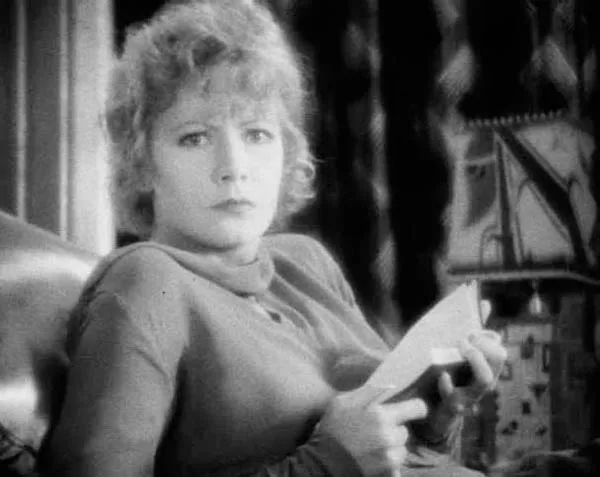
1.1. The Kiss (dir. Jacques Feyder, 1929).
Tumult over a single gunshot, and whether or not the protagonist hears it, is not surprising at a time when the industry is experiencing a startling conversion to sound. Jacques Feyder’s The Kiss (1929) is not unlike other films made during the transition era, like Roy Del Ruth’s The First Auto (1927), Michael Curtiz’s Noah’s Ark (1928), and John G. Blystone’s Thru Different Eyes (1929), that focus keenly on the effects of sound. During the conversion years, between 1926 and 1929, when so many films were neither wholly silent nor completely talkies, and when many others were originally “conceived as pure silents,” as William K. Everson suggests, and then later “given last-minute doctoring to include long and usually unnecessary [sound] sequences,” sound became a central, not incidental, element of the diegesis.1 In a sense, Irene Guarry’s stunned response to the simulated gunshot mirrors Hollywood’s own startled reaction to the quick success of Alan Crosland’s The Jazz Singer (1927) and the ensuing rapid conversion to sound technology.2
In Samuel Goldwyn’s biography, A. Scott Berg recounts the Los Angeles premiere of Crosland’s film, when all of Hollywood’s power players, including the Goldwyns and Irving Thalberg, watched in astounded silence. At the end, “thunderous clapping finally brought the houselights up,” but Goldwyn’s wife Frances Howard recalls seeing “ ‘terror in all their faces’ – the fear that ‘the game they had been playing for years was finally over.’ ” Frances would later contemplate writing a murder mystery set in Hollywood, using this premiere night as her novel’s opening scene. Perhaps it was never too early to begin worrying about the collapse of the studio system. For Frances, the arrival of sound was “ ‘the most important event in cultural history since Martin Luther nailed his theses on the church door.’ ” Before that opening night, many in Hollywood had insisted that sound would not dramatically disrupt filmmaking practices. D. W. Griffith claimed that talkies were “impossible” and insisted that they would soon be “abandoned.”3 Irving Thalberg also did not appear rattled when, on his honeymoon with Norma Shearer, reporters asked him about the possibility of talkies on the horizon. “Novelty is always welcome,” he dismissively argued, “but talking pictures are just a passing fad.”4 But after The Jazz Singer became a sensation at the box office, such predictions were quickly dropped. Even if we allow Frances Howard some gratuitous hysteria, the astounding impact of sound was undeniable. The success of Vitaphone at Warner Bros. sent all of Hollywood into a temporary panic. The effects were not just psychological but also financial. Aida Hozic notes that retrofitting for sound may have cost approximately $10,000 per theater, in addition to exorbitant millions spent on sound stages and new theaters nationwide.5 Douglas Gomery suggests that the investments might have ranged from $23 million to $50 million, numbers that appear even more amazing when considering that “the original studios, built over a 15-year period, were valued at only $65 million.”6 However, after the deafening applause received by The Jazz Singer, surpassed by Lloyd Bacon’s The Singing Fool (1928) a year later, conversion came to be seen as sound business practice. As Marilyn Fabe argues, conversion was nearly complete within two years because “so much did the public love the novelty of the sound film that the best-made silent film could not compete at the box office with the worst, most clumsily crafted ‘talkie.’ ”7 By 1930 or so, silent films had become a relic of the past. With all the hysteria tamed, sound became just another addition to naturalistic filmmaking in Hollywood, and the talkies were standardized within the studio system.
That is the version of the arrival of sound, from chaos to standardization, that Hollywood has created for itself in films about the period of transition. The best known among them, Stanley Donen and Gene Kelly’s Singin’ in the Rain (1952), sets up this narrative. Hollywood is at first shocked and rocked by the popularity of sound. Sound is seen, as the producer tells Don Lockwood (Gene Kelly), as a “sensation.” But it is soon integrated into filmmaking, thus revolutionizing the business and making movies better than ever. To be sure, some careers are destroyed, and other stars fade – many due to their own inability to memorize scripts or sound wholesomely middle-American. Overall, however, conversion is represented as a success story. Made at a time when Hollywood was facing a significant threat from a rival medium, Singin’ in the Rain’s faultless optimism about and faith in the studio system might be understandable. But film historians have naturally been circumspect about such an orderly, classical tale. Donald Crafton calls it the “ ‘revolution’ scenario,” adopted by the studios because it offers “a usable retelling of the incidents, omitting the complicated parts about capitalization, expansion, competition, and the stylistic maneuvering that had modified cinema practice.”8 So how do we think about the “complicated parts” of the transition from silent cinema to complete synchronization? More importantly, how do we evaluate the sensation caused by sound?
In the last three decades, media scholars and historians have sought mostly to demystify Hollywood’s version of the happy transition from turmoil to standardization. Indeed, many have argued against the “chaos” theory, suggesting that sound did not hit Hollywood like a bolt of lightning with the premiere of The Jazz Singer. Rather, it was anticipated for many years, and by 1927 it was inevitable. Thus, Scott Eyman’s argument that “as 1927 became 1928, the limitless bowl of blue sky that habitually hovered over Los Angeles was about to start falling on explorer and homesteader alike” is usually discounted as being too hyperbolic.9 Moreover, as Bordwell, Staiger, and Thompson have argued, sound could not have caused such upheaval because silent and sound cinema are not so different after all. “Sound cinema,” they contend, “was not a radical alternative to silent filmmaking; sound as sound, as a material and as a set of technical procedures, was inserted into the already-constituted system of the classical Hollywood style.”10 That is to say, sound technology was wholly and relatively smoothly incorporated into the studio aesthetic. If anything, the addition of sound only further streamlined and standardized the assembly-line mode of filmmaking. More recently, Douglas Gomery has insisted that any notion of upheaval during the transition is fully misguided. Focusing entirely on the economic aspects of the transition to sound, Gomery maintains that “there was no chaos, but a consolidation of economic power, the collection of more revenues, and a global colossus known to the world as simply Hollywood.”11 Profits and mergers are Gomery’s key words, not confusion or disarray. While Gomery’s insistence that the addition of sound was a purely business decision, causing no uproar in the studio backlots, may be an overstatement, film history has generally opted for thinking of Hollywood’s conversion to sound more or less in terms of integration into the studio system rather than hysterical pandemonium. But need we consider the moment of conversion in such starkly opposing terms? While sound may not necessarily have been “akin to a cinematic earthquake,” the narrative of smooth conversion, as James Lastra suggests, “appears this tidy only in retrospect.”12 Is it not more likely that sound, although anticipated and rapidly integrated, also did arrive rather capriciously and sometimes riotously?
Donald Crafton argues that, during the transition era, sound did not behave as Hollywood expected. Disregarding both conventional versions, Crafton suggests that “there was neither a chaotic upheaval nor, at the other extreme, a carefully executed changeover.”13 He does accept that the distinction between silence and sound is not so clear cut and that “the concept of a dividing line between antediluvian silent cinema and the modern talkies was coscripted by the industry and the media.”14 Crafton also rebuffs the notion of an insurgency or a revolt. Although the conversion was swift, it was no revolution overthrowing the previous regime, as many studio insiders had feared. Instead, Crafton emphasizes how most of Hollywood’s own predictions about sound did not come true. Silent films did not continue to be made alongside the talkies, as expected. The talkies did not attract more sophisticated audiences, as expected. Stars who spoke with European or non-American accents were not instantaneously rejected, as expected. Sound, Crafton suggests, “was more like an experiment that produced unexpected results.”15
It is this notion of sound as an experiment, almost a kind of gamble, that preoccupies this chapter. Not enough attention has been paid to this aspect of the transition between 1926 and 1929. Everson observes that conversion-era films are “a vast no-man’s land of hybrid productions, neither wholly silent nor wholly sound.”16 But he does not fully explore the effects of those films. More recently, Michel Chion has noted “the variety of experimentation going on” during the conversion, but his analysis also does not elaborate the specific forms of such experimentation.17 If not as expected, how did sound behave? Based on this chapter’s opening cinephiliac moment, we might say that Irene Guarry’s startled reaction to the silent gunshot in The Kiss demonstrates that sound caused a somatic sensation. What draws me to it is that Garbo, long known for her poise, becomes so rattled that she virtually jumps out of her skin. What lingers for me is the feeling that, during this transitional moment, sound is regarded not only as aural or visual but also carnal. Indeed, her stunned response becomes especially intriguing if we see it as an allegory of Hollywood’s sensational transition to sound. So, instead of the technological, industrial, and socioeconomic effects of sound, how do we think about that other sense of sensation, as a bodily response, evoked during the conversion era? To put it differently, how do we explore Hollywood’s visceral reaction to the aural innovation? And what does the corporeal functioning of sound tell us about the transition era, when filmmakers were still experimenting and gambling with sound and its effects?
BODILY SENSATIONS
Near the end of Aldous Huxley’s Brave New World (1932), Darwin Bonaparte shoots The Savage of Surrey, chronicling John the Savage’s retreat to a lighthouse in the countryside, followed by his riotous self-flagellation routine. From his hiding place in the woods, Bonaparte captures his subject’s every feral move. This is how Huxley desc...
Table of contents
- Cover
- Half title
- Title
- Copyright
- Dedication
- Contents
- Acknowledgments
- Introduction: Inventing Cinephiliac Historiography
- 1 Sonic Booms: 1929 and the Sensational Transition to Sound
- 2 Show Stoppers: 1937 and the Chance Encounter with Chiffons
- 3 Signature Crimes: 1946 and the Strange Case of the Lost Scene (as Well as the Stranger Case of the Missing Auteur)
- 4 Apocalyptic Antennae: 1954 and the End of Storytelling
- Conclusion: The Cinephiliac Return
- Notes
- Bibliography
- Index
Trusted by 375,005 students
Access to over 1.5 million titles for a fair monthly price.
Study more efficiently using our study tools.
Frequently asked questions
Yes, you can cancel anytime from the Subscription tab in your account settings on the Perlego website. Your subscription will stay active until the end of your current billing period. Learn how to cancel your subscription
No, books cannot be downloaded as external files, such as PDFs, for use outside of Perlego. However, you can download books within the Perlego app for offline reading on mobile or tablet. Learn how to download books offline
Perlego offers two plans: Essential and Complete
- Essential is ideal for learners and professionals who enjoy exploring a wide range of subjects. Access the Essential Library with 800,000+ trusted titles and best-sellers across business, personal growth, and the humanities. Includes unlimited reading time and Standard Read Aloud voice.
- Complete: Perfect for advanced learners and researchers needing full, unrestricted access. Unlock 1.5M+ books across hundreds of subjects, including academic and specialized titles. The Complete Plan also includes advanced features like Premium Read Aloud and Research Assistant.
We are an online textbook subscription service, where you can get access to an entire online library for less than the price of a single book per month. With over 1.5 million books across 990+ topics, we’ve got you covered! Learn about our mission
Look out for the read-aloud symbol on your next book to see if you can listen to it. The read-aloud tool reads text aloud for you, highlighting the text as it is being read. You can pause it, speed it up and slow it down. Learn more about Read Aloud
Yes! You can use the Perlego app on both iOS and Android devices to read anytime, anywhere — even offline. Perfect for commutes or when you’re on the go.
Please note we cannot support devices running on iOS 13 and Android 7 or earlier. Learn more about using the app
Please note we cannot support devices running on iOS 13 and Android 7 or earlier. Learn more about using the app
Yes, you can access Cinematic Flashes by Rashna Wadia Richards in PDF and/or ePUB format, as well as other popular books in Media & Performing Arts & Film History & Criticism. We have over 1.5 million books available in our catalogue for you to explore.