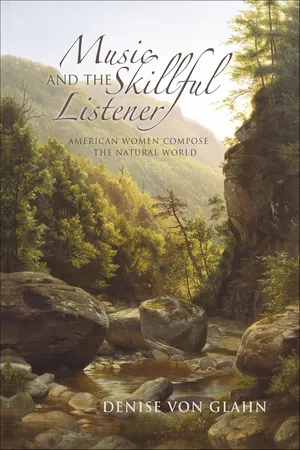
For Denise Von Glahn, listening is that special quality afforded women who have been fettered for generations by the maxim "be seen and not heard." In Music and the Skillful Listener, Von Glahn explores the relationship between listening and musical composition focusing on nine American women composers inspired by the sounds of the natural world: Amy Beach, Marion Bauer, Louise Talma, Pauline Oliveros, Joan Tower, Ellen Taaffe Zwilich, Victoria Bond, Libby Larsen, and Emily Doolittle. Von Glahn situates "nature composing" among the larger tradition of nature writing and argues that, like their literary sisters, works of these women express deeply held spiritual and aesthetic beliefs about nature. Drawing on a wealth of archival and original source material, Von Glahn skillfully employs literary and gender studies, ecocriticism and ecomusicology, and the larger world of contemporary musicological thought to tell the stories of nine women composers who seek to understand nature through music.
eBook - ePub
Music and the Skillful Listener
American Women Compose the Natural World
- 399 pages
- English
- ePUB (mobile friendly)
- Available on iOS & Android
eBook - ePub
About this book
Information
Subtopic
Music1
A Context for Composers
WITHIN THE NATURE-WRITING TRADITION

Until the 1980s, noted American women composers were few in number; their activities were limited in scope. Social mores and circumscribed educational opportunities had discouraged and denied women’s pursuits of professional musical careers. The situation regarding women and music composition, in particular, differed from the long tradition of notable American women writers, and more particularly for purposes of this study, American women nature writers whose history of public participation went back to the earliest colonial times.
Inadequate or nonexistent musical education beyond that which guaranteed a desirable level of “accomplishment” and limiting codes of behavior, which confined women’s musical sphere to the home or school, meant that most aspiring American women composers prior to the twentieth century looked no further than parlor performances as sites for their original songs and piano pieces.1 Public performances that hinted at virtuosic displays would have been construed as unseemly and in certain circles would have drawn severe criticism and even censure.2 Like some of their literary counterpoints, women composers often kept their identities hidden with pen names, or at the very least disguised behind initials or the use of “Mrs.”3 Prior to the closing decades of the nineteenth century, most American women with musical talent confined themselves to singing “sweetly,” or playing violin, organ, piano, or guitar and within a private sphere, often with a goal of attracting an appropriate mate and educating the resulting children.4
While women’s literary and musical traditions differed in significant ways, including their duration and degree of public engagement, both developed within similar social circumstances. This chapter provides a context for the study of American women composers and their interactions with nature by considering some of the nation’s earliest women nature writers and the themes that dominated their works. It documents their desire for silence, solitude, and the opportunity to pursue their work, conditions that eluded many women. As becomes clear, the subject matter and perspective of the nation’s earliest women writers and composers have much in common.
In England, in 1650, the first book of poetry by an American author was published. Without her knowledge, Anne Bradstreet’s brother-in-law, John Woodbridge, had taken her writings with him when he sailed across the Atlantic.5 There they were published as The Tenth Muse Lately Sprung Up in America … By a Gentlewoman in Those Parts; the book found its way to the library of King George III. Anticipating by a good seventy years the more famous writings in natural philosophy by Puritan theologians Cotton Mather and Jonathan Edwards, Anne Bradstreet’s Tenth Muse meditated on the deep connection that she perceived existed between nature and God. Appearing 186 years before Ralph Waldo Emerson’s 1836 essay “Nature,” Bradstreet depicted nature as a moral text ripe with lessons to guide one’s personal behavior. Over the next two centuries, women would become increasingly responsible for and identified with the moral instruction of the nation, as that duty was assigned to them and their sphere, the home. Women would use nature’s lessons to teach their families.
In 1704, Sarah Kemble Knight (Mrs. Richard Knight) traveled from Boston to New York, a distance of about 150 miles, to help a cousin.6 She did this with no single, steady companion, but with a series of hired guides to assist her passage over uneven countryside and swollen waterways. She recorded her alternately humorous, terrifying, and rapturous experiences in a book published posthumously in 1825 as The Journal of Madam Knight. Within its pages, an eighteen-line paean to the moon, that “Bright Aspect” who diffused Joy through [her] soul, aroused a more secular appreciation of nature than Bradstreet had expressed. While Sarah Knight’s journey without a proper escort – which according to social custom would have been a husband, brother, son, or other male relative – might suggest behavior far outside the norms of acceptability for respectable thirty-eight-year-old women at the time, her descriptions of the woods reveal what was then considered a suitable female sensibility. Mrs. Knight portrayed her unaccustomed natural surroundings as comfortable. She employed domestic imagery, which would become the standard vocabulary for women nature writers in the nineteenth century: “the pleasant delusion of a Sumptuous city, filled with famous Buildings and churches, with their spiring steeples, Balconies, Galleries and I know not what.”7 Making the natural world home-like, with its balconies and galleries, or at least familiar, was commonplace for early American women nature writers, who seldom ranged far from their domiciles or towns. By drawing analogies between the potentially dangerous climes and domestic features, Knight claimed her right to be there: she stayed within her sphere, even if only rhetorically.
As the nation expanded, however, the nineteenth century saw the publication of a number of accounts by women who ventured from their northeastern birthplaces and went west to stay. Books by Caroline Kirkland, Margaret Fuller, Susan Fenimore Cooper, and Eliza Farnham reveal additional aspects of women’s experiences with nature. Kirkland’s A New Home – Who’ll Follow? or Glimpses of Western Life by Mrs. Mary Clavers, an Actual Settler, published in 1839, is the story of the New York City–born Caroline Matilda (Stansbury) Kirkland (Mary Clavers is a pseudonym) and her husband traveling by horse-drawn wagon to Michigan, which was then the edge of the frontier. Although she described a broad range of experiences, including fording treacherous bog holes, and the unusual practices associated with purchasing land and naming and constructing towns in the west, Kirkland focused on the domestic sphere, with its specific challenges to women and family life. While not primarily about nature or the spiritual or religious lessons it contained, the natural elements regularly informed and decided her actions, activities, and attitudes; like her predecessors, Kirkland wrote from a decidedly female perspective.
A more widely circulated account of a city-bred northeastern woman interacting with nature was Margaret Fuller’s Summer on the Lakes, in 1843. Fuller’s trip around the Great Lakes lasted only a few months, June 10 to September 19, 1843, so the author did not develop the emic perspective achieved by Kirkland during her eight-year residence in the frontier. But she too used the physical journey to meditate on social issues and explore more interior landscapes. The book became, in Susan Belasco Smith’s words, “an expression of self-discovery.”8
Like Sarah Kemble Knight, Fuller was often transfixed by the beauty of nature; this is nowhere more evident than in her description of the start of her journey at Niagara Falls, considered at the time to be the nation’s most famous natural phenomenon and the symbol of American power and promise. While she despaired that her own reactions to the cataract were thoroughly influenced by those who had already captured it in prose and pictures, and thus denied their full originality, Fuller achieved a personal, epiphanic moment during an uncommon solitary moonlight visit to the falls. Her description reflects the easy blending of nature with spirituality characteristic of many women nature writers and more generally of the Transcendentalist group, of which she was a prominent member.
I felt a foreboding of a mightier emotion to rise up and swallow all others, and I passed on to the terrapin bridge. Everything was changed, the misty apparition had taken off its many-colored crown which it had worn by day, and a bow of silvery white spanned its summit. The moonlight gave a poetical indefiniteness to the distant parts of the waters, and while the rapids were glancing in her beams, the river below the falls was black as night, save where the reflection of the sky gave it the appearance of a shield of blued steel. No gaping tourists loitered, eyeing with their glasses, or sketching on cards the hoary locks of the ancient river god. All tended to harmonize with the natural grandeur of the scene. I gazed long. I saw how here mutability and unchangeableness were united. I surveyed the conspiring waters rushing against the rocky ledge to overthrow it at one mad plunge, till, like topping ambition, o’erleaping themselves, they fall on t’other side, expanding into foam ere they reach the deep channel where they creep submissively away.
Then arose in my breast a genuine admiration, and a humble adoration of the Being who was the architect of this and of all. Happy were the first discoverers of Niagara, those who could come unawares upon this view and upon that, whose feelings were entirely their own.9
Fuller revels in her personal, individual, solitary encounter with nature writ large.10 The extreme rarity of such experiences for women, especially in relation to grand, iconic natural phenomena such as Niagara Falls, undoubtedly fueled the passion of Fuller’s reaction. Women were more often members of large parties of tourists on grand tours of natural wonders who came weighted down with Claude glasses, portable easels, picnic hampers, and pets. The opportunity to interact solitarily with a site of such unique power and beauty was of incalculable importance to Fuller. The experience was hers. As readers will discover, more than one composer in this study has sought out similarly unaccompanied interactions with the natural world. With the urging and intercession of Ralph Waldo Emerson, Fuller turned her journey into her first book.
Women writers continued to acknowledge nature’s moral, spiritual, and aesthetic qualities, although practical exigencies associated with the nation’s western expansion encouraged additional insights and understanding. Eliza Farnham’s Life in Prairie Land from 1846 is a third midcentury chronicle of women’s experiences of the enlarging nation. Moving from her New York home, Farnham lived along the Illinois River in Tazewell County, Illinois, for nearly five years in the mid-1830s. Her account, simultaneously realistic and romantic, benefits from the sobering experiences of extended time spent in an often unforgiving landscape. Farnham, who would become one of the first and most effective advocates of equality for women, was especially aware of the challenges the West presented to her sex, and she attributed many of them to inadequate education and social constraints: “Very many ladies are so unfortunate as to have had their minds thoroughly distorted from all true and natural modes of action by an artificial and pernicious course of education, or the influence of a false social position. They cannot endure the sudden and complete transition which is forced upon them by emigration to the West.”11
Her real-life informed pragmatism, however, did not prevent Farnham from appreciating the inherent beauty of her surroundings. While avoiding the religious overtones of Fuller’s prose, Farnham captured the unique landscape of Tazewell County. The final passage from part 2, chapter 2 shows the author responding to the variety of this prairie place:
The great road from the northern to the southern extremities of the state passes, for the most part, over large prairies. These are sometimes divided by groves two or three miles in extent, sometimes by open, sparsely timbered tracts, called barrens, and sometimes by a mere thread of timber, towering above the swelling plain, showing a dark green line at the distance of miles, the first glimpse of which often elicits a cheerful ‘land ho’ from travelers who are unaccustomed to these long voyages by terra firma. This road intersects at Peoria the Illinois river, with which it runs nearly parallel for sixty or seventy miles, at a distance varying from four to eight, ten, and fifteen miles from the stream. The wood which crowns the bluffs of the stream stretches back at frequent intervals in long lines, and fringes the plains over which the road passes. These groves are generally very beautiful. They are usually seen on the high swells of the prairies, their outlines clearly defined on the horizon, long before you reach them. Their edges are bordered with the plum, hazel, and other fruit-bearing trees, and shrubs, which are frequented by birds, hares, squirrels, et cet. The music, life, and freshness of these woodlands, together with their utility to the husbandmen, led the early settlers to select them as the sites of their new homes. There the cabin was laid up under the spreading boughs of the outermost trees; and there the hardy frontiersman placed his family, remote from every artificial means of comfort, “alone with nature,” rich, beautiful, majestic, nature in the silent prairie land.12
Farnham sees the woods as crowning and fringing the plains. She construes the landscape as “rich, beautiful [and] majestic” and takes aesthetic pleasure in its “music, life, and freshness.” In the context of her values, Farnham’s distance from artificial comforts and solitary communion with nature in “the silent prairie land” has become a desirable condition. Eight years later, Henry David Thoreau would similarly plump the benefits of a wide margin between oneself and softening comforts. The inadequately educated ladies referred to in her preface, however, would likely have thought otherwise.
Back in the Northeast, in 1850, two hundred years after Bradstreet’s Tenth Muse and four years before Thoreau’s Walden, Susan Fenimore Cooper wrote Rural Hours, “a record of our simple rural life.”13 Thoreau read her book, referred to it in his journal, and perhaps even used parts of it as models for his own record of time “alone, in the woods.”14 Like Walden, which would focus on Thoreau’s stay at his cabin by the eponymous pond in Concord, Massachusetts, Rural Hours explored the natural world of Susan Cooper’s hometown, the one founded by her grandfather William Cooper, the one now famous for its Baseball Hall of Fame: Cooperstown, New York.
Thoreau would pond...
Table of contents
- COVER
- TITLE
- COPYRIGHT
- CONTENTS
- ACKNOWLEDGEMENTS
- Introduction
- 1 A Context for Composers: Within the Nature-Writing Tradition
- PART ONE NATURE AS A SUMMER HOME
- PART TWO NATURE ALL AROUND US
- PART THREE BEYOND THE EPA AND EARTH DAY
- Conclusions: The Repercussions of Listening
- NOTES
- BIBLIOGRAPHY
- INDEX
Trusted by 375,005 students
Access to over 1.5 million titles for a fair monthly price.
Study more efficiently using our study tools.
Frequently asked questions
Yes, you can cancel anytime from the Subscription tab in your account settings on the Perlego website. Your subscription will stay active until the end of your current billing period. Learn how to cancel your subscription
No, books cannot be downloaded as external files, such as PDFs, for use outside of Perlego. However, you can download books within the Perlego app for offline reading on mobile or tablet. Learn how to download books offline
Perlego offers two plans: Essential and Complete
- Essential is ideal for learners and professionals who enjoy exploring a wide range of subjects. Access the Essential Library with 800,000+ trusted titles and best-sellers across business, personal growth, and the humanities. Includes unlimited reading time and Standard Read Aloud voice.
- Complete: Perfect for advanced learners and researchers needing full, unrestricted access. Unlock 1.5M+ books across hundreds of subjects, including academic and specialized titles. The Complete Plan also includes advanced features like Premium Read Aloud and Research Assistant.
We are an online textbook subscription service, where you can get access to an entire online library for less than the price of a single book per month. With over 1.5 million books across 990+ topics, we’ve got you covered! Learn about our mission
Look out for the read-aloud symbol on your next book to see if you can listen to it. The read-aloud tool reads text aloud for you, highlighting the text as it is being read. You can pause it, speed it up and slow it down. Learn more about Read Aloud
Yes! You can use the Perlego app on both iOS and Android devices to read anytime, anywhere — even offline. Perfect for commutes or when you’re on the go.
Please note we cannot support devices running on iOS 13 and Android 7 or earlier. Learn more about using the app
Please note we cannot support devices running on iOS 13 and Android 7 or earlier. Learn more about using the app
Yes, you can access Music and the Skillful Listener by Denise Von Glahn in PDF and/or ePUB format, as well as other popular books in Media & Performing Arts & Music. We have over 1.5 million books available in our catalogue for you to explore.