This landmark volume compiled by Jacob K. Olupona and Rowland O. Abiodun brings readers into the diverse world of Ifá—its discourse, ways of thinking, and artistic expression as manifested throughout the Afro-Atlantic. Firmly rooting Ifá within African religious traditions, the essays consider Ifá and Ifá divination from the perspectives of philosophy, performance studies, and cultural studies. They also examine the sacred context, verbal art, and the interpretation of Ifá texts and philosophy. With essays from the most respected scholars in the field, the book makes a substantial contribution toward understanding Ifá and its role in contemporary Yoruba and diaspora cultures.
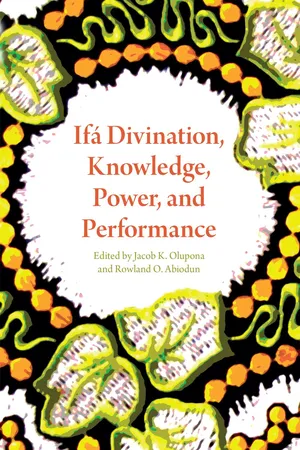
eBook - ePub
Ifá Divination, Knowledge, Power, and Performance
- 390 pages
- English
- ePUB (mobile friendly)
- Available on iOS & Android
eBook - ePub
Ifá Divination, Knowledge, Power, and Performance
About this book
Information
Subtopic
Performing ArtsPART I.
IFÁ ORATURE: ITS INTERPRETATION AND TRANSLATION
1Ayajo as Ifá in Mythical and Sacred Contexts
IF AYAJO (MYTH-INCANTATION) is Ifá in the mythical and sacred contexts, the best angle from which to begin this essay is the definition of myth. In Sacred Narrative: Readings in the Theory of Myth, Lauri Honko gave a definition of myth that he regarded as descriptive and concise, and in which the gods, fundamental events, nature and culture, order, and continuity are foregrounded. According to Honko, a myth is “a story of the gods, a religious account of the beginning of the world, the creation, fundamental events, the exemplary deeds of the gods as a result of which the world, nature and culture were created together with all parts thereof and given their order, which still obtains.” (1984, 49). Honko believed that this definition was “built on four criteria: form, content, function and context” (ibid.). Here, form is explained in terms of myth as sacred and symbolic narrative. Its content implicates the articulation of figures and deeds as verbalized in a narrative or poetic medium. The functions of myth are predicated in its ontological view of the world as it describes aspects of life and the universe. And the context of myth is ritualistic, wherein events once possible and operative can be exerted anew.
To complement the above, Harold Scheub wrote that:
The ancient myth has to do with the supernatural, with gods and with transcendental wisdom, with mystical behavior, and awesome activities. . . . Regularly, ritualistically, through the theatrical re-enactment of the myths, we revisit the ancient times . . . the contexts for our lives. What we do occurs within the context of the ancient myths. Nothing is new; we only routinely re-enact the ancient myths, moving in the paths of our gods. (2002, 185)
Special attention is called to the issue of awesomeness and reenactment (implicating performance) as the wisdom of the great beyond. These issues are reflected in Ayajo myths of Ifá. In the following discussion, attention is given to salient passages where the nature, content, functions, and theoretical angles of Ayajo evince it is a Yorùbá type of sacred myth.
Specifically, the case of Ayajo as Ifá in “sacred” contexts concerns the use of symbols—verbal symbols and objects or materials—in the performance of the genre. O’Keefe described the material objects as “‘anointed’—to symbolize that old feeling, that immanent excitement of power . . . objects that have become symbols of society” (1979, 248). According to Duncan (1961), they relate to the order of the society itself. Whoever controls such symbols must be obeyed, for in obeying we uphold the structure of our society. Thus, it can be said that one reason for the awesomeness of the contexts of Ayajo performance is the use of anointed symbolic objects and utterances.
Preliminaries to the Text of (Ayajo) Myth-Incantations
In Ifá divination contexts, the diviner uses the sacred chain (opele) or palm kernel (ikin) to find odù in connection with an inquirer’s request. The verses of the odù (as related through the signatures of the material objects used in Ifá) are chanted in full. More often than not an appropriate sacrifice is performed; this depends on the urgency, prejudice, and readiness of the inquirer.
After the performance of the sacrifice, the diviner and inquirer assume that all will be well as far as the treated case is concerned. Meanwhile, if the inquirer keeps complaining about the same or a similar issue, the diviner arranges to tackle the problem the Ayajo way. Here, the diviner arranges with the inquirer to invoke the mythological events as contained in the original odù, since it contains the initial sacrifice performed. In other words, the process of borrowing (yiya) the events of a (primordial) day (Ojo) for use (lo)—that is, yiya + ojo + lo = ayajo (lo)—begins. This is premised upon the belief that any problem facing an individual in contemporary times has an equivalent in the past life of our ancestors, as read by Òrunmílà who was the first literary expert on earth in the Odù of Ifá.
Ayajo Myths as a Case Study
In Yorùbá orature scholarship, Afolabi Olabimtan has defined Ayajo Yorùbá sacred myths partly as “a word generally used to refer to the past in relation to the present . . . attachment to a divinity—Òrunmílà, associated with a particular odùifá, relate to an incident in the past, feature some lines of ofo in some instances . . . ancient Ifá priests are appealed to in Ayajo to help the reciter to achieve the purpose of the incantations” (1971, 4). In this excerpt Òrunmílà, the corpus of Ifá, relationships between past and present incidents, and the pragmatic achievement of purposes are mentioned. However, as I stated elsewhere:
Ayajo ni Imo asiri oruko, isele, Itan Iwase, majemu ayeraye ati ijinle akiyesi nipa iwa ewe, egbo tabi eda miiran, ti a n lo lode oni fun ifare, atubi ati abilu, gege bi a ti se awon asiri wonyen lojo sinu odù-Ifá, eyi to fa a ti a fi n kape Òrunmílà bi eleriiki o le fase si atubotan ti a n lepa.
Myth-incantations are the knowledge of secret names, events, myths, old covenants and deeply rooted discoveries about the essence of herbs and roots or any other creatures, which are recounted in contemporary times for luck, as neutralizers and for evil, as those secrets are kept in the corpus of Ifá, which accounts for why we call upon Òrunmílà as a witness to accent the desires in view. (2010, 10)
This statement incorporates a number of aspects of the same genre, but does not reflect that the narrative is usually poetic in presentation.
Because the academic study of Ayajo is still in its infancy, this essay will undertake a proper definition of Ayajo so that readers can identify it whenever it is found or heard. Taking an example of Ayajo from the three broad types, this paper also aims at a critical analysis of representative examples. Specifically, the articulation of the following themes in the example under analysis will be treated: power of invocation, precedence, symbolic objects and covenants, the place of Ayajo in the odù of Ifá, the typology of Ayajo, the essence of primordial origin, verbal law, and the babalawo as a personification of the word in the society.
Typology of Ayajo (Myth-Incantations)
Broadly categorized, there are three types of Ayajo: luck attractant, neutralizers, and spells. Under the luck attractant are subtypes such as those meant for quick sales, soliciting love, and so on. The neutralizers comprise three major subtypes: cases (Aforan), protection against spells (Isasi), and witchcraft (Eleye). Each of the three subtypes has its own subgenres. The third major type is the one used for “spells” (or “evil-works” to employ Verger’s [1977] language) to designate.
A close examination of the names in each category reveals their functionality. In other words, Yorùbá myth-incantations are typologically categorized and named in accordance with the notion of the functions performed.
The Thematic Content of an Ayajo
Of the three subtypes of Ayajo, witchcraft will serve as a case study. In the Yorùbá cultural worldview, once you are in sociological tune with the witches, you stand the chance of living a good long life and getting rich. This is in light of the fact adduced by O’Keefe that “a great deal of ‘magic’ (which I prefer to call ‘myth-incantations’) is little more than a defense against witches . . . the very opposite of every value the group stands for” (1979, 550).
Ayajo Atubi Eleye | |
Ela ro waa | |
Ela ro waa | |
Ela ro waa | |
Alagada-nla loruko a a paye | |
5 | Arabatasi loruko aa pele |
Bi a ba fi efun fun aye | |
Ara aye a ya gaga | |
Bi a ba sepe so Ogun | |
Ara ogun a le koko | |
10 | Ogun a sege |
Omo won nile Ife | |
Oun ni o bi Atepe | |
Bi... |
Table of contents
- Cover
- Half title
- Title
- Copyright
- Dedication
- Contents
- Foreword / His Royal Highness Oba Okunade Sijuade Olubuse II
- Preface
- Introduction
- Part I. Ifá Orature: Its Interpretation and Translation
- Part II. Ifá as Knowledge: Theoretical Questions and Concerns
- Part III. Ifá in the Afro-Atlantic
- Part IV. Sacred Art in Ifá
- List of Contributors
- Index
Trusted by 375,005 students
Access to over 1.5 million titles for a fair monthly price.
Study more efficiently using our study tools.
Frequently asked questions
Yes, you can cancel anytime from the Subscription tab in your account settings on the Perlego website. Your subscription will stay active until the end of your current billing period. Learn how to cancel your subscription
No, books cannot be downloaded as external files, such as PDFs, for use outside of Perlego. However, you can download books within the Perlego app for offline reading on mobile or tablet. Learn how to download books offline
Perlego offers two plans: Essential and Complete
- Essential is ideal for learners and professionals who enjoy exploring a wide range of subjects. Access the Essential Library with 800,000+ trusted titles and best-sellers across business, personal growth, and the humanities. Includes unlimited reading time and Standard Read Aloud voice.
- Complete: Perfect for advanced learners and researchers needing full, unrestricted access. Unlock 1.5M+ books across hundreds of subjects, including academic and specialized titles. The Complete Plan also includes advanced features like Premium Read Aloud and Research Assistant.
We are an online textbook subscription service, where you can get access to an entire online library for less than the price of a single book per month. With over 1.5 million books across 990+ topics, we’ve got you covered! Learn about our mission
Look out for the read-aloud symbol on your next book to see if you can listen to it. The read-aloud tool reads text aloud for you, highlighting the text as it is being read. You can pause it, speed it up and slow it down. Learn more about Read Aloud
Yes! You can use the Perlego app on both iOS and Android devices to read anytime, anywhere — even offline. Perfect for commutes or when you’re on the go.
Please note we cannot support devices running on iOS 13 and Android 7 or earlier. Learn more about using the app
Please note we cannot support devices running on iOS 13 and Android 7 or earlier. Learn more about using the app
Yes, you can access Ifá Divination, Knowledge, Power, and Performance by Jacob K. Olupona, Rowland O. Abiodun, Jacob K. Olupona,Rowland O. Abiodun in PDF and/or ePUB format, as well as other popular books in Media & Performing Arts & Performing Arts. We have over 1.5 million books available in our catalogue for you to explore.