Søren Kierkegaard's 13 communion discourses constitute a distinct genre among the various forms of religious writing composed by Kierkegaard. Originally published at different times and places, Kierkegaard himself believed that these discourses served as a unifying element in his work and were crucial for understanding his religious thought and philosophy as a whole. Written in an intensely personal liturgical context, the communion discourses prepare the reader for participation in this rite by emphasizing the appropriate posture for forgiveness of sins and confession.
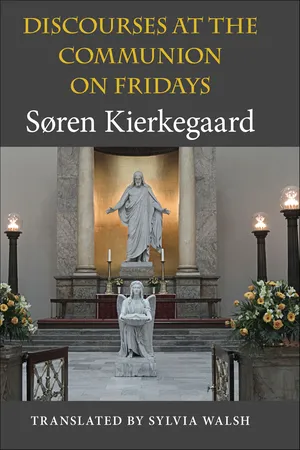
- 168 pages
- English
- ePUB (mobile friendly)
- Available on iOS & Android
eBook - ePub
Discourses at the Communion on Fridays
About this book
Trusted by 375,005 students
Access to over 1.5 million titles for a fair monthly price.
Study more efficiently using our study tools.
Information
Topic
PhilosophySubtopic
Philosophy of ReligionPART ONE
“Discourses at the Communion on Fridays,” Part Four of Christian Discourses (1848)
Preface
Of these discourses, which still lack something essential to be and therefore are not called sermons, two (II and III) were delivered in the Church of Our Lady.1 Even if he is not told, the knowledgeable reader himself will no doubt readily recognize by the form and treatment that these two are “delivered discourses,” written to be delivered, or written as they were delivered.
February 1848
S. K
1. According to Kierkegaard’s journals (SKP VIII 2 B 108), no. III was delivered at the Church of Our Lady on August 27, 1847. No date is given for no. II.
[ 1 ]
Luke 22:15

Prayer
Father in heaven! We know well that you are the one who enables both willing and completing1 and that longing, when it draws us to renew communion with our Savior and Atoner [Forsoner],2 is also from you. But when the longing lays hold of us, oh that we may also lay hold of the longing; when it wants to carry us away, that we may also abandon ourselves; when you are near to us in the call, that we may also keep near to you in supplication; when you offer the highest in the longing, that we may also buy its opportune moment,3 may hold it fast, sanctify it in quiet hours by earnest thoughts, by pious resolves, so that it may become the strong but also well-tested heartfelt longing that is required of those who worthily want to partake of the holy meal of the Lord’s Supper! Father in heaven, the longing is your gift; no one can give it to himself, no one can buy it if it is not given, even if he were willing to sell all4—but when you give it, then he can surely sell all in order to buy it. So we pray for those who are gathered here that they may go up to the Lord’s table today with heartfelt longing and that when they leave there, they may go away with increased longing for him our Savior and Atoner.
Luke 22:15: I have heartily longed to eat this Passover with you before I suffer.
The sacred words just read, which are Christ’s own words, undoubtedly do not belong to the institution of the Lord’s Supper, yet in the narrative they stand in the closest connection with it; the words of institution follow immediately after these words.5 It was on the night when he was betrayed, or rather he was already betrayed, Judas was already bought to sell him and had already sold him;6 the betrayer now sought only the “opportune time, so that he could betray him to the high priests without a crowd” (Luke 22:6).7 For that he chose the stillness of the night in which Christ now for the last time was gathered with his apostles. “And when the hour came he sat down to supper, and the twelve apostles with him. And he said to them: ‘I have heartily longed to eat this Passover with you before I suffer.’”8 That it was the last time he did not learn afterwards; he knew beforehand that it is the last time.9 Yet he did not have the heart to initiate the apostles entirely into how close the danger is, that it is this very night, and what the danger is, that it is the most ignominious death, and how inevitable it is. He who alone bore the sin of the world,10 he also bears here alone his frightful knowledge of what will happen there. He who struggled alone in Gethsemane,11 alone, because the disciples slept, he is also alone here, even though he sits at supper with his only confidants. Thus what will happen this night, how it will happen, by whom it will happen, there is only one person in that little circle who knew, he who was betrayed—yes, and then one more, the betrayer, who is also present.12 So Christ sits down to supper with the apostles, and as he takes a seat at the table he says: “I have heartily longed for this meal.”
My listener, does it not seem to you that this really belongs to the Lord’s Supper in a deeper sense, both intimately and exemplarily, not merely in the way it belongs historically to the sacred account? For is it not true that heartfelt longing belongs essentially to Holy Communion? Would it not also be the most frightful contrast to the sacred account of how the institutor longed heartily for this meal, would it not be the most frightful contrast if it were possible that someone from habit, or because it was common practice, or perhaps was impelled by quite incidental circumstances, in short, if someone went to the sacred meal of the Lord’s Supper without heartfelt longing! The sacred text just read is then, if I dare say so, the introductory words to the institution of the Lord’s Supper, and this in turn is the true godly introduction or entrance for every individual: to come with heartfelt longing.
So let us then use the prescribed moments before the communion to speak on:
the heartfelt longing for the sacred meal of the Lord’s Supper.
It is not anything new we shall teach you, even less shall we lead you into difficult investigations by leading you outside faith; we shall merely strive to express what was stirring within you when you felt the longing to go to communion, the heartfelt longing with which you came here today.
The wind blows where it will; you sense its whistling, but nobody knows where it comes from or where it goes.13 So also with longing, the longing for God and the eternal, the longing for our Savior and Atoner. Comprehend it you cannot, nor should you; indeed, you dare not even want to attempt it—but you should use the longing. Should the merchant be responsible if he does not use the opportune moment, should the seafarer be responsible if he does not use the favorable wind? How much more the one who does not use the opportunity of longing when it is offered. Oh, people talk piously about not squandering God’s gifts, but what better and in a deeper sense should be called God’s gifts than every prompting of the spirit, every tug of the soul, every fervent stirring of the heart, every holy sentiment, every devout longing, which surely are God’s gifts in a far deeper sense than food and clothes,14 not only because it is God who gives them but because God gives himself in these gifts! And yet how often a person squanders these gifts of God! Alas, if you could peer into the innermost being of persons and very deeply into your own, you would surely discover with dismay how God, who never leaves himself without witness,15 lavishes these his best gifts on every human being, and how on the contrary every human being more or less squanders these gifts, perhaps throwing them away entirely. What a frightful responsibility when one day, in eternity if not before, recollections rise up accusingly against a person, recollections of the many times and the many ways in which God spoke to him in his inner being but in vain. Recollections, yes, for even if the person himself has long since forgotten what was squandered so that he therefore does not remember it, God and eternity have not forgotten it, it is recalled to him and in eternity becomes his recollection.
Now it is like that with longing. A person can ignore its call, he can turn it into a momentary impulse, into a whim that vanishes without a trace in the next instant, he can resist it, he can prevent its deeper formation within him, he can let it die unused like an unproductive mood. But if you receive it with gratitude as a gift from God, then it will also become a blessing to you. Oh, never let this holy longing therefore return empty-handed when it wants to visit you; even if it sometimes seems to you that by following it you returned empty-handed—do not believe it, it is not so, it is impossible that it can be so, it may yet become a blessing to you.
So then longing awakened in your soul. Even if it was inexplicable, inasmuch as it is indeed from God, who draws you in it; even if it was inexplicable, inasmuch as it is by him “who lifted up from the earth will draw all to himself” (John 12:32); even if it was inexplicable, inasmuch as it is the work of the Spirit in you—you still understood what was required of you. For truly, even though God gives everything, he also requires everything, requires that the person himself must do everything in order to use rightly what God gives. Oh, in the ordinary pursuits of daily life how easy it is, spiritually understood, to doze off; in the routine course of monotony, how difficult to find a break! In this respect God assisted you through the longing which he awakened in your soul. You then promised yourself and God, is it not true, that you would now also gratefully use it. You said to yourself: “Just as the longing has torn me away from what so easily entangles a person in a spell, so by earnest thoughts I shall also come to its assistance in order to tear myself completely away from what might still hold me back. And by holy resolutions I shall strive rightly to hold on to what those earnest thoughts permit me to understand, for resolution is useful in securing oneself in what one has understood.
“What sheer vanity, after all, the earthly and the temporal are!16 And even if my life thus far has been so fortunate, so carefree, so entirely without acquaintance with a frightening or even merely sad experience, I shall now call forth those earnest thoughts. Allied with the longing for the eternal and with the holy meal before my eyes, to which no one dare come without being well prepared, I shall not be afraid of becoming earnest. For Christianity, after all, is not melancholy; on the contrary, it is so joyful that it is glad tidings to all the melancholy; only the frivolous and defiant can it make gloomy-minded. Behold, everything, everything I see is vanity and vicissitude as long as it exists, and in the end it is the prey of corruption. Therefore, when the moon rises in its splendor, with that pious man17 I shall say to the star, ‘I do not care about you; you are indeed now eclipsed’; and when the sun rises in all its grandeur and darkens the moon, I shall say to the moon, ‘I do not care about you; you are indeed now eclipsed’; and when the sun goes down, I shall say, ‘I thought as much, for all is vanity.’18 And when I see the bustle of running water, I shall say, ‘just keep on running, you will never fill the sea’;19 and to the wind I shall say, yes even if it tears up trees by the roots, I shall say to it, ‘just keep blowing; after all, there is no meaning or thought in you, you symbol of inconstancy.’20 Even if the loveliness of the field that charmingly captivates the eye, and even if the melodiousness of the birdsong that falls blissfully upon the ear, and even if the peace of the forest that invitingly refreshes the heart were to employ all their persuasion, I still shall not allow myself to be persuaded, shall not allow myself to be deceived, I shall remind myself that it is all illusion. And even though the stars have been ever so firmly fixed through thousands of years without changing position in the heavens, I still shall not allow myself to be deceived by this stability; I shall remind myself that some day they must fall down.21
“So I shall remind myself how uncertain everything is, that a human being is cast out into the world at birth and from that moment lies upon the depth of a thousand fathoms, and every moment, yes every moment the future is for him like the darkest night. I shall remind myself that never has anyone been so fortunate that he could not indeed become unfortunate, and never anyone so unfortunate that he could not indeed become more unfortunate!22 That even if I were to succeed in having all my wishes fulfilled, in having them brought up into one building—that still no one, no one would be able to guarantee me that just at the same moment the whole building would not collapse upon me. And if I succeeded (supposing this could otherwise be called a success) in rescuing a wretched scrap of my former good fortune out of this ruin, and if I prepared my soul to be patiently content with this—that still no one, no one would be able to guarantee me that at the next moment this remnant also would not be taken from me! And if there were one or another misfortune, one or another h...
Table of contents
- Cover
- Title
- Copyright
- Contents
- Abbreviations
- Introduction
- Part 1
- Part 2
- Part 3
- Part 4
- Index
Frequently asked questions
Yes, you can cancel anytime from the Subscription tab in your account settings on the Perlego website. Your subscription will stay active until the end of your current billing period. Learn how to cancel your subscription
No, books cannot be downloaded as external files, such as PDFs, for use outside of Perlego. However, you can download books within the Perlego app for offline reading on mobile or tablet. Learn how to download books offline
Perlego offers two plans: Essential and Complete
- Essential is ideal for learners and professionals who enjoy exploring a wide range of subjects. Access the Essential Library with 800,000+ trusted titles and best-sellers across business, personal growth, and the humanities. Includes unlimited reading time and Standard Read Aloud voice.
- Complete: Perfect for advanced learners and researchers needing full, unrestricted access. Unlock 1.5M+ books across hundreds of subjects, including academic and specialized titles. The Complete Plan also includes advanced features like Premium Read Aloud and Research Assistant.
We are an online textbook subscription service, where you can get access to an entire online library for less than the price of a single book per month. With over 1.5 million books across 990+ topics, we’ve got you covered! Learn about our mission
Look out for the read-aloud symbol on your next book to see if you can listen to it. The read-aloud tool reads text aloud for you, highlighting the text as it is being read. You can pause it, speed it up and slow it down. Learn more about Read Aloud
Yes! You can use the Perlego app on both iOS and Android devices to read anytime, anywhere — even offline. Perfect for commutes or when you’re on the go.
Please note we cannot support devices running on iOS 13 and Android 7 or earlier. Learn more about using the app
Please note we cannot support devices running on iOS 13 and Android 7 or earlier. Learn more about using the app
Yes, you can access Discourses at the Communion on Fridays by Søren Kierkegaard, Sylvia Walsh in PDF and/or ePUB format, as well as other popular books in Philosophy & Philosophy of Religion. We have over 1.5 million books available in our catalogue for you to explore.