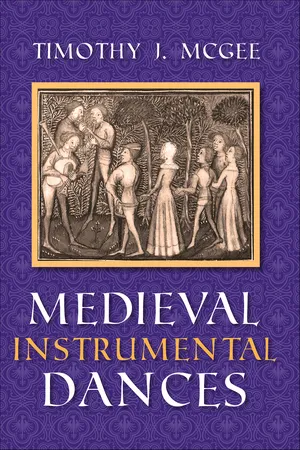
In Europe the tradition of secular dance has continued unbroken until the present. In the late Middle Ages it was an important and frequent event—for the nobility a gracious way to entertain guests, for the peasantry a welcome relaxation from the toils of the day. Now back in print, this collection presents compositions that are known or suspected to be instrumental dances from before ca. 1420. The 47 pieces vary in length and style and come from French, Italian, English, and Czech sources. Timothy McGee relates medieval dances to the descriptions found in literary, theoretical, and archival sources and to the depictions in the iconography of the Middle Ages. In a section on instrumental performance practices, he provides information about ornamenting the dances and improvising in a historically appropriate style. This comprehensive edition brings together in one volume a repertory that has been scattered over many years and countries.
Trusted by 375,005 students
Access to over 1.5 million titles for a fair monthly price.
With the exception of Nos.1b and 30, the dances are all unica and are found in widely varied sources. The manuscripts are from the thirteenth, fourteenth, and early fifteenth centuries, and originate in England (3), France (10), Italy (3), and Czechoslovakia (2). They employ a variety of notations, including modal rhythm, French and Italian mensural notation, and keyboard tablature (a combination of notes and letters). The sources, their notations, and the editorial solutions are discussed below. The following abbreviations are used: n. = note; mx = maxima; 1 = longa; b = breve; sb = semibreve; m = minim; sm = semiminim. For complete citations of the facsimiles and transcriptions listed for individual dances, see pp. 175–77 below.
No.1a. Kalenda Maya
Vocal estampie
Counting unit:
.
Unique music source: Paris, Bibliothèque Nationale, fonds français 22543, fol. 62r.
Sources of text:
Paris, B. N. fonds fr. 22543, fol. 62r, 519.
Paris, B. N. fonds fr. 856, fol. 125 (unique source of verse 5).
Paris, B. N. fonds fr. 12474, fol. 106.
Barcelona, Bibl. de Catalunya 146, fol. 59.
The author of the text of “Kalenda Maya” is troubadour Raimbaut de Vaqueiras (ca. 1155–1205), but the story that he wrote the poem to a melody he heard performed by two jongleurs at the court of Montferrat is questionable, see above, p. 10.
MS 22543, the only source of the music, was copied in western Provence ca. 1300. It is one of two surviving books devoted entirely to the transmission of troubadour songs with their melodies; it contains 950 poems, 160 with melodies.1
The most common system in use for the rhythmic interpretation of twelfth- and thirteenth-century monophonic music follows the theory developed at the turn of the present century by Jean Beck and Pierre Aubry: The shapes of the neumes are ignored, and long and short values are assigned according to the stresses in the syllables of the poetry.2 This theory has been seriously questioned recently as being arbitrary and unfounded in either the theories of the Middle Ages or the notation.3 There are no known treatises that deal with rhythm in monophonic music, and thus I have chosen to follow the only other available guide—the principles established in theoretical writings for the notation of polyphonic music. Throughout the manuscript neumes are used in patterns that suggest that their shapes are intentionally chosen and therefore may well signify duration, as they do in polyphony. The scribe of “Kalenda Maya” has used the longa as the basic neume with occasional ligatures and plicas. My transcription interprets each neume mensurally, resulting in a composition that is almost totally isosyllabic. The caesura mark is interpreted to be a phrase mark but without specific value; its value is adjusted to the needs of the text stresses. That is, the caesura marks at the end of the note for faia (bar 2) and glaia (bar 4) are similar, but the text stress requires different rest lengths. They only deviation from strict isosyllabic transcription is in the assignment of a half note instead of a quarter note to the last syllable in a full phrase. The neume
has been interpreted as 1, mx (
) in line 5, n.4, 5.
The repeat of the refrain is editorial,4 and it is suggested that the last four lines of verse 1 be sung to this section following each stanza. Text edition from Joseph Linskill, The Poems of the Troubadour Raimbaut de Vaqueiras (The Hague: Mouton & Co., 1964), pp.185–87. Translation by Robert Ta...
Table of contents
Cover
Title
Copyright
Contents
Preface
Acknowledgments
Dance in the Middle Ages
The Repertory of Textless Dances
Dancing
Performance Practices
Editorial Practices
Critical Notes
Facsimiles and Transcriptions
Frequently asked questions
Yes, you can cancel anytime from the Subscription tab in your account settings on the Perlego website. Your subscription will stay active until the end of your current billing period. Learn how to cancel your subscription
No, books cannot be downloaded as external files, such as PDFs, for use outside of Perlego. However, you can download books within the Perlego app for offline reading on mobile or tablet. Learn how to download books offline
Perlego offers two plans: Essential and Complete
Essential is ideal for learners and professionals who enjoy exploring a wide range of subjects. Access the Essential Library with 800,000+ trusted titles and best-sellers across business, personal growth, and the humanities. Includes unlimited reading time and Standard Read Aloud voice.
Complete: Perfect for advanced learners and researchers needing full, unrestricted access. Unlock 1.5M+ books across hundreds of subjects, including academic and specialized titles. The Complete Plan also includes advanced features like Premium Read Aloud and Research Assistant.
Both plans are available with monthly, semester, or annual billing cycles.
We are an online textbook subscription service, where you can get access to an entire online library for less than the price of a single book per month. With over 1.5 million books across 990+ topics, we’ve got you covered! Learn about our mission
Look out for the read-aloud symbol on your next book to see if you can listen to it. The read-aloud tool reads text aloud for you, highlighting the text as it is being read. You can pause it, speed it up and slow it down. Learn more about Read Aloud
Yes! You can use the Perlego app on both iOS and Android devices to read anytime, anywhere — even offline. Perfect for commutes or when you’re on the go. Please note we cannot support devices running on iOS 13 and Android 7 or earlier. Learn more about using the app
Yes, you can access Medieval Instrumental Dances by Timothy J. McGee in PDF and/or ePUB format, as well as other popular books in Media & Performing Arts & Music History & Criticism. We have over 1.5 million books available in our catalogue for you to explore.