"An excellent addition to courses on development, inequality, public policy, and globalization, and it could . . . be read by an audience beyond sociologists."—
American Journal of Sociology
Soaring poverty levels and 24-hour media coverage of global disasters have caused a surge in the number of international non-governmental organizations that address suffering on a massive scale. But how are these new global networks transforming the politics and power dynamics of humanitarian policy and practice? In
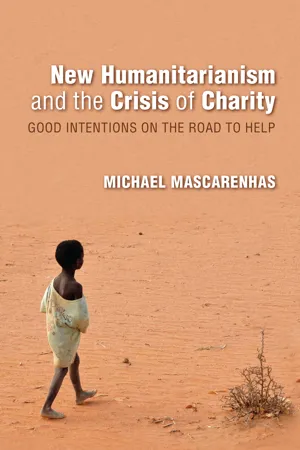
New Humanitarianism and the Crisis of Charity, Michael Mascarenhas considers that issue using water management projects in India and Rwanda as case studies. Mascarenhas analyzes the complex web of agreements ?both formal and informal?that are made between businesses, governments, and aid organizations, as well as the contradictions that arise when capitalism meets humanitarianism.
"Insightful . . . provides a scathing critique of the new humanitarianism." —
University of Chicago Press Journals
eBook - ePub
New Humanitarianism and the Crisis of Charity
Good Intentions on the Road to Help
- 178 pages
- English
- ePUB (mobile friendly)
- Available on iOS & Android
eBook - ePub
New Humanitarianism and the Crisis of Charity
Good Intentions on the Road to Help
About this book
Information
1 I Am Here to Help
“Innovation is the highway and impact is the destination.”
Peter Singer, CEO of Grand Challenges Canada
I SAY ANYTHING I think. I don’t hide much,” admits Heather Meyer, the program advisor for the NGO Water for People, during a candid dinner conversation in Kigali. “I had for a while regular lunches with a group [of friends]. We used to call each other ‘the four,’ Water for People, Water for Life, Living Water International, and WaterAid. The four of us are white expatriates. We used to have lunch all the time and be able to talk openly … and sometimes it was absolutely hysterical. We had this conversation about sustainability, and one us, I think it was the person from Living Water International, was saying, ‘oh, our website is great on sustainability,’ and the other one joked, ‘yeah, I thought about giving to your website.’ And what happens on the ground has nothing to do with it,” concludes Meyer of the daunting gap between what one reads on websites and what one does in practice. In the weeks and months that followed, I would begin to recognize the profound weight of our candid conversation, and the tensions and contradictions that surround the practices and beliefs of new humanitarianism, efforts repeated around the world by sincere folks such as Meyer, “trying to do something else for a while, something much more meaningful.” One thing remains for certain: the governance, economics, and knowledge-making practices of “doing massive social good” have changed over the past two decades, and these changes raise important epistemological questions about the forms of knowledge, knowing, and subjectivity that are produced and sustained in the processes and circuits of the new humanitarian complex.
What is it about the current humanitarian complex that prevents many of these people—these humanitarians—from achieving their stated aims of empowering the marginalized and combating poverty? Moreover, to what extent are they becoming—knowingly or unthinkingly—carriers of the beliefs, policies, and procedures of a global agenda, which many of them openly oppose? And, having recognized their limitations, how do they reconcile them in terms of personal commitments and career aspirations. On the one hand, an army of humanitarian practitioners, employees and volunteers alike, mock the notions of sustainability, charity, and welfare that they are supposed to put into practice, while, on the other hand, these same people work assiduously to raise the profile of their organization, their donors, and their latest strategy in the war on poverty or theory on dispossession. Making sense of this striking contradiction amid the rough-and-tumble of lived humanitarian experience can help us to understand why new humanitarians offer their consent without force, how they maneuver within particular settings and organizations, and why sometimes they enthusiastically participate in agendas they actively oppose, while in other settings they dissent.
Nevertheless, amid a backdrop of personal dilemmas, doubts, and vivid contradictions, humanitarians like Meyer join an expanding empire determined to build a better world (Barnett 2011). Much attention has been paid to the growing scale and scope of this private not-for-profit humanitarian complex. For some scholars, the unprecedented growth in NGOs mirrors the scale and circumstances of contemporary humanitarian atrocities throughout the world. From this perspective, the growth of NGOs is presented as a possible nongovernmental solution to the way in which the world tackles poverty and the problems of welfare service delivery for the growing number of disenfranchised and dispossessed. As this growing network of transnational NGOs goes from one emergency to the next, they not only expand their global reach but also increasingly influence the degree to which a deepening knowledge of vulnerability and a growing ethics of care have spread globally (Barnett 2011; Khagram 2004). NGOs such as Water for People, Water for Life, Living Water International, and WaterAid are playing an increasingly dominant role in determining the parameters that we use and act on in the name of humanity. In working with donors and development agencies, corporate boards, universities and think tanks, these nongovernmental knowledge-producing institutions have been able to extend their influence and shape contemporary human rights and global aid agendas. What remains unclear, however, is how NGOs’ growing influence “fits” or are being pieced together within an expanding corpus of interlocking networks and circuits through which humanitarianism is biopolitically produced, managed, and ordered. Some scholars have argued that this relationship has placed NGOs “too close for comfort,” referring to the fact that nonprofit organizations are influenced more by their supporters’ interests than by the interests of those they support, akin to Trojan horses, as opposed to good Samaritans (Edwards and Hulme 1996; Wallace 2003). But while these generalizations are politically and even intellectually provocative, they glaze over the everyday governing mentality of NGOs, their strategies of rule and expertise, negotiations within rapidly changing environments, and the kinds of humanitarian subjects they produce.
In other words, these sweeping generalizations about NGOs, whether optimistic, pessimistic, or supposedly neutral, fail to recognize the new relations and assemblages of power that are emerging as a result of this new humanitarian conjuncture, where the growth of financial and information flows, and the popularity of philanthropy and entrepreneurship are reshaping both the politics of inequality and the attributes of dispossession. NGOs do not work alone, nor do “they have a hammerlock on humanitarianism,” as Michael Barnett (2011) has suggested. Rather, they work within a humanitarian complex of private and public actors, among them religious bodies, educational institutions, states, corporations, charities and philanthropies, and individuals. Moreover, these relations are evolving as NGOs continuously forge innovative and increasingly complex and wide-ranging formal and informal linkages with one another, with government agencies, with transnational social movements, with international development agencies, and with corporate donors (Fisher 1997).
NGOs are taking on new functions in response to the escalating problems associated with growing inequality and insecurity worldwide. They engage in empirically grounded research methods to undertake needs assessments, consult with scientists, engineers, and other practitioners to guide future work, use marketing techniques and public relations to raise funds, hire consultants to write reports and policy documents, and enlist an endless supply of students and other volunteers to help contribute much needed energy and human resources to their particular cause. These networks, alliances, and practices have opened up new sites for ethnographic research to help us understand the new relations and politics of dispossession and the humanitarian response by NGOs, in particular places and times, to manage, regulate, and order the distribution of vulnerability worldwide (Fisher 1997). Humanitarian practice is where interpretations about dispossession and victimization are produced and sustained, actors—both self and others—are enrolled, and interests and desires are translated, interpreted, and transcribed into collective stories. Examining these practices reveals how these connections are weaved with other entities, how struggles both within and between agencies are resolved, and how the everyday practices of contemporary NGOs have contributed to the expansion of humanitarianism as an ideology, a profession, and a new social movement.
In this chapter, we move away from the intense interest regarding the role of the nonprofit sector in global humanitarian efforts and turn to the hidden abode of humanitarian production.1 We shift the emphasis from the scope and scale of humanitarian organizations to the fluid web of relationships in an effort to draw our attention to the types of knowledge, ideas, people, and funding that move through numerous levels, sites, and associations of the global humanitarian complex. In effect, we turn to an examination of the micropolitics of humanitarianism in an attempt to reveal how welfare needs and efforts are determined and how expertise is established in this morally complicated and densely networked biopolitical assemblage. In so doing, we draw attention to the connections between humanitarian organizations and corporate philanthropy, between institutions of higher learning and the nonprofit sector, and between voluntary associations and educational programs that have, by virtue of expanding their institutions’ programs and policies, taken on new roles in the fight against poverty and dispossession. Some organizations have partnered with the business sector, others have adopted entrepreneurial strategies, and yet others have looked to information and communications technologies in an effort to do massive social good. Still other NGOs have turned to evidenced-based research, while others have turned to fellowship and study-abroad programs. The everyday practices of this increasingly global, diversified, interconnected, and networked complex have shaped the next wave of humanitarian ideas, devices, and practitioners. These sites of humanitarian production have become a formidable force in cultivating new kinds of organized social good, as well as politics, and are therefore valuable applied field sites in clarifying what happens in specific humanitarian spaces.
In this and the next chapter, we focus on two important knowledge-making practices that have come to dominant much of the debate about humanitarian policy and practice. The first knowledge-making practice, information gathering and data production, has become an important and contentious subject concerning assessing humanitarian needs of particular people in particular crises. The second, knowledge-making practice, discussed in chapter 2, is humanitarian training and education. Both of these practices are increasingly falling under the power (legitimate authority) and influence of nonprofit organizations, networks, and alliances.
The role of evidence and data has featured prominently in debates about measuring program transparency, efficiency, impact, and success. Proponents argue that “if we know what works and how, we could create a better humanitarian system with more efficient and effective courses of action” and institutions of care “to address needs and to reduce suffering” (Dijkzeul, Hilhorst, and Walker 2013, S1). A striking example of this widely held belief was theatrically displayed in a discussion on ending poverty in November 2013. Jim Yong Kim, the president of the World Bank, and the rock star and humanitarian Bono, of U2 fame, declared to a packed audience of World Bank and ONE staffers, civil society groups, and media correspondents that “open data and transparency” will “turbocharge the fight against extreme poverty.” For Bono and other proponents of big data, “transparency is” simply “transformative” in tackling the pressing global problem of extreme poverty. In the views of many observers, the increasing use of widespread data gathering and analysis is nothing short of a revolution that is quietly transforming, or in Bono’s view, “turbocharging,” how we live, work, and think about enduring social problems (Mayer-Schönberger and Cukier 2013). “The benefits to society will be myriad,” Viktor Mayer-Schönberger and Kenneth Cukier (2013, 17) profess, “as big data becomes part of the solution to pressing global problems like addressing climate change, eradicating disease, and fostering good governance and economic development.” In effect, these protagonists argue that the rise of big data is nothing short of a historical turning point in humankind’s quest to quantify and understand the postcolonial world, in order to solve its most pressing problems (Mayer-Schönberger and Cukier 2013).
This turning point is often referred to as the fourth paradigm, a new scientific methodology based on data-intensive computing, where knowledge and understanding, in effect, meaning, is gained with sophisticated algorithms and statistical techniques of extensive or megascale databases. Proponents argue that this data-exploration paradigm unifies theory, experiment, and simulation (Hey, Tansley, and Tolle 2009). Some advocates suggest that this paradigm might signal the end of theory in scientific exploration and analysis (Anderson 2008). This new paradigm, or eScience, is distinguished by four unique characteristics. First, large-scale data are captured by new instruments and sensor networks or generated by simulation. Second, software, and not individual scientists or groups of scientists or researchers, process this data. Third, information/knowledge is stored in computer databases and not with individual scientists, communities, or even disciplines. And fourth, scientists analyze the data using data management and statistics techniques, not by using qualitative or other interpretative approaches. The narrative of big data, of course, fits well with other biopolitical discourses (transparency, accountability, efficiency, corruption, and risk, to name a few) that have defined humanitarian policy and practice over the past ten years. This narrative also conveniently parallels larger conjunctural changes in governance, economics, and knowledge making that have been the hallmark of small-d development policy and practice under neoliberal orthodoxy (Hart 2009). These smaller narratives fit seamlessly within the larger modern narrative, or metanarrative (Lyotard 1979)—the unquestioned story—that the heroic West has the capability and the morality to save the rest (quite often from their own fate). This narrative of big data is most clearly expressed in aid agencies’ preoccupation to base humanitarian assistance on solid empirical evidence—on science—and to then use this data to establish field research programs, to measure program efficiency, manage donor effectiveness, and, most importantly, predict successful campaigns. The telling and retelling of this data narrative not only serves to give purpose and meaning to the knowledge-making practices of NGOs but also is critical in establishing legitimacy in a rapidly changing humanitarian environment. It is why, in part, “data” is on the tip of every humanitarian organization’s metaphoric tongue. For example, having open and transparent data is critical not only to donors, such as the World Bank, which want to been seen as funding effective campaigns, but also to recipient and donor governments that are trying to determine the costs of service delivery, as well as nonprofits that are soliciting donations from their supporters.
Yet for all its hype, data remain a scarce and elusive resource in the humanitarian world and accurate information is always difficult to establish. Necessary information is often context specific, cultivated under particular crises conditions, such as droughts, wars, and floods, over a limited duration, and involving multiple researchers with diverse interests and research training. In effect, the generation and, particularly, the application of data are never simple undertakings, and always much more than simply counting the number of people and their urgent needs. Numbers cannot speak for themselves, and data sets—no matter their scale—are still objects of human design. This is why the sociologist Steven Shapin (1998, 6) observed, “we need to understand not only how knowledge is made in specific places but also how transactions occur between places.” If knowledge about humanitarian crises and needs are, indeed, a local product, how does it—or rather some version of it—travel over the uneven terrain that colonialism has reworked to spread across the world to you and I, who sit in our comfortable armchairs and tap away on our personal computers thousands of miles away?
In their evolving role as humanitarian researchers, NGOs are increasingly responsible for how actors in the global humanitarian system and the general public understand poverty and dispossession. In fact, some scholars have suggested that over the past decade NGOs have established a veritable research industry, drastically reshaping the positionality of NGOs as well as the subjectivity of humanitarians, both victims and practitioners alike (Opoku-Mensah 2007; Opoku-Mensah, Lewis, and Tvedt 2007). These knowledge-making practices include needs assessments, field research programs, programing audits, impact assessments, budgetary planning, data-driven methodologies and devices, good practice principles, agency reports, funding proposals, policy documents, the populating of website and social media sites, and the production of newsletters. This knowledge production yields a mass of humanitarian inscriptions—diagrams, prints, photographs, films, documentaries, videos, maps, equations, graphs, tables, articles, and textbooks—that together constitute a shared rhetorical space and language in which humanitarianism can be defined and debated.
A recent funding bulletin from the International Medical Corps (IMC) titled “The Numbers behind Your Support” provides a striking example of the use of inscription devices to both “make knowledge” and “establish links.” The first page of the bulletin features a photograph of an African woman on a gurney. Over her stands an Asian man in a medical gown pointing to a computer beside the patient. Huddled around the doctor, patient, and computer is a group of African men. The photograph leaves the reader, and potential donor, with a pictorial representation of an IMC staff training local health-care professionals with the use of donated technology, medicines, and supplies. Flip to pages 2 and 3 of the bulletin, where the reader is informed that a $1 donation has the potential to expand to $30 in aid, “unlocking additional medicines and supplies,” through the use of IMC’s transnational networks in the medical services sector. On page 4, readers are informed that $1 donation will also make IMC eligible for $30 in additional grant funding from other donors. The rhetoric of leverage, displayed in text and pictures, is particularly strategic because it signals to readers, as well as others within the humanitarian system, that the practices and programs of this NGO address a generally shared concern about humanitarian aid, namely, that funds need to be leveraged more wisely and efficiently to maximize humanitarian impact (Choge, Harrison, McCornick, and Bartlett 2011).
The mess...
Table of contents
- Cover
- Title Page
- Copyright
- Dedication
- Contents
- Acknowledgments
- Introduction
- 1 I Am Here to Help
- 2 Educating the Global Humanitarian Citizen
- 3 The Business of Humanity and the Humanitarian Business
- 4 Failure Is the F Word
- Conclusion: A Crime against Humanity
- Bibliography
- Index
Trusted by 375,005 students
Access to over 1.5 million titles for a fair monthly price.
Study more efficiently using our study tools.
Frequently asked questions
Yes, you can cancel anytime from the Subscription tab in your account settings on the Perlego website. Your subscription will stay active until the end of your current billing period. Learn how to cancel your subscription
No, books cannot be downloaded as external files, such as PDFs, for use outside of Perlego. However, you can download books within the Perlego app for offline reading on mobile or tablet. Learn how to download books offline
Perlego offers two plans: Essential and Complete
- Essential is ideal for learners and professionals who enjoy exploring a wide range of subjects. Access the Essential Library with 800,000+ trusted titles and best-sellers across business, personal growth, and the humanities. Includes unlimited reading time and Standard Read Aloud voice.
- Complete: Perfect for advanced learners and researchers needing full, unrestricted access. Unlock 1.5M+ books across hundreds of subjects, including academic and specialized titles. The Complete Plan also includes advanced features like Premium Read Aloud and Research Assistant.
We are an online textbook subscription service, where you can get access to an entire online library for less than the price of a single book per month. With over 1.5 million books across 990+ topics, we’ve got you covered! Learn about our mission
Look out for the read-aloud symbol on your next book to see if you can listen to it. The read-aloud tool reads text aloud for you, highlighting the text as it is being read. You can pause it, speed it up and slow it down. Learn more about Read Aloud
Yes! You can use the Perlego app on both iOS and Android devices to read anytime, anywhere — even offline. Perfect for commutes or when you’re on the go.
Please note we cannot support devices running on iOS 13 and Android 7 or earlier. Learn more about using the app
Please note we cannot support devices running on iOS 13 and Android 7 or earlier. Learn more about using the app
Yes, you can access New Humanitarianism and the Crisis of Charity by Michael Mascarenhas in PDF and/or ePUB format, as well as other popular books in Social Sciences & Nonprofit Organizations & Charities. We have over 1.5 million books available in our catalogue for you to explore.