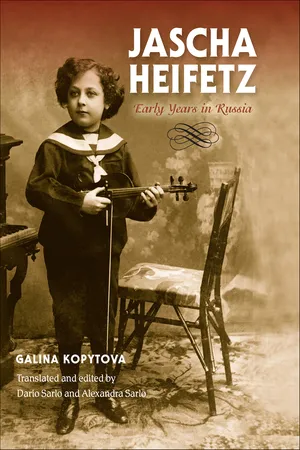
Notoriously reticent about his early years, violinist Jascha Heifetz famously reduced the story of his childhood to "Born in Russia. First lessons at 3. Debut in Russia at 7. Debut in Carnegie Hall at 17. That's all there is to say." Tracing his little-known upbringing, Jascha Heifetz: Early Years in Russia uncovers the events and experiences that shaped one of the modern era's most unique talents and enigmatic personalities. Using previously unstudied archival materials and interviews with family and friends, this biography explores Heifetz's meteoric rise in the Russian music world—from his first violin lessons with his father, to his studies at the St. Petersburg Conservatory with the well-known pedagogue Leopold Auer, to his tours throughout Russia and Europe. Spotlighting Auer's close-knit circle of musicians, Galina Kopytova underscores the lives of artists in Russia's "Silver Age"—an explosion of artistic activity amid the rapid social and political changes of the early 20th century.
- 504 pages
- English
- ePUB (mobile friendly)
- Available on iOS & Android
eBook - ePub
About this book
Trusted by 375,005 students
Access to over 1.5 million titles for a fair monthly price.
Study more efficiently using our study tools.
Information
Subtopic
Music Biographies
CHAPTER ONE
Early Roots of the Heifetz Family
THE HEIFETZ FAMILY TREE includes over one hundred people across five generations and family members who now reside in the United States, Australia, Israel, Latvia, and Russia. The oldest Heifetz name preserved in family memory is that of Ilya (or Elye), Jascha’s paternal grandfather, who was born around 1830. Two photographs of Ilya survive in the personal records of his descendants; one is an individual portrait, and the other a group photograph featuring Ilya, surrounded by his children and grandchildren. With one photograph now located in Russia and the other in the United States, these two unique, symbolic documents unite the Heifetz clan across the world.
According to family legend, Ilya Heifetz worked as a teacher (melamed) in a Jewish boys’ school (cheder) and lived with his large family in Polotsk, a provincial city in the western Russian province (guberniya) of Vitebsk, which is now part of Belarus. The surviving family group photograph dates from the late 1890s, when Ilya was well over sixty and his wife, Feyga, was no longer alive. An earlier photograph from the 1870s shows Jascha’s father, Ruvin, as a child, with his mother and grandmother, and is stamped, “Novo-Alexandria (Poulavy).”1 Novo-Alexandria was the name of a settlement in the Lublin province located on the bank of the Vistula (Wisła) River, seventy-five miles from Warsaw. Formerly known as Puławy, the city was renamed Novo-Alexandria in 1846 after a visit by Empress Alexandra Fyodorovna, wife of Tsar Nicholas I. It functioned as an important trade center between Russia, Austria, and the Baltic region, and reverted to its former name, Puławy, in 1918. By the end of the nineteenth century, Novo-Alexandria had experienced a large influx of Jewish settlers; about 2,500 of its 3,500 residents were Jewish.
Ruvin Heifetz was born on March 22 (NS April 3), 1872, in either Novo-Alexandria or Polotsk. His parents, Ilya and Feyga Heifetz, raised five additional children: a daughter, Mary (Malka-Chaya), and four sons, Morduch-Dov, Aron, Samuil (Shmuyla), and Natan (Nison). At least two of Ruvin’s brothers—Samuil and Natan—were born in Polotsk, one older and one younger, suggesting Ruvin was also born there. Ilya’s six children were registered as belonging to the Polotsk meshchanstvo—the name for the lower middle, urban classes in Russia (a member of this class was called a meshchanin, female meshchanka, or plural meshchane).
According to the recollections of descendants living in Riga, Ruvin’s oldest brother, Morduch-Dov, worked as a teacher and lived in Polotsk with his children and wife, Tsirele. His mail correspondence until the 1910s bore the address, “Polotsk. Morduch Heifetz, beyond the Dvina.” During one of his visits to Polotsk with his parents, five-year-old Jascha played his tiny violin at the wedding of Morduch’s daughter Feyga.
Ilya’s second son Aron Heifetz (1863–1926) also lived and taught in the Polotsk region; one of the earliest surviving Heifetz family documents relates his birth:
Certificate no. 483. It is hereby certified by the Polotsk Community Rabbi that to the Polotsk meshchane, lawful spouses Elye Itskov and Feyga Heifetz, in the month of September 1863 in the city of Polotsk, was born a son, who is given the name Aron.2
According to Aron Heifetz’s employment documents, he completed six years of secondary study in Daugavpils (then Dvinsk), about ninety miles from Polotsk. He taught at a Jewish school in the village of Kreuzberg before returning to Polotsk in 1904, where during the Soviet years he became the director of School number 6. Aron and his wife, Malka or Maria (1875–1948), had five daughters and one son.
Samuil was the only son of Ilya Heifetz not connected with the teaching profession. A certificate from the Imperial Warsaw University held in family papers declares: “Shmuila Elyevich Heifetz is by the medical department of this university found worthy by examination of the title of dentist and confirmed in this title 19 November 1904.”3
The youngest son, Nison Heifetz (1883–1950), more frequently called Natan or sometimes Naum, pursued musical studies at the Warsaw Institute of Music from 1896 to 1903. He later taught at schools in Warsaw and Yekaterinoslav (now Dnipropetrovsk), and after 1920 worked in Moscow at the Jewish Chamber Theater, the University of the Peoples of the West, and the Gnesin School of Music. He married his niece Fanny (1894–1977), the daughter of his brother Aron. During the Soviet years Fanny became a historian, defended her doctoral dissertation, wrote books on the history ofthe French workers’ movement, and worked with historian and academic Yevgeny Tarle. In 1945, Fanny became a victim of political repression under the Soviets. Natan and Fanny figured prominently in Jascha’s childhood.
By the end of the nineteenth century, the city of Polotsk, where Ilya Heifetz and his family lived, was a district center with a population of twenty thousand, 62 percent of which were Jews. The thousand-year history of the city witnessed several tragic episodes, including the Livonian war in the second half of the sixteenth century and Napoleon’s 1812 invasion of Russia. For the Jewish population, the most traumatic event occurred in 1563, when Ivan the Terrible ordered the drowning of the entire Polotsk Jewish population in the Daugava (Dvina) River. Locals commemorated the day ofthe tragedy each year with a procession to a hill on the riverbank, the supposed burial place of the drowned victims.
Few Jews lived in Russia proper during the second half of the eighteenth century, but with the partitioning of Poland toward the end of the century, Russia acquired Belarusian, Lithuanian, and Polish territories, each with a long history of Jewish settlement. Almost immediately Russian authorities classed the Jews as a foreign element and subjected them to restrictive laws. As the more democratic western countries began to remove such limitations, however, Russia hardened its relationship to the Jews throughout the nineteenth century, a development strongly supported by the state’s official ideology declared under Tsar Nicholas I, referred to as “Orthodoxy, Autocracy, Nationality.” Russian Jews faced increasing restrictions, but conversion to Christianity could free them from such laws as those forbidding them from living in or acquiring property in rural areas and closing off certain trades and crafts from them. Furthermore, a series of laws sought to remove Jews from a thirty-mile belt stretching through the western provinces. In essence, state policies strove feverishly to reduce the number of Jews in Russia, either by assimilating them or by encouraging them to settle beyond the borders of the empire, after which any return became impossible.
Laws permitting Jewish settlement only in Russia’s western regions, called the Pale of Settlement, led to the relative isolation of more than five million people. The Pale encompassed Ukraine, Moldova, Belarus, Lithuania, and Poland, as well as portions ofwestern Russia proper. Furthermore, the structure of traditional Jewish life itself encouraged the separation of Jews from the rest of the population; Jewish upbringing, family relationships, and education all bore a religious character, creating a strong internal bond within the Jewish communities.
Given the traditional organization of Jewish society in the nineteenth century, Ilya Heifetz most likely worked as a teacher and taught in a Jewish boys’ school with instruction in reading, writing, basic arithmetic, and prayers. For most of the nineteenth century, such boys’ schools and the Talmud Torah (a boys’ school for the poor) were the only available sources of religious education, giving even the poorest Jews a chance to study and learn about their heritage. The idea of a Jewish boys’ school has traditionally evoked images of a crowded, cold, dimly lit space, where boys of varying ages studied up to twelve hours a day. Instruction was in Yiddish, textbooks and other study aids were a rarity, and teaching methods usually focused on rote learning. Most teachers tended to be elderly men from a variety of backgrounds, including former merchants, craftsmen, brokers, haulers, and synagogue servants. Generally, a teacher’s own education was limited to the same type of school, and most lived meager lives with few luxuries.
From the 1840s onward, Russian authorities battled to raise the teaching standards in these schools. They began by instituting compulsory teaching exams for instructors and introduced requirements for those graduating from rabbinical schools; both approaches failed and were subsequently canceled. In the 1890s, following an unsuccessful fifty-year struggle, the authorities declared that anyone wishing to teach Jewish children religion and the Hebrew language would require a certificate from the director of a Jewish school. A certificate lasted for one year and cost three rubles; since no professional exam was required, the certificate functioned as little more than a confirmation of trustworthiness.4 Teachers received very small salaries, and although some began teaching out of necessity alone, others were truly dedicated to imparting knowledge and wisdom to the younger generation.
Teaching is not the only profession attributed to Ilya Heifetz. After some of Jascha’s earliest concerts, the Jewish press showed a heightened interest in the boy’s background, reporting that his grandfathers “were Jews who led prayers and sang Sabbath hymns [at home] and in general were fond of singing.”5 Another newspaper added that “his grandfathers were cantors and singers.”6 More information about Ilya appears on a document dated 1943 that belonged to his son Natan, which reads: “Father: worker (tailor), mother: homemaker.”7 During the Soviet years, few would admit on a work-related document to having a father who did religious work. Natan’s document comes from the employment records at the Gnesin School of Music, and it is possible that he listed his father as a tailor to hide the fact that Ilya was a teacher or cantor. Natan’s intention was not, most likely, to distort the truth but simply to omit it. Fulfilling duties as a cantor and teacher did not necessarily prevent a Jewish meshchanin from working as a tailor, and so it is also possible that Ilya worked as a tailor as well as a teacher and cantor.
Judging by the photograph of Ilya Heifetz from the early 1890s when he was about sixty, he was a solidly built man with a round face and high forehead. By the time of the family group photograph in 1898, he looked significantly older, but his appearance is deceiving, since during this same period he remarried, and in 1902 his new wife gave birth to their daughter, Feyga-Vikhne, from whom originated the Leningrad branch of the Heifetz family. The name of Ilya’s second wife is not recorded, but it is known that she died from injuries sustained during the Russian Civil War (1917–1922). Since Ilya had already died by then, sixteen-year-old Feyga was taken in by Aron’s family, and she lived with them in Polotsk and then in Moscow, where all of Aron’s six children eventually moved to pursue higher education.
Ruvin left home at the age of twenty-six, in 1898, the same year his father Ilya remarried. He was of average height, slender, and like all his brothers, he began balding early. He cultivated a mustache curled at the ends, and his right cheek carried a faint but noticeable birthmark. In Russia, and in the Russian language, Ruvin’s name traditionally appears as the variant “Ruvim,” which is the spelling used in the canonical translation of the Old Testament. As a result, Russian publications often refer to Jascha Heifetz with the patronymic “Ruvimovich,” but his father called himself Ruvin throughout his life, and the name Ruvin (not Rubin or Reuven) appears in the majority of official documents associated with him, both in Russia and the United States.
The extent of Ruvin’s early education is unknown, but he was reasonably educated. The family spoke Yiddish (by the end of the nineteenth century, 95 percent of Jews in the region considered it their native language), and it was in Yiddish that Ruvin wrote lengthy and animated letters to his family. Although Ruvin’s letters in Russian contain no major spelling errors, they are full of stylistic and grammatical errors. For example, after Ruvin moved to the United States, he continued to communicate with his brother Natan in Yiddish, but after Natan’s death in 1950, Ruvin wrote a letter in Russian (dated December 8) to the children of his deceased brother, since they did not know Yiddish. The letter is full of mistakes and shows how profoundly his Russian had deteriorated.8
Ruvin received no higher or conservatory education. Having become a proficient violinist early on, he began working in the small local orchestras which were plentiful in Polotsk and throughout the Pale. According to Lev Raaben, the author of the first Russian study on Jascha Heifetz, all those acquainted with Ruvin claimed that he had great musical talent, and that “only hopeless poverty in his youth, and the absolute impossibility of receiving a musical education interfered with the development of his talent.”9 Life was difficult for Ilya Heifetz’s large family surviving on his teacher’s wage, but the term “hopeless poverty” seems too extreme; many people lived in far worse circumstances. Ruvin knocked on doors in search of work; he performed in klezmer orchestras at weddings along with his brother Natan, who had received a conservatory education and played the violin. Natan explained in his personal memoirs that the first steps in his own musical development began at home: “From five years old, my mother, who had excellent musical talent and a wonderful voice, began to teach me piano.”10 It seems the family owned a piano, further contradicting the image of “hopeless poverty,” and it is probable that like Natan, Ruvin also received his earliest musical training...
Table of contents
- Cover
- Half title
- Title
- Copyright
- Dedication
- Contents
- Author’s Preface
- Editors’ Introduction
- List of Abbreviations
- 1 Early Roots of the Heifetz Family
- 2 1901–1906: Vilnius
- 3 1906–1909: Music School
- 4 1910: St. Petersburg Conservatory and Nalbandian
- 5 First Performances in St. Petersburg
- 6 Summer 1911: Concerts in Pavlovsk and Odessa
- 7 Fall 1911: In the Class of Professor Auer
- 8 The Beginning of 1912
- 9 1912: First Trip to Germany
- 10 1912: A German Tour
- 11 The Beginning of 1913
- 12 Summer-Fall 1913: Loschwitz
- 13 Winter 1913–1914: Bar Mitzvah
- 14 Spring 1914
- 15 Summer-Fall 1914: War
- l6 January-September 1915
- 17 The End of 1915
- 18 The First Half of 1916
- 19 The Second Half of 1916: Norway and Denmark
- 20 The First Half of 1917: February Revolution
- 21 Summer 1917: Departure for America
- Appendix 1: Reviews of Jascha Heifetz’s Debut at Carnegie Hall, October 27,1917
- Appendix 2: Jascha Heifetz’s Repertoire in Russia
- Notes
- Selected Sources
- Index
Frequently asked questions
Yes, you can cancel anytime from the Subscription tab in your account settings on the Perlego website. Your subscription will stay active until the end of your current billing period. Learn how to cancel your subscription
No, books cannot be downloaded as external files, such as PDFs, for use outside of Perlego. However, you can download books within the Perlego app for offline reading on mobile or tablet. Learn how to download books offline
We are an online textbook subscription service, where you can get access to an entire online library for less than the price of a single book per month. With over 1.5 million books across 990+ topics, we’ve got you covered! Learn about our mission
Look out for the read-aloud symbol on your next book to see if you can listen to it. The read-aloud tool reads text aloud for you, highlighting the text as it is being read. You can pause it, speed it up and slow it down. Learn more about Read Aloud
Yes! You can use the Perlego app on both iOS and Android devices to read anytime, anywhere — even offline. Perfect for commutes or when you’re on the go.
Please note we cannot support devices running on iOS 13 and Android 7 or earlier. Learn more about using the app
Please note we cannot support devices running on iOS 13 and Android 7 or earlier. Learn more about using the app
Yes, you can access Jascha Heifetz by Galina Kopytova, Dario Sarlo,Alexandra Sarlo in PDF and/or ePUB format, as well as other popular books in Media & Performing Arts & Music Biographies. We have over 1.5 million books available in our catalogue for you to explore.