A history and analysis of scientific charity organizations that arose in late nineteenth century America.
In the 1880s, social reform leaders warned that the "unworthy" poor were taking charitable relief intended for the truly deserving. Armed with statistics and confused notions of evolution, these "scientific charity" reformers founded organizations intent on limiting access to relief by the most morally, biologically, and economically unfit. Brent Ruswick examines a prominent national organization for scientific social reform and poor relief in Indianapolis in order to understand how these new theories of poverty gave birth to new programs to assist the poor.
"Ruswick's well-researched monograph traces the history of the charity organization society in the US from its origins in the Gilded Age to its merging with social work in the Progressive Era. . . . Recommended." —
Choice
"[This] study provides a welcome insight into the inner workings of charity organization societies and their drive to eliminate poverty." —
Nonprofit & Voluntary Sector Quarterly, Volume
43, Issue 4, 2014
"
Almost Worthy offers a lot of interesting detail pulled from COS case files, professional conference proceedings, journals of the field, and more; some possibly fruitful hypotheses about what to make of changes in COS approaches over time; thoughtful new propositions about the relationship between scientific charity and eugenics (including some charity reformers' apparent remorse); and a fresh, new mini-biography of Oscar McCulloch interspersed throughout." —H-SHGAPE
"Brent Ruswick wants to put the science back into scientific charity. He argues that the essence of organized charity was not its class prejudices and censorious attitude toward the poor, but rather its belief that systematic evidence-gathering could serve to improve the quality of charity work and public policy." —
American Historical Review, Volume
119, Issue 4, October 2014
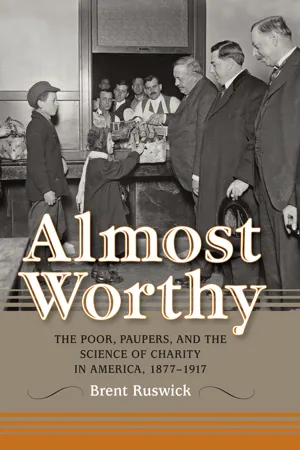
eBook - ePub
Almost Worthy
The Poor, Paupers, and the Science of Charity in America, 1877–1917
- 288 pages
- English
- ePUB (mobile friendly)
- Available on iOS & Android
eBook - ePub
About this book
Trusted by 375,005 students
Access to over 1.5 million titles for a fair monthly price.
Study more efficiently using our study tools.
Information
1
INTRODUCTION: BIG MOLL AND THE SCIENCE OF SCIENTIFIC CHARITY
Big Moll, Pauper
In June 1881 a council of concerned Indiana citizens filed a petition with the Board of County Commissioners of Marion County, asking that they investigate the rampant abuse and negligence rumored to be infesting the Marion County Poorhouse. Thomas A. Hendricks, a former Indiana governor, U.S. senator, vice presidential running mate to Samuel Tilden, and later vice president to Grover Cleveland, headed the petitioning council. Their case rested on four contentions: that the poorhouse overseers did not differentiate between the different types of people residing in their facility, that their negligence and improper training had resulted in abuse of the inmates, that the poorhouse was part of the local Republican machine and coerced its residents to vote the party ticket, and that biology and statistics proved that the poorhouse’s system perpetuated pauperism, or willful dependence upon private charity and public welfare.
In spite of concerns voiced to the board by the Reverend Oscar C. McCulloch, a member of the committee that wrote the petition, that the inmates feared “they will be thrown in the dungeon” of the poorhouse if they offered critical testimony, several residents chose to share their experiences.1 Their remarks brought forth sordid examples of neglect, especially of beatings, solitary imprisonment in the cellar, rancid food and drink, as well as inadequate ventilation, heating, blanketing, medical care, and other injustices. Ed Akins testified that “he had been given the diabetes from drinking a peculiar kind of tea” offered to him by the steward, Dr. Culbertson. With the approval of Peter Wright, a farmer who with his wife and daughter supervised the institution, more a poor farm than poorhouse, Culberson then refused to provide the necessary medicine to Akins.2 Samuel Churchwell recounted how his two-year-old child had been separated from its mother, left so underclothed during winter that “its legs had been frozen,” starved to the point of being unable to recognize its parents upon being returned to them, then caught a cold and died.3 A newborn died when, allegedly, the professionally inexperienced Dr. Culbertson (whose legal record already included a conviction for assault and battery) waited two days before attending to its illness. Reports suggested that other than to receive beatings or solitary confinement, the insane residents warranted even less attention than the infants.4
Hendricks also alerted the commissioners to the consequences of indiscriminately throwing together nearly two hundred people of very different conditions: children, the sick, the insane, the vicious, and the elderly. Oliver Thomas, an “insane idiot” child unable to recognize his own name, reportedly whipped another child, Harry White, two to six times because Harry had screamed after a dog had frightened him. Witnesses reported that Mr. Wright always kept with him a cowhide to beat inmates, and he had also beaten Harry because he “had used careless language and was full of fun.” Harry in turn tormented and mistreated other inmates. Hendricks accused Wright of attempting to run the institution without proper discrimination between these classes, an effort “which, in the nature of things, is impossible.” To remedy the situation, Hendricks requested that the commissioners remove the children from the poorhouse, build a separate home for the sick, and for those who remained, to separate “the vicious from the virtuous.”5
In the 1820s and 1830s, local governments across the nation had constructed poorhouses, prisons, and asylums for social outcasts. By creating an institutional system of “indoor relief,” Jacksonian era reformers hoped they could discourage the beggars and tramps who searched for towns with better job opportunities or, more likely, more generous levels of “outdoor” public relief. But even as the distrust of the poor amplified calls for their physical isolation, the enthusiasm for poorhouses also reflected a new belief among reformers that poverty was both a moral and a social problem, one that might be solved through concerted effort, especially by building institutions designed either to morally reform or socially isolate the beggar. Almshouses rested “at the center of public policy” toward the poor in the decades before the Civil War.6
In practice, however, poorhouse mismanagement was commonplace. The institutions devolved into warehouses that indiscriminately mixed the so-called vicious—paupers, hardened criminals, and the insane—with the virtuous—the elderly, the young, and the “honest” poor—under one poorly repaired roof. The original poorhouse in Indianapolis was “merely a receptacle into which was thrust that inconvenient class in the community who, being unable to help themselves, were put away out of sight and dismissed from public concern. As long as the general public was not informed of the conditions within the asylums few changes were made.”7 Under partisan control, the institutions typically did not answer to any regular form of oversight and often served the interests of the political machine. By the 1870s, a broad range of critics sought to bring charitable and correctional agencies underneath professional, nonpartisan supervision. The Wright family, for instance, had allegedly provided all male inmates over the age of twenty-one with new suits of clothes in October 1880 to encourage their vote in the presidential election, and then only offered the inmates Republican tickets. They confiscated the clothes after the election.8
Although the Indianapolis newspapers covered Churchwell and White’s tales of abuse with lurid and highly partisan interest, the greatest media sensation was a pair of paupers, Mrs. Pierce and “Big Moll.” Newspapers’ accounts injected much confusion into the story by using different spellings of the witnesses’ names from day to day and paper to paper: Big Moll was Molly, Mollie, or Mary Oliver, and her experiences regularly were juxtaposed with Mrs. Pierce, who sometimes was identified as Miss, and additionally shared her surname and uncertain marital status with a woman at the poorhouse who worked with the insane. When Wright arrived, he placed the pauper Pierce in charge of twenty-five children at the farm. It was not an auspicious choice. Pierce had lived for twelve years at the institution, and according to Hendricks, she was “without education, and as far as Mr. Wright knew, without morality.”9 The Churchwell child who had died from neglect had briefly been one of her charges.10 Fearing what she might say, Mrs. Wright had given Pierce a new dress and slippers and had promised a second dress and an attempt to secure for her “a set of teeth . . . in consideration of favorable testimony at the trial.” Pierce insisted she had not recognized this to be a bribe.11
Hendricks warned that leaving a pauper like Mrs. Pierce to raise the children in the poorhouse risked exposing them to a fate worse than death: they would grow up to resemble Big Moll. Could that even be called living? Hendricks presented Moll, who had been raised since infancy in poorhouses, as a monster, a menace to social and moral order, and fundamentally different in nature from both the well-off and the normal poor. The News breathlessly reported that the “glimpse of her rude life” so interested the commissioners “that the ordinary rules of evidence were not regarded, and she was more closely questioned as to her own character and career than as to her knowledge of the matters at hand.” If not the most accurate description of Molly Oliver, the character constructed by the report indicates the depth of fear and animus that paupers often provoked. Said the News:
She was utterly debased, without a humanizing trait. She was a product of the poor house system. She was reckless and vicious. Her face was without a gleam of virtuous impulse. She was not desperate for she had never hoped. . . . She has only known poor-house care and poverty. She has found nothing in that to awaken the gentler phases of woman’s nature. Her moral sense is dull, because it has never been aroused and quickened. She simply exists as she has always existed, friendless, hopeless, and alone, the sport of passions and impulses purely animal, a creature for whom charity regrets the birth. She serves to show, however, wherein our poor farm managements are wrong. She illustrates what is the outcome of such conditions . . . [for] pauper children. She suggests to the humanitarians what should be done. She stands [as] an example and a warning.12
Moll was immoral, crude, even unfeeling due to a lifetime spent in poorhouses. She also was “rotten driftwood,” an “ill-looking, disgusting woman,” and “a great animal.”13
Life had not been easy for Big Moll. About twenty-eight years old by her own guess, she had either been born or abandoned in a poor farm, spent time in jail, and since shown a “remarkable . . . facility for gaining admission to poor farms.” She had four children, each out ofwedlock, at least one, scandalously, from a black man, and according to hearsay she had burned one of her children to death by resting it on a steam coil. At the Marion County Poorhouse, Moll seems to have cursed, mistreated, and fought with nearly everyone. She soon ran afoul of Dr. Culbertson, who thought her “a boisterous, high tempered woman.” To deal with an alleged outburst, Culbertson needed his male nurse to sit on Moll and bind her with straps, “as she fought us all the way.” Once subdued and under the influence of morphine, they bound her wrists, dragged her by her arms along the floor to “a bad-smelling cell” in the basement, where she was kept for three or four days on a straw bed with no pillow, and “with nothing to eat except two pieces of dry bread three times a day. When she was released she was so weak she could scarcely stand.” Culbertson dismissed any complaints about her wounds as the product of Moll having syphilis, “which causes her to have pains over the body occasionally.”14
The intertwined stories of Mrs. Pierce and Big Moll demonstrated several concerns about poorhouses and poverty that had characterized American thinking at least since the early 1800s, but also revealed something much newer: reformers’ alarm at the supposedly biological nature of pauperism. In environments such as the poorhouse, individuals already predisposed by their heredity toward pauperism, crime, or insanity might degenerate, hardened into hopelessly irredeemable cases. Hendricks claimed that the poorhouse children already were biologically predisposed toward lives of idleness and that a childhood spent under the tutelage of a pauper like Mrs. Pierce threatened to leave them as hopelessly squalid and degenerate as Big Moll and just as likely to reproduce carelessly. To prove this claim, in the closing arguments he discussed at length the recent findings of Richard Dugdale, whose genealogical study of the Jukes family of upstate New York was widely interpreted by reformers of the period as proof that parents passed the traits of criminality and poverty on to their children the way another family might pass on a prominent chin or nose.15 In doing so Hendricks hoped to impress upon the commissioners adjudicating the case the magnitude of the threat posed by poorhouse mismanagement. Employing the familiar hereditary imagery of the period, he warned the commissioners that their poorhouse was “raising up plants which would bring forth just such fruit” as Big Moll. Biology and statistics showed that from pauper parentage and supervision arose a new generation of paupers, thieves, and “bad characters.”16
The defense accepted and even extended upon the hereditarian argument in order to justify Mr. Wright’s rough treatment of his inmates. The lead defense attorney, Mr. Norton, argued that the demands placed upon the poorhouse had surpassed the law that had created it; indeed, there should be separate institutions for separate classes of people, staffed with trained physicians instead of farmers. Norton advised the panel to consider the sorts of people with whom Wright and Culbertson dealt. Affirming Dugdale’s expertise on the subject, he then reinterpreted Dugdale’s research and that of several other recent reports as proof that the inmates were responsible for their pitiful state, thereby justifying Wright and Culbertson’s handiwork. Quoting from the findings of an article on the state of the nation’s poorhouses that had appeared in the Atlantic Monthly in June, he advised the panel, “Probably it is liberal to put down one-tenth of the paupers as people deserving of sympathy. The other nine-tenths are in the Alms House because they have not wit enough or energy enough to get into prison.”17
Presiding over an investigation of their own institution and employees, the Board of County Commissioners accepted this defense, as they ruled that the food had been adequate and the cells in the basement “reasonably suited to the purposes for which they were intended.” With one commissioner dissenting and then resigning, the board also ruled that Wright and Culbertson attended properly to the sick and that they were “not prepared to describe any of the treatments as abusive.” Although satisfied that no abuse had occurred, they expressed greater concern for the lack of oversight and proper discrimination between types of dependent persons. The board did recommend that a well-paid physician head the institution, that a farmer serve as steward, that a children’s home organized like a kindergarten be established so that the children could be removed from the poorhouse, and that the city and county appoint a board of visitors to supervise the poorhouse continuously.18 Big Moll disappeared from the public’s view as suddenly as she had arrived.
Finding the Worthy among the Unworthy in the Postbellum United States
Big Moll’s sorry circumstances aptly illustrate the panic felt by Gilded Age reformers over the seemingly contagious moral and physical disease known as pauperism and the allegedly insufficient or even counterproductive measures then available for addressing it. More drastic reforms of the poor relief system were needed than merely the intermittent patching up of almshouses. Few characters aroused so much fear and condemnation in nineteenth-century America as the pauper. As a general rule, Americans believed that poverty struck those beset by either personal misfortune or moral failings. This understanding of poverty logically demanded that charity be given judiciously. Personal misfortune might strike a man through no fault of his own; in such a case he ought to receive charitable relief. Moral weakness and misconduct, however, were inherent human frailties that would always lead some to value idleness over industriousness if given the chance. Unlike the ordinary worthy poor, who suffered authentic poverty due to some piece of bad fortune like illness or infirmity, the unworthy pauper supposedly chose a life of idleness, living off relief that he won by deceiving charities with fabricated stories of hardship. Conventional wisdom dictated that charity only reinforced the pauper’s laziness and willful dependence by creating a disincentive to work. Without needing to labor, his physical and moral vigor would atrophy, and he would descend into a state of permanent dependence, or pauperism, which would furthermore tempt the honest poor to follow his languid ways.
The pauper had lived alongside the worthy poor for centuries, but only with seismic economic, demographic, scientific, and social disruptions in America during the nineteenth century did observers reimagine the pauper as a social problem requiring concentrated and coordinated action. Industrialization and immigration brought a host of new challenges to the towns and cities of antebellum America. Young men migrating from rural settings to the cities and Irish immigrants made the urban poor a new, more foreign, Catholic, and potentially subversive threat congregating in pockets of American cities. The pauper’s chronic, willful condition and aggressive pursuit of alms seemingly subverted the classical liberal and Victorian values of independence and thrift, the biblical image of the meek and modest poor, and the transition to a wage-based, modern industrial economy.
While maintaining the traditional moral distinctions between the worthy and unworthy poor, Pro...
Table of contents
- Cover
- Half title
- Title
- Copyright
- Dedication
- Contents
- Acknowledgments
- 1 Introduction: Big Moll and the Science of Scientific Charity
- 2 “Armies of Vice”: Evolution, Heredity, and the Pauper Menace
- 3 Friendly Visitors or Scientific Investigators? Befriending and Measuring the Poor
- 4 Opposition, Depression, and the Rejection of Pauperism
- 5 “I See No Terrible Army”: Environmental Reform and Radicalism in the Scientific Charity Movement
- 6 The Potentially Normal Poor: Professional Social Work, Psychology, and the End of Scientific Charity
- Epilogue
- Appendix 1. Course Syllabus, Alexander Johnson: Study Class in Social Science in the Department of Charity
- Appendix 2. Course Syllabus, Mrs. S. E. Tenney: The Class for Study of the Friendly Visitor’s Work
- Notes
- Selected Bibliography
- Index
Frequently asked questions
Yes, you can cancel anytime from the Subscription tab in your account settings on the Perlego website. Your subscription will stay active until the end of your current billing period. Learn how to cancel your subscription
No, books cannot be downloaded as external files, such as PDFs, for use outside of Perlego. However, you can download books within the Perlego app for offline reading on mobile or tablet. Learn how to download books offline
Perlego offers two plans: Essential and Complete
- Essential is ideal for learners and professionals who enjoy exploring a wide range of subjects. Access the Essential Library with 800,000+ trusted titles and best-sellers across business, personal growth, and the humanities. Includes unlimited reading time and Standard Read Aloud voice.
- Complete: Perfect for advanced learners and researchers needing full, unrestricted access. Unlock 1.5M+ books across hundreds of subjects, including academic and specialized titles. The Complete Plan also includes advanced features like Premium Read Aloud and Research Assistant.
We are an online textbook subscription service, where you can get access to an entire online library for less than the price of a single book per month. With over 1.5 million books across 990+ topics, we’ve got you covered! Learn about our mission
Look out for the read-aloud symbol on your next book to see if you can listen to it. The read-aloud tool reads text aloud for you, highlighting the text as it is being read. You can pause it, speed it up and slow it down. Learn more about Read Aloud
Yes! You can use the Perlego app on both iOS and Android devices to read anytime, anywhere — even offline. Perfect for commutes or when you’re on the go.
Please note we cannot support devices running on iOS 13 and Android 7 or earlier. Learn more about using the app
Please note we cannot support devices running on iOS 13 and Android 7 or earlier. Learn more about using the app
Yes, you can access Almost Worthy by Brent Ruswick in PDF and/or ePUB format, as well as other popular books in Social Sciences & Sociology. We have over 1.5 million books available in our catalogue for you to explore.