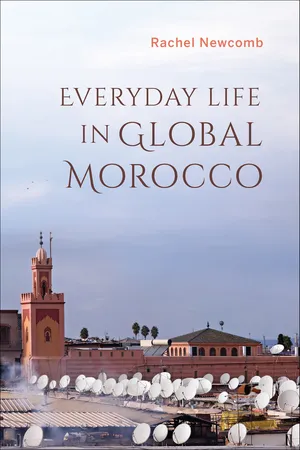
Following the story of one middle class family as they work, eat, love, and grow, Everyday Life in Global Morocco provides a moving and engaging exploration of how world issues impact lives. Rachel Newcomb shows how larger issues like gentrification, changing diets, and nontraditional approaches to marriage and fertility are changing what the everyday looks and feels like in Morocco. Newcomb's close engagement with the Benjelloun family presents a broad range of responses to the multifaceted effects of globalization. The lived experience of the modern family is placed in contrast with the traditional expectation of how this family should operate. This juxtaposition encourages new ways of thinking about how modern the notion of globalization really is.
- English
- ePUB (mobile friendly)
- Available on iOS & Android
eBook - ePub
Everyday Life in Global Morocco
About this book
Trusted by 375,005 students
Access to over 1.5 million titles for a fair monthly price.
Study more efficiently using our study tools.
Information

INTRODUCTION
What is past is gone, what is hoped for is absent, for you is the hour in which you are.
—Moroccan proverb
Ordinary lives do not confront the global as such. They face more immediate issues.
—Friedman and Ekholm Friedman 2013, 249
If a man told you that a dog had run off with your ear, would you go after the dog or search first for your ear? The year is 2011. All around Morocco, the so-called Arab Spring is making its presence felt, with frequent Sunday demonstrations in major cities organized by the February 20th Movement. So far, the movement’s demands have been modest: more accountability in government, an independent judiciary, jobs, and other reforms. When a few demonstrations turned violent, some of the attacks were directed at businesses, including a French company in Tangier that had begun privatizing water and charging higher prices than the municipality.
The city of Fes has also seen its share of demonstrations, but Khaled has little interest in joining them. Although he is unemployed, the movement’s concerns do not seem to resonate with him, and he generally dismisses its rhetoric. What truly inflames him, and the project to which he devotes his summer, is getting his neighborhood together to protest the addition of a bakery on their street. He has organized petitions, visited city government officials, and canvassed among friends, acquaintances, and nearby businesses. He does not know the businessman, an outsider, who wants to open the bakery, and that, to Khaled, is a major part of the problem. What was once, during his childhood, a small city of old French buildings with neighbors who all knew one another has become a place overrun by gleaming, unaffordable new high-rises owned by strangers. What he knows is that the city in which he grew up is changing, and soon, he worries, rising costs will force everyone he knows to relocate.
He who eats when he is full digs his grave with his teeth. 2013. In the morning, Ilham rises first, straightening the kitchen from the previous night’s meal and putting a pot of coffee and milk on the stove. She unwraps yesterday’s baguettes and places them on a plastic tray with jam, small silver packets of La Vache Qui Rit cheese, and glasses, then rouses her family from sleep: her husband, Brahim, and her two children, Sara and Samir, ages ten and fifteen. They snatch bites of breakfast between taking turns in the family’s small bathroom, then everyone is off to work and school. At lunch, Brahim returns home for the tagine Ilham has prepared, which they eat together. An hour later Samir arrives; he eats a pressed panini sandwich and fries Ilham bought from the frozen food section of the Marjane supermarket, then returns to school. Sara, who eats lunch at school, does not come home until three in the afternoon, when a bus brings her back to the house. She nibbles on cookies and Danone yogurt while doing her homework. When Samir arrives a little later, he downs a soda and a bag of chips before going back out again to meet his friends. For tea at around seven that evening, Sara helps Ilham fry up some fresh malawi, a multilayered pancake with large quantities of oil and butter between each layer. Samir returns to do his homework, and his mother makes him a sandwich with cacher (processed meat) and cheese, along with a Fanta orange soda. After returning from having coffee with his friends, Brahim also has a piece of malawi before drinking a glass of hot chamomile tea to help him sleep.
For the sake of a single rose, the gardener becomes servant to a thousand thorns. 2009. Hanane wants a baby. She has been married twice. She has no children and has had one miscarriage. She has visited doctors, healers, and herbalists, taking careful note of their prescriptions, even if there are some she will not be able to follow. She does not place the medical doctors’ expertise higher than that of anyone else. “If I could afford it, I’d do the expensive treatments,” she says, referring to in vitro fertilization (IVF). But one cycle of IVF costs more than she makes all year as a teacher in a primary school. And she is skeptical about the success rates of any one treatment over others: all the doctors and herbalists she has visited claim similar success rates and exude expertise. In fact, the health practitioners, both traditional and modern, all offer advice and counseling to their patients, and from them all she hears a common message: Our treatments offer your best chances for success, but if they don’t work, stay together. A marriage doesn’t need children to be happy. In her mother’s day, she says, her condition would have been devastating: her husband would have left her or taken another wife. “If I can’t have children, of course I will be sad, but he says it’s not important to him, and if it doesn’t work out, he won’t leave me,” she says with certainty.
Three Moroccan proverbs open these vignettes into everyday life in a globalized Morocco: about pursuing the wrong targets, the excesses of our modern diets, and the multiple options that globalization seems to provide (although not to everyone). The stories themselves have been chosen to represent slices of everyday life in which average Moroccans confront larger issues related to globalization. What connects the broader contexts of the upheavals in the Arab world in 2011, a national protest movement, and a man who is concerned about the opening of a bakery in his small corner of the city of Fes? What can a typical day in the life of a middle-class Moroccan family tell us about culture, cuisine, health, and the changing dynamics of food and family? What is global about the life of a woman who still chooses from among traditional therapies to try to have children?
Khaled, Ilham, and Hanane Benjelloun are adult siblings from a middle-class family, born during the forty-year reign (1960–1999) of King Hassan II.1 They have two other brothers: Rachid, a migrant who has struggled since the 2008 recession to make ends meet in Europe, and Mourad, a small-scale entrepreneur who sells used clothing out of a tiny shop in a suburb of Fes. They came of age around the time of the fall of the Berlin Wall, a moment that marked the end of the Cold War and the beginnings of the era of globalization. Their lives reflect many of the challenges and opportunities of living in a globalized world. They are children of the era of structural adjustment programs in Morocco, when Morocco borrowed heavily by agreeing to the terms of the International Monetary Fund (IMF) and the World Bank: cutting the government jobs an earlier generation relied on and encouraging private investment. They have lived through a time when the main language of instruction for Morocco’s educational system switched dramatically and suddenly from French to Arabic, through the birth of the internet, and through a dramatic population shift when average family size fell from around seven children per woman in the early 1970s to slightly over two in 2014. Although middle class, the Benjellouns are subject to the same forces of globalization that have scattered families in search of better opportunities to support themselves and their loved ones. Their diet is affected by worldwide trends toward processed foods, and the resulting health problems are those increasingly shared by countries in both the Global South and the Global North. When they are sick, the medical care they seek also represents the middle tier of income: they do not need to use public hospitals, where the quality of the treatment is often abysmal. Instead they rely on a medium tier of private clinics that provide acceptable care yet do not offer the latest technologies, which are within the means of the upper class but not the rest of the population.
The Benjelloun patriarch, Si Mohammed, worked for years in a steady government job with benefits, a position that was eliminated when he retired. His wife, Latifa, raised their five children and was known around their middle-class neighborhood for her excellent cooking and fine embroidery, which she occasionally sold to make extra income. Since Si Mohammed passed away from a heart attack several years ago, Latifa divides her time among her children’s houses, and until recently she and Khaled shared the small apartment in the city center where all her children grew up.
This ethnography explores how everyday lives in urban Morocco are affected by globalization.2 We will see how global factors come into play as individuals navigate activities that are both timeless and human: marrying, having children, working, eating, and finding shelter. With globalization, these activities have all grown much more complex. Cultures, however, give their own meanings to biological activities, and exploring those meanings can teach us about a culture’s distinctiveness while revealing the underlying facets that unite “us” with “them.” As globalization connects us through technology, trade, and travel, it possesses potentially homogenizing effects as well. Work schedules around the world come closer to resembling a Euro-American model, corporations spread their reach nearly everywhere, and technology offers simultaneous access to news and media.
The Benjellouns are part of Morocco’s middle class, living modestly but in adequate comfort, in jobs and circumstances that are quite different from those of their parents’ generation. They bear an illustrious Moroccan family name and are members of an extended family that, in other cities, has enjoyed power, influence, and wealth beyond their reach. A billionaire, a soccer star, and a writer all share the same name but are relations so distant that the Benjellouns cannot trace the exact family connections they might have shared in the distant past. For this branch of the family, the Benjelloun name implies a higher social class than their economic status actually conveys. They often tell the story of their grandfather and his three brothers. The brothers left Fes to seek their fortunes in Casablanca and Rabat, while their grandfather stayed behind, marrying a local woman and starting a large family of ten children that included their father, Si Mohammed. When the grandfather died, his property was divided among his many heirs, some of whom managed to build their wealth with astute (or lucky) business decisions, while others sold their assets and spent their inheritance. Si Mohammed himself held onto the family’s apartment in the center of town, where Latifa and Khaled lived until the building was sold. Latifa used some of the proceeds she received from the sale to rent a small apartment on the outskirts of the city, where she lives with Khaled whenever she is not visiting her daughters. Rachid, who is frequently in Morocco as a result of the economic downturn in Spain, often stays with them as well. But even without the residential connection to the city center, Khaled still returns daily to spend time in his favorite café, networking with people from the old neighborhood.
The three vignettes that begin this book—Khaled Benjelloun’s protest against the opening of a bakery, Ilham Benjelloun’s efforts to feed her family despite disjointed schedules and multiple dietary preferences, and Hanane Benjelloun’s quest to have a baby—relate to larger globalization issues in Morocco. They reflect gentrification and rising inequality; the disappearance of the Mediterranean diet, leading to an increase in health issues such as obesity and diabetes, and new ways of dealing with infertility and its effects on marriage and family. Later chapters focus on the lives of the other siblings: of Rachid Benjelloun’s forays into migration and transnational marriage, and of Mourad Benjelloun’s experiences with the Moroccan labor market. Along the way, I explore situations Moroccans face as they navigate globalization-related dilemmas, including an increased emphasis on consumer culture, the presence of conflicting discourses on female virginity and premarital sex, and the perils of the informal labor market. These are issues people confront everywhere around the world, yet they do so in locally and culturally specific ways.
Globalization is an abstract concept, often described in terms of processes such as flows of capital and technology. But what is often lost in theoretical discussions of globalization is its lived reality, portrayed in a way that humanizes the struggles of individuals navigating an increasingly globalized world. Everyday life has changed as a result of discourses interacting on multiple levels: local, national, and global. The global permeates both the local and the national in ways that are not always obvious. People do not usually perceive themselves as encountering globalization head-on. Yet globalization makes its presence felt in numerous ways, in a chain reaction of sorts. Barriers to trade and investment are removed as governments withdraw from being the main provider of jobs and services to their people. Multinational supermarkets and shopping malls open, while neighborhood markets disappear. People change their shopping and eating patterns, and new health concerns emerge. Using the internet and satellite media, people form connections with each other in cyberspace and learn about other ways of living and other goods to covet, or about the possibilities for political action or “correct” religious observance. Through all of these processes, cultures are both resilient and malleable, maintaining aspects of their uniqueness while also finding themselves dramatically altered by global encounters.
These processes are common to countries such as Morocco that occupy the territory known as the Global South, the term applied to most nations within Africa, Latin America, and much of Asia.3 Many governments embarked on structural adjustment programs in the name of “development” so that the Global South could become part of the high-speed international world of trade and commerce that characterizes life for the Global North, which comprises the wealthier countries of the Northern Hemisphere, plus Australia and New Zealand. What effect do these processes have on people in these countries? How are their everyday lives affected by globalization, and what are the core facets of Moroccan identity that remain stable amid flux and change? What is globalization, and what can an anthropological view of one family tell us about its larger meanings?
A BRIEF HISTORY OF MOROCCO
Located in northwest Africa, 7.7 nautical miles across the Strait of Gibralter from Spain, Morocco is a stunningly beautiful country with a varied geography, three major mountain ranges, extensive beaches on its Atlantic and Mediterranean coasts, rich, flat agricultural land, and arid deserts in the south. Bordered by Algeria on the east and Mauritania on the south, Morocco has long been a crossroads of cultures. Inhabited since Paleolithic times (190,000–90,000 BCE), its original indigenous population were Berbers, with the Phoenicians settling in the area as early as the sixth century BCE. The word “Berber” comes from the Greek barbaroi, and designated those who spoke no Latin or Greek (Ilahiane 2006, xxx). Subsequently, Morocco was occupied by Carthage, and then the Roman Empire from the first to the fifth century CE, and was briefly part of the Byzantine Empire, although Berber tribes in the hinterlands generally continued to live unaffected by these waves of occupation. Some Berbers converted to Christianity during the Roman Empire. There were also preexisting Jewish populations, whereas other Berbers followed animist religious practices. That was to change in the seventh century with the arrival of the Arabs, who brought with them the new religion of Islam.
Today, 99 percent of the country is Muslim, and all but a few thousand Jewish Moroccans, most of them now living in Casablanca, have emigrated. There are no significant Christian populations except for foreign residents. Moroccan Islam has historically been moderate in nature. Like all Muslims, Moroccans follow the Qur’an, hadiths, and sunna, or sayings and customs of the Prophet. They follow the juridical school of Maliki Islam for Islamic law. But the country is also home to a variety of popular religious practices often loosely associated with Islam, such as Sufism or mysticism, the seeking of blessings at the tombs of holy men, the writing of amulets as a protection against black magic, and trance and spirit possession.4 Both the internet and migration have caused many Moroccans to attempt to eradicate or “correct” such religious practices, often in keeping with a more hard-line, conservative Islam learned in the mosques of Europe, which are frequently funded by Saudis.
The first attempted conquest of Morocco was by the Umayyad Caliphate in 670 CE, and over the next century Morocco was claimed by various caliphates originating in the Middle East until the establishment of the Idrisid dynasty in 788. From the eleventh century onward, ruled by both Berber and Arab dynasties, Morocco was a substantial power in the region, commanding not only its own territory but parts of Spain and Algeria as well. In 1492 Spain reclaimed its land, expelling both Muslims and Jews from the country. Many settled in Morocco’s “imperial” cities—Fes, Meknes, Rabat, and Marrakech—so named because they have all served as national capitals. Throughout history, there has been tension among the rural and urban areas, with the urban areas being under control of the makhzen (the central state apparatus), while the rural areas were often under tribal control and only nominally subject to the ruling dynasty.5 In 1666 the current ruling dynasty, the Alaouites, took power. They first came to Morocco in the thirteenth century and trace their lineage back to the Prophet Muhammed.
Long coveted for its strategic position at the mouth of the Mediterranean, Morocco was eyed as a colonial possession by several European powers, but in 1912 France gained control of most of the country as a “protectorate,” while Spain colonized the north and far south of Morocco. As a protectorate, Morocco was not considered a full colonial possession by the French, who built new cities (villes nouvelles) alongside the existing Moroccan ones rather than razing the Moroccan cities. The French did, however, take advantage of Morocco’s rich agricultural and mining resources, and they created a substantial infrastructure in the country, including railways, government offices, and an educational system. In 1956, after an active independence movement, Morocco gained its freedom from the French, and the Spanish ended their Protectorate in northern Morocco later that year (although they continued to occupy parts of the country and did not leave the Sahara until the 1970s). Sultan Mohammed V, who had become popular when exiled to Madagascar by the French, became king. After his death in 1960, his son, Hassan II, ruled until 1999. Hassan’s son, Mohammed VI, has ruled ever since.6
The king of Morocco is believed by Moroccans to rule by divine right because of his status as a descendant of the Prophet. Mohammed VI is moderate and generally well liked by the Moroccan population, although some human rights violations have characterized his regime, suc...
Table of contents
- Cover
- Title Page
- Copyright
- Dedication
- Contents
- Note on Transliteration
- Introduction
- One Transnational Suspicions: Marriage and Changing Gender Roles
- Two Reproduce: Changing Conceptions of Reproduction and Infertility
- Three Labor: Migration and the Informal Market
- Four Consume: The End of the Mediterranean Diet
- Five Dwell: Urban Nostalgia as Neoliberal Critique
- Conclusion
- Appendix: Glossary of Terms
- Bibliography
- Index
Frequently asked questions
Yes, you can cancel anytime from the Subscription tab in your account settings on the Perlego website. Your subscription will stay active until the end of your current billing period. Learn how to cancel your subscription
No, books cannot be downloaded as external files, such as PDFs, for use outside of Perlego. However, you can download books within the Perlego app for offline reading on mobile or tablet. Learn how to download books offline
Perlego offers two plans: Essential and Complete
- Essential is ideal for learners and professionals who enjoy exploring a wide range of subjects. Access the Essential Library with 800,000+ trusted titles and best-sellers across business, personal growth, and the humanities. Includes unlimited reading time and Standard Read Aloud voice.
- Complete: Perfect for advanced learners and researchers needing full, unrestricted access. Unlock 1.5M+ books across hundreds of subjects, including academic and specialized titles. The Complete Plan also includes advanced features like Premium Read Aloud and Research Assistant.
We are an online textbook subscription service, where you can get access to an entire online library for less than the price of a single book per month. With over 1.5 million books across 990+ topics, we’ve got you covered! Learn about our mission
Look out for the read-aloud symbol on your next book to see if you can listen to it. The read-aloud tool reads text aloud for you, highlighting the text as it is being read. You can pause it, speed it up and slow it down. Learn more about Read Aloud
Yes! You can use the Perlego app on both iOS and Android devices to read anytime, anywhere — even offline. Perfect for commutes or when you’re on the go.
Please note we cannot support devices running on iOS 13 and Android 7 or earlier. Learn more about using the app
Please note we cannot support devices running on iOS 13 and Android 7 or earlier. Learn more about using the app
Yes, you can access Everyday Life in Global Morocco by Rachel Newcomb in PDF and/or ePUB format, as well as other popular books in Social Sciences & Cultural & Social Anthropology. We have over 1.5 million books available in our catalogue for you to explore.