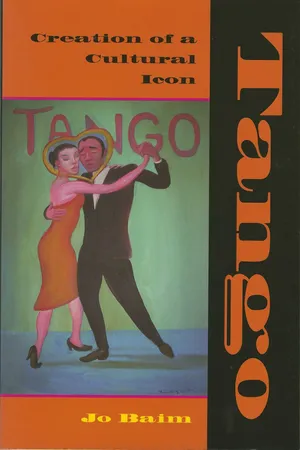
In Tango: Creation of a Cultural Icon Jo Baim dispels common stereotypes of the tango and tells the real story behind this rich and complex dance. Despite its exoticism, the tango of this time period is a very accessible dance, especially as European and North American dancers adapted it. Modern ballroom dancers can enjoy a "step" back in time with the descriptions included in this book. Almost as interesting as the history of the tango is the cultural response to it: cities banned it, army officers were threatened with demotion if caught dancing it, clergy and politicians wrote diatribes against it. Newspaper headlines warned that people died from dancing the tango and that it would be the downfall of civilization. The vehemence of these anti-tango outbursts confirms one thing: the tango was a cultural force to be reckoned with!
- 232 pages
- English
- ePUB (mobile friendly)
- Available on iOS & Android
eBook - ePub
About this book
Trusted by 375,005 students
Access to over 1.5 million titles for a fair monthly price.
Study more efficiently using our study tools.
Information
1 The Origins of the Tango
The Tango is a dance of South American origin.—Charles Durang, The Fashionable Dancer’s Casket (1856)
The People of the Early Tango

The history of the tango is as elusive as the history of the Argentine people. Argentina is a country made up of persons claiming a mixture of, among others, Italian, Spanish, British, Basque, Irish, German, African, and native ancestry, with many shadings of caste and class. Unlike the United States, where a variety of ethnic identities can be preserved and hyphenated with “American,” Argentina is a country whose people merged their various heritages with that of the native population to create a common Argentine identity. And unlike the United States, where native populations were driven out, early European arrivals to Argentina absorbed most native groups into the new society they built. Like most other societies, that of Argentina was stratified economically, and, especially in Buenos Aires, the least-urbanized natives were rapidly disenfranchised. Yet at the same time the various separate European threads quickly merged in the porteño, or citizen of the port city. The question is, Why did Buenos Aires gain both the prominence and the uniqueness that allowed the birth of such a distinctive cultural icon—distinctive certainly to Argentina, but even within Argentina, distinctive to Buenos Aires? Finding the answer requires at least an overview of how Argentina sorted itself out between the arrival of the first Spanish settlers and the turn of the twentieth century.
Early Spanish settlers in Argentina found resonance with the nomadic, cattle-herding native groups and intermixed freely with them. As more settlers arrived from Spain, however, the need for a greater Spanish administrative presence was felt. The imposition of the Spanish model of government introduced the idea of towns, most of which were built on the Spanish plan: a large church on one edge of the town square, surrounded by a few shops and businesses. Next would be a ring of large patio-style houses of wealthy families (some of which occupied a whole block). The outermost areas comprised progressively smaller houses of the lower classes.
Most of the wealthy families were of pure Spanish stock. Additionally, one of the wealthiest entities was the Roman Catholic Church. Not surprisingly, early Spanish settlers were given enormous land grants as well as positions of power and influence in both the church and the government. Wealthy monastic houses owned large properties and had control of education. Some larger towns had university-level schools run by monastic scholars. Thus, European ideas of culture and education were reserved for the wealthy, mostly Spanish class. By the nineteenth century, miscegenation laws preserved the wealth and family lineages of this privileged creole class.
Outside the towns, life centered around ranching. Under the estancia system, huge tracts of land were cheaply acquired but often difficult to control. The nineteenth century saw a gradual shift to sheep ranching in the north, as land was fenced in, with the gauchos (cowboys) and the more nomadic cattle herds moving further south. Whether it focused on sheep or cattle, the rural economy was based on meat, hides, and wool, with crop farming reserved for more coastal areas. These rural items formed the basis of Argentina’s export market, although transporting goods to shipping ports took months by oxcart. Eventually, British-built railroads sped up the process considerably.
Buenos Aires gained early dominance as the major port city. As the point of entry for luxury European goods such as woolens, cottons, iron, and china, Buenos Aires quickly developed a taste for European styles and intellectual pursuits. The University of Buenos Aires—free of church control from its founding—opened in 1821. Literary, scientific, and charitable societies were numerous, and the latest dances and fashions from Paris were eagerly copied. While other inland cities such as Cordoba, Salta, and Tu-cumán were also cultural centers, they lacked the direct contact with European fashion and were quickly left behind.
Thus by the middle of the nineteenth century, several dichotomies were in place that made Buenos Aires unique even in its own country. The countryside was dominated by Spanish and native populations, while Buenos Aires was beginning to see the influx of immigrants from other countries. In the rural towns, wealthy families remained loyal to Spain and did not want political power centralized in Buenos Aires, while in the port city, liberal politics called for self-government. City life grew in variety and complexity with exciting new ideas and news arriving from Europe every day, while country life remained traditional and much more placid.
The rise to power of Juan Manuel de Rosas in the 1830s marked a brief return to a more conservative world. Rosas was pro-cattle and sympathetic toward the plight of the lower classes. He was against farming, industry, and liberal education. The biggest change for Buenos Aires was in the repression and censorship of scholarly debate, and many intellectuals fled. The church briefly regained some of the power in the cities that it had maintained in the countryside. Even so, Buenos Aires kept its European focus by continuing to import art and culture.
At mid-century, half of the population of Argentina lived in Buenos Aires or in the coastal region. Immigrants came as highwage laborers, intending to earn a fortune and then leave. Many stayed, however, and brought new crops of wheat, corn, and flax to coastal farms. Trade continued, particularly with England. The British were given trade priority, and this status had important implications for British citizens working or living in Argentina: they could not be conscripted into the army, and they were allowed to practice their own form of religion.
By the third quarter of the nineteenth century, Buenos Aires began to receive large numbers of European immigrants. By 1900, two-thirds of Argentina’s population was living on the coast or in the port city. The mestizo (mixed) class had largely been absorbed, the gauchos and nomadic groups had been driven south, the creole class was well established, and the shift to a Europeanized urban life was well under way. In the century’s last two decades, massive development and public works projects were undertaken in Buenos Aires. By the 1880s, half of the streets were paved. Installation of electric lights and other new technologies kept pace with Europe and the United States. Arts and culture in the form of museums, opera, ballet, and theatre continued to grow. Intellectual freedom from church censorship was restored, and legislation passed in 1884 that prohibited priests from teaching.
Rampant inflation caused many of the public works to be halted. In May 1890 a group calling itself the Union Civica attacked the government, with three days of fighting in the streets of Buenos Aires. The lesson was learned, and the ruling oligarchy vowed to work for greater economic stability.
By 1900, three-quarters of the population of Buenos Aires was European-born. Each immigrant group had its own newspapers, social clubs, schools, and hospital. Even though these groups thought of themselves according to their country of birth, they were absorbed into porteño life and politics without any group making much trouble. Neighborhoods and districts developed according to immigrant origins and economic status, and frequently these barrios were largely self-contained with their own service industries. Other districts sprang up with other distinctions—significant to the tango is the downtown district of Corrientes, the site of many dance halls and nightclubs. Wealth counted more than birth in determining social hierarchy—the sons of wealthy sheep ranchers could move freely in the highest circles of Buenos Aires society. The sons of wealthy families were educated in Europe, and even daughters received a relatively broad education in arts and letters.
Thus Buenos Aires attracted many large groups of immigrants, who both melted into the local identity and consciously preserved their origins. The same could be said of New York, San Francisco, or any number of other port cities. What was it about Buenos Aires that prompted the invention of this unique dance form, the tango? What elements combined across the different cultures to make the tango the dance of all porteños, wherever their roots?
Argentina’s multicultural history is relevant in many ways to the history of the tango, but the tango presents scholars with its own unique challenges. First, the tango can be traced to no single Argentine source. Many groups claim a connection to the etymology of the word tango. Some scholars of the history of the African diaspora link the word tango to an earlier word, tambo, the African term for the pens and markets where slaves were sold. Others retain the African link but attribute the word tango to a vocalization of the sounds of drums.
Those who place the tango’s origins in the Cuban candombe or the Spanish (Andalusian) tango make similar exclusionary claims. More likely is a theory of combined influences that developed in a nearer parallel to that of the Argentine people, rather than an attribution to any single group. Buenos Aires, with the mismatched collection of people who populated its conventillos (tenements), was in some (occasionally unsavory) ways a truer melting pot than the United States ever was. The tango’s original practitioners left no systematic documentation of its early history. In its early days it was referred to only by the literate classes, who were far distanced from life in the conventillos, except in the usual larks by privileged young men. Typically, such young men sought excitement, danger, and novelty in their outings and only encountered the seamier side of the tango. Thus only part of its history has been described in eyewitness accounts. One must search through documents written for other purposes to find anything approaching the whole story of the tango’s origins and early history.
While the stage was being set for the collision of peoples who would produce the tango, Argentina’s elite society was following the same path as the upper classes in Europe and North America. Musical life in Buenos Aires included performances of all the current operatic and concert works. A resident opera company was founded in 1848, and ballet was performed as early as the 1830s. Gottschalk and Paganini were among the artists who gave concerts in Buenos Aires; in addition, sacred music was very popular, particularly in the form of organ concerts.1 Buenos Aires citizens of all classes participated in social dancing, learning the quadrilles, waltzes, polkas, mazurkas, and schottisches that were all the rage in nineteenth-century ballrooms. An African American dance teacher from the United States, Joseph William Davis, advertised himself in La gaceta mercantil on January 9, 1827, as a “professor of the north American dances, from the state of Rhode Island,” and offered a pamphlet he had written explaining the quadrille. Davis ran a dance studio in Buenos Aires from 1827 to 1848 and returned to the United States, England, and France on at least one occasion to collect the latest repertoire of steps. Also, Theodore Rousseaux, who established the Academia de Baile del Comercio Republicano-Federal (Dance Academy of the Federal Republic) in ...
Table of contents
- Cover
- Half Title
- Title Page
- Copyright Page
- Dedication
- Table of Contents
- Acknowledgments
- Introduction
- 1 The Origins of the Tango
- 2 Europe and the United States Discover the Tango
- 3 Argentina Reclaims Its Native Dance
- 4 Tango Music
- 5 Tangos in Waltz Time
- 6 The Tango in the World of Art Music
- Appendix 1. Tango Steps, 1911–1925
- Appendix 2. A Sampling of New York Times Article Titles on the Tango, 1911, 1913, and 1914
- Notes
- Bibliography
- Index
Frequently asked questions
Yes, you can cancel anytime from the Subscription tab in your account settings on the Perlego website. Your subscription will stay active until the end of your current billing period. Learn how to cancel your subscription
No, books cannot be downloaded as external files, such as PDFs, for use outside of Perlego. However, you can download books within the Perlego app for offline reading on mobile or tablet. Learn how to download books offline
We are an online textbook subscription service, where you can get access to an entire online library for less than the price of a single book per month. With over 1.5 million books across 990+ topics, we’ve got you covered! Learn about our mission
Look out for the read-aloud symbol on your next book to see if you can listen to it. The read-aloud tool reads text aloud for you, highlighting the text as it is being read. You can pause it, speed it up and slow it down. Learn more about Read Aloud
Yes! You can use the Perlego app on both iOS and Android devices to read anytime, anywhere — even offline. Perfect for commutes or when you’re on the go.
Please note we cannot support devices running on iOS 13 and Android 7 or earlier. Learn more about using the app
Please note we cannot support devices running on iOS 13 and Android 7 or earlier. Learn more about using the app
Yes, you can access Tango by Jo Baim in PDF and/or ePUB format, as well as other popular books in History & 19th Century History. We have over 1.5 million books available in our catalogue for you to explore.