eBook - ePub
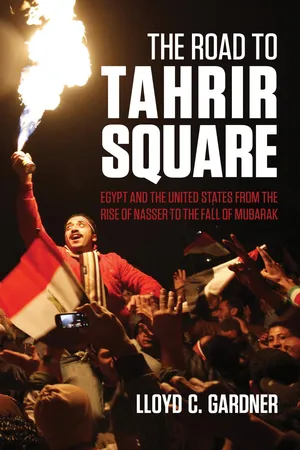
The Road to Tahrir Square
Egypt and the US from the Rise of Nasser to the Fall of Mubarak
- 230 pages
- English
- ePUB (mobile friendly)
- Available on iOS & Android
eBook - ePub
The Road to Tahrir Square
Egypt and the US from the Rise of Nasser to the Fall of Mubarak
About this book
When protesters in Egypt began to fill Cairo's Tahrir Square on January 25, 2011 - and refused to leave until their demand that Hosni Mubarak step down was met - the politics of the region changed overnight. And the United States' long friendship with the man who had ruled under emergency law for thirty years came starkly into question. The Road to Tahrir Square is the first book to connect past and present - from Franklin D. Roosevelt's brief meeting with King Farouk near the end of World War II, to Barack Obama's 2009 speech in Cairo, and the recent fall of Mubarak - offering readers an understanding of the events and forces determining American policy in this important region. Making full use of the available records, including the controversial WikiLeaks archive, renowned historian Lloyd C. Gardner shows how the United States has sought to influence Egypt through economic aid, massive military assistance, and CIA manipulations - an effort that has immediate implications for how the current crisis will alter the balance of power in the Middle East. As millions around the world ponder how the Egyptian Revolution will change the face of the region and the world, here is both a fascinating story of past policies and an essential guide to possible futures.
Information
Topic
HistoireSubtopic
Biographies politiques1
PRELUDE: SEARCHING FOR A POLICY
Great Britain is endeavoring to use the Near Eastern Area as a great dam which serves both to hold back the flow of Russia toward the south and to maintain an avenue of communications with India and other British possessions. . . . The Soviet Union seems to be determined to break down the structure which Great Britain has maintained so that Russian power can sweep unimpeded across Turkey and through the Mediterranean. . . . The United States has been pursuing a policy of the open door in the Near East. It has taken the position that the independent countries of the Near East . . . should not be considered as lying within the sphere of influence of any Great Power.
—Loy Henderson, director of the Office of Near Eastern and
African Affairs, “The Present Situation in the Near East—
A Danger to World Peace,” December 28, 1945
When President Roosevelt hosted King Farouk on board the USS Quincy anchored in the Great Bitter Lake of the Suez Canal on February 13, 1945, he offered the Egyptian monarch some advice. FDR suggested breaking up “many of the large landed estates in Egypt.” They should be made available, he said, “for ownership by the fellaheen [agricultural laborers] who worked them, and that at least 100,000 additional acres be placed under irrigation annually as a continuing program.”1 It was bold, even presumptuous, to offer such advice to a king who had come aboard an American warship for a friendly chat. But Roosevelt had similar things to say during the war about what other Middle Eastern rulers had to do to meet the postwar expectations of their peoples. At the 1943 Tehran Conference, for example, where the final plans for D-Day were agreed upon with Churchill and Stalin, the president had discussed reports from advisers about what American ingenuity could do to bring Iran’s economy into the modern world. He was “rather thrilled with the idea of using Iran as an example of what we could do by an unselfish American policy.” “Iran,” he wrote Secretary of State Cordell Hull, “is definitely a very, very backward nation.” It consisted of tribes with 99 percent of the population in bondage to the other 1 percent. “The real difficulty is to get the right kind of American experts who would be loyal to their ideals, not fight among themselves[,] and be absolutely honest financially.”2
American forces had entered Iran during the war to ensure that Lend-Lease supplies reached the Soviet Union. Along with the military came a corps of economic experts and others who had ideas about how to accelerate development of Iran’s economy after the war. In contrast, in Egypt the United States had neither a large troop presence nor the advisers on hand eager to take on the country’s very similar problems. But during his brief chat with Farouk two days after the close of the Yalta “Big Three” conference in the Crimea, the president enthused about prospects for increased trade between the countries. When peace came, he said, he hoped American purchases of long-staple cotton, a vital Egyptian export, would increase, along with trade in other commodities. Tourist travel to Egypt, he felt sure, was certain to become greater after the war. Thousands of Americans, Roosevelt predicted, would visit Egypt and the Nile region, both by ship and air.
Trade with Egypt had in fact increased eightfold during the war. The American minister in Cairo, Alexander Kirk, had advocated extending Lend-Lease aid in order to solidify the two nations’ relations after the war. After deliberation in Washington over possible ramifications in Anglo-American relations, such aid was granted, followed by diplomatic efforts to secure favorable investment laws to encourage joint-stock companies with American firms. Washington also sought permission for American commercial airliners to carry passengers from Cairo to the principal cities of Europe. As one policy planner put it, “Cairo is vital to air navigation, just as Suez is to shipping.”3
The implication here was that the wartime British occupation of Suez belonged to the passing era of European imperialism, now in an accelerated decline caused by the war, while the new age of commerce depended on secure air routes, just as the original industrial age had hit its peak with projects like the Suez Canal. “Freedom of the seas” had been the catchphrase of the dominant powers of the time; now it was all about “freedom of the air”—a phrase that well matched the postcolonial age.
Roosevelt’s New Deal–like ideas and his zeal for far-reaching land reform were not shared by many of his foreign policy advisers, but there was a consensus that the American mission in the postwar era would be to help the British “out”—in both senses of the word—from predicaments such as the vexed matter of Suez and similar situations elsewhere tied to a defunct colonial ideology. During the war Secretary of State Hull warned that the United States could not work with the colonial powers in Europe and against them in the rest of the world. But in the full blush of victory at war’s end, Washington imagined things would now go more smoothly as its influence would spread even to areas Joseph Conrad had called the “Heart of Darkness.” But Roosevelt’s successors found that “whittling down” the British Empire, as one policy adviser cautioned—complicated as it was by domestic politics on related issues like the contest over the future of the British mandate in Palestine—risked a disaster.
The Need for Commitment
Making a safe transition would depend, American policymakers agreed, on Washington’s ability to convince Farouk and other Middle Eastern leaders that the United States would not allow the old colonial powers, Great Britain and France, to reclaim the privileged positions they held before the war, and was, in fact, ready to offer economic and, if carefully managed, military aid to insure the independence and internal security of those countries. All this had to be handled so as to ease the transition from the old colonial order to a new global politics led by the United States, without permitting extreme nationalists or Communists to take advantage of the situation to gain a foothold in the area. In this regard, the onset of the Cold War presented both an opportunity to shift the subject to common defense against a military threat that obscured old arguments, and the challenge of Communist penetration of reform movements.
Roosevelt’s comments to the Egyptian king and his later guests, Emperor Haile Selassie of Ethiopia and, especially, King Ibn Saud of Saudi Arabia, were designed to promote a postwar vision of the Middle East following such a safe path to prosperity. Saud remained skeptical: “What am I to believe when the British tell me that my future is with them and not with America?” The British told him that America’s interest in his country was transitory. Once the wartime emergency was over, Lend-Lease aid would end and the Americans would return to the Western Hemisphere—leaving Saudi Arabia behind within the pound sterling area economically and defended by the Royal Navy and British army. “On the strength of this argument they seek a priority for Britain in Saudi Arabia,” Saud said. “What am I to believe?”
That was not going to be the future, insisted Roosevelt. America’s postwar plans envisaged “a decline of spheres of influence in favor of the Open Door.” He hoped the door of Saudi Arabia would be open to all nations, for only by free exchange of goods, services, and opportunities “can prosperity circulate to the advantage of free peoples.” That was all very well, replied Saud, but the British would continue as before to claim a sphere of influence around and over his country. Roosevelt’s adviser William Eddy warned the president that words would not be enough. Ibn Saud’s well-grounded fears could be dispelled only when the United States acted to implement a long-range plan to secure the Open Door.4
The American minister in Cairo, S. Pinckney Tuck, had escorted King Farouk to the meeting with Roosevelt—a small gesture that pleased the Egyptian ruler. Instead of going aboard the warship with the king, Tuck had stepped back and did not accompany him to where the president sat waiting. Farouk told the American diplomat afterward that the British ambassador, Lord Killearn, to his great annoyance, always insisted on being present when he met with Prime Minister Churchill. It was a little thing, but Farouk appreciated Tuck’s display of respect.
In the waning days of World War II, one of the key questions was whether or how the United States would supplant the United Kingdom in the British Empire’s former possessions. Egypt was never a formal colony, but the history of Anglo-Egyptian relations revolved around the issue of continued British control of the Suez Canal and the military base and garrison that had protected the canal since the late nineteenth century. Opened to shipping in 1869, the Suez Canal had been built by a French company operating under a concession granted by the Egyptian khedive, Sa‘id Pasha. The British had not even been in the picture originally and had, in fact, opposed the canal’s construction. When the canal revolutionized global commerce, however, and the Egyptian government sought to sell its shares of the company to pay off international debts for four million pounds, the British leapt in with both feet. Although the Constantinople Convention of 1888 declared the Suez Canal a neutral area, Sa‘id’s successor invited British troops in to suppress a rebellion against his government. There they stayed through World War I and World War II. During those years the British high commissioner became, in effect, a viceroy, who according to the 1936 Anglo-Egyptian Treaty of Friendship and Alliance had to be given preference at the Egyptian court over representatives of any other nation.
London regarded its Suez base as a strongpoint from which to defend all its interests in the Mediterranean and North Africa and was loath to give it up, even in the face of rising nationalist sentiments. These had manifested themselves in different ways. During World War II, King Farouk was known to be pro-Axis and had even written Hitler a letter saying he would welcome an invasion. Rommel’s Afrika Korps never got to Cairo, but the British demanded that Farouk dismiss pro-German ministers or be turned out of the palace. Born in 1920, Farouk was the great-grandson of the famous Muhammad Ali Pasha, Egypt’s longest-ruling figure until Hosni Mubarak. Farouk had gone to school in Britain and began his reign in 1937. He had been very popular at first, but his lavish lifestyle soon began to alienate not only ordinary Egyptians, but important figures in the so-called Free Officers Movement as well.
American policymakers were fully aware that undermining the British in the Middle East was not a way to achieve American objectives in the region. The head of the State Department’s policy planning staff, George F. Kennan, the author of the famous 1947 “X” article, “The Sources of Soviet Conduct,” which summarized the rationale for a Cold War “containment” policy, insisted it would be not desirable to attempt to duplicate British strategic facilities in the Middle East such as the base at Suez, because, for one thing, British facilities would be available to the United States in the event of a war with the Soviet Union. Any attempt to take bases away from the British was an even worse option to contemplate, involving a host of problems that would weaken Western influence and only embolden enemies. “This means that we must do what we can to support the maintenance of the British in their strategic position in that area.”5 Kennan had put his finger on a pressure point in emerging American policy toward Egypt: if supporting the Open Door policy meant straining British relations with Arab countries, where was the benefit for the United States? The United States still needed British military support to defend its strategic interests, and yet siding with a colonial power risked alienating powerful anticolonial forces stirring across Africa and Asia.
Kennan was quite clear about what America’s interests were in this regard, and they did not involve “sentimentality and day-dreaming”: “We have about 50% of the world’s wealth but only 6.3% of its population. . . . In this situation, we cannot fail to be the object of envy and resentment. Our real task in the coming period is to devise a pattern of relationships which will permit us to maintain this position of disparity without positive detriment to our national security.”6
Unfortunately, the U.S. government was now subject to pressures that “impel us toward a position where we would shoulder major responsibility for the maintenance, and even the expansion, of a Jewish state in Palestine,” Kennan wrote. To the extent that policy moves in this direction, the United States “will be operating directly counter to our major security interests” in the Arab world. Kennan had no real answer for dealing with this problem, nor did any of his successors find a way to get around the Arab-Israeli imbroglio.
At the time Kennan wrote, the Truman administration was trying to find a solution to please Congress and public opinion, and indeed was caught in a bind that brought it into precisely the sort of conflict with Great Britain that Kennan and many in the State Department feared would destroy the influence of the West across the whole region. Whenever envoys of Middle Eastern states—with the exception of Israel—appeared at the State Department to argue their grievances over American policy and Palestine’s fate, the Egyptian ambassador served as their spokesman. The Arab League was seated in Cairo, and King Farouk liked to think that his championing of resistance to Jewish plans for a state carved out of Palestine and his responsiveness to resentment at British military policy could be combined into a program that would save his monarchy.
But there was another distressing problem confronting U.S. policymakers as they attempted to act as a friend to both London and Cairo in resolving the growing disputes over the British military garrison at Suez and revision of the 1936 Anglo-Egyptian Treaty. Before the war these were matters that would not have involved the United States, but the war had changed the world—ideologically by the discrediting of European imperialism, and materially by the exhaustion of the military capabilities of the colonial powers. American policymakers saw themselves in a race, moreover, facing the challenge of what a later secretary of state, John Foster Dulles, would call “International Communism.”
In the spring of 1947, with the “Truman Doctrine” (which called for the support of the “free peoples” of the world against totalitarian regimes) in newspaper headlines, the Anglo-Egyptian dispute over continued British occupation of the Suez neared a flashpoint. Foreign Secretary Ernest Bevin called in the American ambassador, Lewis Douglas, to caution him against an American attempt to mediate the crisis. London had offered to withdraw all troops by September 1949, but that was apparently not enough for the Egyptians, who were seeking to take the dispute to the United Nations. This was an unwelcome development for London and Washington, obviously, quite a turnaround from the Anglo-American cheerleading when the Iranians had brought the issue of Russian troops to the Security Council a year earlier. While Bevin was prepared to negotiate changes to the 1936 treaty with Cairo, he would not countenance intervention by the United Nations, or by any country that attempted to ...
Table of contents
- Cover
- Title
- Copyright
- Contents
- Introduction
- 1. Prelude: Searching for a Policy
- 2. The Nasser Gamble Fails
- 3. Eisenhower Doctrine to Six Days of War
- 4. Life with Anwar Sadat: Or a Story of Empire by Invitation
- 5. The $50 Billion Gamble: Thirty Years of Egyptian-American Co-Dependence
- 6. Arab Spring
- Postscript
- Notes
- Index
Trusted by 375,005 students
Access to over 1.5 million titles for a fair monthly price.
Study more efficiently using our study tools.
Frequently asked questions
Yes, you can cancel anytime from the Subscription tab in your account settings on the Perlego website. Your subscription will stay active until the end of your current billing period. Learn how to cancel your subscription
No, books cannot be downloaded as external files, such as PDFs, for use outside of Perlego. However, you can download books within the Perlego app for offline reading on mobile or tablet. Learn how to download books offline
Perlego offers two plans: Essential and Complete
- Essential is ideal for learners and professionals who enjoy exploring a wide range of subjects. Access the Essential Library with 800,000+ trusted titles and best-sellers across business, personal growth, and the humanities. Includes unlimited reading time and Standard Read Aloud voice.
- Complete: Perfect for advanced learners and researchers needing full, unrestricted access. Unlock 1.5M+ books across hundreds of subjects, including academic and specialized titles. The Complete Plan also includes advanced features like Premium Read Aloud and Research Assistant.
We are an online textbook subscription service, where you can get access to an entire online library for less than the price of a single book per month. With over 1.5 million books across 990+ topics, we’ve got you covered! Learn about our mission
Look out for the read-aloud symbol on your next book to see if you can listen to it. The read-aloud tool reads text aloud for you, highlighting the text as it is being read. You can pause it, speed it up and slow it down. Learn more about Read Aloud
Yes! You can use the Perlego app on both iOS and Android devices to read anytime, anywhere — even offline. Perfect for commutes or when you’re on the go.
Please note we cannot support devices running on iOS 13 and Android 7 or earlier. Learn more about using the app
Please note we cannot support devices running on iOS 13 and Android 7 or earlier. Learn more about using the app
Yes, you can access The Road to Tahrir Square by Lloyd C. Gardner in PDF and/or ePUB format, as well as other popular books in Histoire & Biographies politiques. We have over 1.5 million books available in our catalogue for you to explore.