- 296 pages
- English
- ePUB (mobile friendly)
- Available on iOS & Android
eBook - ePub
About this book
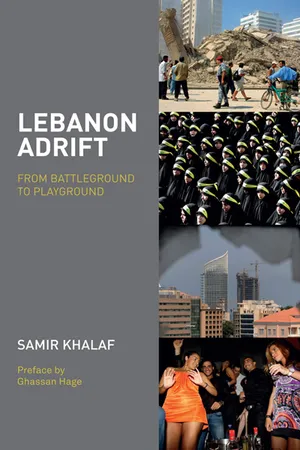
Lebanon today is at a fateful crossroads in its eventful socio-cultural and political history. Imperiled by unsettling transformations, from postwar reconstruction and rehabilitation to the forces of postmodernity and globalism, it remains adrift. In this landmark study, Samir Khalaf explores how ordinary citizens, burdened by the consequences of an ugly and unfinished war, persisting regional rivalries, mounting economic deprivation and diminishing prospects for well-being, find meaning and coherence in a society that has not only lost its moorings and direction, but also its sense of control. Khalaf argues that a mood of lethargy and indifference prevails, with a growing tendency for the Lebanese to seek refuge in religiosity, communalism and cloistered spatial identities, or temporary relief in the allure of mass consumerism.
Information
Chapter 1
On Protracted and Displaced
Collective Violence
When unappeased, violence seeks and always finds a surrogate victim. The creature that excited its fury is abruptly replaced by another, chosen only because it is vulnerable and close at hand.
(René Girard, Violence and the Sacred, 1977)
The animus was always the same: Whether nation, province, or city, whether religion, class or culture – the more one loved one’s own, the more one was entitled to hate the other ... Through the centuries politicians had exploited this human trait. In the knowledge that hatred can be cultivated with a purpose, they constructed enemies in order to bolster domestic concord.
(Peter Gay, The Cultivation of Hatred,1993)
In cases where conflict is primarily of an ethnic, communal character in contrast to those provoked by economic and/or political issues, the likelihood of a negotiated non-belligerent resolution becomes very slim. Indeed, all communal wars end in blood. There must be a victor and a vanquished before combatants begin to consider negotiation.
(Jay Kaplan, ‘Victors and Vanquished’, 1980)
Lebanon’s perilous and extended encounters with collective violence continue to invite a relentless output of speculative writing, both scholarly and journalistic. Despite its diversity, and much like the broader and conventional literature on civil unrest, the output converges on a set of recurrent themes. In fact, one can identify five general perspectives, which have gained currency during the past two decades or so, in accounting for the sources and patterns of political violence.
First, some scholars focus on the fragmented character of political culture in new states in transition. The voluminous output of scholars like Huntington (1993), Eisenstadt (1966), Pye (1966), Apter (1965), Geertz (1968), Deutsch (1961), Black (1966), Shils (1965), Lerner (1958) etc, particularly during the 1960s, consisted mostly of efforts to elucidate the dialectical relationship between fragmentation and political instability. Fragmentation is, on the whole, treated here as a by-product of both traditional divisive and segmental loyalties or the asymmetrical growth and cultural differentiation generated by processes of development and modernization. Hence, vertical and horizontal divisions, particularly in plural societies like Lebanon, are prone to pull the society apart and threaten the delicate balance of forces. In short, fragmentation generates political unrest which, in turn, accentuates the cleavages in society.
Second, there are those who, armed with dependency theory and conspiracy models, advance some version of ‘inside–outside’ polemics. Internal disparities, the argument goes, prompt threatened and dispossessed groups to seek external patronage. External forces, through direct forms of foreign intervention, growing dependence on world markets or patronage of local client groups, produce pronounced shifts in the relative socio-economic and political positions of the various religious communities. These dislocations almost always touch off renewed outbreaks of civil unrest and political violence.
Virtually all peasant uprisings and communal hostilities in Mount Lebanon during the second half of the nineteenth century, much like the civil war of 1958, were replete with the escalating disruptive consequences of such ‘inside–outside’ dialectics. This polemic became sharper and more devastating during the extended hostilities of 1975–92. More recently the adverse by-products of unresolved regional and global rivalries – such as nascent Islamophobia and Islamic militancy in the wake of 9/11, the global struggle between the US and Iran and its implications in precipitating and compounding the intensity of hostility between pro and anti Syrian and Iranian factions and the inveterate belligerent Israel and Palestinian resistance factions – have all had a decisive impact on the pattern and intensity of collective violence.
Third, drawing upon theories of cognitive dissonance and relative deprivation – as expounded by Festinger (1957), Gurr (1980), Feierabend and Feierabend (1966) and others – this group of scholars tends to focus instead on the socio-psychological strains generated by the growing gaps and disparities between aspirations and opportunities. One of the most celebrated versions of this perspective is, of course, that of relative deprivation, treated here in terms of the group’s perception of a discrepancy between what they believe they are legitimately entitled to get, and their estimation of what they are actually able to receive under existing conditions. According to this analysis, feelings of relative deprivation will produce anger and frustration, which in turn will trigger violent action. This is inevitably compounded by the inherent dissonance between subjective perception and objective conditions.
Fourth, and by contrast, theories of so-called ‘collective action’ are more inclined to argue that what matters is not so much that people have grievances and unmet needs, but rather that they possess the political resources which will enable them to translate their discontent into action. Noted examples here are Tilly (1978), Hirschman (1970) and Moore (1966), who in much of their research concentrate on the conditions conducive to the mobilization of groups and their predisposition to participate in collective action.
Finally, a growing number of scholars in recent years have shifted their concern to the analysis of the impact of rapid urbanization on domestic political violence. Particular emphasis here is placed on the revolutionary potential of the urban poor and ‘urban marginals’, and the impact of communal networks on the pattern and intensity of civil strife. Theoretical reformulations by Tilly (1978), Bienen (1984) and Wilson (1992), among others, reinforced by empirical surveys in regions undergoing rapid urbanization, are beginning to reveal some telling but inconsistent trends. For example, while the survival of communal networks in Latin American and African cities has been generally associated with the reduction in the incidence of political violence, preliminary results from a selected number of Middle Eastern cities provide evidence to the contrary (Karpat on Turkey, Kazemi on Iran, Ibrahim on Egypt and Khalaf and Denoeux on Lebanon).
Instructive as such analyses have been, they are predominantly concerned with the inception and etiology of civil unrest. Consequently, they have had little to say about (1) why violence has been sustained, (2) the forms and intensity it has assumed or (3) how people cope with chronic unrest and unsettled times. At least in the case of Lebanon, the exercise has become rather futile; at best a laborious and painful elaboration of the obvious. For example, it is quite common for a pluralistic society like Lebanon to display a high propensity for violence. The lack of political integration in new states has, after all, been cited over and over again as a major cause, indeed a prerequisite for violence. One could, likewise, write volumes about the destabilizing impact of the presence of Syrians, Palestinians and Israelis, or the unresolved regional and superpower rivalries, without adding much to what we know already.
What is, however, unusual is the persistence, growing intensity and shifting targets of hostility. By the early 1990s, in fact, the conflict was fractured even further as inter-communal rivalries degenerated into intraconfessional hostilities. The ecology of violence, reinforced by all the psychological barriers of restructured enmities, began to assume more intensive forms as street and quarter in-fighting displaced and/or compounded the earlier communal violence. Hence, much of the former characterization of the initial stages of civil unrest – ‘Christian versus Muslim’, ‘right versus left’ – generally became outmoded. It clearly does not help in accounting for the upsurge in the level of hostility between Sunnis and Shi‘ites, Druze and Shi‘ites, Kurds and Shi‘ites, Palestinians and Shi‘ites, Maronites and Armenians ... or between Maronites and Maronites. Indeed, by the early 1990s victims and casualties of intraconfessional violence had started to outnumber those generated by intersectarian or inter-religious hostility.
Doubtless, the most menacing was the displaced and surrogate character of violence and victimization. As the hostility degenerated into internecine fighting between fractious groups, combatants were often trapped in localized turf wars where they ended up taking vengeance on almost anyone, including their own kinsmen. This is, clearly, the most perfidious feature of the incivility of violence. Fighters were killing not those they wanted to kill but those they could kill. In repeated episodes of such in-group hostility, wanton killing was the bloodiest in terms of its victimization of innocent bystanders.
Considerations of this sort, along with all the other ruinous manifestations of civil unrest, clearly suggest that violence has become counterproductive and self-defeating. Contrary to what is often suggested, it has had little to do with the rebirth or recovery of justice and virtue, which are unlikely to rescue Lebanon from its deepening crisis and transform it into a secular and more civic social order. I take my cue here from Hannah Arendt (1958) who has suggested that the practice of violence, like all action, changes the world, but the most probable change is to a more violent world.
Expressed in more explicit political terms, the resort to violence has had little effect so far on (1) redressing the gaps and imbalances in society, or (2) transforming Lebanon’s communal and confessional loyalties and institutions into more civic entities typical of a nation-state.
Yet, renewed cycles of violence went on unabated. Though Lebanon is often dubbed as an instance of ‘low-intensity conflict’, violence began to assume all the aberrant manifestations of endemic and autistic hostility. Unlike other encounters with civil unrest, which are often swift, decisive and localized, and where a sizeable part of the population could remain sheltered from its traumatizing impact, the Lebanese experience has been much more protracted and diffuse. The savagery of violence was also compounded by its randomness. In this sense, there is hardly a Lebanese today who is exempt from these atrocities either directly or vicariously. Violence and terror touched virtually everyone. It was everywhere and nowhere. It was everywhere because it could no longer be confined to one specific area or a few combatants. It was nowhere because it could not be identified or linked to one concrete cause. Recurring cycles or episodes of violence erupted, faded and resurfaced for no recognized or coherent reason.
The warring communities also locked themselves into a dependent relationship with violence and chronic conflict became both protracted and insoluble. Personal memories and recollections of the war, which for a while became an appealing genre of literary writing, reveal how perceiving and coping with the ugly everyday episodes of the war were domesticated and routinized. It is then that violence became both protracted and insoluble. It was also then that it was sustained by a pervasive feeling of helplessness, demoralization and obsessive dependency on external patrons and foreign brokers.
Within such a context, it became more instructive to shift the analysis from the partial and almost exclusive concern with the etiology of violence and extend it to incorporate those features that sustain and escalate the belligerency. Only by so doing can we begin to understand fully some of the socio-psychological and cultural attributes of protracted violence and, more importantly, suggest possible courses of action or strategies to constrain its aberrant consequences.
More specifically, this shift in concern from the initiating to the sustaining factors accompanying protracted conflict can help us better in elucidating at least two distinctive features of civil unrest in Lebanon: (1) the tendency for both pluralism and violence to become more pathological, and (2) the existence of ideologies of enmity through which warring communities reinvent strategies for mutual debasement and demonization to rationalize acts of aggression, particularly when the victims of that aggression might well be their own co-religionists or groups they coexisted with previously.
When we extend our concerns to those features which sustain and escalate the intensity of hostility, then we must part company with some of the conventional perspectives and consider other sources and paradigms more appropriate for the analysis of such overlooked features of protracted conflict. Fortunately I discovered, as seen in the rich and diverse sources I consulted, a rather substantial volume of writing which could be more imaginatively applied to the instances of communal conflict under study.
Since I am assuming a dialectical interplay between the reassertion of communal identities and heightened magnitude of collective strife, it is necessary that the three persisting features underlying this interplay be explored. Indeed, these features stand out, perhaps, as the defining elements in Lebanon’s checkered political history: (1) the reawakening of primordial identities, (2) foreign intervention, and (3) the escalation of protracted violence. I have elsewhere (Khalaf, 2002) identified and accounted for how the unresolved regional and global rivalries have contributed to the protraction and escalation of conflict and the reassertion of communal solidarities. The aim here is to document a few of the persisting features underlying the survival of communal loyalties, particularly those aspects of Lebanon’s ‘retribalization’ exacerbated by the inside–outside dialectics. How and under what circumstances, to be more concrete, are communal loyalties radicalized?
By focusing on different episodes – ranging from peasant uprisings, factional feuds, ‘class’ and ideological struggles to other intermittent incidents of civil strife – it is possible to elucidate how, regardless of their origins and overt manifestations, they are all transformed (or deformed) into sectarian hostility. It is also then, as will be seen, that the conflict becomes bloodier, uncivil and more mired into the tangled world of foreign intervention.
For purposes of analysis, three different layers or magnitudes of violence are identified. There is first social strife, the product largely of socio-economic disparities, asymmetrical development, ideological rivalries, relative deprivation and feelings of neglect and dispossession. These, normally, are non-militant in character and express themselves in contentious but non-belligerent forms of social protest and political mobilization. Second, if the socio-economic disparities persist and the resulting hostilities are unappeased, particularly if accompanied by feelings of threatened communal legacy and confessional loyalties, conflict and discord are inclined to become more militant and bellicose. It is here that social discord is transformed into communal violence; or in the words of Bouyer-Bell (1987) that the civil strife passes the point of no return into civil war. Finally, civil violence is not, or does not always remain, ‘civil’. When inflamed by atavism or reawakened communalism, enmity and deep-seated suspicion of the ‘other’, internecine feuds and unresolved regional and global conflicts, collective violence could readily degenerate further into the incivility of proxy war and surrogate victimization. It is here that violence acquires its own inherent self-destructive logic and spirals into an atrocious cycle of unrelenting cruelties.
Within this context, it is meaningful to identify and account for some of the circumstances associated with the tenacity of communalism and its various manifestations. An effort is also made to consider how social strife is deflected into communal violence and ultimately descends into further barbarism and incivility. Queries of this sort are not only of historic significance. There has been recently renewed theoretical interest in the nature, manifestations and consequences of renewed ‘tribalism’ and reassertion of local and communal identities, particularly as they relate to the forces of globalization and postmodernity.1
Despite the varied circumstances associated with the repeated episodes or armed conflict Lebanon has been beset with for so long, they do evince features which have become distinctive elements in its checkered political culture. The purpose of this chapter is to highlight, albeit briefly, a few of those defining features.
DISSONANCE BETWEEN INITIATING AND SUSTAINING SOURCES OF VIOLENCE
Perhaps one of the most striking anomalies of the character and pattern of violence is the disparity between the factors which initiated it and those which sustained and accounted for its growing intensity and magnitude. Clearly, the circumstances which impelled groups to resort to political violence were not necessarily those which sustained their mobilization and informed the direction and outcome of conflict. What this in essence means is that as hostility is released it is likely to acquire its own momentum, almost a life of its own unrelated to the original sources which might have sparked it. It is then that embattled groups become trapped, as it were, in an escalating spiral of vengeance and retribution.
For example, all the peasant uprisings were initially sparked off by a sense of collective consciousness and a concern for public welfare. Yet all were deflected, at one point or another, into confessional hostility. Likewise, episodes of communal conflict, originally provoked by socio-economic disparities and legitimate grievances, were transformed into factional rivalry. The enthusiasm for ‘class’ struggle and collective mobilization among Christian peasants in the north found little appeal among their counterparts in the Druze districts. By arousing latent confessional enmity, traditional Druze leaders could easily ma...
Table of contents
- Cover
- Title
- Contents
- Preface by Ghassan Hage
- Prologue
- 1. On Protracted and Displaced Collective Violence
- 2. The Spaces of War and Postwar: Reflections on Collective Memory, Identity and Nostalgia
- 3. Consumerism in a Traumatized Society
- 4. Touting Luxury, Sensuality and Image
- 5. The Allure of the Spectacle and Kitsch
- 6. Prospects for Transforming Consumers Into Citizens
- Epilogue
- Bibliography
- Acknowledgments
- Index
- About the Author
- Copyright
Trusted by 375,005 students
Access to over 1.5 million titles for a fair monthly price.
Study more efficiently using our study tools.
Frequently asked questions
Yes, you can cancel anytime from the Subscription tab in your account settings on the Perlego website. Your subscription will stay active until the end of your current billing period. Learn how to cancel your subscription
No, books cannot be downloaded as external files, such as PDFs, for use outside of Perlego. However, you can download books within the Perlego app for offline reading on mobile or tablet. Learn how to download books offline
Perlego offers two plans: Essential and Complete
- Essential is ideal for learners and professionals who enjoy exploring a wide range of subjects. Access the Essential Library with 800,000+ trusted titles and best-sellers across business, personal growth, and the humanities. Includes unlimited reading time and Standard Read Aloud voice.
- Complete: Perfect for advanced learners and researchers needing full, unrestricted access. Unlock 1.5M+ books across hundreds of subjects, including academic and specialized titles. The Complete Plan also includes advanced features like Premium Read Aloud and Research Assistant.
We are an online textbook subscription service, where you can get access to an entire online library for less than the price of a single book per month. With over 1.5 million books across 990+ topics, we’ve got you covered! Learn about our mission
Look out for the read-aloud symbol on your next book to see if you can listen to it. The read-aloud tool reads text aloud for you, highlighting the text as it is being read. You can pause it, speed it up and slow it down. Learn more about Read Aloud
Yes! You can use the Perlego app on both iOS and Android devices to read anytime, anywhere — even offline. Perfect for commutes or when you’re on the go.
Please note we cannot support devices running on iOS 13 and Android 7 or earlier. Learn more about using the app
Please note we cannot support devices running on iOS 13 and Android 7 or earlier. Learn more about using the app
Yes, you can access Lebanon Adrift by Samir Khalaf in PDF and/or ePUB format, as well as other popular books in Social Sciences & International Relations. We have over 1.5 million books available in our catalogue for you to explore.