- 304 pages
- English
- ePUB (mobile friendly)
- Available on iOS & Android
eBook - ePub
About this book
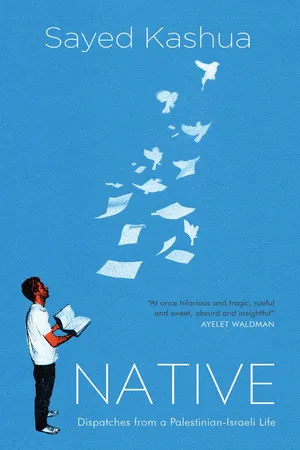
Sayed Kashua has been lauded by the New York Times as "a master of subtle nuance in dealing with both Arab and Jewish society." A Palestinian-Israeli who lived in Jerusalem for most of his life, Kashua started writing with the hope of creating one story that both sides could relate to. He devoted his novels and his satirical column in Haaretz to exploring the contradictions of modern Israel while also capturing the nuances of everyday family life in all its tenderness and chaos. Over the last decade, his humorous essays have been among the most widely read in Israel. He writes about fatherhood and marriage, the Arab-Israeli conflict, and encounters with prejudice, as well as his love of literature. With an intimate tone fueled by deep-seated apprehension and razor-sharp wit, he has documented his own life as well as that of society at large - from instructing his daughter on when it's appropriate to speak Arabic (everywhere, anytime, except at the entrance to a mall) to opening a Facebook account during the Arab Spring (so that he wouldn't miss the next revolution).From the events of his everyday life, Kashua brings forth a series of brilliant, caustic, wry, and fearless reflections on social and cultural dynamics as experienced by someone who straddles two societies. Amusing and sincere, Native - a selection of his popular columns - is comprised of unrestrained, profoundly thoughtful personal dispatches.
Information
PART I
WARNING SIGNS
2006–2007
WARNING SIGNS
April 7, 2006
To: Editor, Haaretz magazine
Re: Sayed Kashua’s column
Dear Sir,
Well now. This is of course not the first time I’ve had occasion to send a letter to the editor of a newspaper on which my husband, who goes by the name Sayed Kashua, is employed. And like the letters that came before, this one, too, is a formal warning. If my demands are not met, I will have no choice but to resort to legal measures.
Your correspondent, my husband, is a chronic liar, gossip, and cheat who unfortunately makes a living by distorting the truth and creating a highly unreliable picture of reality. I am astounded that a newspaper that is considered respectable, like Haaretz, goes ahead and publishes my husband’s abusive articles without bothering to check the accuracy of the material. How can you not have a system, even minimal, that checks whether the columns of your esteemed correspondent might be libelous and constitute grounds for a whole slew of lawsuits?
The law firm I’ve contacted assures me that 90 percent of my husband’s columns that were published in your paper contain grounds for lawsuits whose favorable outcomes are not in doubt. Until now I have avoided filing such suits, as I am not greedy like my husband, your correspondent, who has proved beyond a doubt that he will balk at nothing to make a living. Knowing my husband’s character as well as I do, I am not surprised at his behavior. However, I am amazed that your paper’s many worthy editors are unaware of the gravity of the situation.
As a condition for terminating legal procedures, I demand that your distinguished newspaper publish a crystal clear apology in a place that’s at least as respectable as the one you provide for your immoral correspondent. The paper’s readers need to be aware beyond any doubt that the picture my husband paints of his family life is a crude lie and has no basis in reality.
Almost every week, my husband impertinently, and with your backing, creates a monstrous picture in which I usually play the lead. This abuse has to end, and because there is no way to communicate with the nutcase who has hospitalized himself in my home, I am asking you, who bear exclusive responsibility, to put a stop to this vile smear campaign.
As his readers realize, my husband suffers from a serious addiction problem—by which I do not necessarily mean alcohol and other substances, but an addiction to lies and fabrications that have become an inseparable part of his daily life.
He reached new peaks in his last column, when he described me as an irritable, grumpy woman who wishes him dead and says things like “May worms eat his lungs.” Of course, I never spoke any such words. It’s all the product of the hallucinations and perversions of his feverish mind. Not to mention the other aspersions he casts on me—but this is not the place to repeat them, in order not to offend the public’s sensibilities.
It’s altogether baffling that my husband uses swear words as a regular tool in his writing. The only conclusion is that your editors don’t bat an eyelash at the unbroken string of obscenities.
His descriptions of me cause me no end of grief and trouble. I find myself being forced to provide answers and explanations to my circle of acquaintances, at work, in the neighborhood, and within the family. I am bombarded day and night with questions about groundless accusations that are published in your serious newspaper. As long as I alone was the target of his barbs, I bit my lip and decided to restrain myself in order to keep up an appearance of domestic harmony. Lately, though, my husband has been undermining his children’s routine as well: his daughter and firstborn child is also having to come up with answers and explanations to the parents of the other children in her kindergarten. Last Purim, tears welled up in my eyes when one of the mothers wanted to know—based on material published in your paper—whether my mother, whom your correspondent calls “my mother-in-law,” is really a witch whose only goal in life is to get me away from my husband.
I don’t understand why family matters, irrespective of whether they are reliable, have to be published in newspapers, still less in a newspaper like Haaretz. By the way, I want to take this opportunity to inform you that I am joining the list of those who are canceling their subscription to your paper, and I call on everyone with common sense to follow my example and that of many others who do not allow this defective product into their home.
I am not one of those people who like to go public with family disputes, but in this case, and in the light of past experience, I am well aware that this is the only way to stop the malicious smear campaign. It is my fervent hope that you will follow the path of previous newspapers that received formal warnings and acceded to my request to fire my husband instantly.
The reading public needs to know that my husband—and I am speaking here as a professional with many years of work experience in a psychiatric hospital—is afflicted with any number of personality disorders. In jargon, his condition is officially described as a borderline personality who suffers from a number of behavioral disorders, of which the most serious, perhaps, are paranoid personality disorder, induced delusional disorder, and severe narcissistic damage. The reading public needs to know that my husband suffers from recurrent attacks of delusions—graded as level 4 on a scale of 5—which are becoming increasingly grimmer as he grows older.
Here’s one small example out of many, just to illustrate what I mean. Recently, my husband has convinced himself that he is an Ashkenazi of Polish descent whose parents—both of whom are in fact still alive and living in the village of Tira—are Holocaust survivors who came to this country on an illegal immigrant ship in 1945. Esteemed editors and readers, my husband, your correspondent, has been wandering the streets of Beit Safafa, the Palestinian neighborhood of Jerusalem where we live, telling passersby that he’s the only Ashkenazi in the neighborhood. He gives his address, when requested, as “Beit Safafa Heights.”
I very much regret having been dragged into this series of verbal abuses in the pages of the newspaper. It is unnatural, but in view of the deteriorating situation I am left with no choice. I ask the readers’ pardon.
Yours sincerely,
Sayed Kashua’s wife
P.S. Please publish my letter anonymously.
HIGH TECH
June 1, 2006
“So, what are you going to do today?” my wife asked when I woke up.
“What do you mean?” I replied, not getting her drift. “Go to work, as usual.”
“Don’t tell me you forgot.”
“What?”
“I don’t believe it. For the past week I’ve been telling you that there’s a holiday in the kindergarten today. You never listen. Do you know how many times I told you?”
“What holiday is that?”
“I don’t know, the school’s announcement says Aliyah Day.”
They’re overdoing it in school, I thought. Bilingual, all right, ‘ala rasi, my choice, respect all the religions, the two languages, the two narratives of the two peoples. I respect all that, despite the endless holidays in the school. But Aliyah Day, rabak, for heaven’s sake?
“Who celebrates Aliyah Day?” I shouted. “What kind of cynicism is it to celebrate Jewish immigration?”
“Daddy,” my daughter cut in, “the kindergarten teacher said it’s the day when Jesus went up to heaven.”
“Ah, yes?” I calmed down. “Well, we have to respect that.”
Fine. It’s been a while since I spent quality time with my daughter, and Ascension Day can be a terrific opportunity for bridge building. “We’ll have a fun day,” I said to my daughter. “We’ll celebrate the ascension right.”
So I could have the car, we all left together: first we dropped off the baby at his crèche, which thank God is not bi-anything and follows the Muslim calendar for holidays, and then we took Mom to work.
“Are you hungry?” I asked my daughter when we were alone in the car, and drove to the restaurant in the Botanical Garden on the Hebrew University’s campus. “You see?” I explained to my daughter, brimming with pride at the education I was giving her as we attacked a salad and cheeses. “This garden is filled with flowers, trees, and plants from the whole world.”
“I want to walk around in the garden. Can we, Daddy?”
“Uh,” I said. The thought of a hike wasn’t especially appealing. “Isn’t what you can see from here enough? Look, there are ducks in the pond.”
“No, Daddy, let’s walk a little.”
“All right, finish eating.”
After five minutes of walking, I was cursing myself for the dumb idea of eating in the Botanical Garden. “And what’s this, Daddy?” my daughter asked, stopping next to every explanatory sign.
“Aren’t you tired?” I asked her.
“No, this is really fun. Look at this, Daddy, so pretty and yellow. What does it say?”
“Maybe we’ll go to the mall? I’ll buy you ice cream.”
“Yummy, ice cream.”
I drove to the mall. There’s actually something I have to buy, maybe at long last I’ll change the fluorescent lamp in the bathroom. It hasn’t been working for a year, and I moved the reading light there.
“Daddy,” my daughter said as we waited in the line of cars that were queued for the security check, “can I speak Arabic now?”
“What do you mean?”—I turned around to her—“Of course. You can speak Arabic whenever you want and wherever you want. What are you talking about, anyway?”
The security guard looked through the window and I smiled at him. “What’s happening? Everything all right?” he asked, so he could check my accent. Before I could say, “Good, thanks”—two words without the telltale letters “p” and “r”—my daughter chimed in with “Alhamdulillah”—everything’s fine.
“ID card, please,” the security guard said.
“You hear, sweetie,” I explained to my daughter as we entered a do-it-yourself store, “it’s fine to speak Ara...
Table of contents
- Cover
- Title
- Copyright
- Contents
- Introduction
- Part I: Warning Signs (2006–2007)
- Part II: Foreign Passports (2008–2010)
- Part III: Antihero (2010–2012)
- Part IV: The Stories That I Don’t Dare Tell (2012–2014)
Trusted by 375,005 students
Access to over 1.5 million titles for a fair monthly price.
Study more efficiently using our study tools.
Frequently asked questions
Yes, you can cancel anytime from the Subscription tab in your account settings on the Perlego website. Your subscription will stay active until the end of your current billing period. Learn how to cancel your subscription
No, books cannot be downloaded as external files, such as PDFs, for use outside of Perlego. However, you can download books within the Perlego app for offline reading on mobile or tablet. Learn how to download books offline
Perlego offers two plans: Essential and Complete
- Essential is ideal for learners and professionals who enjoy exploring a wide range of subjects. Access the Essential Library with 800,000+ trusted titles and best-sellers across business, personal growth, and the humanities. Includes unlimited reading time and Standard Read Aloud voice.
- Complete: Perfect for advanced learners and researchers needing full, unrestricted access. Unlock 1.5M+ books across hundreds of subjects, including academic and specialized titles. The Complete Plan also includes advanced features like Premium Read Aloud and Research Assistant.
We are an online textbook subscription service, where you can get access to an entire online library for less than the price of a single book per month. With over 1.5 million books across 990+ topics, we’ve got you covered! Learn about our mission
Look out for the read-aloud symbol on your next book to see if you can listen to it. The read-aloud tool reads text aloud for you, highlighting the text as it is being read. You can pause it, speed it up and slow it down. Learn more about Read Aloud
Yes! You can use the Perlego app on both iOS and Android devices to read anytime, anywhere — even offline. Perfect for commutes or when you’re on the go.
Please note we cannot support devices running on iOS 13 and Android 7 or earlier. Learn more about using the app
Please note we cannot support devices running on iOS 13 and Android 7 or earlier. Learn more about using the app
Yes, you can access Native by Sayed Kashua in PDF and/or ePUB format, as well as other popular books in Social Sciences & Historical Biographies. We have over 1.5 million books available in our catalogue for you to explore.