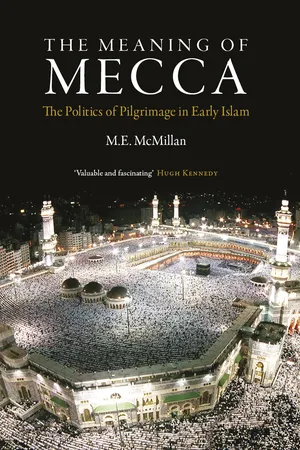
eBook - ePub
The Meaning of Mecca
The Politics of Pilgrimage in Early Islam
- 196 pages
- English
- ePUB (mobile friendly)
- Available on iOS & Android
eBook - ePub
The Meaning of Mecca
The Politics of Pilgrimage in Early Islam
About this book
The hajj, the fifth pillar of Islam, is a religious duty to be performed once in a lifetime by all Muslims who are able. The Prophet Muhammad set out the rituals of hajj when he led what became known as the Farewell Hajj in 10 AH / 632AD. This set the seal on Muhammad's career as the founder of a religion and the leader of a political entity based on that religion. The convergence of the Prophet with the politician infuses the hajj with political, as well as religious, significance. For the caliphs who led the Islamic community after Muhammad's death, leadership of the hajj became a position of enormous political relevance as it presented them with an unrivalled opportunity to proclaim their pious credentials and reinforce their political legitimacy. Exhaustively researched, The Meaning of Mecca is the first study to analyse the leadership of the hajj in the formative and medieval periods and to assess the political subtext of Islam's most high-profile religious ritual.
Information
Topic
StoriaSubtopic
Storia mondialeONE
The Prophet’s Precedent: The Farewell Ḥajj of 10/632
THE PROPHET AND THE PILGRIMAGE
In 10/632, the Prophet Muḥammad left Medina to return to Mecca to perform what Islamic tradition would remember as the Farewell Pilgrimage, the Ḥijjat al-Wadā‘.
Only ten years earlier, Muḥammad had been forced to flee his home city in the dead of night, his life in danger because of the prophetic mission he refused to give up. But the intervening decade had brought him a level of success that allowed him – almost uniquely in history – to be recognized as a Prophet in his own country.
Muḥammad’s goal in Mecca was to perform the ḥajj. The city was an ancient cultic centre and the Ka‘bah had long been home to a pantheon of pagan idols revered by Arab tribes throughout the peninsula.1 Four months of the year were set aside for pilgrimage: the spring month of Rajab for the lesser pilgrimage known as the ‘umrah and the last two months of the year and the first of the new year for the main pilgrimage or ḥajj.2 Raiding amongst tribes ceased during these months and many of them took advantage of their time in Mecca to engage in trade.3 Over the years, the city’s economy had become so closely linked with this commercial activity that fear of losing it lay behind much of the opposition to Muḥammad and his new religion.
The Farewell Pilgrimage saw Muḥammad reinforce the centrality of Mecca as a cultic centre but shift the spiritual focus away from the multitude of pagan gods towards the One God – Allāh. He also set about returning the ḥajj to what he believed were its true origins.4 According to Muslim sacred history, it was Ibrāhīm (Abraham) and his son Ismā‘īl (Ishmael) by the bondswoman Hajar who originally built the Ka‘bah.5 When they finished, Ibrāhīm received divine instructions not to associate any gods with God and to proclaim pilgrimage to the Sacred House.6
Muḥammad saw himself as the restorer of this message and in Mecca in 10/632 he, too, proclaimed pilgrimage to the Sacred House.7 At ‘Arafāt, just outside the Holy City, he delivered a sermon in which he explained the rituals of the pilgrimage and where they were to be done.8
He joined the lesser pilgrimage, the ‘umrah, with the main pilgrimage and abolished the intercalary month to make the Islamic year lunar.9 As the lunar year is eleven days shorter than the solar year, the ḥajj falls earlier each year and, over a thirty-year cycle, rotates through all four seasons. The abolition of the intercalary month thus placed the Islamic pilgrimage outside the cycle of the seasons. This break with the past left no room for ambiguity about the meaning of the new ḥajj: it was an act of worship directed to God, and only God, not a celebration of nature or a god of nature.10
Rather ominously during his sermon, the Prophet warned his listeners to pay careful attention to what he was saying because he did not know if he would ever be with them again in Mecca.11 Days later, on his way home to Medina, he fell ill and died soon afterwards.
The Farewell Pilgrimage is an important part of Islamic sacred history. Western scholarship has, however, questioned whether the rituals of the pilgrimage were finalized at that time or whether this process occurred over a much longer period.12 Attempts to understand the historical development of the ḥajj are further complicated because the accounts we have of Muḥammad’s life and religious mission were written over a century after his death; a time delay which has provoked considerable – and often impassioned – debate over their likely reliability.13
As well as tracing the development of the pilgrimage, scholars have also sought to find a historical context for the rites performed during it. Some see traces of stone worship, pre-Islamic pagan practices, or the influence of Judaism in the rituals of the ḥajj.14 Others have interpreted them as independent developments originating within Arab-Islamic culture.15
The origins of the rituals may never become fully clear. And perhaps the last word on the subject should go to the great philosopher al-Ghazālī who declared that, for Muslims, the ḥajj stands beyond explanation. Like Islam itself, it is a willing act of submission to God. God commands it, therefore it is done.16
THE RITUALS OF THE ḤAJJ17
Day 1: Dhū al-Ḥijjah 8
The ḥajj takes place in Dhū al-Ḥijjah, the twelfth – and final – month of the Islamic year and lasts for six days: from the 8th to the 13th.18
The first day is known as Yawm al-Tarwiyah, the day of quenching.19 On this day pilgrims enter the state of ritual purity, iḥrām, and declare their intention, niyyah, to perform the ḥajj.
The state of iḥrām places a number of obligations on pilgrims which are aimed at focusing their attention on the internal and the spiritual rather than the external and the secul...
Table of contents
- Cover
- Title
- Copyright
- Contents
- Acknowledgements
- Introduction: The Politics of Pilgrimage
- 1. The Prophet’s Precedent: The Farewell Ḥajj of 10/632
- 2. Following in the Prophet’s Footsteps: The Era of the Rightly Guided Caliphs
- 3. Mu‘āwiyah B. Abī Sufyān: A New Regime and a New Ḥajj Policy
- 4. The Caliphate in Transition: The Ḥajj as a Barometer of Political Change
- 5. The Return of the Umayyads and the Reintroduction of the Sufyānid Ḥajj Policy
- 6. A House Dividing: The Successor Sons of ‘Abd Al-Malik: Al-Walīd and Sulaymān
- 7. ‘Umar II and Yazīd II: A Different Approach to the Ḥajj
- 8. The Last of a Line: Hishām B. ‘Abd Al-Malik
- 9. The Third and Final Generation: Al-Walīd II to Marwān II
- 10. Summary: The Meaning of Mecca
- Appendix A: The Sources and Their Challenges
- Appendix B: Further Reading on the Ḥajj and the Umayyads
- Bibliography
- Index
Trusted by 375,005 students
Access to over 1.5 million titles for a fair monthly price.
Study more efficiently using our study tools.
Frequently asked questions
Yes, you can cancel anytime from the Subscription tab in your account settings on the Perlego website. Your subscription will stay active until the end of your current billing period. Learn how to cancel your subscription
No, books cannot be downloaded as external files, such as PDFs, for use outside of Perlego. However, you can download books within the Perlego app for offline reading on mobile or tablet. Learn how to download books offline
Perlego offers two plans: Essential and Complete
- Essential is ideal for learners and professionals who enjoy exploring a wide range of subjects. Access the Essential Library with 800,000+ trusted titles and best-sellers across business, personal growth, and the humanities. Includes unlimited reading time and Standard Read Aloud voice.
- Complete: Perfect for advanced learners and researchers needing full, unrestricted access. Unlock 1.5M+ books across hundreds of subjects, including academic and specialized titles. The Complete Plan also includes advanced features like Premium Read Aloud and Research Assistant.
We are an online textbook subscription service, where you can get access to an entire online library for less than the price of a single book per month. With over 1.5 million books across 990+ topics, we’ve got you covered! Learn about our mission
Look out for the read-aloud symbol on your next book to see if you can listen to it. The read-aloud tool reads text aloud for you, highlighting the text as it is being read. You can pause it, speed it up and slow it down. Learn more about Read Aloud
Yes! You can use the Perlego app on both iOS and Android devices to read anytime, anywhere — even offline. Perfect for commutes or when you’re on the go.
Please note we cannot support devices running on iOS 13 and Android 7 or earlier. Learn more about using the app
Please note we cannot support devices running on iOS 13 and Android 7 or earlier. Learn more about using the app
Yes, you can access The Meaning of Mecca by M. E. McMillam,M E McMillan,M. E. McMillan in PDF and/or ePUB format, as well as other popular books in Storia & Storia mondiale. We have over 1.5 million books available in our catalogue for you to explore.