- 176 pages
- English
- ePUB (mobile friendly)
- Available on iOS & Android
eBook - ePub
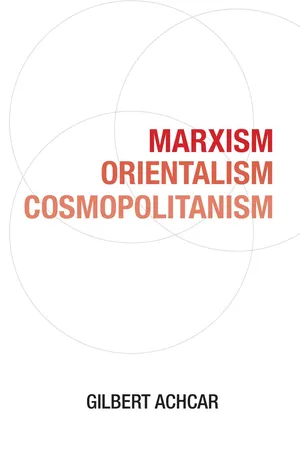
Marxism, Orientalism, Cosmopolitanism
About this book
In this collection of essays, Gilbert Achcar examines the controversial relationship of Marxism to religion, to Orientalism and its critique by Edward Said, and to the concept of cosmopolitanism. A compelling range of issues is discussed within these pages, including a comparative assessment of Christian liberation theology and Islamic fundamentalism; "Orientalism in reverse", which can take the form of an apology for Islamic fundamentalism; the evolution of Marx's appraisal of non-Western societies; and the vagaries of "cosmopolitanism" up to our present era of globalisation. Erudite and incisive, these essays provide a major contribution to the critical discussion of Marxism, Orientalism and cosmopolitanism, and illuminate the relationships between all three.
Information
Marxism and Cosmopolitanism
In memory of a very dear friend, Peter Gowan
Four conceptions of cosmopolitanism
Four main conceptions of cosmopolitanism could be identified in Marx’s time: philosophical (ethical); institutional (governmental); rights-based (juridical); and economic.
The oldest of these four variants was the philosophical:1 it can be traced back to pre-Socratic thinkers, notably Heraclites, although the first explicit statement of the doctrine that used the word “cosmopolitan” itself is generally attributed to the most famous of the Cynics, Diogenes of Sinope. When asked his national affiliation, he is said to have replied: “a citizen of the world” (i.e. kosmopolitês [“cosmopolitan”]).2
Institutional cosmopolitanism, which argues in favour of a world government, was first plainly articulated in the early fourteenth century by Dante Alighieri, in his De Monarchia.3 Dante pleaded for a world monarchy or empire, citing the Roman Empire as a model, with the achievement of “universal peace” as its major rationale. This vision found a radical counterpart in Anacharsis Cloots’ advocacy in 1792 of a République universelle based on a social contract between individuals.4
Immanuel Kant issued the most famous statement on rights-based cosmopolitanism in his 1795 essay “Perpetual Peace: A Philosophical Sketch”.5 Kant made “cosmopolitan law” (ius cosmopoliticum, or Weltbürgerrecht) the last of his three definitive articles for perpetual peace, going beyond the “law of nations” (ius gentium, or international law) of which Hugo Grotius is the foremost exponent in legal history, as well as beyond the aspiration to establish a peaceful, rights-based society of states. Kant, however, restricted “cosmopolitan law” very explicitly to a single and rather banal entitlement to what he called “hospitality” (Wirthbarkeit), consisting of a right to visit (Besuchsrecht) – i.e. the right to a short-term sojourn, as distinct from the right to long-term or permanent settlement granted by invitation only (Gastrecht).6 Although it is nowhere offered to the citizens of all countries under equal conditions, Kant’s “cosmopolitan” right is actually recognised by most states nowadays as the right to short visits for various purposes such as tourism or business.
Kant also contributed to the topic of institutional cosmopolitanism. Although he considered that a world state or “state of nations” (civitas gentium) created as an act of free will would be the only rational way to overcome international anarchy, he believed it so unlikely that he advocated an international anti-war alliance instead of a universal republic. Kant observed that, as separate states are much preferable to the forceful fusion of states under a universal despotic monarchy, a federation of free states (Föderalism freier Staaten) would be the most realistic solution.
At the end of the “First Supplement” included in his treatise, Kant explained that the most efficient incentive for peace among nations is trade, i.e. money.7 He thus adhered to the economic version of the theory of “liberal peace” after having emphasised its political variant: “republican peace” (the modern version of which is the theory of “democratic peace”).8 Kant thus showed his affinity with economic liberalism as articulated classically by his contemporary Adam Smith, whose magnum opus he had read.9 Smith’s 1776 The Wealth of Nations, while singing the praises of “free trade” and the “free circulation of labour and stock” as the safest way to opulence for all countries, also advocates low-cost (i.e. low-tax) government as a necessary correlate if states wish capital to remain freely on their territory. Within the context of this argument, he invoked the concept of cosmopolitanism without the term itself, but with its English equivalent, defining it as an attribute of capitalists:
The proprietor of stock is properly a citizen of the world, and is not necessarily attached to any particular country. He would be apt to abandon the country in which he was exposed to a vexatious inquisition, in order to be assessed to a burdensome tax, and would remove his stock to some other country where he could either carry on his business, or enjoy his fortune more at his ease.10
The concept and the term itself were harshly attacked by Smith’s principal bourgeois critic, Friedrich List, in his The National System of Political Economy (1841).11 Setting “political economy” against “cosmopolitical economy” (kosmopolitische Ökonomie), List criticised the “philanthropy and cosmopolitanism” of British liberal economists acrimoniously, denouncing their “free trade” attitude as stemming in reality from the dominant position of their country and deriding their French and German co-thinkers as naive. An heir to mercantilism and a major exponent of economic nationalism and protectionism, List emphasised the duty of each nation to put its own selfish interests above any other consideration and principle. He is one of the first authors to use the label “cosmopolitan” pejoratively and was, in his day, the most prominent critic of cosmopolitanism. In his book he called it bodenloser Kosmopolitismus,12 by which he clearly meant “rootless” – i.e. having no sense of belonging to a country – or unpatriotic; this same connotation of Boden (“soil”) would find its way into the late nineteenth-century German nationalist formula, Blut und Boden (“blood and soil”). Cosmopolitanism, as List described it, “neither recognises the principle of nationality, nor takes into consideration the satisfaction of its interests”.13
The concept of cosmopolitanism, and the term itself, would re-emerge in the economic literature in neutral guise, in the 1848 textbook Principles of Political Economy authored by John Stuart Mill, a disciple of Smith and David Ricardo:
[C]apital is becoming more and more cosmopolitan; there is so much greater similarity of manners and institutions than formerly, and so much less alienation of feeling, among the more civilized countries, that both population and capital now move from one of those countries to another on much less temptation than heretofore.14
Mill was more realistic than Smith, however, in acknowledging the limits to the circulation of capital in his time. He commented:
It needs but a small motive to transplant capital, or even persons, from Warwickshire to Yorkshire; but a much greater to make them remove to India, the colonies, or Ireland. ... To countries still barbarous, or, like Russia or Turkey, only beginning to be civilized, capital will not migrate, unless under the inducement of a very great extra profit.15
Marx and Engels’ initial conception of cosmopolitanism
In his 1841 doctoral dissertation on the philosophies of nature of Democritus and Epicurus, Marx did not comment on the elements of egalitarianism or cosmopolitan ethics in the thinking of the two ancient Greek philosophers. Only two years later, after his political radicalisation, did Marx approach the theme of cosmopolitanism – albeit indirectly – in relation to a critique of the bourgeois transformation of the world. That was in his contribution to the criticism of religion, which he regarded as “the premise of all criticism”.16
Infamous because of its anti-Jewish utterances, which are particularly unbearable to modern ears,17 Marx’s 1843 pamphlet On the Jewish Question is nevertheless a landmark in his transition to historical materialism and communism. Marx criticised Judaism all the more harshly as he himself was of Jewish origin, and hence felt at ease in his severity. Behind his stereotyped Hegel-like depiction of “the Jew”, who is presumed to have no homeland but money (a prejudice applied throughout history to all diasporic communities specialising in merchant and money-lending activities), Marx’s real target was the global reign of money, especially among “Christian peoples”. He meant this not in the anti-Semitic sense of Jewish control over the world, but in that Christians themselves “have become Jews”. Marx was thus directly rebutting the theologian Bruno Bauer who, in his critique of Judaism, had praised a conception of Christianity inspired by Ludwig Feuerbach.18
The Jew has emancipated himself in a Jewish manner, not only because he has acquired financial power, but also because, through him and also apart from him, money has become a world power and the practical Jewish spirit has become the practical spirit of the Christian nations. The Jews have emancipated themselves insofar as the Christians have become Jews. ... The god of the Jews has become secularised and has become the god of the world. The bill of exchange is the real god of the Jew. His god is only an illusory bill of exchange.19
Cosmopolitanism (world citizenship, Weltbürgertum) being a global extension of the concept of citizenship,20 note that Marx, in his On the Jewish Question, does not reject the political concept of “citizen”; on the contrary, he upholds it against the abstract notion of Man (Mensch).21 In the use made of the latter in the declarations of rights issued by successive bourgeois revolutions, he sees a codename for a member of “civil society” (bürgerliche Gesellschaft), i.e. a bourgeois:
Above all, we note the fact that the so-called rights of man, the droits de l’homme as distinct from the droits du citoyen, are nothing but the rights of a member of civil society – i.e., the rights of egoistic man, of man separated from other men and from the community. ...
This fact becomes still more puzzling when we see that the political emancipators go so far as to reduce citizenship, and the political community, to a mere means for maintaining these so-called rights of man, that, there...
Table of contents
- Cover
- Title
- Copyright
- Contents
- Foreword
- Religion and Politics Today from a Marxian Perspective
- Orientalism in Reverse: Post-1979 Trends in French Orientalism
- Marx, Engels and “Orientalism”: On Marx’s Epistemological Evolution
- Marxism and Cosmopolitanism
- Bibliography and References
Trusted by 375,005 students
Access to over 1.5 million titles for a fair monthly price.
Study more efficiently using our study tools.
Frequently asked questions
Yes, you can cancel anytime from the Subscription tab in your account settings on the Perlego website. Your subscription will stay active until the end of your current billing period. Learn how to cancel your subscription
No, books cannot be downloaded as external files, such as PDFs, for use outside of Perlego. However, you can download books within the Perlego app for offline reading on mobile or tablet. Learn how to download books offline
Perlego offers two plans: Essential and Complete
- Essential is ideal for learners and professionals who enjoy exploring a wide range of subjects. Access the Essential Library with 800,000+ trusted titles and best-sellers across business, personal growth, and the humanities. Includes unlimited reading time and Standard Read Aloud voice.
- Complete: Perfect for advanced learners and researchers needing full, unrestricted access. Unlock 1.5M+ books across hundreds of subjects, including academic and specialized titles. The Complete Plan also includes advanced features like Premium Read Aloud and Research Assistant.
We are an online textbook subscription service, where you can get access to an entire online library for less than the price of a single book per month. With over 1.5 million books across 990+ topics, we’ve got you covered! Learn about our mission
Look out for the read-aloud symbol on your next book to see if you can listen to it. The read-aloud tool reads text aloud for you, highlighting the text as it is being read. You can pause it, speed it up and slow it down. Learn more about Read Aloud
Yes! You can use the Perlego app on both iOS and Android devices to read anytime, anywhere — even offline. Perfect for commutes or when you’re on the go.
Please note we cannot support devices running on iOS 13 and Android 7 or earlier. Learn more about using the app
Please note we cannot support devices running on iOS 13 and Android 7 or earlier. Learn more about using the app
Yes, you can access Marxism, Orientalism, Cosmopolitanism by Gilbert Achcar in PDF and/or ePUB format, as well as other popular books in Politics & International Relations & European Politics. We have over 1.5 million books available in our catalogue for you to explore.