- 224 pages
- English
- ePUB (mobile friendly)
- Available on iOS & Android
eBook - ePub
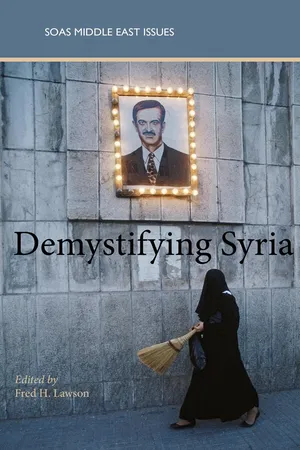
Demystifying Syria
About this book
Syria stands at the centre of contemporary Middle Eastern affairs but remains poorly understood. Recent writing has focused on the intentions and objectives of the political leadership in Damascus, yet there are many severe constraints on what senior policy-makers can actually do. This collection presents new research conducted by the contributors on aspects of Syrian politics, economics and diplomacy that are too often ignored. Essays on the shifting relations between the Ba'th party and the armed forces, burgeoning private enterprise and the dramatic Turkish - Syrian detente will prove essential reading for anyone with an interest in this pivotal and assertive Middle Eastern state. Contributors include Bassem Haddad, Souhail Belhadj, Baudoin Dupret, Zouhair Ghazzal, Thomas Pierret, Salwa Ismail, Joshua Landis and Joe Pace.
Information
ONE
Changing Social Structure, Shifting Alliances and Authoritarianism in Syria
Salwa Ismail
Since the 1960s Syrian politics have been dominated by authoritarian forms of political rule that have concentrated governmental power in the hands of a few. Using repression, and resting on an elaborate security apparatus, the military officer class that rose to power in the 1960s entrenched itself and banished all contending forces. Following his assumption of power in July 2000, President Bashar al-Asad expressed support for political liberalisation and pluralism. Seizing the opportunity, segments of society began to organise in the public sphere under the rubric of the movement for the revival of civil society (harakah ‘ihya’ al-mujtama‘ah al-madani).1 However, the promise of this political opening was short-lived, as the regime soon moved to close down the civil society forums, arrest activists and restrain all forms of societal organisation.
This retreat into repression notwithstanding, the Syrian regime exhibits signs of weakness and appears to be faltering. Further, there are indications that splits inside the military–political elite are developing, as evidenced by numerous episodes of rivalry and squabbling. Among the questions that arise in this context are: what are the internal forces of change and who are the actors that might press for a transition away from authoritarianism?
To answer these questions, I suggest that we examine the structural foundations of authoritarianism in Syria and the transformations that these are undergoing as the result of a reconfiguration of political forces and alliances. By bringing into focus the structural conditions that allow for the consolidation of authoritarianism, and by tracing changes in these conditions, this article contributes to understanding how authoritarian regimes persist.2 Recent political developments in Syria present us with a good case for the study of authoritarianism in crisis.
With the ongoing process of elite differentiation that has accompanied economic liberalisation, a realignment of socio-political forces is taking place in contemporary Syria. On one hand, the historical alliance between the ‘Alawi-dominated military regime and the Sunni merchants is under increasing strain and may be dissolving. On the other, the alliances of earlier eras – for instance, the alliance between shaikhs and merchants – are being resurrected. I contend that we are witnessing the reproduction of a religio-mercantile complex that may contribute to further disintegration of the regime.
Changing Class Foundations
As a military-led regime in which key positions are held by individuals from the ‘Alawi minority, the Syrian system has often been referred to as one of ‘Alawi rule. However, this formulation is simplistic and lacks nuance. ‘Alawi political dominance takes such forms as the control of security positions – intelligence services and key army divisions, for instance. However, there is a civilian decision-making group in which Sunnis, with a strong Damascene component, are well represented. During the era of President Hafiz al-Asad, two of the most trusted politicians were Sunnis, namely Mustafa Tlas and ‘Abd al-Halim Khaddam. Both men are credited with having prepared the grounds for Bashar al-Asad’s accession to the presidency. All the same, some Syrian intellectuals include Tlas and Khaddam as members of a regime of political ‘Alawism (al-‘alawiyyah al-siyasiyyah). Political ‘Alawism refers to a form of rule that consecrates sectarianism and rests on a certain alliance and intersection of interests. The concept is meant to capture the idea that authority and rule (al-sultah wal-hukm) are ‘Alawi, but that the ‘Alawis do not rule. This situation can also be described as the sectarianism of authority (ta’ifiyyah al-sultah) but not the authority of the ‘Alawis (sultah al-‘alawiyyah) or the authority of the sect (sultah al-ta’ifah).3
The military–sectarian power configuration is tied to a particular economic order that rests on alliances and exchanges with certain socio-economic forces. These, in turn, broaden the ruling coalition and bring in strata that have a vested interest in the continuation of the ruling elite’s monopoly over state power. Thus, in considering opportunities and constraints in the process of transition, we should take sufficient note of the political–economic alliances that support the regime and, importantly, outline certain features of the wider configuration. The al-Asad regime was consolidated through a historic alliance between the predominantly ‘Alawi military officer corps and the Sunni merchant-business class, in particular its Damascene component. We should consider briefly the terms of this historical alliance, the context in which it was fostered and how it has unfolded over the last three decades.
The Ba‘th Party, from its more radical days in the mid-1960s, undertook to liquidate Syria’s landed elite and small group of large industrialists. Through land-reform laws and nationalisation, these two strata were effectively marginalised. It should be recalled that these social forces had taken the form of notable families and clans that had dominated not only Syria’s economy but also its polity. Thus, the families who engaged in what Albert Hourani called ‘the politics of the notables’ virtually disappeared from Syria’s political scene.
During its revolutionary phase (1963–70), the Ba‘th Party in government embarked on policies of economic redistribution and welfare provision that reshaped society and contributed to the rise of new social forces that provided the party with widespread support. As Raymond Hinnebusch4 shows, peasants and workers were major beneficiaries of these policies. In return, they gave their allegiance to the regime and constituted its social base. These forces were absorbed through corporatist structures organised and managed by the party.
As the radical phase came to an end with the rise of Hafiz al-Asad, a slow move towards a mixed economy began and measures of economic liberalisation were introduced. Studies of the political economy of Syria under Hafiz al-Asad point out that the Ba‘thi regime engaged once again in the restructuring of economic forces, helping to engender the rise of strata whose vested interests were intimately tied to the ruling group.5 As such, it helped create commercial–business interests that worked in conjunction with the state monopoly of most sectors of the economy and that benefited from the ‘socialist’ principles guiding economic policy. The liberalising turn set the ground for the development of new social and political alliances that consolidated the regime. Over the years, differentiated economic elites grew in power and extended support for the ruling group.
With the regime’s move towards a mixed economic system, certain private sector actors were allowed to resurface, namely segments of the middle merchant class. Thus, after a period of contraction, there was a resurgence of the middle-level merchant families of the 1930s and 1940s – for example, al-Shallah, al-Qalla‘, al-Qabban, al-Habbal, al-‘Aqqad, al-Farra, al-Haffar, al-Jallad and al-Sabbagh – whom the state sought to incorporate while continuing to shun the remaining ‘aristocratic’ families of the Ottoman period. Central to the incorporation of this stratum was its role as a junior partner to the state in the economic field. In this partnership, the middle merchants dominated the chambers of commerce and were given privileged entry into the mixed sector. In that role, they functioned as subcontractors on deals managed by the state. For instance, the middle merchant class was party to the barter agreements with East European countries. To repay its military debt, the Syrian government entered into numerous such agreements, using its local manufacturing industries to supply products in return for monies owed on purchases of arms. Trade in textiles, chemicals and foodstuffs flourished under these arrangements.
The co-optation of the representatives of the middle merchants was central to the regime’s consolidation of power. The most notable event that cemented this alliance took place in 1980 when the regime faced one of its most serious crises – a possible nationwide uprising. At the forefront of this uprising stood the established merchants of Aleppo. Having called for a nationwide strike that included the closing of shops in the suqs (marketplaces), the merchants signalled their public opposition to the regime and their willingness to join other forces contesting it, mainly the Muslim Brothers and the banned leftist parties. Damascene merchants were expected to join the strike, and it was thought that their participation would bring down the regime. However, while the merchants of Aleppo closed their shops, their Damascene counterparts kept theirs open. To this day, many local observers believe that the Damascene merchants could have brought down the regime but chose not to do so. By all accounts, elements of the traditional merchant class co-operated with the regime at this crucial moment. The role of the Damascus Chamber of Commerce and its resident, Badr al-Din al-Shallah, was particularly important. According to some accounts, al-Shallah and his aides called other merchants and advised them not to participate in the strike.6 A warning was given that shop shutters would be forcibly opened and that no protection would be provided. There are also indications that intimidation tactics were used and rumours circulated to the effect that some merchants who opposed the decision not to strike had been murdered. The decision by the Damascene merchants not to join the strike was shaped by their earlier experience of a national strike in 1964, when their locked shops were forcibly opened and their stores looted. Further, there was a fear of a bloody confrontation with the special military forces of Rif ‘at al-Asad, which were thought to have encircled the city.
From that moment on, Damascene merchants became partners of the regime and continued to express their public allegiance. The close relationship between al-Shallah and President al-Asad attained legendary status when, during a national election, the latter chose to cast his vote in al-Shallah’s precinct. This was more than a photo opportunity. Rather, the symbolism of an allegiance declaration (bay’a) was realised when al-Shallah took off his cloak (‘abaya) and placed it on the president’s shoulders.
The National Bourgeoisie and the Rise of Awlad al-Sultah
Along with the re-emergent merchant strata of the 1930s and 1940s, a commercial bourgeoisie – whose main figures, as noted by Volker Perthes,7 were al-‘A’idi, al-Nahhas and al-‘Attar – was engineered by the regime in the 1970s. During this period, the principal areas of state–business partnership were in tourism and transport. Perthes’s classification of the Syrian bourgeoisie into four groups highlights an early process of elite differentiation. His schema captures similarities among the various strata, as well as divisions and fissures. One line of division that remains important and has now been accentuated is that between what Perthes calls the ‘industrial bourgeoisie’ and the ‘new class of contractors and middlemen’. At the heart of the division lies the distinction between productive and unproductive economic activities and between national capital and crony capitalism. These distinctions are important in the context of liberalisation and privatisation, as rent-seeking activities undermine trust and weaken interest in long-term investments in favour of quick-profit-making ventures.
Lines of division and fissure among the economic elites have been accentuated. The rise of new actors, known as awlad al-sultah (the children of authority), as key players in the new sectors of the economy has exacerbated elite divisions. These new players have joined the commercial stratum engineered by the regime in the 1970s. We can now speak of a new class that has distinctive features, best captured under the descriptor ‘oligarchy’ (whose economic activities are concentrated in areas such as car dealerships and information technology). These features and characteristics have implications for the period of transition. Of these, the flight of capital, the illegal appropriation of public resources, the usurious nature of investment and the web of connections represent important challenges. The conditions outlined here enter into the scenario of a breakdown of the historical alliance between the national bourgeoisie (traditional merchants and industrialists) and the state.8
These developments constitute key variables in understanding the process of reform and the course of transition. For present purposes, I want to highlight the implications of two interrelated developments: first, the rise of awlad al-sultah and second, the apparent loosening of the alliance between the ruling group and the traditional bourgeoisie. The economic opening pursued by the regime since the 1980s and consolidated in the 1990s saw the rise and integration of what some Syrian analysts call a new oligarchy, composed of high-ranking officials and their offspring. Members of this new class profited from the spoils of the economic opening: car dealerships, travel agencies, monopoly rights over the provision of certain goods and services. Certain features of their activities confirm the monopolistic character of their economic engagement. For example, some areas of production and commercial distribution are in the hands of a few – in the area of food imports, the al-Jud, al-Tun and Tlas family names stand out. It should be noted, further, that these same families are present in a multitude of commercial sectors.
Families and clans tied to the regime have become major economic actors. Today, Rami Makhluf, the president’s maternal cousin, is held to be the most representative figure of this development. Makhluf has a virtual monopoly over mobile phone services, given through a sweet deal in which tendering rules were manipulated. He also enjoys a monopoly in the running of duty-free markets on Syria’s borders. His diversified business portfolio includes a number of o...
Table of contents
- Cover
- Title
- Copyright
- Contents
- Acknowledgements
- Introduction by Fred H. Lawson
- 1. Changing Social Structure, Shifting Alliances and Authoritarianism in Syria: Salwa Ismail
- 2. Enduring Legacies: The politics of private sector development in Syria: Bassam Haddad
- 3. Civil Law and the Omnipotence of the Syrian State: Zohair Ghazzal, Baudouin Dupret and Souhail Belhadj
- 4. Sunni Clergy Politics in the Cities of Ba’thi Syria: Thomas Pierret
- 5. The Shi‘i Mausoleums of Raqqa: Iranian proselytism and local significations: Myriam Ababsa
- 6. The 2004 Events in al-Qamishli: Has the Kurdish question erupted in Syria?: Julie Gauthier
- 7. The Syrian Opposition: The struggle for unity and relevance, 2003–2008: Joe Pace and Joshua Landis
- 8. Partnership with the European Union: Hopes, risks and challenges for the Syrian economy: Anja Zorob
- 9. Demystifying Syrian Foreign Policy under Bashar al-Asad: Bassel F. Salloukh
- 10. The Beginning of a Beautiful Friendship: Syrian–Turkish relations since 1998: Fred H. Lawson
- Notes on Contributors
- Bibliography
- Index
Trusted by 375,005 students
Access to over 1.5 million titles for a fair monthly price.
Study more efficiently using our study tools.
Frequently asked questions
Yes, you can cancel anytime from the Subscription tab in your account settings on the Perlego website. Your subscription will stay active until the end of your current billing period. Learn how to cancel your subscription
No, books cannot be downloaded as external files, such as PDFs, for use outside of Perlego. However, you can download books within the Perlego app for offline reading on mobile or tablet. Learn how to download books offline
Perlego offers two plans: Essential and Complete
- Essential is ideal for learners and professionals who enjoy exploring a wide range of subjects. Access the Essential Library with 800,000+ trusted titles and best-sellers across business, personal growth, and the humanities. Includes unlimited reading time and Standard Read Aloud voice.
- Complete: Perfect for advanced learners and researchers needing full, unrestricted access. Unlock 1.5M+ books across hundreds of subjects, including academic and specialized titles. The Complete Plan also includes advanced features like Premium Read Aloud and Research Assistant.
We are an online textbook subscription service, where you can get access to an entire online library for less than the price of a single book per month. With over 1.5 million books across 990+ topics, we’ve got you covered! Learn about our mission
Look out for the read-aloud symbol on your next book to see if you can listen to it. The read-aloud tool reads text aloud for you, highlighting the text as it is being read. You can pause it, speed it up and slow it down. Learn more about Read Aloud
Yes! You can use the Perlego app on both iOS and Android devices to read anytime, anywhere — even offline. Perfect for commutes or when you’re on the go.
Please note we cannot support devices running on iOS 13 and Android 7 or earlier. Learn more about using the app
Please note we cannot support devices running on iOS 13 and Android 7 or earlier. Learn more about using the app
Yes, you can access Demystifying Syria by Fred H. Lawson in PDF and/or ePUB format, as well as other popular books in Politics & International Relations & Global Politics. We have over 1.5 million books available in our catalogue for you to explore.