- 336 pages
- English
- ePUB (mobile friendly)
- Available on iOS & Android
eBook - ePub
About this book
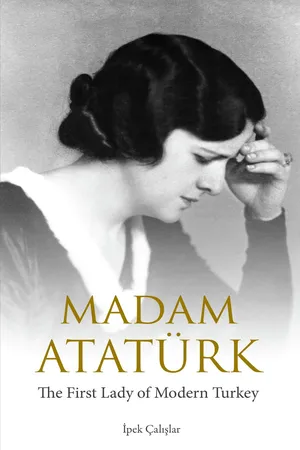
Mustafa Kemal Ataturk is hailed as one of the most charismatic political leaders of the twentieth century, but little is known today about his one and only wife, Latife Hanym. A multilingual intellectual educated at the Sorbonne, Latife's marriage to Ataturk in 1923 set her apart from her contemporaries, raising her to the pinnacle of political power. She played a central role in the creation of a modern and secular Turkey and campaigned tirelessly for women's right to vote. Throughout her marriage, Latife stood beside her husband and acted as his interpreter, promoter and diplomatic aide. She even twice risked her own life to save his. However, after only two years of marriage, Ataturk divorced Latife and she soon disappeared from public life. She was shunned, blamed for the failure of the marriage and portrayed as a sharp-tongued, quarrelsome woman who had strained Ataturk's nerves. Latife spent the rest of her life in seclusion. In the first biography to be written on Latife Hanym, Ypek Calyplar recounts the life of an exceptional and courageous woman, well ahead of her time, who lived through a remarkable period in Turkish history.
Information
Print ISBN
9780863568428
Subtopic
Historical Biographies1
Meeting
It was an autumn evening in 1919 when a smartly dressed Frenchman alighted before the White Mansion in Izmir’s Göztepe district.
The blockade sentry strode threateningly towards the gate, where the closed phaeton flying the tricolour had come to a stop. His determination to bar the visitor’s path only earned him a rebuke:
‘I am the French Consul, here to play bridge with Muammer Bey.’
Although the soldier spoke no French, he drew his rifle to one side:the documents the diplomat pulled from his pocket impressed him enough to make him retreat.
Izmir’s Turks had been suffering untold hardship under Greek occupation since 15 May. Yet, mused the consul, gazing at the house wistfully as he walked down the rose garden, he had singularly failed to convince his friend to hoist the French flag. Why couldn’t he have followed the example of Turks from Damascus? They raised the tricolour, and they were spared Greek harassment.
The door opened before he reached the bell: Izmir’s celebrated merchant Muammer Uşşakizade, smartly turned out in his customary crisp white jacket, greeted his friend at the door, and the two men embraced. Spotting the suitcases as his feet followed the familiar route to the reception room, the consul knew the family were ready.
Prominent Turks had been under pressure to collaborate with the occupation, and Muammer was the most influential merchant in all Izmir. He had confided the last time they spoke freely, ‘They’re insisting I become mayor; neither does a day pass but that I don’t receive death threats.’
Both men were freemasons, and their friendship, which had begun at the Bridge Club, predated the occupation by some time. The White Mansion in Göztepe was something of a second home for the consul.
He was genuinely terrified at the risk of death Muammer faced, and had repeatedly urged expediency, adding how he had already assisted some of his Turkish friends to escape from Izmir.
All being well, Muammer and his family would leave for Marseilles on a boat sailing that night. The consul had arranged for tickets and passports for the entire family; these documents were hidden in a secret compartment of the case in his hand.
‘Is Makbule Hanım coming? What have you decided?’
‘No,’ replied Muammer, ‘my mother begs to stay behind: she says she is too old to travel. Travel is more risky for her than staying in Göztepe.’
‘The passports are ready. Here: Latife, Adeviye, İsmail, Ömer, Münci, Rukiye, Vecihe and yours … Here’s one for your mother, too; she might still change her mind, don’t you think?’
Adeviye entered, a glum-looking Latife beside her.
‘Please don’t sulk, Latife; these Greeks are only here temporarily,’ mumbled Muammer.
‘My grandmother,’ explained Latife, ‘she won’t come along. It’s not easy leaving her behind.’
The consul tried to placate her. ‘But we are here right beside her. Should anything go wrong, you could be back in three days. This curfew can’t last for ever, and the resistance is spreading … Everyone has great confidence in Kemal Paşa. He’s certainly impressed our lot; they refer to him as a military genius.’
The bridge table was set in the garden, as usual. İsmail and Latife joined in to make up the four. Talk was loud, as usual, and Latife had a good run of aces and kings. The bridge party went on until nightfall. A sumptuous dining table had been laid, again as usual. The servants busied themselves with their tasks, as the household followed routine. Adeviye gathered a few more items that had been overlooked and checked Münci’s medicines. Their youngest son had contracted polio; how he would cope with the journey was a real worry.
The family boarded the phaeton in the dark, careful not to be spotted by the sentries. Latife was the first to leave the house, followed by the rest as Muammer took leave of his friend. Makbule came out, a crystal pitcher in hand, and poured water at the roots of the old wisteria, honouring an ancient custom that bids travellers a smooth journey and a speedy return.
The phaeton was not big, so the younger boys had to lie on the suitcases and one of the girls sat on the other’s lap. They followed the last few passengers boarding the French ship when they reached the port. Once through passport control safely, they all gazed at Izmir one last time from the deck.
The consul sank into a book he had drawn at random after the departure of the fugitives; he would read all night, the mansion ablaze with lights. The Greek soldiers were accustomed to all night long bridge parties at the White Mansion.
He was whistling as he left in the morning, again as usual, albeit a little tense on this occasion, and walked out between the unsuspecting sentries. He had rescued his dear friend Muammer and his family.
Three years later
Latife was standing on the deck of the boat leaving Marseilles, her gaze fixed on the deep blue sea. She was on her way back to Izmir, then still under Greek occupation. Their worst fears had come true, and bad news did travel fast: her grandmother Makbule was ailing. The young woman stopped her father, who was preparing to return:
‘Father, they’d kill you; it’s best I return instead.’
Once she made her mind up, that was that. Muammer’s influence proved invaluable once more, and a French passport duly arrived, bearing a note: ‘Under special protection.’
The Greeks were losing to the Nationalists on all fronts. Latife had been following news of the resistance and trusted Mustafa Kemal to liberate Izmir. She was wearing his portrait – cut from a newspaper – in a locket for good luck.
The boat was destined for Istanbul, where she would spend a day before making her way to Izmir. Three years earlier, she had, in fact, been actively engaged in the resistance; this time, she had some papers to collect in Istanbul.
She had planned her every move during the passage. Collecting the documents at the address she had been given proved no problem at all; she boarded the Izmir boat without opening her case. Unusually for her, she was dressed in a çarşaf this time, taking special pains to avoid a search. Her passport might identify her as a French citizen, but she still was the daughter of a prominent Izmir family well known to the occupation.
She arrived in Izmir on 17 June 1922, as Mustafa Kemal met his mother in Adapazarı, an event witnessed by an emotional crowd. The general had taken the opportunity of a visit with a diplomat to arrange to meet Zübeyde Hanım. He knew he had been neglecting her, rushing from one battlefront to the next; the time had come to take her to live close to him.
In a strange coincidence, Mustafa Kemal and his mother had also spent three years apart. Chance would throw these people together a few months later.
It was Latife’s twenty-third birthday. Returning to her birthplace was not as straightforward as entering Istanbul had been. Suspicious of this Turkish girl travelling on a French passport, Greek officials wanted to search her. She was defiant: how could they search a Muslim woman? Haughtily she denied them permission to even touch her çarşaf, when, all the while, resistance documents were concealed in her undergarments.
The soldiers gave up on this covered girl and flung her into a cell instead.
‘No food or water’ was the order.
News spread instantly: the celebrated businessman Uşşakizade Muammer Bey’s daughter had returned. Yet there was no sign of her. The French had provided entrance documents, but could do little through diplomatic channels now. What if they compromised their earlier role in the entire family’s escape? So they took the next best course of action: making sure people learned of her arrival and immediate incarceration. It was not long before the entire city knew: ‘Uşşakizade Latife has returned, but is in custody.’
Her maternal uncle Ragıp Paşa had been warned before her departure. When she failed to turn up, he reached out to his influential contacts amongst the occupying forces. The solitary confinement of a Muslim girl increased the tension. Risk of an even greater reaction ultimately forced their hand, and the Greeks had no choice but to release her on the third day. Latife had indeed made it to her grandmother’s bedside within the week.
Sadly, their troubles were not yet over. An inflamatory letter she had written to a leading Izmir official in the early days of the occupation (‘The enemy might well have occupied these lands, but the time will come when Mustafa Kemal will liberate the country, and we will all be free’) had fallen into Greek hands, sparking her next ordeal. Now marked as a troublemaker, she was placed under house arrest.1
The brace of sentries posted at the Uşşakizade gate checked up on her hourly. To spite them, she frequently covered up in a çarşaf, pretending to be the ironing woman, going out and coming back as she pleased. Oppressed by the occupation, she had confided in a friend, ‘You know what I’m going to do? I’m going to marry the commander who liberates Izmir.’ Liberating commanders graced the dreams of many an Izmir girl.
Latife said much later, ‘It was an interminable nightmare; they could have executed me at any point. I never once considered escape; I was so convinced of our ultimate liberation.’ And encouraging news did indeed trickle in from the front.
She vowed to host Mustafa Kemal Paşa – whose valour she had found awe-inspiring – at her home, were he to enter Izmir victoriously.
As the Nationalist forces liberated the Aegean region step by step, Greek propaganda persisted in promising imminent victory. The truth was very different, however. Not even the Allies harboured any delusions of the Greeks’ ability to last one more winter in Izmir.
In spite of the war raging in the interior, life in Izmir had been curiously unaffected, even carefree, until the last days of August 1922. The city was the centre of the nation’s commercial and agricultural life, and although trade with the interior was diminished, the harbour bustled with traffic.
In season, baskets of rose petals lined the streets […] In some streets the smell of freshly baked bread overpowered the roses. […] The markets testified to an abundant harvest […] grapes, fresh figs, apricots, melons, cherries, pomegranates.2
On 26 August, news of the collapse of the Greek front at Afyonkarahisar reached Izmir. The Greeks and Armenians wanted to believe the Turkish advance to be of a temporary nature. The British Consulate, concerned at the turn of events, alerted its subjects to be on their guard. English clubs in Buca and Bornova buzzed with comments on the news coming from the front, and wealthy Greeks and Armenians would mention, in passing, impromptu plans for a short break abroad. All would become clearer within a few days, in any case.
Latife followed the reports in the local press and recounted tales from the front – spread by word of mouth – to her grandmother. Encouraged by the turn of events, Makbule Hanım brightened up visibly. Afyonkarahisar was retaken on the 29 August. The Greek army was surrounded in Dumlupınar on the following day. In Izmir’s attics, young women secretly embroidered crescents and stars in pearls on crimson fabrics, preparing to adorn the entire city come liberation day.
It was on this first day of September, too, that the Greek wounded began arriving. […]
Civilian refugees from the interior began to ...
Table of contents
- Cover
- Title
- Copyright
- Contents
- Introduction
- Translator’s Note
- Glossary
- 1. Meeting
- 2. Latife’s Family
- 3. The Occupation of Izmir, Latife’s Hometown
- 4. Love Springs from the Ashes of the Great Fire
- 5. Mustafa Kemal Paşa Proposes
- 6. Waiting for the Wedding
- 7. Zübeyde Hanım, the Mother-in-Law
- 8. A Purebred Arabian as an Engagement Present
- 9. ‘Get ready; we’re getting married!’
- 10. Honeymoon
- 11. Arrival in Ankara, the Nationalist Base
- 12. The Bride Who Came to the Garrison
- 13. Latife Entertains the Foreign Press at Çankaya
- 14. Touring the Country Together
- 15. The ‘Impertinent’ Bride Who Wears Spurs
- 16. Bullet Holes in Latife’s Clothes
- 17. Latife Wants to Stand for Parliament
- 18. Life at the Residence
- 19. The Proclamation of the Republic
- 20. The Groom Has a Heart Attack
- 21. Latife Shields Her Husband with Her Own Body
- 22. Latife Prepares the State Protocol
- 23. Women of the Time
- 24. The Women’s Movement and Latife
- 25. Fikriye: The Former Consort Comes Back
- 26. Kick-starting the Economy
- 27. Autumn Tour
- 28. Days of Opposition
- 29. Was It a Love Match?
- 30. Divorce
- 31. Reverberations
- 32. Separation
- 33. Tears in Mustafa Kemal’s Blue Eyes
- 34. Latife Supports the Second Party
- 35. A Unique Surname from Atatürk
- 36. The Campaign of Vilification
- 37. Latife Hides Her Illness
- 38. Guarding the History of the Republic in Her Safe
- Appendix I: Two Obituaries in the Foreign Press
- Appendix II: An Obituary in the Turkish Press
- Biographical Notes
- Acknowledgements
- Notes
- Bibliography
- Index
Trusted by 375,005 students
Access to over 1.5 million titles for a fair monthly price.
Study more efficiently using our study tools.
Frequently asked questions
Yes, you can cancel anytime from the Subscription tab in your account settings on the Perlego website. Your subscription will stay active until the end of your current billing period. Learn how to cancel your subscription
No, books cannot be downloaded as external files, such as PDFs, for use outside of Perlego. However, you can download books within the Perlego app for offline reading on mobile or tablet. Learn how to download books offline
We are an online textbook subscription service, where you can get access to an entire online library for less than the price of a single book per month. With over 1.5 million books across 990+ topics, we’ve got you covered! Learn about our mission
Look out for the read-aloud symbol on your next book to see if you can listen to it. The read-aloud tool reads text aloud for you, highlighting the text as it is being read. You can pause it, speed it up and slow it down. Learn more about Read Aloud
Yes! You can use the Perlego app on both iOS and Android devices to read anytime, anywhere — even offline. Perfect for commutes or when you’re on the go.
Please note we cannot support devices running on iOS 13 and Android 7 or earlier. Learn more about using the app
Please note we cannot support devices running on iOS 13 and Android 7 or earlier. Learn more about using the app
Yes, you can access Madam Ataturk by Ypek Calyplar,Ipek Çalislar in PDF and/or ePUB format. We have over 1.5 million books available in our catalogue for you to explore.