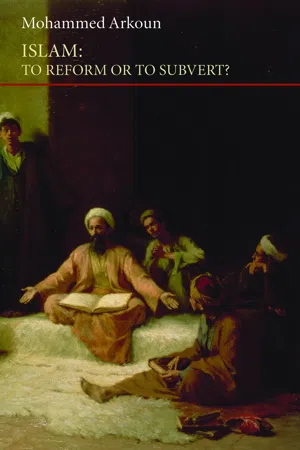
- 416 pages
- English
- ePUB (mobile friendly)
- Available on iOS & Android
eBook - ePub
About this book
At a time when Islam is the focus of attention, vilified by some and a source of inspiration for others, Arkoun's is one of few voices that seek to go against the stream. His radical review of mainstream historiography of Islam draws on interdisciplinary analysis - historical, social, psychological and anthropological. As one of the foremost thinkers of the Muslim world, Arkoun is in a position to question dogmatic constructs from within, with respect and critical acumen. An understanding of this approach will lead to an emancipatory turn in the intellectual and political spheres of Muslim societies.
Information
Subtopic
PolitiqueONE
A Critical Introduction to Qur’Ánic Studies
Therefore, take heed (faÝtabirÙ), you who have eyes.
Qur’Án, 59, 2.
Surely, We have sent down to you the Book with the Truth, so that you may judge between the people by that which God has shown you.
Qur’Án, 4, 105.
Scientific reason is not questioned according to the criterion of the true or false on the (paradigmatic) axis of the message/referent, but according to the performative level of the pragmatic axis of the addresser/addressee.
F. Lyotard, in L’état des sciences sociales en France, p. 15.
A critical introduction to Qur’Ánic Studies should not only evaluate the content of the most significant contributions published in the last 20 years, it should also discuss the theoretical aspects of the approaches required by religious discourse as it is employed in Islamic contexts as well as in other religious traditions. Muslims avoid or reject radically such a comparative inquiry; they focus on the Qur’Án as the Word of God providing all the believers with clear, eternal, indisputable norms, teachings and ideal commandments to enlighten this life and lead to Salvation in the next. An increasing number of books and commentaries in all languages are invoked in order to support and spread this purely religious acceptance of the heavenly Book. What place is left in this practice to the scholarly works devoted to the interpretation of the Qur’Án? And how can scholarship, with its specific tools and methodologies, incorporate or discard the pious literature produced by the believers? Should scholars accept the wide gap generated by the contrast between ‘scientific’ and ‘traditional’ attitudes to the religious phenomenon, or should they include in their inquiry all the facts relating to the Qur’Án as a source of life, an ultimately constraining point of reference, a global, complex, recurrent, commanding historical force? The cognitive status of modern scholarship is challenged by the phenomenon of what I called the religions of the Book-book; critical scholarship has certainly shed light on several aspects of this phenomenon, but the recent emergence of religion as a refuge, a springboard for historical action in many societies, has convincingly unmasked the failure of ‘scientific’ interpretations of religion to enhance the rational, cultural dimensions of religious belief and emancipate popular/populist religion from its mythological, ideological and fantastical expressions. This failure should itself be the subject of scientific inquiry in order to enrich the cognitive ambitions of modern scholarship.
To illustrate these observations, I shall consider the following aspects:
• From ‘ilm al-yaqÐn to the end of certainty.
• Reading the Qur’Án today. Faithful readings and ‘scientific’ readings
• Methodological priority and the limits of historical-anthropological reading.
• An analysis of religious discourse.
• From traditional exegesis to the hermeneutical circle.
• New horizons of meaning and action.
Under these six headings, I shall focus on the contemporary methodology operative in the critical study of the Qur’Án, especially in the West, as well as the historical, anthropological, linguistic, literary, philosophical and epistemological questions, problems and queries relating to the study of the Qur’Án as the focal point of Islam, Islamic tradition, Islamic Law, and Islamic thought, which are themselves confronted by the challenges of classical and meta-modernity.
1. From ‘Ilm al-YaqÐn to the End of Certainties
Qur’Ánic discourse has given ontological, psychological, thematic and rhetorical support to the concept of ‘ilm al-yaqÐn, certainty-based science. Not only does the revealed Word of God provide full intangible certainty and defines the limits thereof, but it functions as the source and the fundamental root of every type of knowledge derived therefrom, taking due account of the rules, procedures and methods. Islamic law, sharБa, is called ‘Divine Law’ because it is presented as fully, correctly derived from the teachings of holy texts (the Qur’Án and the ÎadÐth). The quest for certainty in Law, for the purpose of undermining the role of doubt, is richly expressed in the following statement by BihbahÁnÐ, a ShБÐ, a scholar who died in 1792:
You know that the cause of the difference between the akhbÁrÐ and the mujtahid is ijtihÁd itself, that is acting on the basis of opinion (ªann). Whoever acts on its basis is a mujtahid, and whoever claims not to, but rather claims to be acting on the basis of religious science (‘ilm) and certainty (yaqÐn), is an akhbÁrÐ.1
Theology (‘ilm al-kalÁm) is more controversial; some schools prefer to avoid it, or at least to prevent the unprepared masses from having any exposure to it. ÑÙfÐ search and spiritual exercise are another field in which a more emotional, subjective, less logocentrist certainty is conquered, possessed and used as a path by which to reach the level of unification with God (ittiÎÁd, ittiÒÁl).
In classical modernity (1680–1945, according to Paul Hazard in La crise de la conscience européenne), positivist reason has fostered the imaginary of scientific progress with a sense of mathematical, experimentally based certainty that has become the solid foundation of a culture of disbelief replacing the traditional culture of religious belief and eschatological hope in eternal Salvation. Historians of science, such as Ilya Prigogine, have dated the ‘end of certainties’ based on scientific reasoning and experimentation from 1945 onwards. Social sciences are contributing to the dissolution of the inherited systems of knowledge and the subversion of the cultural and legal regimes of truth both in their religious and modern versions. Qur’Ánic studies. as the majority of Muslims continue to pursue them, distance themselves from these intellectual shifts and scientific revolutions, maintaining the ‘orthodox’ theological and legal frameworks of belief and interpretation in order to legitimize the ‘universal’ perspective of the Islamic regime of truth, sustaining the Islamic model of human history as an alternative to the Western secularized model. The emergence of a meta-modern horizon of meaning, knowledge and action is simply ignored or misunderstood in the current ideological debate opposing ‘Islam’ and the ‘West’.
There is a need for a new ranking of rational processes; we cannot stick to the ranking established and imposed for centuries by the two foundational disciplines developed by Muslim theologians and jurists under the name of uÒÙl al-dÐn and uÒÙl al-fiqh. Contemporary reason no longer offers the certainty and the uniqueness of a Truth that is still defended by all those who think, interpret, decide and act in the dogmatic, conservative belief patterns and knowledge. Even in the Middle Ages, these frameworks were pluralistic and conflicting, much less monolithic than what the fundamentalist discourse has been imposing for several decades. Ranking rational processes means maintaining constantly open the theoretical debate on the epistemological axioms and postulates commanding each implicitly or explicitly assumed hierarchy of approaches (l’ordre des raisons) in every cognitive construction. From that point of view, the social sciences are not always helpful, especially for those who aim to displace the ordre des raisons elaborated by uÒÙlÐ thinking in the mediaeval context to the meta-modern criticism of any foundationalist attempt. I have shown this intellectual and methodological discrepancy in my ‘Critique of legalistic reasoning in Islamic contexts’ (to be published in Penser l’Islam aujourd’hui). So-called ‘ tele-techno-scientific reasoning’ is spreading a new pragmatic instrumental form of reasoning lead by the principle of ‘just do it’, as long as so doing ensures concrete, significant technological and economic success. Facing the hegemonic achievements of teletechno-scientific reasoning, academic scholastic reasoning, such as P. Bourdieu has presented its cognitive status in his Méditations pascaliennes,2 is unlikely to elicit any fruitful response to the type of issues we are introducing about the radical critique of the cognitive status of the Qur’Ánic discourse, itself, that are considered here as a mere example among others of an attempt to reach all types and levels of ‘holy Scriptures’, or sacred foundational texts.
European modernity, at least since the eighteenth century, has left us with the impression that reason would finally be liberated from the constraints of dogmatism in order to be placed in the service of objective knowledge alone, once a radical separation between every institutionalized religious law and the ‘neutral’ state has been accomplished. When this latter body is free to exercise its undisputed sovereignty, it does not, however, struggle with the same determination for such a radical separation between cognitive reasoning and the reasoning of the state (raison d’état). This is not the place to explore this subject further; it is enough to recall now that in the various Islamic contexts, reason multiplies the constraints which it had itself created for the sake of its independence in the face of the strict control of the state which unilaterally proclaims itself the exclusive administrator of orthodox religious truth and law.
Such are the two contexts in which the Qur’Án has been read, consulted and interpreted for fourteen centuries by the Muslims and for some two centuries by the modern scholarship. This introduction of a hierarchy of approaches (ordre des raisons) makes the debate on Orientalism irrelevant at least in the manner it has hitherto been conducted, i.e., devoid of any preliminary critique, devoid of scholastic reasoning (as defined above) and devoid of recognition of the fact that cognitive reasoning has willingly accepted the actual hegemony of the utilitarian, pragmatic, experimental, instrumental reasoning which is becoming all-powerful under the name of tele-techno-scientific reason. One must, however, remember two troublesome issues for the western scholar of the Qur’Án who is using the tools and assumptions of the social sciences of religions (see the French journal Archives des Sciences Sociales des Religions), after the long domination of a positivist, historicist, philological methodology and epistemology:
1. During the long academic supremacy of Formgeschichte and philology, Qur’Ánic scholars had little regard for questions of an epistemological nature, if they were even aware of them at all. Methodological discussions were restricted to the ways in which philological rules were applied to reach ‘facts’ and solve problems in relation to both authentic and apocryphal documents. The philosophical implications of the cognitive framework chosen in which to conduct this criticism have not yet been adequately considered even in the new framework introduced by social sciences.
2. Apart from specialists who are themselves believers and bring their Jewish or Christian theological culture to bear on the question at hand, all who declare themselves agnostic, atheist or simply secular dodge the question of meaning – its genesis and metamorphoses – in religious discourse and thus refuse to enter into a discussion of the content of faith, not as a set of life rules to be internalized by every believer, but as a psycho-linguistic, social and historical construct. The concept of religious discourse differentiated from theological, philosophical, historiographical and legalistic discourses, has not yet been shown to become operative and meaningful when it is applied to the sacred, religious, basic texts currently called the Holy Scriptures. Hence the essential question about truth, for religious reasoning as well as that of the most critical philosophical kind, is totally absent in the so-called scientific study of a corpus of texts of which the raison d’être – the ultimate goal to which all rhetorical and linguistic utterances bear witness – consists in providing for its immediate audience, who have multiplied and succeeded one another throughout the centuries, the unique, absolute and intangible criterion of Truth as a True Being, a True Reality and a True Sense of Righteousness (al-Îaqq). Doubtlessly, from the time when was first announced orally between 610 and 632 C. E., the Îaqq has developed in a way that must be taken into account by history of thought and cultural sociology.
It is not a matter of establishing the true meaning of texts as lived and received by the faithful, i.e., as sacred and revealed, or of articulating that which is taken as a certainty insofar as recorded in a process of sacralization, transcendantalization, ontologization, spiritualization, etc., in the manner of the great systems of theological, philosophical, legal or historiographical thought inherited from the Middle Ages; the task of the researcher is to problematize all the systems that claim to produce meaning, all the forms, whether or not they are still extant, which offer meaning and assumptions of meaning (effets de sens). This is a necessary distinction that refers to many problems yet to be raised or, if they have been raised, they have been raised inadequately or without full recognition. In the case of the Qur’Án and similar corpuses in other cultures (a comparative approach is always in order), the activity of the human mind can be found nearest to its own utopian vision, its hopes, both those which are unfulfilled and those which recur, its struggle to attain the full exercise of its ‘will to know,’ combined with its critical and creative freedom. The purpose in the case of the Qur’Ánic corpus and its vast historical development, is to test the capacity of reason to decipher the mysteries which it has itself produced in a previous age.
With this idea of utopia, it is important not to lose sight of the fact that Qur’Ánic studies lag considerably behind biblical studies to which they must always be compared (see scripture and Qur’Ánic study). This could be said to reflect the different concerns in the historical development of societies in which the Qur’Án continues to play the role of ultimate and absolute reference point and has never been replaced as the sole criterion for the definition and function of all true, legitimate and legal values. The stakes in the violent and passionate rejection of what political Islam calls ‘the West’ lie less in the grasping of an ephemeral power than in the progress of the secular model of the production of history, and could ultimately render the ‘divine’ model obsolete, as it is in the West. This point is noteworthy in order to release the Qur’Ánic studies from its isolation vis-à-vis the historical perspective of modernity as well as that of the religious problem, which has been at one and the same time, appropriated by and disqualified along with its former force. This premise is essential for clarifying the strategy of mediating a solution and thus guiding the pedagogy of the scholar-thinker (chercheur-penseur).3
During the years of struggle for political independence (1945– 1970), one could have hoped that an opening toward modern historical criticism, as shown in the Middle East and North Africa during the so-called Renaissance (nahÃa, 1830–1940), would have expanded to include such taboo subjects as Qur’Ánic studies, including the sanctified areas of law appropriated by the sharБa and its legal statutes and rulings (see law and the Qur’Án), the corpus of ÎadÐth which enjoys the status of foundational sources (uÒÙl) as defined by al-ShÁfiÝÐ (d. 204/820). However, certain historical events have altered this potential course, beginning with the 1979 Islamic Revolution in Iran, which was in turn, extended globally by so-called fundamentalist movements. This revived, in the already very complex and inadequately explored area of Qur’Ánic studies, the rather archaic combination of violence and the sacred, which was still able, with some effect, to bring its weight to bear upon the global civilization of disenchantment, desacralization and the supremacy of science over all dimensions of human existence.
Like Christians during the modernist crisis of the nineteenth century, Muslims have reacted – and sti...
Table of contents
- Cover
- Title
- Contents
- Preface to the Second Edition
- Introduction
- 1. A Critical Introduction to Qur’Ánic Studies
- 2. Belief and the Construction of the Subject in Islamic Contexts
- 3. Logocentrism and Religious Truthin Islamic Thought
- 4. Authority and Power in Islamic Thought
- 5. The Concept of Person in Islamic Tradition
- 6. Aspects of Religious Imaginary
- 7. The Rule of Law and Civil Society in Muslim Contexts
- Select Bibliography
- Index
- Copyright
Trusted by 375,005 students
Access to over 1.5 million titles for a fair monthly price.
Study more efficiently using our study tools.
Frequently asked questions
Yes, you can cancel anytime from the Subscription tab in your account settings on the Perlego website. Your subscription will stay active until the end of your current billing period. Learn how to cancel your subscription
No, books cannot be downloaded as external files, such as PDFs, for use outside of Perlego. However, you can download books within the Perlego app for offline reading on mobile or tablet. Learn how to download books offline
Perlego offers two plans: Essential and Complete
- Essential is ideal for learners and professionals who enjoy exploring a wide range of subjects. Access the Essential Library with 800,000+ trusted titles and best-sellers across business, personal growth, and the humanities. Includes unlimited reading time and Standard Read Aloud voice.
- Complete: Perfect for advanced learners and researchers needing full, unrestricted access. Unlock 1.5M+ books across hundreds of subjects, including academic and specialized titles. The Complete Plan also includes advanced features like Premium Read Aloud and Research Assistant.
We are an online textbook subscription service, where you can get access to an entire online library for less than the price of a single book per month. With over 1.5 million books across 990+ topics, we’ve got you covered! Learn about our mission
Look out for the read-aloud symbol on your next book to see if you can listen to it. The read-aloud tool reads text aloud for you, highlighting the text as it is being read. You can pause it, speed it up and slow it down. Learn more about Read Aloud
Yes! You can use the Perlego app on both iOS and Android devices to read anytime, anywhere — even offline. Perfect for commutes or when you’re on the go.
Please note we cannot support devices running on iOS 13 and Android 7 or earlier. Learn more about using the app
Please note we cannot support devices running on iOS 13 and Android 7 or earlier. Learn more about using the app
Yes, you can access Islam by Mohammad Arkoun,Mohammed Arkoun in PDF and/or ePUB format, as well as other popular books in Politique et relations internationales & Politique. We have over 1.5 million books available in our catalogue for you to explore.