- 288 pages
- English
- ePUB (mobile friendly)
- Available on iOS & Android
eBook - ePub
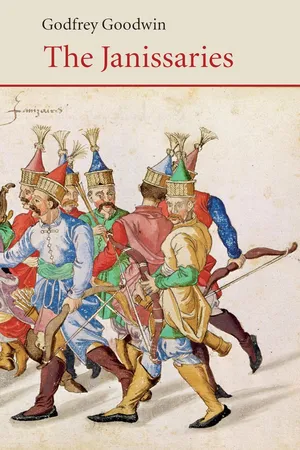
The Janissaries
About this book
From the fifteenth to the sixteenth century, the janissaries were the scourge of Europe. With their martial music, their muskets and their drilled march, it seemed that no one could withstand them. Their loyalty to their corps was infinite as the Ottomans conquered the Balkans as far as the Danube, and Syria, Egypt and Iraq. They set up semi-independent states along the North African coast and even fought at sea. Their political power was such that even sultans trembled. Who were they? Why were they an elite? Why did they decline and what was their end? These are some of the questions which this book attempts to answer. It is the story of extraordinary personalities in both victory and defeat.
Information
Topic
HistoriaSubtopic
Historia asiática1
The Origins of the Janissary Corps
Dark Birds over Anatolia
In the year 1336 a North African traveller on a tour of the Islamic world crossed Anatolia from south to north and left us an account of his journey. Ibn Battuta1 was known and respected then, as he is now, and so was able to journey from one emirate to the next over territory which offered every kind of refuge to bandits and rapacious nomads. The decline of Mongol authority left the country divided among chieftains whose authority nominally derived from the khan’s governors, such as Eretna, but who were virtually independent. Geographically, the terrain divided naturally into regions with fertile pockets between rude mountains and goat-ravaged wastes2 where the inhabitants of polyglot ethnic stock had cohesive local loyalties. Moreover, the old gods lingered on in their fastnesses in valley and gorge and in the hearts of a peasant population monotonously assaulted by invading bands and companies.3 Superstition remains strong to this day, when files of women still ascend the citadel hill at Kars to perform rites to placate Cybele or woodcutters at Elmalı still alarm the townsfolk of the coastal plain when they emerge from the forest, bronzed and fiercely bearded, armed with their axes.
Long before Hellenistic or Roman times, the government of the sub-continent depended on highways although the importance of one particular route might decline or grow over time. Thus the main road from Pertek to Divriği is still the track that it always was, whereas others now have metalled highways. Beyond the roads were the people and beyond the people were the bandits; this is still true in the mountains, especially in Kurdish areas. In the view of Christian landowners under the Byzantines, an infection as grim as the plague came in the form of Türkmen raiders4 and they were, indeed, harbingers of defeat and desolation: but also of that reorganization into Muslim emirates that Ibn Battuta was to explore.
The Türkmen (known as Karakuş or Dark Birds) were birds of ill omen all over Central Asia. Their outstanding quality as cavalry depended on their sturdy horses, which could cover some 100 kilometres a day and are said to have achieved twice the distance when pressed.5 Their riders were equally tough and could ride twenty hours a day for an entire week. As was to be the custom in the camp of the Ottoman army, they picketed their horses outside their tents and never stabled them. Although the rider carried a whip, it was for show or use on dogs, not his horse; and no man needed a spur.6
Their history was one of raids and pillage, made possible by their great skill as bowmen for they let fly several arrows from the saddle, one after the other, with deadly accuracy. Their favourite and time-hallowed manoeuvre was to ride off as if in retreat and then turn to fire the Parthian shot. Türkmen had been captured and made slaves in the sense of kul (a term which is discussed in Chapter 2) by the Samanids for whom they formed a valued bodyguard. Later, the caliphate was to employ Turkish slaves to its cost for gradually these democratic soldiers became the rulers of the Muslim provinces.
Türkmen were the cavalry of the Seljuk army and when Anatolia became a conglomeration of rival emirates they were the foremost raiders on the frontiers, the gazis (warriors for the Faith) who took their faith—to which they subscribed more for martial reasons than for Allah’s—into Christian territories. In Central Asia, Islam made little progress but by the tenth century Arab merchants were trading in eastern Mongolia. The region had attracted an astonishing number of missionary religions from Zoroastrianism, Buddhism and Christianity to Judaism and Manichaeism; but the original shamanist beliefs and customs were too deep-rooted to be disturbed and it was this primitive worship of the mountains and the sky that the Türkmen took south with them. The year 960 saw the first official conversion to Islam of a numerous group of Turkic people—amounting to 2,000 tents—and the rulers of established states with roughly defined frontiers also gradually became Muslims. By 1127 Aslan Khan had built a minaret 50 metres high in Bukhara.
It was in the eleventh century that the bands of Türkmen led by their beys (chieftains) overran Persia and descended on Mesopotamia. Some of the tribes were Mongol and not Turkish in origin and they had absorbed more Chinese culture than the Türkmen; moreover, they tended to be more aristocratic in outlook. A leader such as Chingiz Khan was so contemptuous of the populace that his history is gruesome with massacres. Only a quarter of the 100,000 inhabitants of Samarkand survived its capture in 1221 and the slaughtered local craftsmen were replaced by Chinese artisans.
Out of this feudal force of Türkmen evolved the Ottoman sipahis (feudal cavalry), but tribes loyal to a nomadic way of life remain a source of worry for the governments of both Turkey and Iran to this day. Transoxiana never lost its political force as the original homeland of Turk and Mongol. In the sixteenth century, the emotional importance of Central Asia for the Ottomans reinforced its strategic significance and an attempt was made to build a canal from the Volga to the Don—this would have circumvented the frontiers of Persia and opened up an Ottoman trade route across Central Asia. But the uneasy Tartar Giray Khan of the Crimea sabotaged this project because he did not wish to see his nominal overlord strongly established across his frontier. The canal would have permitted an Ottoman fleet to sail into the Caspian Sea and encircle the Safavid kingdom of Persia. The call of Asia was one that the janissaries found disagreeable, since few of them were Turks until the end of the sixteenth century, and this, too, resulted in a latent dislike of the mounted sipahis.
Frontier, Faith and Fervour
When the Byzantine army was routed at Manzikirt in 1071, Anatolia was overrun by Asiatic tribesmen; in their wake came the creed of Muhammad, which, with its camaraderie of the frontier, appealed to soldiers above all other sections of society. There is no caste more superstitious than the military and the tribesmen were followed, as if by their shadows, by a heterogeneous throng of mystics and charlatans, inebriated from wine or drugs, and single-minded missionaries for the Faith. There were indeed dedicated men in the midst of this rabble, just as there were true Christians among the raffish monks of the later Middle Ages (or are today in the dilapidated monasteries of Mount Athos). Such men had the authority of their courage and the necessary austerity with which to order the hordes into local communities. They followed after the invading companies of Islam to fix their tekkes (convents) at the crossroads of the conquered territories. From these headquarters they established sufficient tranquillity for agriculture to continue to sustain the villages until their confidence and co-operation had been won. In 1261 Anatolia was infested with robbers and terrorists, corruption was rampant and landlords had fled while the great estates were broken up.7 Seventy years later, Ibn Battuta travelled unmolested.
Many of these dervishes were of the same Turkic stock and thought the same thoughts and shared the same phantoms as the settlers. Their quasi-socialist outlook succoured the indigent peasantry just as much as it did the newcomers at a time when central authority was impotent. Moreover, these fierce frontiersmen protected and advanced their borderlands because there were brothers among them endowed with such religious fanaticism that their daring made them invincible in battle. The Ottomans were later to harness this fervour and use it as a bridge over which the janissaries could traverse the breached defences of their foes. They were not a suicide brigade, however, since their enemies usually fled and the greatest honour was awarded those who achieved the highest heap of infidel dead.
Not all dervish orders were warlike or even populist. The ascetic Mevlevi, based in Konya, had little in common with the Rifai, or Howling Dervishes, whose orgasms for the Faith rendered them impervious to knife or fire. Yet the educative work of the Mevlevi sect, who civilized the leaders of society, was less important to the stability of the emergent Ottoman state in the fourteenth century than the ability of more plebeian orders to absorb the fears and direct the aspirations of the humble. They well knew that survival depended on cunning and dissembling, not least by that pretence of stupidity that was a protective garment which proved to be a hair shirt for successive governments. In this they were akin to peasant knaves or Russian serfs, who also resorted to the mask of simplicity.
But since cunning as a humour is not altogether satisfying, the people yearned for something more than just the wit to ward off the evil day when a rapacious tax-collector, landlord or troop of horse was hungry for forage and fat hens. No man lives without a modicum of hope, even in the shadow of declining fortunes and the depopulation of Anatolia which preceded Selim I’s establishment of stable government in the sixteenth century. Its survival is a tribute to its power even if this hope amounted to the wish to swap places with the tax-gatherer and to be the oppressor rather than the oppressed.
Hope in the abstract sense was kept alive by the dervish orders, who irrationally fired a faith which could never be fuelled by reason. This fanaticism also accounts for the ferocity of such sultans as Selim I, who could not overcome the heretic tribesmen of Anatolia with anything short of an ordered terrorism to outwit their own. Previously, in the fourteenth century, the small size of some emirates had brought relief from oppression because the bey or other local overlord was easily approached—each freeborn Muslim had the right of access to his ruler. Indeed, this right may have been one reason why, some two centuries later, Süleyman I (known to the West as the Magnificent) moved his residence from the centre of Istanbul to Topkapısaray, the seat of government. Public petitioners could now no longer delay him as he rode to and from his place of work. It was a right which extended to women and which was acknowledged from the beginning of Ottoman rule.8 The beys, from whose company the Ottomans emerged, were humble enough rulers: their halls and mosques were small and their towns were what we would call villages. Their summer palaces were tents by a stream in the woods or on a hillside; their wealth was worn on the body or represented by a cup or ewer, like the superb basin in the Mevlevi convent at Konya, which became a potent symbol of authority.
Such localized power could hardly degenerate into tyranny when the leading courtiers had characters as strong as their lord’s. Moreover, one and all were free men dedicated to the advancement of the Standard of the Prophet (sancak şerif) and if ritual prayers were perfunctorily uttered by some—not least, the opportunist Byzantine converts—the unifying force of Islam was too strong for any overt expression of agnosticism.9 Moreover, if the ruler and his vezir (minister of state) were named individuals, whose quirks of personality have come down to us, most men were less personages than the shadow puppets of the brotherhood.
Islam, however, was rent into sects as violently as was Christianity. The emergence of a national ruling house in Persia epitomized this in the sixteenth century: Shah Ismail represented a heterodox sect, the Shi‘ites, who were at odds with the orthodox Sunni Ottomans. The Ottoman adherence to the Sunni creed was partly due to geography. Had their early wanderings led them down into central Anatolia, they might have been sucked into the Shi‘ite whirlwind which stirs the dust of that plateau. But their flocks and their swords grazed northwards and their Sufi dervishes kept pace with them. There the lure of Constantinople was irresistible and they could not remain goatherds and shepherds for long.
If brotherhood belongs to shepherds and soldiers, democracy inhabits battlefields and towns. The countryman is compelled by the seasons to a passivity that the desperate may only escape by banditry, seeking perpetual refuge in the mountain fastnesses. The democracy of the towns in the time of Ibn Battuta was maintained by a free brotherhood possessing considerable sophistication and consisting of younger merchants and the sons of the rich.
Islam as a faith was divided between a military caste and the merchants who were the educated leaders of society. Wealth determined their pursuit of the law—which was also the pursuit of religion since there were no priests, only the judiciary of a republic where a...
Table of contents
- Cover
- Title
- Contents
- List of Illustrations
- Acknowledgements
- Genealogy of the House of Osman
- A Note on Pronunciation
- Glossary
- Introduction
- 1. The Origins of the Janissary Corps
- 2. The Devşirme or Christian Levy
- 3. Pillars of the Empire
- 4. The Ottoman Armed Forces
- 5. The Victorious Years
- 6. The Great Campaign
- 7. Fish Stink from the Head
- 8. Sharp Eyes and Long Legs
- 9. Tulips and Turmoil
- 10. The Auspicious Event
- Epilogue
- Notes
- Bibliography
- Index
- Copyright
Trusted by 375,005 students
Access to over 1.5 million titles for a fair monthly price.
Study more efficiently using our study tools.
Frequently asked questions
Yes, you can cancel anytime from the Subscription tab in your account settings on the Perlego website. Your subscription will stay active until the end of your current billing period. Learn how to cancel your subscription
No, books cannot be downloaded as external files, such as PDFs, for use outside of Perlego. However, you can download books within the Perlego app for offline reading on mobile or tablet. Learn how to download books offline
Perlego offers two plans: Essential and Complete
- Essential is ideal for learners and professionals who enjoy exploring a wide range of subjects. Access the Essential Library with 800,000+ trusted titles and best-sellers across business, personal growth, and the humanities. Includes unlimited reading time and Standard Read Aloud voice.
- Complete: Perfect for advanced learners and researchers needing full, unrestricted access. Unlock 1.5M+ books across hundreds of subjects, including academic and specialized titles. The Complete Plan also includes advanced features like Premium Read Aloud and Research Assistant.
We are an online textbook subscription service, where you can get access to an entire online library for less than the price of a single book per month. With over 1.5 million books across 990+ topics, we’ve got you covered! Learn about our mission
Look out for the read-aloud symbol on your next book to see if you can listen to it. The read-aloud tool reads text aloud for you, highlighting the text as it is being read. You can pause it, speed it up and slow it down. Learn more about Read Aloud
Yes! You can use the Perlego app on both iOS and Android devices to read anytime, anywhere — even offline. Perfect for commutes or when you’re on the go.
Please note we cannot support devices running on iOS 13 and Android 7 or earlier. Learn more about using the app
Please note we cannot support devices running on iOS 13 and Android 7 or earlier. Learn more about using the app
Yes, you can access The Janissaries by Godfrey Goodwin in PDF and/or ePUB format, as well as other popular books in Historia & Historia asiática. We have over 1.5 million books available in our catalogue for you to explore.